Nobel news

Physics

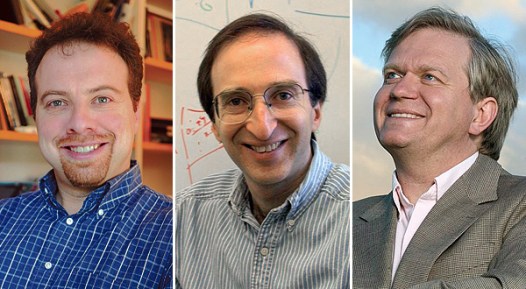
Three American scientists have been awarded the Nobel Prize in physics for their discovery that the universe is expanding at an accelerating rate. Saul Perlmutter will share the prize with Brian Schmidt and Adam Riess.

The discovery of the accelerating expansion of the universe followed an unexpected observational discovery in 1998. Astronomers in two different groups — the Supernova Cosmology Project (Perlmutter) and the High-z Supernova Search Team (Schmidt and Riess) — were observing the characteristic light signature of a certain type of supernova, called a Type 1a supernova, to probe the expansion history of the universe.

Let’s pause the story for a moment to explore the significance of these objects. Type 1a supernovae are a special subclass of exploding stars. Other types of supernovae occur when a massive star runs out of fuel, causing the core to collapse; their intrinsic brightness depends on a variety of factors, including the mass of the progenitor star. Type 1a supernovae occur when a white dwarf — the exposed core of a dead less-massive star — reaches a mass limit, called the Chandrasekhar limit. The mass limit can be reached if a white dwarf siphons matter from a companion star (see the header image above) or if two white dwarfs in a binary system collide. Since the resulting explosion always occurs at roughly the same mass, these supernovae always have roughly the same intrinsic brightness. This predictable brightness makes Type 1a supernovae excellent probes of distance and cosmic history.

Back to our story. The astronomers were using Type 1a supernovae to test the idea that the universe was slowing down in its expansion. If their idea was right, then the supernovae would appear to be brighter than expected, meaning they would be closer to the Earth than they would be if the universe had been expanding at a uniform rate. But they found the opposite: the supernovae appeared significantly dimmer than expected, meaning these exploding stars were further away than they would be for a uniform expansion. The astronomers concluded that the expansion of the universe was not slowing down, but rather speeding up. This conclusion was further supported by discoveries from other cosmological experiments, including mapping of the cosmic microwave background.

These discoveries led to the hypothesis that a mysterious force, called dark energy, is driving the accelerated expansion. Very little is currently known about this force, but several experiments, including HETDEX, Destiny, and SNAP, are underway to hopefully shed some light (as it were) on the subject.

Chemistry

Israeli scientist, Dan Schechtman, has been awarded the Nobel Prize in chemistry for his discovery of quasicrystals. What makes this award particularly interesting is the degree to which Schechtman persisted to make his discovery known. He worked for years in the face of skepticism and ridicule — two-time Nobel laureate, Linus Pauling, evidently referred to Schechtman as a “quasi-scientist” — before he managed to convince the scientific community that his observations overturned the prevailing model for how atoms and molecules can be arranged in solids.

A crystal is a type of material in which the arrangement of atoms is ordered and periodic. Scientists have probed crystalline structures using electron diffraction experiments in which beams of electrons are passed through crystal layers, producing an interference pattern. When Schechtman performed similar experiments on a different type of material, he found a peculiar interference pattern that seemed to defy the known laws of nature, since it indicated an ordered but non-periodic pattern in the arrangement of atoms. This is similar to the mosaic tile patterns found in medieval Islamic shrines.

Since Schechtman’s discovery, many quasicrystals have been synthesized and studied, and a naturally-occurring quasicrystal was discovered in Russia in 2009. Quasicrystals possess some useful properties, including a non-stick surface, low heat conduction, and hardness, that make them useful material for many products, from frying pans to surgical instruments.

In spite of his vindication and receiving the highest of accolades, Schechtman remains endearingly modest:

“The main lesson that I have learned over time is that a good scientist is a humble and listening scientist and not one that is sure 100 percent in what he read in the textbooks.”

Just as it’s difficult to be a devoted Christian in the face of skepticism, mockery, and exclusion, it’s difficult to be a devoted scientist under such conditions, as well. Schechtman deserves his award all the more for his determination and perseverance.

Physicists apparently break the speed of light

The big news coming out of CERN is that scientists there have apparently exceeded the speed of light. The experiment, carried out repeatedly over a period of three years, involved the acceleration of neutrinos — tiny, neutrally-charged particles — over a distance of nearly 500 miles and timing their travel. Surprisingly, the neutrinos arrived 60 billionths of a second faster than light would have. It may sound like a miniscule difference, but considering that light travels over 186,000 miles per second, it’s actually quite significant.

If confirmed, the discovery would undermine Albert Einstein’s 1905 theory of special relativity, which says that the speed of light is a “cosmic constant” and that nothing in the universe can travel faster.

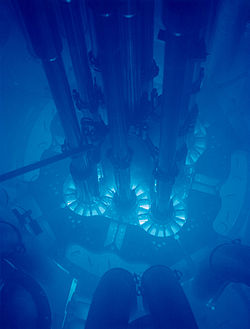
To be specific, Einstein’s theory says that particles with mass can be accelerated to speeds arbitrarily close to the speed of light in a vacuum — say, 99.9999999999% of the speed of light — but never at the speed of light in a vacuum, and certainly not exceeding it. In some cases, particles with mass can exceed the speed of light in certain types of material, for example high-energy electrons traveling through water in pool-type nuclear reactors. When this happens, the particles emit an eerie glow called Cherenkov radiation. (Fun fact: As you can see below, this glow is blue in color, not neon-green as seen on The Simpsons.)

As for the implications of breaking the speed of light, some physicists are holding off on scrapping the theory of relativity until the results are confirmed at other facilities.

Alvaro De Rujula, a theoretical physicist at CERN, the European Organization for Nuclear Research outside Geneva from where the neutron beam was fired, said he blamed the readings on a so-far undetected human error.

If not, and it’s a big if, the door would be opened to some wild possibilities.

The average person, said De Rujula, “could, in principle, travel to the past and kill their mother before they were born.”

Even in the face of such wild possibilities, I admire the restraint and humility of the CERN research group that conducted the experiment:

But Ereditato [spokesman for the CERN research group] and his team are wary of letting such science fiction story lines keep them up at night.

“We will continue our studies and we will wait patiently for the confirmation,” he told the AP. “Everybody is free to do what they want: to think, to claim, to dream.”

He added: “I’m not going to tell you my dreams.”

Compared with the wild speculation of some other scientists over similarly startling results in the recent past, this is refreshing.

Continue reading

Higgs boson running out of places to hide

I’m starting to get whiplash from all this back-and-forth on the Higgs boson (aka the “God particle”), but now its existence is really looking doubtful:

Scientists chasing a particle they believe may have played a vital role in [the] creation of the universe indicated on Monday they were coming to accept it might not exist after all.

But they stressed that if the so-called Higgs boson turns out to have been a mirage, the way would be open for advances into territory dubbed “new physics” to try to answer one of the great mysteries of the cosmos. …

“Whatever the final verdict on Higgs, we are now living in very exciting times for all involved in the quest for new physics,” Guido Tonelli, from one of the two LHC detectors chasing the Higgs, said as the new observations were announced.

You have to admire their willingness to drop the Higgs hypothesis if it doesn’t work out. The idea has been around for decades, and a lot of hopes were pinned on it being right. But the willingness to go where the data take you is what moves science forward.

Continue reading

Politics, science, and a false dichotomy

** Written by “Surak” **

There was a political confrontation last Thursday in New Hampshire between conservative politician, Rick Perry, and a liberal woman protestor. The dispute concerned Perry’s views about evolution and creationism, and it demonstrated why we need to be concerned about the future of science in America. Governor Perry spoke to the woman’s young son in front of the usual swarm of reporters eager for a headline. Perry gave them one by telling the boy that evolution was a theory with gaps in it. In an obvious attempt to contrive an unflattering media incident to hurt the Texas governor’s campaign, the mother could be heard urging the child to ask Perry why he didn’t believe in science. Perry ignored the mother and told the boy that in Texas both evolution and creationism are taught, “… because I figured you’re smart enough to figure out which one is right.” I am appalled by what the mother did and troubled by the implications of Perry’s response.

The mother undoubtedly thinks of herself as a defender of ‘science,’ by which I guess she means the usual vague understanding of the currently popular but failed mid-20th century version of evolution. Whatever her beliefs, it was an abuse of science to pull a cheap political trick like this. And, it was a disturbing corruption of her child’s innocence by putting words in his mouth he couldn’t possibly have understood. She obviously thought she was protecting him and other children from false ideas, but her actions amount to nothing more than a crude form of indoctrination based on the prevailing conviction that any questioning of ‘evolution’ is an intellectual sin.

Continue reading

Charcoal-black planet discovered

Astronomers have observed what they believe to be an exceptionally dark planet orbiting a star 750 light-years from Earth. The planet, called TrES-2b, is apparently so dark that it reflects only 1% of the light that reaches it from its parent star. By comparison, the Earth reflects about 30% of the light that reaches it from the Sun. The reflectivity of TrES-2b is so low that it would be outshone by charcoal (reflectivity of 4%).

The new exoplanet was discovered with the Kepler spacecraft, which looks for stars that exhibit periodic dips in the amount of light they shine. These periodic dips are interpreted as the signal of a planet passing in front of its parent star as it orbits. Once Kepler detects such a star, astronomers observe it in greater detail and use the data they collect to calculate properties of the exoplanet candidate, such as mass, radius, orbital distance, surface temperature, and reflectivity.

The data obtained for TrES-2b indicate that it is a “hot Jupiter,” a planet with a mass similar to or greater than Jupiter that orbits very close to its parent star — about 0.02 – 0.5 astronomical units (AU). The orbital distance for TrES-2b is 0.04 AU, far closer to its parent star than Mercury is to the Sun at 0.39 AU. (The Earth orbits the Sun at an average distance of 1 AU, which is about ~150,000,000 km). The close proximity of TrES-2b means its surface temperature is quite high, about 1,000 degrees Celsius, the same as Mercury’s peak temperature on the side facing the Sun.

According to theoretical models of planet formation, a gas giant could not form so close to its parent star, thus astronomers believe that these hot Jupiters form further out in their systems and migrate in over time. Theoretical models that describe the formation of this type of planet predict that they should reflect at least 10% of the light that comes from their parent star, about the same reflectivity as the planet Mercury. The exceptional darkness of TrES-2b has astronomers wondering if their models need to be rethought.

As for what type of substance could cause TrES-2b to be so inky black, astronomers are not sure, but speculate that it could be something exotic.

“Some have proposed that this darkness may be caused by a huge abundance of gaseous sodium and titanium oxide,” [lead astronomer David] Kipping said. “But more likely there is something exotic there that we have not thought of before.

“It’s this mystery that I find so exciting about this discovery.”

Spoken like a true scientist!

Continue reading

“God particle” detection in doubt

Remember that rumor a couple of months ago that the folks at Tevatron may have found the Higgs boson, aka the “God particle”? Well, turns out probably not. The Collider Detector at Fermilab (CDF) reportedly discovered a signal that was consistent with the Higgs boson, but the experiment could not be replicated with Tevatron’s other detector, DZero.

That’s how science works, folks. Keep trying, but if your results can’t be replicated, it’s back to the drawing board.

Continue reading

Heroes sometimes fail: Why Stephen Hawking is wrong

Please excuse the inactivity of the last few weeks. I was busy with extensive travel and work, but am now back to posting on a regular basis. The biggest story to emerge while I was away concerned Stephen Hawking’s comments about the non-existence of heaven and the nature of the human brain. I asked Surak to write a response to this, since he has a particular interest in the monist vs. dualist argument. – Ed.

** Written by “Surak” **

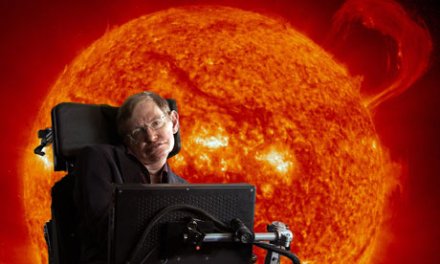
As a human being who often struggles with relatively trivial difficulties in life, I have long felt admiration for Stephen Hawking’s courage and determination to continue working in spite of a highly-debilitating disease. As a physics enthusiast, I have the greatest respect for his accomplishments. But now, as a result of an article published in The Guardian two weeks ago, I also feel embarrassment for, and disappointment in, Hawking. The article reported his views on religion and metaphysics — they were unoriginal, ill-informed, biased, insensitive, and even arrogant.

The article was entitled, “Stephen Hawking: ‘There is no heaven; it’s a fairy story’.” I don’t believe Hawking is capable of such an inane statement, so I attribute this bit of silliness to the reporter’s desire for an attention grabbing headline. It’s just another example of why no one can trust reporters. Unfortunately the rest of the silliness that follows is undoubtedly Hawking’s.

Continue reading

“God particle” discovered?

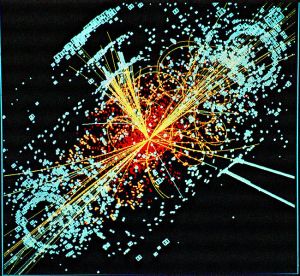
Simulated accelerator signal of a Higgs boson

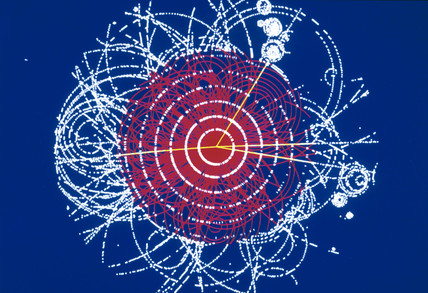
Shhh! Rumor of a signal consistent with the elusive Higgs boson (aka the “God particle”) has been leaked from the LHC. However, a spokesman for CERN has said that it’s “way, way too early” to draw any conclusions from the data.

The Higgs boson is predicted to exist by the Standard Model of particle physics — the prevailing theory governing the organization of subatomic particles — and is supposed to explain how most subatomic particles get their mass. Physicist Peter Higgs, after whom the hypothetical particle is named, gave a formal description of the particle’s properties in a paper in 1966. Over four decades later, this is the first hint that it might actually exist. But as always in science, judgment should be deferred until the evidence is confirmed.

Continue reading

Our analysis of the Great Debate

Well, it didn’t quite take us a week — we were just so excited by “The Great Debate: Is There Evidence for God?” that we couldn’t wait to comment on it. The following analysis is co-written by Surak and Sarah.

The two opposing sides of the scientific debate over the God hypothesis were well represented on Wednesday by Dr. William Lane Craig (Christian Philosopher and Theologian from Talbot School of Theology) and Dr. Lawrence Krauss (Theoretical Physicist from Arizona State University). Dr. Craig’s argument was based on the clearly-stated and logical assertion that if God’s existence is more probable given certain information, that information meets the essential criterion for evidence. Dr. Krauss was equally clear in his definition of evidence: it must be falsifiable to be scientific. We find both standards to be very useful.

There was some confusion on the part of the moderator as to whether the topic of the debate was the existence of any evidence for God or the existence of enough evidence to prove God’s existence. We think the moderator erred in his statement of the debate’s purpose, since no one could reasonably argue that there is proof or disproof of God’s existence. As Dr. Krauss correctly stated, science cannot falsify God; so, the question can only be, “Is God likely?”

We will assess the debate in terms of whether or not there is any evidence for the existence of God, although Dr. Krauss tried to set the bar unfairly high with his assertion that a highly extraordinary proposition, such as the God hypothesis, requires extraordinary evidence. However, we think defenders of the God hypothesis can accept and meet this challenge.

Continue reading

The Great Debate: Postmortem

Well. That was thorough.

It’ll probably take me about a week to write up my commentary on The Great Debate. It will be broken into two or three parts, since there is a lot of ground to cover. Also, it won’t be just me — Surak will handle one aspect of the material (the probability argument) and I will handle the other (the nature of science argument).

Meanwhile, after two hours and twenty minutes of rousing debate about the deepest questions of existence, this is my frame of mind:

(Click to enlarge.)

Off to do some wallowing.

Continue reading