The free frontier

Yesterday, on the 50th anniversary of the first man in space, The Atlantic featured an article by Jim Hodges lamenting the decline of American exceptionalism in space:

[In the 1960s] Americans didn’t talk of their exceptionalism. They did exceptional things, and the world talked about it. In many places around the world, in science labs and classrooms, the NASA “meatball” was as recognizable as the Stars and Stripes.

People remember that President Kennedy said, “I believe that this nation should commit itself to achieving the goal, before this decade [of the 1960s] is out, of landing a man on the moon and returning him safely to the Earth.”

Forgotten is that just before that challenge, he said this as a preamble to it: “I believe we possess all of the resources and talents necessary [to lead the world into space]. But the facts of the matter are that we have never made the national decisions or marshaled the national resources required for such leadership. We have never specified long-range goals on an urgent time schedule, or managed our resources and our time as to insure their fulfillment.”

The government is certainly not doing that now, and we can’t count on it to do these things ever again.

However, I do not see this as occasion to despair. As well-intentioned as NASA has been, government almost always does things slower, costlier, and with less innovation than private enterprise. In fact, while government has been slashing NASA’s budget and scaling back its goals, private companies out in Mojave have been quietly innovating like crazy:
Continue reading

108 minutes that changed the world

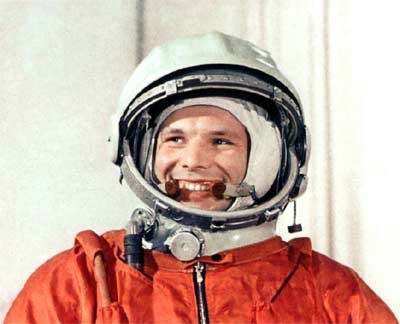
Tomorrow will mark the 50th anniversary of the first man in space. On April 12, 1961 Soviet cosmonaut, Yuri Gagarin, spent 108 minutes in space aboard the Vostok 1 spacecraft. It would be his only space flight. Gagarin continued his career designing spacecraft and training other cosmonauts. He died in 1968 when a jet he was piloting crashed.

Gagarin received many honors for his achievement, but perhaps none so great as being immortalized in musical form by French techno-artiste Jean-Michel Jarre:

Continue reading

Physicists discover new particle?

A proton - anti-proton collision at Fermilab provides evidence for the top quark in 1995 (Credit: LBNL)

Physicists at the Tevatron particle accelerator at Fermilab have discovered a strange new signal emerging from proton – anti-proton collisions that is unlike anything seen before. It could be a new kind of particle — and with it, possibly a new kind of fundamental force — or it could be a statistical blip. While the community is excited about the discovery, many physicists are understandably reserved about it until the result is replicated with the Large Hadron Collider.

Whatever it is, the signal is not consistent with a Higgs boson, the elusive “God particle” posited to explain why certain particles have mass. In fact, nobody seems to know what it could possibly be — music to a theorist’s ears. The last major particle discovery made at Fermilab was in 1995 with the top quark, whose existence (together with the bottom quark) was predicted to exist by physicists in 1973.

Continue reading

Our analysis of the Great Debate

Well, it didn’t quite take us a week — we were just so excited by “The Great Debate: Is There Evidence for God?” that we couldn’t wait to comment on it. The following analysis is co-written by Surak and Sarah.

The two opposing sides of the scientific debate over the God hypothesis were well represented on Wednesday by Dr. William Lane Craig (Christian Philosopher and Theologian from Talbot School of Theology) and Dr. Lawrence Krauss (Theoretical Physicist from Arizona State University). Dr. Craig’s argument was based on the clearly-stated and logical assertion that if God’s existence is more probable given certain information, that information meets the essential criterion for evidence. Dr. Krauss was equally clear in his definition of evidence: it must be falsifiable to be scientific. We find both standards to be very useful.

There was some confusion on the part of the moderator as to whether the topic of the debate was the existence of any evidence for God or the existence of enough evidence to prove God’s existence. We think the moderator erred in his statement of the debate’s purpose, since no one could reasonably argue that there is proof or disproof of God’s existence. As Dr. Krauss correctly stated, science cannot falsify God; so, the question can only be, “Is God likely?”

We will assess the debate in terms of whether or not there is any evidence for the existence of God, although Dr. Krauss tried to set the bar unfairly high with his assertion that a highly extraordinary proposition, such as the God hypothesis, requires extraordinary evidence. However, we think defenders of the God hypothesis can accept and meet this challenge.

Continue reading

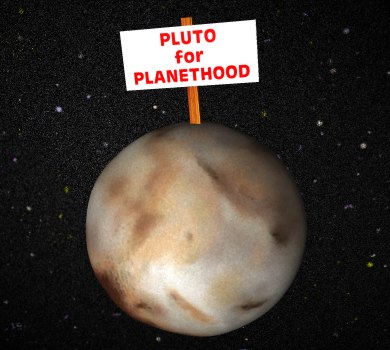
Pluto is a planet once again

[In case it wasn’t obvious: April Fool! -Ed.]

In a surprising reversal this week, members of the International Astronomical Union voted to reinstate Pluto’s status as a planet. This overturns the IAU’s 2006 decision to reclassify Pluto as a ‘dwarf planet’ following the adoption of an official definition of what constitutes a planet, which excluded Pluto.

Speaking on behalf of the IAU, one member is quoted as saying, “People were surprisingly passionate about Pluto’s status. The pressure from the general public to re-admit it to the ‘planet club’ was so great, we just couldn’t ignore it. Welcome back, Pluto.”

Continue reading

The Great Debate: Postmortem

Well. That was thorough.

It’ll probably take me about a week to write up my commentary on The Great Debate. It will be broken into two or three parts, since there is a lot of ground to cover. Also, it won’t be just me — Surak will handle one aspect of the material (the probability argument) and I will handle the other (the nature of science argument).

Meanwhile, after two hours and twenty minutes of rousing debate about the deepest questions of existence, this is my frame of mind:

(Click to enlarge.)

Off to do some wallowing.

Continue reading

The Great Debate: Is There Evidence for God?

Update: Be sure to check out our analysis of The Great Debate.

♦ ◊ ♦

Re-posting this, since today’s the day. I will be tuning in, and will present a critique of both sides on this blog within a day or three of the debate.

Copied-and-pasted from an email I received:

Join Thousands across America tuning in on March 30 to…

The Great Debate: Is There Evidence for God?

Two Really Smart Guys Go Head to Head to debate the existence of God on a live, streaming video. Dr. William Lane Craig (Christian Philosopher and Theologian from Talbot School of Theology) will debate Dr. Lawrence Krauss (Theoretical Physicist from Arizona State University) on the question, “Is There Evidence For God?”

The debate will stream live on the web on the night of March 30, beginning at 7 PM.

It is suggested you log on to view the debate on the web at least 15 minutes prior to the event, to make sure everything on your computer is set up correctly. If you cannot watch it then, the debate will be available to watch at any time after the debate is over. Some suggestions may be to watch it from your home or to set up a live showing of it for a group.

If you have friends with whom you have discussed these kinds of questions be sure to pass along this info. And then tune in and decide which side you think presents the most compelling arguments.

DETAILS:

Date: Wednesday, March 30, 2011
Time: 7:00 PM EDT
[Note: The email stated EST, but I’m pretty sure it’s EDT. -Ed.]

Location: NC State

You can stream it live from the official website (link appears to be working now).

♦ ◊ ♦

Some background for each of the debaters [h/t PQ Exchange]:

MESSENGER’s first image from orbit

The MESSENGER probe began sending images of Mercury back to Earth yesterday. Here is the historic first image from orbit:

Click on the image to go to the MESSENGER website and download a larger version.

The large feature with rays, near the top of the photo, is an impact crater named Debussy. The crater is about 85 km across, with the rays stretching hundreds of km, covering much of the southern half of the planet. Radio images of the crater and rays indicate that it’s a relatively young crater, though astronomers don’t know how young.

Image of impact crater Debussy taken by MESSENGER during a previous flyby of Mercury

Continue reading

Astronomers discover an unusually bright supernova

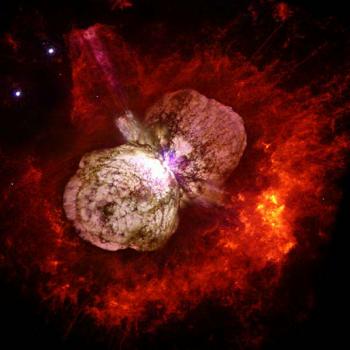
Astronomers have discovered a rare, ultra-luminous supernova whose intrinsic brightness, at peak luminosity, was 100 billion times that of the Sun. This special type of stellar explosion, called a self-interacting supernova or super-luminous supernova, results from exploded material interacting with previously puffed-off layers from the star. The type of progenitor star whose fate it is to end this way is called a luminous blue variable. A well-known example in our own galaxy is Eta Carinae, pictured below.

Luminous blue variable star, Eta Carinae, could end its life as a super-luminous supernova

Measured to be about 3.7 billion light-years away, the extreme brightness of the newly discovered supernova allowed astronomers to detect it using a relatively small robotic telescope that’s part of the ROTSE Supernova Verification Project (RSVP). So far, RSVP has found five of the 12 known supernovae of this type. To give you some idea how rare these objects are, consider how supernovae are named. This particular object is called SN 2008am. The numbers tell us the year it was discovered, while the letters tell us the order in which it was discovered. The first supernova detected in 2008 was called 2008a, the second 2008b, and so on. This makes SN 2008am the 39th supernova discovered that year. I don’t know the total number of supernovae that were discovered in 2008, but the RSVP website indicates an object named SN 2008io, which means there were at least 249. (All of those are in other galaxies, by the way — we haven’t observed a supernova in our own galaxy for about three hundred and fifty years.) So, 12 super-luminous supernovae out of hundreds of all types observed annually makes these particular objects rare indeed.

Continue reading

Clean energy turns over a new leaf

Scientists at MIT have developed an artificial leaf that mimics photosynthesis, only much more efficiently. The leaf breaks water molecules into hydrogen and oxygen parts and stores them in cells for generating electricity. Previous artificial leaves were highly unstable and made of expensive components — the new leaf is a big step forward in that it’s made of cheap and resilient components.

David Nocera, the lead scientist on the project, claims that one artificial leaf in a gallon of water could produce enough electricity to power a household in developing countries for a day. A company in India is already planning to implement this technology on a larger scale with the creation of a small power plant about the size of a refrigerator.

Continue reading