If you’ve got a driver’s license, a light-aircraft license, and about $230,000 in spare cash, you can put in an order for a Terrafugia Transition, which is supposed to be available by late 2012 (supply delays have pushed this date back from the planned 2011 roll-out date).
“It’s kind of a letdown knowing we now have to rely on foreign interests” to launch American astronauts into space, said Terry Deguentz, a firefighter from St. Louis who said he was friends with one of Atlantis’s astronauts, mission specialist Sandy Magnus. “American ingenuity has been downplayed in the last decade. Once we let it go, I wonder if we can get it back.”
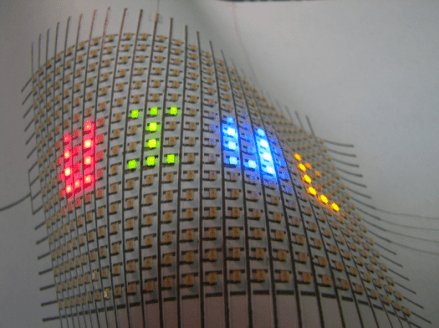
Researchers at the University of Illinois at Urbana-Champaign have developed a liquid metal “ink” that, when used in a ballpoint pen, allows circuits to be hand-drawn. Circuits can be drawn on flat surfaces, like paper, as well as irregular surfaces. In the photo above, researchers used the pen to hand-draw circuits that connected to LEDs (light-emitting diodes) powered by a battery connected to the paper. During testing it was shown that a circuit drawn on a piece of paper using the liquid metal ink could survive intact even if the paper was folded thousands of times.
“Pen-based printing allows one to construct electronic devices ‘on-the-fly’,” says Jennifer Lewis, one of the engineering profs who came up with the new pen at Illinois uni. “This is an important step toward enabling desktop manufacturing (or personal fabrication) using very low cost, ubiquitous printing tools.”
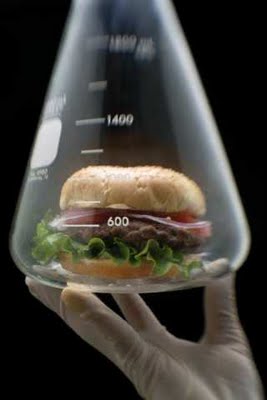
Dutch scientists believe they are about one year away from producing the first “test-tube hamburger” — that is, beef grown from stem cells.
I’m all for technology, and hamburgers are just about my favorite food, but this doesn’t sound at all appetizing. It doesn’t help that the lead scientist for the project isn’t too keen to be the first person to try it, either.
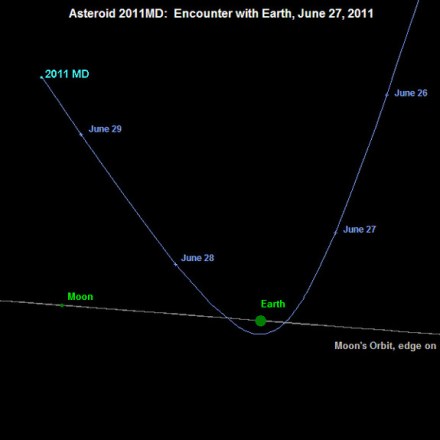
A bus-sized asteroid will “just” miss the Earth today around noon CDT. Asteroid 2011 MD, which is estimated to be 9-30 meters in size, will come within about 7,500 miles of the surface of the Earth, pretty close as far as asteroid encounters go, and well within the 22,000 mile radius of geosynchronous satellite orbits. But for comparison, it is well beyond the 220-mile orbit of the International Space Station. Even at its closest approach, the asteroid will not be visible to the naked eye, but may appear as a bright dot to sharp-eyed observers with medium-sized telescopes.
NASA scientists, who have been tracking asteroid 2011 MD since June 22, say there is “no chance” it will strike the Earth. Even if it did, its rocky composition means it would very likely break apart and burn up in the atmosphere (over Antarctica). The ones you have to watch out for are the rocks made up of iron, which are more likely to survive the trip through the atmosphere.
This isn’t the first close-encounter we’ve had this year. Asteroid 2011 CQ1 came within 3,400 miles of Earth in February, and set a new record as the closest recorded pass ever. NASA estimates that moderate-sized asteroids make close flybys about six times a year, and they have not been able to track all of them — asteroid 2011 CQ1 wasn’t discovered until hours before its closest approach. But the truth is, the Earth is struck by stuff from outer space all the time, and we haven’t experienced a catastrophic event for a very long time. Approximately 500 small meteors make it all the way to the surface of the Earth each year, and it is estimated that about one small asteroid (1-10 meters in size) reaches the Earth per year. The latter usually break up and vaporize in the upper atmosphere. Fortunately, there is an inverse relationship between the size of an object and the frequency with which it is likely to strike the Earth. In other words, the bigger they are, the less likely we are to be hit by one. Here is a comparison of asteroid radius and strike frequency:
10 m: every year
50 m: every 1,000 years
1 km: every 500,000 years
5 km: every 10 million years
10 km: every 100 million – 1 billion years
The last known very large impact event involving an asteroid about 10 km in size is the one that is believed to have wiped out the dinosaurs 65 million years ago. We’re not due for even a 1 km event until the year 2880 when asteroid (29075) 1950 DA has a possibility of hitting the Earth. So it’s probably okay to carry on with civilization for a while longer.
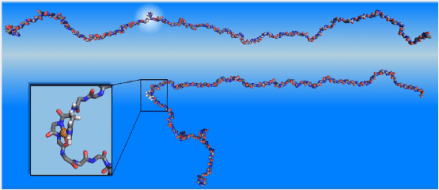
The protein alpha-synuclein in its normal state (above) and misfolded after the attachment of copper (below)
A team of physicists at North Carolina State University — led by my very good friend, Frisco Rose — has published the results of their study of the process that leads to Parkinson’s disease. Parkinson’s is a degenerative disorder that affects the nervous system, manifesting in tremors and difficulty controlling motion. Actors Katherine Hepburn and Michael J. Fox are well-known sufferers of the disease.
The work involved simulations using the most powerful supercomputer in the world, the Jaguar supercomputer at Oak Ridge National Laboratory, to understand the way in which a protein associated with Parkinson’s gets tangled. The protein, called alpha-synuclein, is normally long and straight, but it becomes tangled, or misfolded, in patients with Parkinson’s (see figure above).
Proteins are the basic building blocks of life. They are comprised of long chains of molecules called amino acids that regulate biochemical reactions in living things. The shape of a protein — the way in which it is folded — dictates its function. Amazingly, these biochemical machines assemble, or fold, themselves1.
Most of the time this self-assembly proceeds without error. However, when a protein misfolds, it becomes tangled and clumped together with other protein strands, and this is believed to cause a number of diseases, including Parkinson’s, Mad Cow, cystic fibrosis, and some forms of cancer. In order to devise treatments for these diseases, it’s important to understand how certain proteins misfold.
Study of protein folding may sound like a job for biologists, but it has been an increasingly popular topic of study in physics, because the different ways in which a protein can fold are determined by equations involving forces and energy. For a typical protein, these calculations would normally require hundreds of thousands of computing hours, far more than is feasible. To get around this problem, Rose’s team devised a new tactic: focus the simulations only on the part of the protein where the tangling occurs. By reducing the region of study, they were able to successfully carry out simulations, and discovered that certain metals, such as copper, affect the folding by binding to the protein in a way that accelerates tangling.
“We knew that the copper was interacting with a certain section of the protein, but we didn’t have a model for what was happening on the atomic level,” says Frisco Rose, Ph.D. candidate in physics and lead author of the paper describing the research. “Think of a huge swing set, with kids all swinging and holding hands—that’s the protein. Copper is a kid who wants a swing. There are a number of ways that copper could grab a swing, or bind to the protein, and each of those ways would affect all of the other kids on the swing set differently. We wanted to find the specific binding process that leads to misfolding.”
The tactic allowed them to identify the most likely way in which copper binding to the protein leads to misfolding. This is a significant step toward finding a treatment for Parkinson’s.
Other researchers studying protein folding are getting around the computing problem using a different tactic: using thousands of volunteered home computers — your computers — to perform the calculations. If you’d like to get involved by donating some of your home computer’s run time to help these scientists do their work, check out Standford University’s Folding@home project.
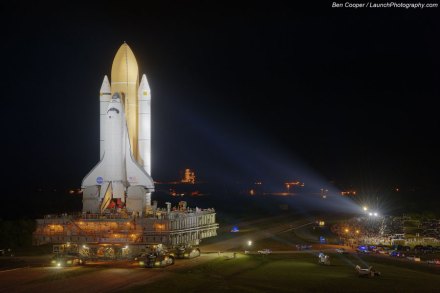
In the final move of its kind, NASA’s space shuttle Atlantis was photographed earlier this month slowly advancing toward Launch Pad 39A, where it is currently scheduled for a July launch to the International Space Station. The mission, designated STS-135, is the 135th and last mission for a NASA space shuttle. Atlantis and its four-person crew will be carrying, among other things, the Multi-Purpose Logistics Module Raffaello to bring key components and supplies to the ISS. Pictured above, the large Shuttle Crawler Transporter rolls the powerful orbiter along the five-kilometer long road at less than two kilometers per hour. Over 15,000 spectators, some visible on the right, were on hand for the historic roll out.
Click on the link to get the beautiful hi-res version of the photo.