Cosmic exclamation mark

Above is a recently released NASA image of two distant galaxies on a collision course. The galaxies, collectively referred to as VV 340 (also Arp 302 and UGC 9618), are 450 million light-years from Earth, and will take millions of years to collide. NASA released an optical image of the cosmic pair taken by the Hubble Space Telescope in 2008. The new image is a composite of an optical image from the Hubble and an X-ray image from the space-based Chandra X-ray Observatory. The X-ray image shows radiation from extremely hot gas (millions of degrees) within the galaxies.

What is apparently striking about this image is that the galaxies form a cosmic exclamation mark. However, celestial sky-writing is nothing new. Below is a cosmic message “written” using a galactic alphabet …

Continue reading

Charcoal-black planet discovered

Astronomers have observed what they believe to be an exceptionally dark planet orbiting a star 750 light-years from Earth. The planet, called TrES-2b, is apparently so dark that it reflects only 1% of the light that reaches it from its parent star. By comparison, the Earth reflects about 30% of the light that reaches it from the Sun. The reflectivity of TrES-2b is so low that it would be outshone by charcoal (reflectivity of 4%).

The new exoplanet was discovered with the Kepler spacecraft, which looks for stars that exhibit periodic dips in the amount of light they shine. These periodic dips are interpreted as the signal of a planet passing in front of its parent star as it orbits. Once Kepler detects such a star, astronomers observe it in greater detail and use the data they collect to calculate properties of the exoplanet candidate, such as mass, radius, orbital distance, surface temperature, and reflectivity.

The data obtained for TrES-2b indicate that it is a “hot Jupiter,” a planet with a mass similar to or greater than Jupiter that orbits very close to its parent star — about 0.02 – 0.5 astronomical units (AU). The orbital distance for TrES-2b is 0.04 AU, far closer to its parent star than Mercury is to the Sun at 0.39 AU. (The Earth orbits the Sun at an average distance of 1 AU, which is about ~150,000,000 km). The close proximity of TrES-2b means its surface temperature is quite high, about 1,000 degrees Celsius, the same as Mercury’s peak temperature on the side facing the Sun.

According to theoretical models of planet formation, a gas giant could not form so close to its parent star, thus astronomers believe that these hot Jupiters form further out in their systems and migrate in over time. Theoretical models that describe the formation of this type of planet predict that they should reflect at least 10% of the light that comes from their parent star, about the same reflectivity as the planet Mercury. The exceptional darkness of TrES-2b has astronomers wondering if their models need to be rethought.

As for what type of substance could cause TrES-2b to be so inky black, astronomers are not sure, but speculate that it could be something exotic.

“Some have proposed that this darkness may be caused by a huge abundance of gaseous sodium and titanium oxide,” [lead astronomer David] Kipping said. “But more likely there is something exotic there that we have not thought of before.

“It’s this mystery that I find so exciting about this discovery.”

Spoken like a true scientist!

Continue reading

Terve!

My husband and I just got back from a couple of weeks in Finland and Sweden. We spent most of our time on tiny islands in the Baltic without any reliable Internet access. Regular posting will resume tomorrow.

New Mars rover will look for signs of liquid water

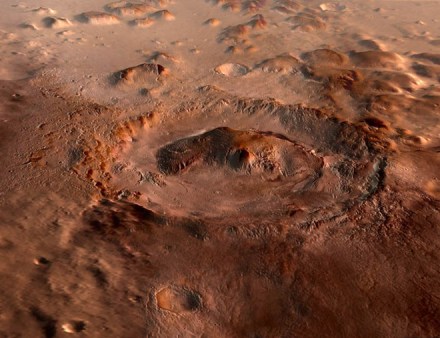
An enhanced-color image of the Gale crater (Credit: NASA/Steven Hobbs)

Scientists at NASA’s Mars Science Laboratory have selected the crater ‘Gale’ as the landing site of the rover, Curiosity, when it visits the Red Planet next year to search for signs of historical liquid water.

This will mark the 15th time the U.S. has visited Mars since it was first photographed by the Mariner 4 orbiter in 19651. Mars is of great interest to scientists, not only because of its proximity to Earth (it’s our second-closest planetary neighbor after Venus), but because the Red Planet has been the subject of intense speculation about the presence of alien life for over 200 years.

Speculation about Martian life started in the late 1700s with German-British astronomers and siblings, William and Caroline Herschel, who observed the Red Planet and noticed that it had some features in common with Earth, including axis tilt, length of day, and seasonal changes in its appearance. Moved by these similarities, William speculated that Mars had inhabitants. From his address to the Royal Society in 1784:

It appears that this planet is not without considerable atmosphere; for besides the permanent spots on the surface, I have often noticed occasional changes of partial bright belts; and also once a darkish one… These alterations we can hardly ascribe to any other cause than the variable disposition of clouds and vapors floating in the atmosphere of the planet… Mars has a considerable but modest atmosphere, so that its inhabitants probably enjoy a situation in many respects similar to our own.

In the late 1800s, Italian astronomer Giovanni Schiaparelli added to this speculation when he observed what he thought were canals on the surface of Mars. Schiaparelli’s observations inspired the construction of the Lowell Observatory in Flagstaff, Arizona to further study the phenomena. Astronomer Percival Lowell, who founded the observatory, became convinced that the canals were signs of advanced, intelligent life on Mars. From there, it wasn’t much of a leap to science fiction stories about Martian life, including H. G. Wells’ dark tale, The War of the Worlds, and C. S. Lewis’ Christian-themed Out of the Silent Planet.

Despite the fervor over possible Martian life, there were astronomers who questioned whether there was any credible visual evidence for the canals. These questions persisted until Mariner 4 was sent to Mars and failed to detect any signs of the infamous canals. Since then, the focus on the search for life on Mars has shifted to evidence for historical, probably much more primitive, forms of life. If such life ever existed on Mars, it would have required the presence of liquid water, which is why scientists are so eager to find signs of the stuff.

Continue reading

Largest ever mass of cosmic water discovered

Turns out water has been present in the universe for most of its history. Astronomers studying a distant quasar — a supermassive black hole actively feeding on gaseous material — detected the presence of water vapor in the cold material surrounding the quasar.

Water vapor has been discovered elsewhere/when in the universe, particularly in water masers emanating from objects as varied as the Saturn system to far-distant galaxies, but this latest observation pushes the earliest detection of water back to a mere 1.6 billion years after the big bang. It’s also the largest mass of water ever discovered — about “140 trillion times more water than all of Earth’s oceans combined.”

Continue reading

There it is! Wait … no … er, maybe?

New results from the Large Hadron Collider have physicists wondering if they have actually, for reals now, detected the signal of a Higgs boson, aka the “God particle.” Earlier this year, scientists at Tevatron (an accelerator at Fermilab) thought they might have picked up the signal of a Higgs boson, but excitement turned to disappointment as it was revealed last month that the result could not be replicated with Tevatron’s other detector.

The Higgs boson is the lynchpin of the Standard Model of particle physics, explaining as it does why particles have mass, so physicists are trying like all get-out to find it. This latest hint at its existence is interesting, but nobody at LHC will be making any definitive statements about the result until they’ve analyzed the data and determined whether these fluctuations are statistically important.

Continue reading

Fourth moon discovered around Pluto

Ultraviolet images taken with the Hubble show the location of P4.

Astronomers using the Hubble Space Telescope have discovered another moon orbiting Pluto, joining the ranks of Pluto’s three other known moons. The largest, Charon, was discovered in 1978 at the U.S. Naval Observatory in Flagstaff. The existence of two other moons — Hydra and Nix — was confirmed using the Hubble telescope in 2005. The newly-discovered moon has been given the tentative name P4. (Presumably the discoverers or the IAU will come up with something more interesting once a little more is known about it. I offer ‘Zaphod’ as a candidate. It’s about time we started introducing ephemeral pop culture to outer space.)

Incidentally, Pluto is the only member of the original nine-planet system that has not been explored by an Earth probe; but that will change in 2015 when the New Horizons probe, launched in 2006, flies by to study the dwarf planet and its four (known) moons.

Continue reading