The Great Debate: Postmortem

Well. That was thorough.

It’ll probably take me about a week to write up my commentary on The Great Debate. It will be broken into two or three parts, since there is a lot of ground to cover. Also, it won’t be just me — Surak will handle one aspect of the material (the probability argument) and I will handle the other (the nature of science argument).

Meanwhile, after two hours and twenty minutes of rousing debate about the deepest questions of existence, this is my frame of mind:

(Click to enlarge.)

Off to do some wallowing.

Continue reading

The Great Debate: Is There Evidence for God?

Update: Be sure to check out our analysis of The Great Debate.

♦ ◊ ♦

Re-posting this, since today’s the day. I will be tuning in, and will present a critique of both sides on this blog within a day or three of the debate.

Copied-and-pasted from an email I received:

Join Thousands across America tuning in on March 30 to…

The Great Debate: Is There Evidence for God?

Two Really Smart Guys Go Head to Head to debate the existence of God on a live, streaming video. Dr. William Lane Craig (Christian Philosopher and Theologian from Talbot School of Theology) will debate Dr. Lawrence Krauss (Theoretical Physicist from Arizona State University) on the question, “Is There Evidence For God?”

The debate will stream live on the web on the night of March 30, beginning at 7 PM.

It is suggested you log on to view the debate on the web at least 15 minutes prior to the event, to make sure everything on your computer is set up correctly. If you cannot watch it then, the debate will be available to watch at any time after the debate is over. Some suggestions may be to watch it from your home or to set up a live showing of it for a group.

If you have friends with whom you have discussed these kinds of questions be sure to pass along this info. And then tune in and decide which side you think presents the most compelling arguments.

DETAILS:

Date: Wednesday, March 30, 2011
Time: 7:00 PM EDT
[Note: The email stated EST, but I’m pretty sure it’s EDT. -Ed.]

Location: NC State

You can stream it live from the official website (link appears to be working now).

♦ ◊ ♦

Some background for each of the debaters [h/t PQ Exchange]:

MESSENGER’s first image from orbit

The MESSENGER probe began sending images of Mercury back to Earth yesterday. Here is the historic first image from orbit:

Click on the image to go to the MESSENGER website and download a larger version.

The large feature with rays, near the top of the photo, is an impact crater named Debussy. The crater is about 85 km across, with the rays stretching hundreds of km, covering much of the southern half of the planet. Radio images of the crater and rays indicate that it’s a relatively young crater, though astronomers don’t know how young.

Image of impact crater Debussy taken by MESSENGER during a previous flyby of Mercury

Continue reading

Astronomers discover an unusually bright supernova

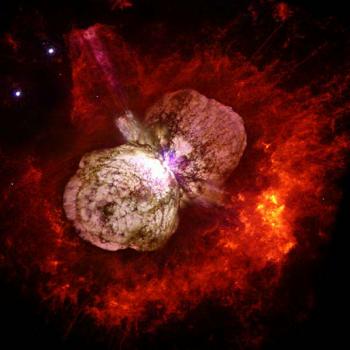
Astronomers have discovered a rare, ultra-luminous supernova whose intrinsic brightness, at peak luminosity, was 100 billion times that of the Sun. This special type of stellar explosion, called a self-interacting supernova or super-luminous supernova, results from exploded material interacting with previously puffed-off layers from the star. The type of progenitor star whose fate it is to end this way is called a luminous blue variable. A well-known example in our own galaxy is Eta Carinae, pictured below.

Luminous blue variable star, Eta Carinae, could end its life as a super-luminous supernova

Measured to be about 3.7 billion light-years away, the extreme brightness of the newly discovered supernova allowed astronomers to detect it using a relatively small robotic telescope that’s part of the ROTSE Supernova Verification Project (RSVP). So far, RSVP has found five of the 12 known supernovae of this type. To give you some idea how rare these objects are, consider how supernovae are named. This particular object is called SN 2008am. The numbers tell us the year it was discovered, while the letters tell us the order in which it was discovered. The first supernova detected in 2008 was called 2008a, the second 2008b, and so on. This makes SN 2008am the 39th supernova discovered that year. I don’t know the total number of supernovae that were discovered in 2008, but the RSVP website indicates an object named SN 2008io, which means there were at least 249. (All of those are in other galaxies, by the way — we haven’t observed a supernova in our own galaxy for about three hundred and fifty years.) So, 12 super-luminous supernovae out of hundreds of all types observed annually makes these particular objects rare indeed.

Continue reading

Clean energy turns over a new leaf

Scientists at MIT have developed an artificial leaf that mimics photosynthesis, only much more efficiently. The leaf breaks water molecules into hydrogen and oxygen parts and stores them in cells for generating electricity. Previous artificial leaves were highly unstable and made of expensive components — the new leaf is a big step forward in that it’s made of cheap and resilient components.

David Nocera, the lead scientist on the project, claims that one artificial leaf in a gallon of water could produce enough electricity to power a household in developing countries for a day. A company in India is already planning to implement this technology on a larger scale with the creation of a small power plant about the size of a refrigerator.

Continue reading

Evidence for jet mechanism of black hole Cygnus X-1

Artist's conception of material from a nearby star forming a plasma disk around black hole Cygnus X-1. Credit: ESA

Astrophysicists have observed what appears to be direct evidence of strong magnetic fields around a black hole, supporting a popular theory about the production of plasma-and-radiation jets observed to emanate from these mysterious objects. The evidence comes from seven years of data showing high-energy polarized light radiated from a region near the event horizon of Cygnus X-1, the first black hole ever observed.

Polarized light is light that vibrates in a specific pattern, and it can be a signature of radiation from charged particles that are sped up in a magnetic field. The magnetic field is a product of super-hot plasma — material torn from a nearby star — that’s smeared into a disk around the black hole. The twisting of the magnetic field lines as the black hole rotates is believed to be the mechanism for producing jets.

Cygnus X-1 was discovered as a mysterious X-ray source in the 1960s, but it was many years later when astrophysicists reached consensus that it was a black hole1. The discovery and speculation as to its nature inspired the prog-rock band, Rush, to write a song about Cygnus X-1 in the late 1970s, complete with some of the best rock-song lyrics of all time:

Continue reading

Quantum physics could explain our sense of smell

Did you know that nobody really knows how the nose knows? But some scientists think our sense of smell could come down to quantum physics:

The key, [scientists] say, is tiny packets of energy, or quanta, lost by electrons.

Experiments using tiny wires show that as electrons move on proteins within the nose, odour molecules could absorb these quanta and thereby be detected.

The way our brains translate raw data from our noses into a smell is apparently understood, but how our noses recognize odor molecules in the first place is still largely unknown. The quantum explanation, once highly debatable, now appears to be more plausible with the results from these experiments.

Continue reading

Coldest-ever brown dwarf discovered

Astronomers have discovered the coldest-ever failed star with a surface temperature of 100o C. To give you some perspective, consider: 1) the hardiest Finns can easily withstand 120o C saunas; and 2) our Sun, a relatively mediocre star, has a surface temperature of almost 5,500o C.

This lukewarm object, called CFBDSIR J1458+1013B, appears to be a brown dwarf, a class of objects somewhere between star and super-planet. The distinction between star and brown dwarf is clear — a star is only a star if it undergoes nuclear fusion in its core — but the distinction between brown dwarf and super-planet isn’t as clear.  Brown dwarfs are all about the same size as Jupiter, but they pack a lot of mass into that space — at the high end of the range, they can be 90 times the mass of Jupiter — and unlike planets, they sometimes emit X-rays. CFBDSIR J1458+1013B is at the lower end of the range with a mass of about 6-15 Jupiter-masses. With its super-cool surface temperature, astronomers speculate that it could even have water clouds in its atmosphere.

Continue reading

Radiation dose chart

I’m encountering a lot of people who are understandably concerned about radiation leakage from the damaged Fukushima plant in Japan. But very few of them seem to know the extent to which exposure to radiation is a fact of life on Earth. Did you know, for instance, that you’ll be exposed to more radiation by eating a banana than by living within 50 miles of a nuclear power plant for a year?

Randall Munroe, who pens the hilariously geeky webcomic, xkcd, has teamed up with a friend at the Reed Research Reactor to create a visual aid for understanding radiation exposure levels. As Munroe cautions, the situation at Fukushima seems to be changing by the hour, but this should at least help put things in perspective.

Click on the image to enlarge.

Stars caught in the act of merging

It appears a close binary system — a pair of stars orbiting so close they were touching — has finally merged into a single stellar object, producing an enormous flash of light in the process. The pair, called V1309 Sco, was observed by astronomers to briefly reach a luminosity 10,000 times greater than normal (30,000 times more luminous than the Sun) before settling back down to its normal brightness. Astronomers believe the unusual flash corresponded to the moment when the two stars merged — the first time such an event has been directly observed.

It is not known how common such close pairs are, but multiple-star systems of larger separation are quite common. This vid features animation (apparently using real data) showing the orbits of several known binary star systems.

Continue reading