Nerve cells link up through tiny tubes

The affinity of nerve cells for exploring tiny tubes could lead to futuristic neuroscience developments:

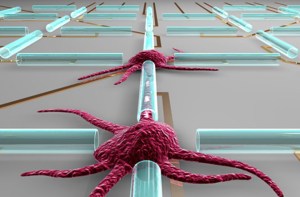
Nerve-cell tendrils readily thread their way through tiny semiconductor tubes, researchers find, forming a crisscrossed network like vines twining toward the sun. The discovery that offshoots from nascent mouse nerve cells explore the specially designed tubes could lead to tricks for studying nervous system diseases or testing the effects of potential drugs. Such a system may even bring researchers closer to brain-computer interfaces that seamlessly integrate artificial limbs or other prosthetic devices.

The technology required to interface the brain with a computer is apparently still a long way off, but every step in the right direction counts. (Unless of course this is one more step toward a Borg future, in which case prepare to be assimilated.)

“Super Moon” visible tonight

If you happen to be outside this evening, check out the Moon when it’s close to the horizon — it’s going to appear slightly larger than usual, thanks to a (somewhat) rare alignment of the Moon’s position in its orbit around Earth relative to the Sun.

The media are referring to it as a “Super Moon.” So, what exactly makes it “super”? The Moon has a slightly elliptical orbit around the Earth, which means sometimes it’s a little closer to the Earth (this position is called “perigee”) and sometimes a little further away (“apogee”). The difference is about 42,000 km, which sounds like a lot, but it’s only about 10% of the Moon’s average distance from the Earth. Today’s perigee is a smidgen1 closer than usual, but not enough to have any significant impact on ocean tides, earthquakes, or volcanic activity. Anyway, when the Moon’s perigee is especially close and coincides with a full moon, that seems to be a “Super Moon.” But it really amounts to a not-so-super 14% increase in the Moon’s apparent size in the sky compared with its apogee size. (I think I just broke the record for how many times the word “moon” can be crammed into a blog post.)

This NASA vid explains it all with nifty images:

DIY Science: If you’re an empirical kind of person, you can try the following: hold up a ruler or some other reference object at arm’s length (steady your arm on a stable surface) and carefully measure the apparent size of the Moon tonight, then do the same on October 12th when there is another full moon, but this time its close to apogee. See if you can detect a slight difference. If you have a telescope equipped with an eyepiece with a linear-scale reticle, this should be a piece of cake.

Continue reading

MESSENGER probe locks into orbit around Mercury

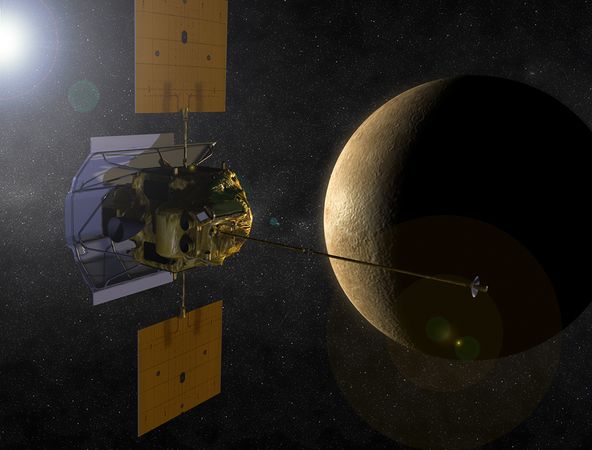
Artist's conception of MESSENGER approaching Mercury (Credit: NASA)

For the first time ever, we have a probe orbiting the planet Mercury. The MESSENGER probe was successfully maneuvered into orbit around Mercury yesterday following a six-and-a-half-year series of gravitational flybys past Earth, Venus, and Mercury, to nudge it into course. Starting in April, MESSENGER will make two orbits of Mercury per (Earth) day, collecting information to send back to scientists on Earth.

Previous missions to Mercury include the Mariner 10 spacecraft, which gathered data as it quickly flew past Mercury three times in 1974-1975, and three data-collecting flybys of Mercury by the MESSENGER probe in 2008-2009.

NASA scientists hope the mission will help answer several questions about Mercury, including why the tiny planet is so dense, what its geological history is, and whether there is actually ice at its poles.

Continue reading

Methane rain on Titan

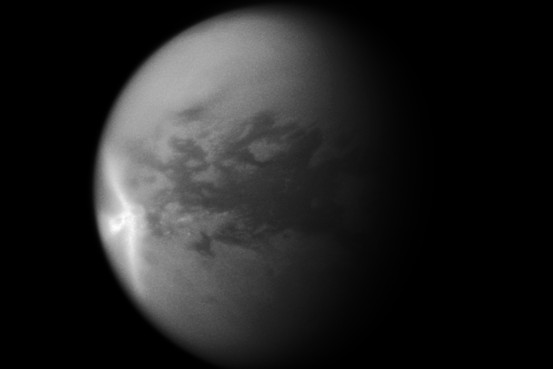
NASA's Cassini spacecraft snapped this infrared photo of equatorial rainfall on Titan (Credit: NASA/JPL/Space Science Institute)

Spring has sprung on Saturn’s largest moon, Titan, and that means rain showers. But not the kind of spring showers that bring flowers — on Titan it rains methane:

Instead of water, as on Earth, Titan’s cycles of precipitation, evaporation and cloud formation involve hydrocarbons such as methane and ethane, which at the extremes of cold on Titan pool as liquids in thousands of lakes around its north and south poles. Indeed, scientists estimate that Titan holds hundreds of times more liquid hydrocarbons than all the known oil and natural gas reserves on Earth.

Outer space may seem hostile to advanced life, but the solar system is rich in natural resources needed to survive. If we ever venture out into the solar system with long-term or permanent manned space missions, we should have little trouble availing ourselves of necessities like bulk building materials, hydrocarbon fuels, water, and oxygen.

Update: APOD has featured an artist’s conception of what it might look like from the surface of Titan (not very inviting).

Continue reading

More support for the existence of dark energy

The case for dark energy is looking stronger, thanks to new results from the recently-installed Wide Field Camera 3 instrument aboard the Hubble Space Telescope. Dark energy has been hypothesized as the mysterious force causing the expansion of the universe to speed up, but competing models suggest other reasons for the accelerated expansion. A leading competitor is a bubble model that suggests our Milky Way galaxy sits at the center of a relatively sparse region of the universe, and the resulting weaker gravity is causing our local “bubble” to expand more rapidly than the universe as a whole. However, astrophysicists at the Space Telescope Science Institute claim that refined measurements made with the WFC3 have ruled out the bubble model, which predicts a different expansion rate than what is observed.

There are philosophical objections to the bubble model, as well. Ever since Copernicus put forth his Sun-centered model of the solar system, scientists have tended to reject the notion that we occupy any special place in the universe. A model that requires Earth-observers to be at the center of a cosmic bubble makes us a little too special for comfort for most scientists. This alone doesn’t disprove the model (we must never be locked into a conclusion by our philosophy), but it can certainly offer guidance. Adam Riess, head of the research team publishing the new results, comments,

“I know that a lot of people have not taken that theory very seriously because of a major problem with it,” he said. “We tend to believe theories where we don’t live in any special place in the universe. That would be very strange – why should we be in a special place?”

Now that scenario is even less likely to be true, Riess said.

“But on the other hand, dark energy’s pretty weird too,” he said.

Every revolutionary idea in science seems weird at first. If the dark energy model survives the rigors of scientific testing, people a hundred years from now probably won’t find it any weirder than we find the electromagnetic theory of light.

Continue reading

American astronauts to hitch rides with the Russians

Now that the U.S. is retiring its shuttle fleet, Russia seems to be embracing the concept of supply and demand. Can’t really blame the Russians for taking advantage of the situation, but still … yikes:

The new deal will allow NASA to fly a dozen astronauts from the U.S. or its partner agencies on Russia’s venerable Soyuz spacecraft between 2014 and 2015 at a cost of about $62.7 million per seat. That’s an increase from the $55.8 million per seat NASA paid under a deal for six round trips to the station in 2013 and 2014.

At least we’re on friendly terms with them now. I remember what a big deal it was back in 1984 to portray American astronauts hitching a lift with the Soviets in the sequel to 2001: A Space Odyssey. But nobody ever thought they’d be fleecing us someday just for a ride to the International Space Station.

Happily, this is not a permanent arrangement. NASA’s priority for 2015 and beyond is to have private American companies develop spacecraft to deliver our astronauts into space, at which point it’s dasvidaniya to the Russians.

Continue reading

Nanotech may keep you chatting for much longer

Tired of having to charge your cell phone battery every couple of days? Nanotechnology may be coming to the rescue with an improvement in cell phone technology that could reduce the drain on your battery by a factor of 100 — that means months of use without having to charge your battery. The new technology involves the use of carbon nanotubes to reduce the size of tiny wires that convey digital information in your phone, which in turn cuts the amount of electricity that’s needed to make your phone work. Even better: reduced power consumption could eventually lead to cell phones that are powered by heat or sunshine.

Check out this quickie vid if you’re wondering what in the world these carbon nanotube thingies are anyway. (Note how the nanotube professor describes what he does as “curiosity-driven science.” That’s an outstanding explanation.)

Continue reading