Rethinking the origin of cosmic rays

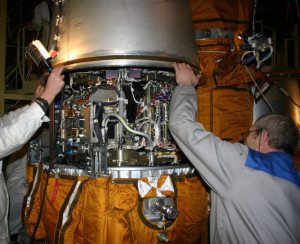
The PAMELA instrument. Credit: Piergiorgio Picozza

New results from an Italian space-based experiment have astronomers puzzled about the origins of cosmic rays. Cosmic rays are charged particles — protons and other atomic nuclei — that are accelerated to near-light speeds and continue on through the universe. The Earth is awash in them, with dozens of cosmic rays passing through your body every second of every day. Until now, the prevailing explanation for their origin was that they are accelerated by the remnants of supernovae, the spectacular final moments of dying high-mass stars. However, evidence gathered by the exquisitely sensitive Italian space-based instrument, called PAMELA, suggests this is not the case. It seems that different types of particles are accelerated in different ways, contrary to what is expected if they are accelerated by the same source.

It’s another entry in the “We didn’t expect that” file, which is part of what science is all about. And theorists always like the extra business.

Continue reading

Buckyballs in space

Sounds like the title of a cheesy sci-fi movie, doesn’t it? Buckyballs (short for “buckminsterfullerenes”) are the largest molecules that we know of, and just last year they were discovered for the first time in space. Based on their properties, astronomers predicted that buckyballs would exist in certain environments in space and not in others. However, a group using the Spitzer Space Telescope has found precisely the opposite. This is why observation and experiment are so important in science.

Continue reading

Never tell me the odds!

The Pan-STARRS telescope in Hawaii discovered a record-breaking 19 asteroids in one night last January, two of which are projected to come close to the Earth at some point.

Even with all of these discoveries, it’s estimated we’re tracking only about 1% of the total number of Near Earth Objects (NEOs) in the solar system. To get an idea of the distribution of all the stuff zipping around out there, check this out (seriously).

A little scary perhaps, but at least it’s not this bad:

Recommended reading:

Space researchers likely to benefit from space tourism

For every problem, there is almost always a free-market solution

Science, perhaps even more than tourism, could turn out to be big business for Virgin and other companies that are aiming to provide short rides above the 62-mile altitude that marks the official entry into outer space, eventually on a daily basis.

A $200,000 ticket is prohibitively expensive except for a small slice of the wealthy, but compared with the millions of dollars that government agencies like NASA typically spend to get experiments into space, “it’s revolutionary,” said S. Alan Stern, an associate vice president of the Southwest Research Institute’s space sciences and engineering division in Boulder, Colo.

I think it has escaped the general consciousness that up until the last one hundred years or so scientific research was privately funded. It looks like technical advancements combined with economic forces are driving research back in that direction, however slowly. Personally, I couldn’t be happier about that, because private funding disengages science from whatever government orthodoxy happens to be in place at the moment*.

Continue reading

Aussie physicists produce the first cold-atom laser

This is quite a year for laser breakthroughs. First we had the anti-laser, and now Australian physicists have created an atom laser from extremely cold helium atoms. Conventional lasers (LASER = Light Amplification by Stimulated Emission of Radiation) produce coherent light, that is light comprised of photons that are evenly spaced instead of clustered together in groups. The Aussie physicists have managed to produce atoms that behave the same way by super-cooling them to a millionth of a degree above absolute zero (even outer space isn’t that cold). Atom lasers can be applied to nifty things like holography, which means we’re one (tiny) step closer to every Trekkie’s fantasy of visiting a Holodeck.

Continue reading

Some galaxies grow like snowflakes

Massive elliptical galaxy M87

Astronomers have found further evidence that some galaxies grow in a way similar to snowflakes. A snowflake grows by building up ice crystals around a tiny grain of dust in the atmosphere. Likewise, some galaxies start off as modest “seed” galaxies within a cluster and then build up by acquiring stars from other galaxies in the cluster. This brief computer simulation shows the process (the bright dots in the simulation are the luminous cores of galaxies; notice how the one in the center grows to enormous proportions by grabbing stars from the other galaxies).

The authors of the new study observed the massive elliptical galaxy, NGC 1407, also commonly known as M87. Their case relies on measurements of the proportion of heavy elements in M87’s stars as a function of where they are located in the galaxy. The stars in the outer part of the galaxy have a different chemical composition than stars near the core, so it’s likely the galaxy wasn’t built all at once, but from the inside out like a snowflake. Not a gentle, delicate snowflake mind you: M87 is the most massive galaxy in the local universe, with a powerful black hole-driven jet of particles shooting out of its core at near-light-speed.

Continue reading

Last flight

The Scholar Redeemer (my friend and colleague, Dr. Robb Wilson) eloquently commemorated the last space shuttle flight yesterday

… it was truly awesome to witness so much power under complete control, doing exactly what was expected. It was amazing to have a human made device that went from sitting completely still in Florida to being over 100 miles up and over the Indian Ocean less than an hour later. Watching such a complicated machine with so much demonstrated explosive capability safely carry fellow humans completely off of our planet so quickly… there just aren’t words for it.

Please pay him a visit and read the whole thing.

The shuttle had become a bit of a dinosaur, but I couldn’t help but be moved every single time I watched one launch into space: to me there are fewer sights more awe-inspiring than a 2,000-ton spacecraft slipping the bonds of the Earth, and realizing that it is powered almost entirely by human ingenuity.

Continue reading

Science faction

The Scientific Curmudgeon ponders whether theoretical physics is going soft:

Roger Penrose and V. G. Gurzadyan recently proposed that minute ripples in the cosmic microwave background- the afterglow of the big bang- originated from the collision of monster black holes in another universe that preceded our cosmos, and may have spawned it; moreover, our universe might be just one of an infinite series spawned by such cataclysms.

My reaction to reading about this idea was: Far out! Penrose, one of the most famous, creative physicists in the world, along with Gurzadyan had dusted off the old oscillating universe theory of the cosmos, which I always liked. But not for a nanosecond did I think their proposal was true. The proposal is literally too far out; it can never be confirmed in the way that the existence of quarks has been confirmed or the big bang itself.

This is the problem I’ve always had with the various proposed “theories” of the multiverse: if a proposal can’t be confirmed, it’s not science.

Physics is at a real crossroads with the multiverse. If the majority of physicists accept it as science, the field of physics is doomed; if the majority relegate it to speculation, physics will continue on the path of genuine science.

Stay tuned for a mega-post on the multiverse in the coming months.

Continue reading