Physicists untangle process involved in Parkinson’s disease

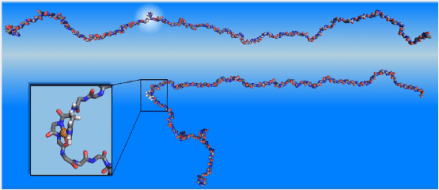
The protein alpha-synuclein in its normal state (above) and misfolded after the attachment of copper (below)

A team of physicists at North Carolina State University — led by my very good friend, Frisco Rose — has published the results of their study of the process that leads to Parkinson’s disease. Parkinson’s is a degenerative disorder that affects the nervous system, manifesting in tremors and difficulty controlling motion. Actors Katherine Hepburn and Michael J. Fox are well-known sufferers of the disease.

The work involved simulations using the most powerful supercomputer in the world, the Jaguar supercomputer at Oak Ridge National Laboratory, to understand the way in which a protein associated with Parkinson’s gets tangled. The protein, called alpha-synuclein, is normally long and straight, but it becomes tangled, or misfolded, in patients with Parkinson’s (see figure above).

Proteins are the basic building blocks of life. They are comprised of long chains of molecules called amino acids that regulate biochemical reactions in living things. The shape of a protein — the way in which it is folded — dictates its function. Amazingly, these biochemical machines assemble, or fold, themselves1.

Most of the time this self-assembly proceeds without error. However, when a protein misfolds, it becomes tangled and clumped together with other protein strands, and this is believed to cause a number of diseases, including Parkinson’s, Mad Cow, cystic fibrosis, and some forms of cancer. In order to devise treatments for these diseases, it’s important to understand how certain proteins misfold.

Study of protein folding may sound like a job for biologists, but it has been an increasingly popular topic of study in physics, because the different ways in which a protein can fold are determined by equations involving forces and energy. For a typical protein, these calculations would normally require hundreds of thousands of computing hours, far more than is feasible. To get around this problem, Rose’s team devised a new tactic: focus the simulations only on the part of the protein where the tangling occurs. By reducing the region of study, they were able to successfully carry out simulations, and discovered that certain metals, such as copper, affect the folding by binding to the protein in a way that accelerates tangling.

“We knew that the copper was interacting with a certain section of the protein, but we didn’t have a model for what was happening on the atomic level,” says Frisco Rose, Ph.D. candidate in physics and lead author of the paper describing the research. “Think of a huge swing set, with kids all swinging and holding hands—that’s the protein. Copper is a kid who wants a swing. There are a number of ways that copper could grab a swing, or bind to the protein, and each of those ways would affect all of the other kids on the swing set differently. We wanted to find the specific binding process that leads to misfolding.”

The tactic allowed them to identify the most likely way in which copper binding to the protein leads to misfolding. This is a significant step toward finding a treatment for Parkinson’s.

Other researchers studying protein folding are getting around the computing problem using a different tactic: using thousands of volunteered home computers — your computers — to perform the calculations. If you’d like to get involved by donating some of your home computer’s run time to help these scientists do their work, check out Standford University’s Folding@home project.

Continue reading

A final roll-out for Shuttle Atlantis

And a final roll-out for the shuttle program. From Astronomy Picture of the Day (APOD), which you really should be checking out every day:

In the final move of its kind, NASA’s space shuttle Atlantis was photographed earlier this month slowly advancing toward Launch Pad 39A, where it is currently scheduled for a July launch to the International Space Station. The mission, designated STS-135, is the 135th and last mission for a NASA space shuttle. Atlantis and its four-person crew will be carrying, among other things, the Multi-Purpose Logistics Module Raffaello to bring key components and supplies to the ISS. Pictured above, the large Shuttle Crawler Transporter rolls the powerful orbiter along the five-kilometer long road at less than two kilometers per hour. Over 15,000 spectators, some visible on the right, were on hand for the historic roll out.

Click on the link to get the beautiful hi-res version of the photo.

Sunspot hiatus may mean colder weather ahead

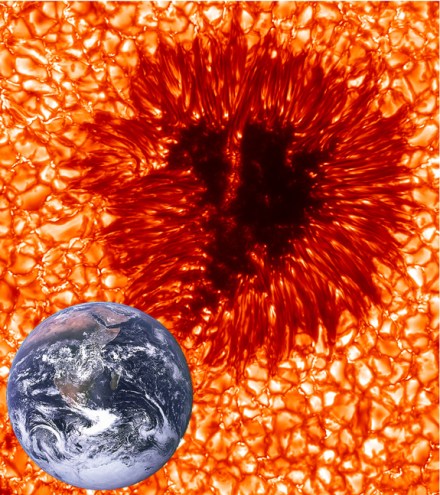
A colorized photo of a sunspot with the Earth shown for scale.

New results from three different studies indicate the Sun is likely entering a prolonged period of low activity, which will have a profound effect on the Earth. Solar scientists base their conclusion on weakening magnetic fields along the poles of the Sun and decreasing intensity of sunspots.

“The solar cycle may be going into a hiatus,” Frank Hill, associate director of the National Solar Observatory’s Solar Synoptic Network, said in a news briefing [June 14].

The studies looked at a missing jet stream in the solar interior, fading sunspots on the sun’s visible surface, and changes in the corona and near the poles.

“This is highly unusual and unexpected,” Hill said. “But the fact that three completely different views of the sun point in the same direction is a powerful indicator that the sunspot cycle may be going into hibernation.”

Since the 1800s, scientists have known that the Sun goes through a cycle in which the number of sunspots visible on the Sun’s surface gradually rises to a maximum and then falls to a minimum, repeating approximately every 11 years. Sunspots are dark patches on the surface of the Sun about the size of the Earth. They appear dark in photos of the Sun, because the plasma in sunspots is relatively cool (~4,500 K) compared with the plasma elsewhere on the surface of the Sun (~5,800 K). The key word is relatively — if you were so unwise as to point your telescope directly at a sunspot, you would still be blinded.

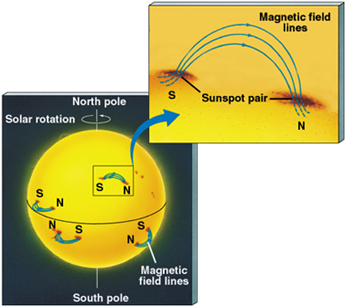
Sunspots usually appear on the surface in pairs, and that is because they are connected by magnetic field lines, which are created and altered by the roiling sea of plasma on the surface of the Sun. Magnetic field lines are kind of like rubber bands in that they can be twisted and stretched, and sometimes this twisting action causes magnetic field lines to get wound up and extend out from the surface of the Sun. Sunspot pairs are observed where the lines poke out from the surface (see below). The reason the temperature of sunspots is lower than the surrounding region is that the magnetic field lines prevent hotter plasma from flowing into those areas.

During the solar maximum, when the number of visible sunspots reaches a peak, the Sun’s magnetic field actually flip-flops. If you think of the Sun as sort of like a gigantic bar magnet, this means the south magnetic pole becomes the north magnetic pole, and vice versa. The Sun thus has a solar cycle that lasts about 22 years, since this is how long it takes for the Sun’s magnetic field to return to its previous polarity.

Solar scientists believe that the current maximum may be the last we’ll see for decades, and this has profound implications for the Earth’s climate. The sunspot cycle repeats fairly regularly, but the intensity of the sunspot cycle can change dramatically. In the late 1950s there was a particularly strong solar maximum, and in the period 1645 to 1715 there was virtually no sunspot activity at all. The latter period is referred to as the Maunder minimum (after the astronomer who discovered it in observational records1). The significance of the Maunder minimum is that it coincided with a prolonged period of exceptionally cold weather in Europe and North America, referred to as the Little Ice Age. This is part of a general trend of colder periods coinciding with solar minima. If we are entering another prolonged period devoid of solar maxima, it is likely we will experience a prolonged period of cooler weather.

Continue reading

“God particle” detection in doubt

Remember that rumor a couple of months ago that the folks at Tevatron may have found the Higgs boson, aka the “God particle”? Well, turns out probably not. The Collider Detector at Fermilab (CDF) reportedly discovered a signal that was consistent with the Higgs boson, but the experiment could not be replicated with Tevatron’s other detector, DZero.

That’s how science works, folks. Keep trying, but if your results can’t be replicated, it’s back to the drawing board.

Continue reading

Active black hole twins discovered in center of galaxy

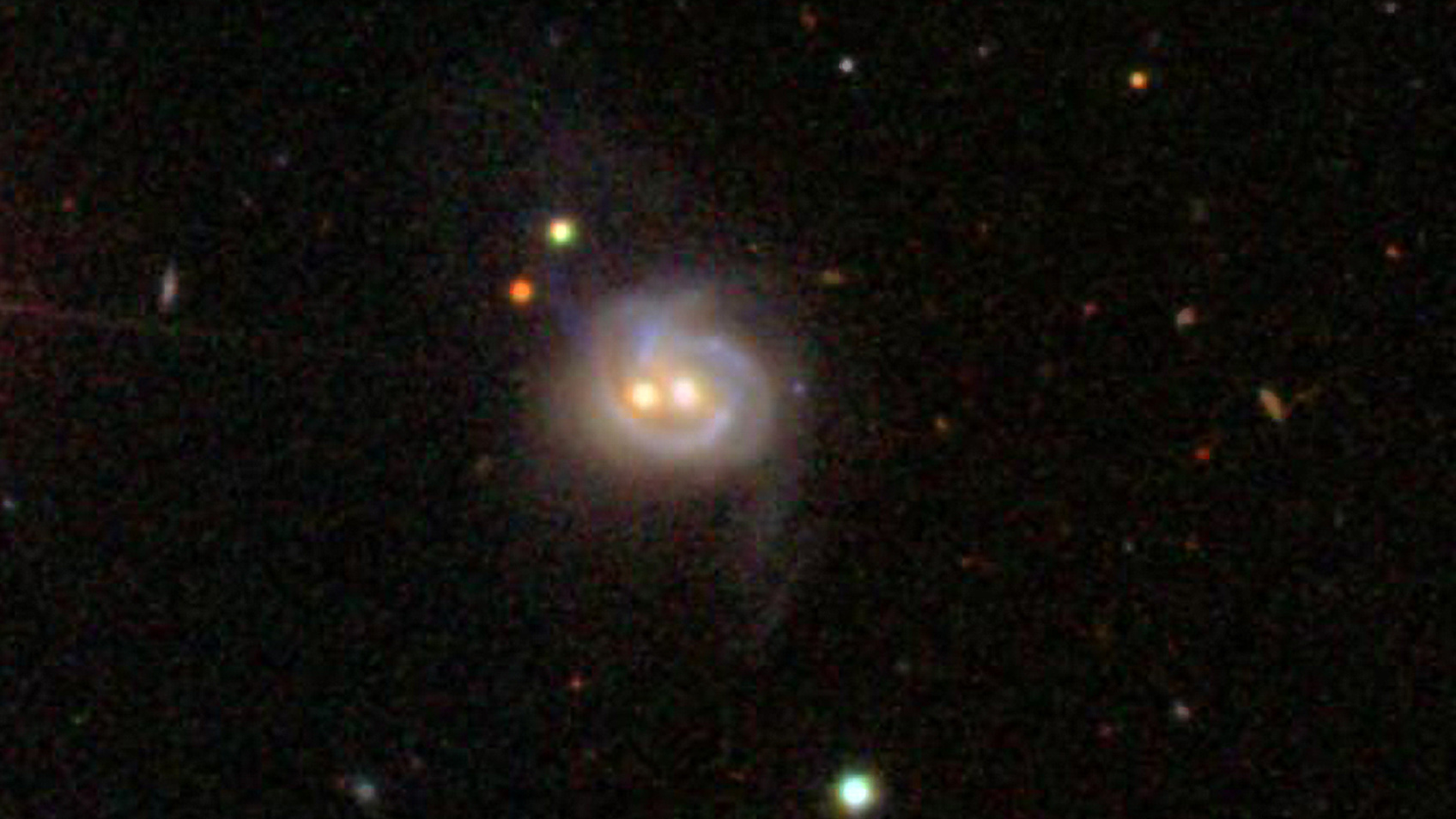
In a surprise discovery, astronomers using the Burst Alert Telescope aboard the Swift satellite learned that both supermassive black holes in galaxy Mrk 7391 (yes, it has two) are actively feeding on material. (Check out the link for a cool vid of the galaxy.) Mrk 739 is a mere 425 million light-years from Earth, making it the second-closest active pair of supermassive black holes to Earth. (The first-closest is in galaxy NGC 6240.)

So, besides the sheer coolness of two supermassive black holes in a single galaxy, why do astronomers care about such objects? As it turns out, they are an important key to understanding galaxy evolution.

Nearly every galaxy, including our own Milky Way, harbors a supermassive black hole in its nucleus, but only a few percent of those black holes are observed to be actively feeding on significant amounts of gaseous and stellar material. Such systems are referred to as active galactic nuclei or AGN for short, and they are believed to be a temporary stage through which all galaxies harboring supermassive black holes pass. During this relatively brief active period, typically lasting ~50 million years, the gaseous material AGN feed on becomes superheated as it spirals down onto the black hole, causing AGN to shine very brightly. The intense brightness means these objects are often observable at very great distances, and therefore over a big range of cosmic history. This is why AGN are important probes of galaxy evolution.

Astronomers aren’t entirely sure what drives this material from the outskirts of the galaxy all the way down to the black hole, but it has been posited that galaxy interactions, including major mergers like the one shown below, are a likely mechanism.

What’s happening here is that the mutual gravitational tugging on gas orbiting in the galactic disks causes it to lose angular momentum and travel inward toward the nucleus of at least one galaxy, and possibly both, eventually reaching one or both of the black holes. If both black holes are active, the object is referred to as a binary AGN. As the hypothesis goes, such objects should be abundant but short-lived (in cosmic terms), lasting a few to tens of millions of years depending on the distance between the black holes. Eventually, the black holes spiral down to merge into a single, more massive black hole, and the two galaxies become a single, more massive galaxy.

It is a fact that galaxies frequently merge — there are several striking examples of this — but whether they are a major mechanism for creating AGN is another matter. I am a co-author on several papers involving searches for binary black holes, including binary AGN and recoiling black hole pairs, and I have been somewhat surprised by the relatively low frequency with which we observe genuine binary AGN  — about 100 times less than the predicted frequency. This implies: 1) the measurements needed to make such detections at large distances are so fine that we are not detecting the vast majority of such objects; or 2) perhaps the notion that mergers play a major role in creating AGN needs to be reconsidered.

Continue reading

Possible dark matter detection

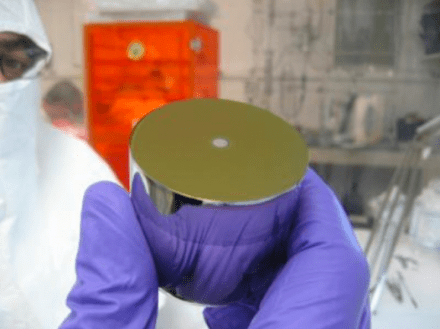
Dark matter detector prototype similar to the ones used in the recent experiment


University of Chicago physicists have discovered signals that are consistent with WIMPs — weakly-interacting massive particles — the leading candidates for dark matter. The signals were measured in a laboratory apparatus that is buried deep below the surface of the Earth in an abandoned mine in Minnesota, where layers of rock prevent cosmic rays and radiation from interfering with the experiment. Oddly enough, physicists discovered that the signal counts were higher in the summer than in the winter, but it sort of makes sense: in the summer months the Earth’s rotation is aligned with the motion of the Sun through the disk of the Milky Way, creating a net velocity through the dark matter cloud that is theorized to envelope our galaxy.

These results are not confirmation of the existence of dark matter, but they are encouraging nonetheless, especially as they are consistent with results from ten years ago that were deemed controversial at the time.

Continue reading

New class of supernova intrigues astronomers

The Palomar Transient Factory (PTF) at Caltech has discovered a new class of bright supernovae that has astronomers baffled. The properties of these objects — extreme brightness, high ultraviolet luminosity, the presence of oxygen and lack of metals common to most supernovae — are not explained by current theoretical models. PTF astronomers speculate that these objects could be the result of exploding supermassive stars with 100 times the mass of the Sun or perhaps even magnetars (rapidly rotating neutron stars with super-strong magnetic fields).

The PTF uses an automated system that includes a telescope that scans large portions of the sky night after night using a wide-field imaging camera, and an algorithm that looks for transients — anything that has varied in brightness and/or position — by comparing these images with images from previous nights. When a transient is discovered, its coordinates are automatically sent to a larger telescope at Palomar for further observation. Finally, if the transient turns out to be interesting enough, an actual astronomer will follow-up with even more observations on an even bigger telescope.

This turns out to be an excellent way to pore over the sky looking for supernovae, which are exceedingly short-lived as cosmic events go — a typical supernova will begin to fade after just a few weeks. Prior to automated sky searches like PTF, this meant that catching a supernova in the act was to a large degree a matter of luck. Even though they’re extremely luminous events, most supernovae occur in galaxies that are so far away that they appear as faint dots in astronomical images. Yet there’s a universe potentially brimming over with them. Astronomers estimate that one in every 100 Milky Way-like galaxies will experience a supernova event each year. With about a hundred billion galaxies in the observable universe — about 20% of which are spirals like the Milky Way — that’s potentially hundreds of millions of events every year, and obviously astronomers want to catch as many of them as they can.

Continue reading

Stunning southern vistas with the VLT Survey Telescope

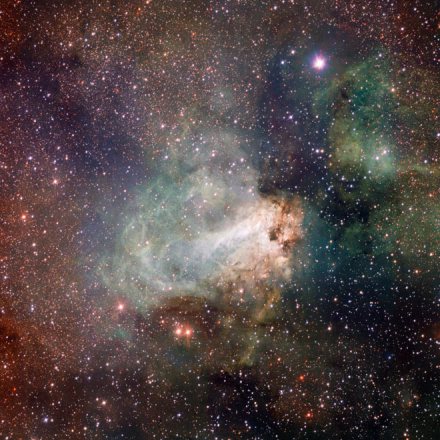
Wired Science has posted a photo gallery of the new VLT Survey Telescope (VST) in Chile, including VST’s first breathtaking photos of the Southern sky.

The VST is a celestial scout of sorts — its purpose is to take vivid photos of celestial objects and identify suitable candidates for more detailed study by the VLT (Very Large Telescope). The VLT is an array of four large telescopes — each 8.2-m in diameter — with a combined resolution of 1 milli-arcsecond. In practical terms, this means the VLT would be able to distinguish two astronauts standing five feet apart on the surface of the Moon. Since time on the VLT is very precious, the VST — with its impressive 268-megapixel wide-field imaging camera — will be invaluable in selecting optimum targets for it.

Continue reading

Antimatter successfully contained for several minutes

An illustration of anti-hydrogen containment

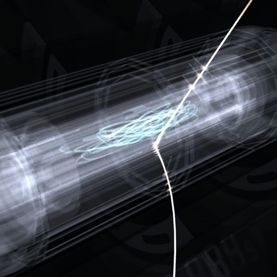
Physicists at the ALPHA facility at CERN report that they have managed to contain antimatter for several minutes, a huge improvement over their previous attempt at antimatter containment last year, which lasted only two tenths of a second.

Antimatter is comprised of particles that have the same mass as “normal” particles, like protons or electrons, but have opposite charge: for example, anti-protons have negative charge, while anti-electrons (aka positrons) have positive charge. The antimatter in the ALPHA experiment is in the form of neutral anti-hydrogen — an anti-proton and a positron — created in a high energy state. Anti-hydrogen is the antimatter counterpart to hydrogen, the simplest and by far the most abundant element in the universe.

Physicists at particle accelerates have been able to produce positrons and anti-protons for a long time. Getting them to stick together to form a neutral anti-hydrogen atom and keep it contained has been the real trick. The ALPHA physicists used electric fields to clear out stray charged particles, and used superconducting magnets to hold the remaining anti-hydrogen particles in place. The purpose for containing antimatter for a long periods of time is to allow study of its properties and see how it differs from normal matter. Why is this important? Out of laziness, I’ll just quote myself from a previous article:

… big bang theory requires that equal amounts of matter and antimatter existed in the very early history of the universe. The matter and antimatter would collide and annihilate, producing a burst of energy. The great mystery is why our galaxy and everything we observe appears to be made of matter. Actually, the great mystery is why there is any matter at all, for if there was an equal amount of antimatter, all of it should have been annihilated. Some theories propose a tiny asymmetry, with slightly more matter than antimatter, but these theories raise problems of their own.

What physicists hope to understand is why matter came to dominate the universe instead of antimatter (or no matter at all). Some sort of asymmetry has to exist, and studying anti-hydrogen may reveal what that is.

Continue reading

Earth-Moon system perhaps not all that rare

Until recently, our Earth-Moon system was thought to be a rare configuration — most moons in the Solar System are proportionally very small compared to the planets they orbit, but our Moon is proportionally large at about one-quarter the size of Earth. Now, results from a new computer simulation conducted by physicists in Zurich and Colorado indicate that such a configuration may be more common than previously thought.

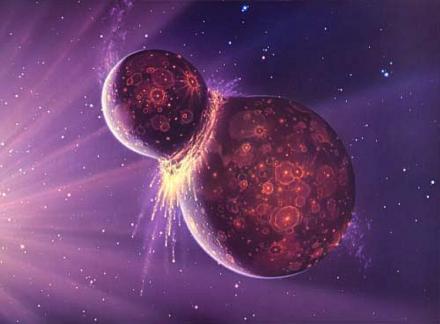
Our Moon is believed to have formed 100 million years after the initial formation of the Solar System when a Mars-sized planet collided with Earth, breaking the smaller planet apart, and forming a debris ring that eventually coalesced into what is now the Moon. According to the simulations, there is about a one in 12 chance of a similar scenario occurring in other systems.

While interesting, keep in mind that these are simulations, not observations, and they do not take into account all of the different variables. They simply tell us that formation of other planets with proportionally large moons is plausible.

Continue reading