All eyes on nuclear reactors in the aftermath of Japan quake

Nuclear power is used by many countries to produce electricity, including Japan where the 8.9-magnitude earthquake that shook the country on Friday has caused the Fukushima I facility’s backup safety systems for two of its eight reactors to fail. The No. 1 reactor suffered an explosion, likely fueled by hydrogen gas, that has apparently not affected the reactor containment structure.  The USAF has supplied emergency coolant to the reactors, but the situation is critical enough that tens of thousands of residents within a 20 km radius of the plant have been evacuated.

Experts from around the world, including the deputy director of the Chernobyl nuclear safety center, have said this will not be a repeat of the Chernobyl disaster that occurred in Ukraine in 1986. Japan’s 54 nuclear reactors, and all Western civil nuclear facilities, are designed with better safety standards than the Chernobyl facility. Still, it seems the extent of the damage to the Fukushima facility is unclear, and residents are understandably nervous.

Please keep the Japanese people in your prayers.

Continue reading

Mars orbiter spots Mars rover

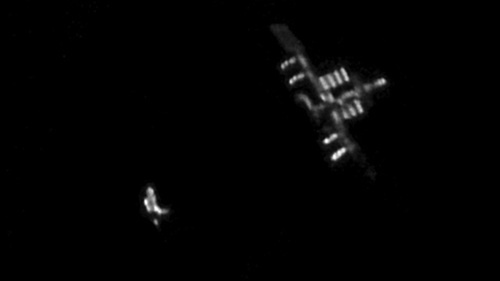
The Mars Reconnaissance Orbiter captured the progress of the Mars Exploration Rover Opportunity as it investigates a 90-meter crater on the Martian surface. A few months ago the rover was on one side of the crater, and it’s apparently made its way to the other side. See if you can spot it below. (No word on whether any hrossa or pfifltriggi have been seen.)


(Click on the photo to see a larger version.)

Continue reading

Of robots and revulsion

I am generally positive about high technology, and as a science fiction fan I have never had a problem with the concept of androids — until now. Check this thing out:

The guy on the right is not a real person, it’s a very sophisticated robot, called Geminoid DK, created by Japanese researchers. It seriously creeps me out:

Why am I disturbed by this thing instead of curious about it or even sympathetic to it the way I am with Data, the android from Star Trek: The Next Generation? Because, underneath all the makeup, I know Data is a real person. (Plus, the more you think about his character, the more you realize how unintentionally human he is.) But the Geminoid robot? I know it’s not a real person.

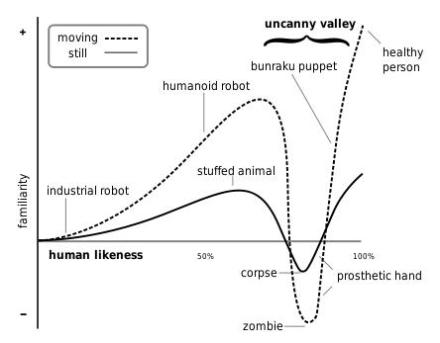
There is supposedly an explanation for this revulsion. It’s called the “uncanny valley,” and it says that our feelings of sympathy for a robot are proportional to how human-like it is, up until a point where the similarities rapidly become repulsive. Then as the robot becomes indistinguishable from a human, our feelings of sympathy rise again. The effect is enhanced if the robot moves. The graph below shows what this looks like:

Human emotional response to objects as a function of how human-like they are. (From the Wikipedia entry on "uncanny valley.")

The problem with this explanation is that until now, we haven’t had any robots that were anywhere close to indistinguishable from humans, so there could not have been direct testing of how humans react to such robots. Furthermore, when I showed the video to some relatives, they didn’t think anything of it until they realized it wasn’t human. Then they were horrified. There seems to be something within us that is innately repelled by an object that looks and acts human and yet lacks both animal intelligence and a soul.

I don’t see the Geminoid robot as a wonderful technological breakthrough. In fact, for the first time I am deeply troubled about the prospect of androids ever serving humanity. I don’t think the outcome would be like Data, but something more like the replicants from Blade Runner.

Continue reading

Rethinking the origin of cosmic rays

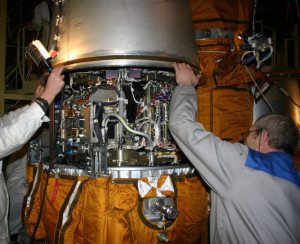
The PAMELA instrument. Credit: Piergiorgio Picozza

New results from an Italian space-based experiment have astronomers puzzled about the origins of cosmic rays. Cosmic rays are charged particles — protons and other atomic nuclei — that are accelerated to near-light speeds and continue on through the universe. The Earth is awash in them, with dozens of cosmic rays passing through your body every second of every day. Until now, the prevailing explanation for their origin was that they are accelerated by the remnants of supernovae, the spectacular final moments of dying high-mass stars. However, evidence gathered by the exquisitely sensitive Italian space-based instrument, called PAMELA, suggests this is not the case. It seems that different types of particles are accelerated in different ways, contrary to what is expected if they are accelerated by the same source.

It’s another entry in the “We didn’t expect that” file, which is part of what science is all about. And theorists always like the extra business.

Continue reading

Aussie physicists produce the first cold-atom laser

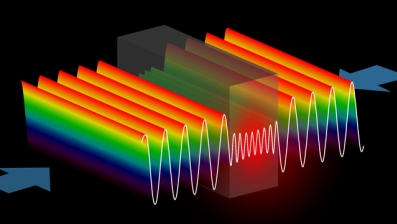
This is quite a year for laser breakthroughs. First we had the anti-laser, and now Australian physicists have created an atom laser from extremely cold helium atoms. Conventional lasers (LASER = Light Amplification by Stimulated Emission of Radiation) produce coherent light, that is light comprised of photons that are evenly spaced instead of clustered together in groups. The Aussie physicists have managed to produce atoms that behave the same way by super-cooling them to a millionth of a degree above absolute zero (even outer space isn’t that cold). Atom lasers can be applied to nifty things like holography, which means we’re one (tiny) step closer to every Trekkie’s fantasy of visiting a Holodeck.

Continue reading

Last flight

The Scholar Redeemer (my friend and colleague, Dr. Robb Wilson) eloquently commemorated the last space shuttle flight yesterday

… it was truly awesome to witness so much power under complete control, doing exactly what was expected. It was amazing to have a human made device that went from sitting completely still in Florida to being over 100 miles up and over the Indian Ocean less than an hour later. Watching such a complicated machine with so much demonstrated explosive capability safely carry fellow humans completely off of our planet so quickly… there just aren’t words for it.

Please pay him a visit and read the whole thing.

The shuttle had become a bit of a dinosaur, but I couldn’t help but be moved every single time I watched one launch into space: to me there are fewer sights more awe-inspiring than a 2,000-ton spacecraft slipping the bonds of the Earth, and realizing that it is powered almost entirely by human ingenuity.

Continue reading

Separating philosophy from science

** Written by “Surak” **

An article appeared several months ago in the Daily Telegraph with the headline, “Neuroscience, free will and determinism: ‘I’m just a machine.’” It describes how a British neuroscientist, Professor Patrick Haggard, found that magnetic fields can be used to affect a person’s brain and exert some small degree of control of his body without touching it in any way. The magnetic field is created by a device held close to a person’s head; a technique he calls “transcranial magnetic stimulation.” Although the amount of ‘control’ he was able to demonstrate was only the waggling of his index finger and the twitching of a hand, it was a wonderfully original experiment that sparks the imagination with intriguing visions of further research and possible cures.

Unfortunately the article wasn’t about the scientific possibilities. The researcher chose instead to make wildly speculative philosophical statements in the guise of science:

Continue reading