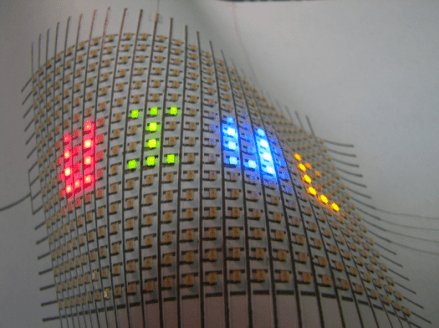
Researchers at the University of Illinois at Urbana-Champaign have developed a liquid metal “ink” that, when used in a ballpoint pen, allows circuits to be hand-drawn. Circuits can be drawn on flat surfaces, like paper, as well as irregular surfaces. In the photo above, researchers used the pen to hand-draw circuits that connected to LEDs (light-emitting diodes) powered by a battery connected to the paper. During testing it was shown that a circuit drawn on a piece of paper using the liquid metal ink could survive intact even if the paper was folded thousands of times.
“Pen-based printing allows one to construct electronic devices ‘on-the-fly’,” says Jennifer Lewis, one of the engineering profs who came up with the new pen at Illinois uni. “This is an important step toward enabling desktop manufacturing (or personal fabrication) using very low cost, ubiquitous printing tools.”
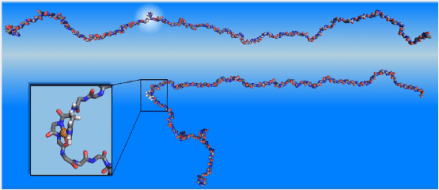
The protein alpha-synuclein in its normal state (above) and misfolded after the attachment of copper (below)
A team of physicists at North Carolina State University — led by my very good friend, Frisco Rose — has published the results of their study of the process that leads to Parkinson’s disease. Parkinson’s is a degenerative disorder that affects the nervous system, manifesting in tremors and difficulty controlling motion. Actors Katherine Hepburn and Michael J. Fox are well-known sufferers of the disease.
The work involved simulations using the most powerful supercomputer in the world, the Jaguar supercomputer at Oak Ridge National Laboratory, to understand the way in which a protein associated with Parkinson’s gets tangled. The protein, called alpha-synuclein, is normally long and straight, but it becomes tangled, or misfolded, in patients with Parkinson’s (see figure above).
Proteins are the basic building blocks of life. They are comprised of long chains of molecules called amino acids that regulate biochemical reactions in living things. The shape of a protein — the way in which it is folded — dictates its function. Amazingly, these biochemical machines assemble, or fold, themselves1.
Most of the time this self-assembly proceeds without error. However, when a protein misfolds, it becomes tangled and clumped together with other protein strands, and this is believed to cause a number of diseases, including Parkinson’s, Mad Cow, cystic fibrosis, and some forms of cancer. In order to devise treatments for these diseases, it’s important to understand how certain proteins misfold.
Study of protein folding may sound like a job for biologists, but it has been an increasingly popular topic of study in physics, because the different ways in which a protein can fold are determined by equations involving forces and energy. For a typical protein, these calculations would normally require hundreds of thousands of computing hours, far more than is feasible. To get around this problem, Rose’s team devised a new tactic: focus the simulations only on the part of the protein where the tangling occurs. By reducing the region of study, they were able to successfully carry out simulations, and discovered that certain metals, such as copper, affect the folding by binding to the protein in a way that accelerates tangling.
“We knew that the copper was interacting with a certain section of the protein, but we didn’t have a model for what was happening on the atomic level,” says Frisco Rose, Ph.D. candidate in physics and lead author of the paper describing the research. “Think of a huge swing set, with kids all swinging and holding hands—that’s the protein. Copper is a kid who wants a swing. There are a number of ways that copper could grab a swing, or bind to the protein, and each of those ways would affect all of the other kids on the swing set differently. We wanted to find the specific binding process that leads to misfolding.”
The tactic allowed them to identify the most likely way in which copper binding to the protein leads to misfolding. This is a significant step toward finding a treatment for Parkinson’s.
Other researchers studying protein folding are getting around the computing problem using a different tactic: using thousands of volunteered home computers — your computers — to perform the calculations. If you’d like to get involved by donating some of your home computer’s run time to help these scientists do their work, check out Standford University’s Folding@home project.
Remember that rumor a couple of months ago that the folks at Tevatron may have found the Higgs boson, aka the “God particle”? Well, turns out probably not. The Collider Detector at Fermilab (CDF) reportedly discovered a signal that was consistent with the Higgs boson, but the experiment could not be replicated with Tevatron’s other detector, DZero.
That’s how science works, folks. Keep trying, but if your results can’t be replicated, it’s back to the drawing board.
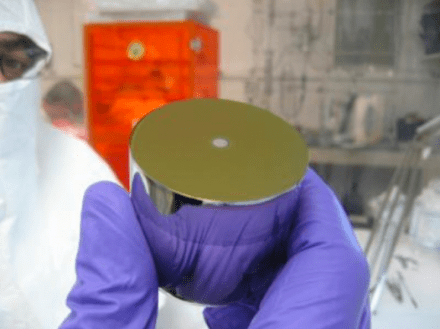
Dark matter detector prototype similar to the ones used in the recent experiment
University of Chicago physicists have discovered signals that are consistent with WIMPs — weakly-interacting massive particles — the leading candidates for dark matter. The signals were measured in a laboratory apparatus that is buried deep below the surface of the Earth in an abandoned mine in Minnesota, where layers of rock prevent cosmic rays and radiation from interfering with the experiment. Oddly enough, physicists discovered that the signal counts were higher in the summer than in the winter, but it sort of makes sense: in the summer months the Earth’s rotation is aligned with the motion of the Sun through the disk of the Milky Way, creating a net velocity through the dark matter cloud that is theorized to envelope our galaxy.
These results are not confirmation of the existence of dark matter, but they are encouraging nonetheless, especially as they are consistent with results from ten years ago that were deemed controversial at the time.
Physicists at the ALPHA facility at CERN report that they have managed to contain antimatter for several minutes, a huge improvement over their previous attempt at antimatter containment last year, which lasted only two tenths of a second.
Antimatter is comprised of particles that have the same mass as “normal” particles, like protons or electrons, but have opposite charge: for example, anti-protons have negative charge, while anti-electrons (aka positrons) have positive charge. The antimatter in the ALPHA experiment is in the form of neutral anti-hydrogen — an anti-proton and a positron — created in a high energy state. Anti-hydrogen is the antimatter counterpart to hydrogen, the simplest and by far the most abundant element in the universe.
Physicists at particle accelerates have been able to produce positrons and anti-protons for a long time. Getting them to stick together to form a neutral anti-hydrogen atom and keep it contained has been the real trick. The ALPHA physicists used electric fields to clear out stray charged particles, and used superconducting magnets to hold the remaining anti-hydrogen particles in place. The purpose for containing antimatter for a long periods of time is to allow study of its properties and see how it differs from normal matter. Why is this important? Out of laziness, I’ll just quote myself from a previous article:
… big bang theory requires that equal amounts of matter and antimatter existed in the very early history of the universe. The matter and antimatter would collide and annihilate, producing a burst of energy. The great mystery is why our galaxy and everything we observe appears to be made of matter. Actually, the great mystery is why there is any matter at all, for if there was an equal amount of antimatter, all of it should have been annihilated. Some theories propose a tiny asymmetry, with slightly more matter than antimatter, but these theories raise problems of their own.
What physicists hope to understand is why matter came to dominate the universe instead of antimatter (or no matter at all). Some sort of asymmetry has to exist, and studying anti-hydrogen may reveal what that is.
Using money from private donations, space enthusiasts and at least one former NASA employee constructed and successfully launched their own rocket from a floating platform in the sea. The prototype cost $73,000 — extremely cheap as far as rockets go, and no wonder: the components included a hair dryer that was intended to keep a valve from freezing. The rocket was dubbed ‘Heat-1X Tycho Brahe’ after the famous 16th century Danish astronomer.
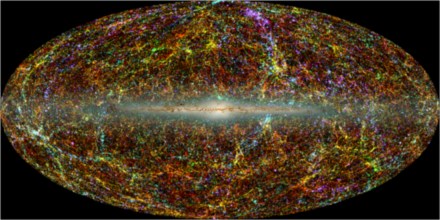
Dark matter was first posited to exist in 1934 by astronomer Fritz Zwicky to explain the strange behavior of visible matter spinning around in galaxies. Since that time, detailed observations and complex computer simulations, like those of the prize-winning cosmologists, have helped pin down exactly how much dark matter is in the universe and how it’s distributed.
Thirty years ago, nobody really knew how matter was distributed in the universe on a large scale. Today we know from observations that matter is distributed in cosmic clumps, chains, and filaments surrounding enormous voids. Results from computer models reproduced these features using slow-moving massive dark matter particles, giving cosmologists confidence that dark matter was indeed a major constituent of the universe.
The map shows two dimensions in terms of celestial longitude and latitude, with a third dimension added by redshift, an indicator of cosmic distance. The map is a culmination of decades of survey work that includes 45,000 galaxies in the local universe.
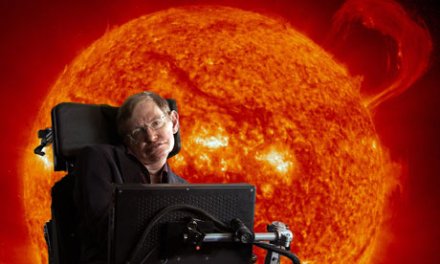
Please excuse the inactivity of the last few weeks. I was busy with extensive travel and work, but am now back to posting on a regular basis. The biggest story to emerge while I was away concerned Stephen Hawking’s comments about the non-existence of heaven and the nature of the human brain. I asked Surak to write a response to this, since he has a particular interest in the monist vs. dualist argument. – Ed.
** Written by “Surak” **
As a human being who often struggles with relatively trivial difficulties in life, I have long felt admiration for Stephen Hawking’s courage and determination to continue working in spite of a highly-debilitating disease. As a physics enthusiast, I have the greatest respect for his accomplishments. But now, as a result of an article published in The Guardian two weeks ago, I also feel embarrassment for, and disappointment in, Hawking. The article reported his views on religion and metaphysics — they were unoriginal, ill-informed, biased, insensitive, and even arrogant.
The article was entitled, “Stephen Hawking: ‘There is no heaven; it’s a fairy story’.” I don’t believe Hawking is capable of such an inane statement, so I attribute this bit of silliness to the reporter’s desire for an attention grabbing headline. It’s just another example of why no one can trust reporters. Unfortunately the rest of the silliness that follows is undoubtedly Hawking’s.
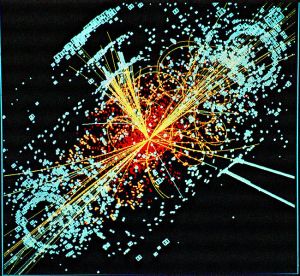
Shhh! Rumor of a signal consistent with the elusive Higgs boson (aka the “God particle”) has been leaked from the LHC. However, a spokesman for CERN has said that it’s “way, way too early” to draw any conclusions from the data.
The Higgs boson is predicted to exist by the Standard Model of particle physics — the prevailing theory governing the organization of subatomic particles — and is supposed to explain how most subatomic particles get their mass. Physicist Peter Higgs, after whom the hypothetical particle is named, gave a formal description of the particle’s properties in a paper in 1966. Over four decades later, this is the first hint that it might actually exist. But as always in science, judgment should be deferred until the evidence is confirmed.
Shuttle flight #134 out of 135 is set to launch this Friday, April 29, when Space Shuttle Endeavour will blast into space for the last time. During its last mission, the Endeavour crew will deliver a special physics instrument to the International Space Station.
The instrument, called the Alpha Magnetic Spectrometer (AMS), is designed to make detections of exotic phenomena that are not observable from the surface of the Earth, including antimatter, dark matter, strangelets, and cosmic ray counts. These are all important for testing various theories and for practical reasons.
Antimatter
Big bang theory requires that equal amounts of matter and antimatter existed in the very early history of the universe. The matter and antimatter would collide and annihilate, producing a burst of energy. The great mystery is why our galaxy and everything we observe appears to be made of matter. Actually, the great mystery is why there is any matter at all, for if there was an equal amount of antimatter, all of it should have been annihilated. Some theories propose a tiny asymmetry, with slightly more matter than antimatter, but these theories raise problems of their own. It is important to determine whether any antimatter still exists in the universe, and this is where AMS comes in. AMS is designed to be highly sensitive to antimatter detections all the way to the “edge” of the observable universe.
Dark Matter
Anyone who has been fortunate enough to view the night sky free from the glow of city lights knows that the sky appears to be awash in stars. It’s tempting to think the entire universe looks this way, but this view is misleading. Our night sky provides a local view of a particularly dense area of the universe, the inside of a galactic disk of stars. Even the lovely visage of seemingly endless galaxies in the Hubble Ultra Deep Field may tempt the viewer into thinking the universe is overflowing with galactic material. The (theoretical) reality is that the vast majority of the “stuff” of the universe can’t be seen at all. In fact, according to the latest results from WMAP, stars and gas make up less than 5% of the total stuff out there. Dark matter is theorized to make up 23% of the total stuff (with dark energy making up the biggest chunk at 72% of the total). Even though it’s supposed to be a major constituent of the universe, dark matter has never been directly detected. AMS will look for neutralinos, the leading candidate for the dark matter particle. Theory predicts that when neutralinos collide, they produce other charged particles and energy, which can be detected by AMS.
Strangelets
One of the great discoveries of particle physics was the quark, the basic building block of matter. “Normal” matter (also called baryonic matter) comprises the familiar things of existence, from people to planets to stars. Normal matter is made of two kinds of quarks, called “up” and “down” quarks, bound together in groups of three. Four other types of quarks — called charm, strange, top, and bottom — were predicted to exist and subsequently discovered in particle accelerators. Some of these quarks are known to combine into other types of hadrons, or heavy particles. One theory predicts that strange quarks may group with up and down quarks to make extremely heavy “strange matter” particles called strangelets. Theory predicts that if strange matter comes into contact with normal matter, it could convert the normal matter into strange matter. AMS is designed to make detections of these strangelets if they do in fact exist.
Cosmic Ray Counts
If we have any hope of sending a manned mission to Mars we will need an accurate measurement for the rate of cosmic rays in our solar system. Cosmic rays are charged particles accelerated to near-light speeds, and they represent a major hazard to astronauts who would be exposed to them in space long term without the protection of the Earth’s atmosphere. AMS will make accurate counts of cosmic rays in the solar system so that scientists and engineers can devise appropriate protection for Mars-bound astronauts.
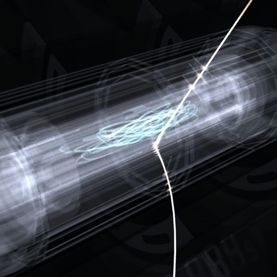
A proton - anti-proton collision at Fermilab provides evidence for the top quark in 1995 (Credit: LBNL)
Physicists at the Tevatron particle accelerator at Fermilab have discovered a strange new signal emerging from proton – anti-proton collisions that is unlike anything seen before. It could be a new kind of particle — and with it, possibly a new kind of fundamental force — or it could be a statistical blip. While the community is excited about the discovery, many physicists are understandably reserved about it until the result is replicated with the Large Hadron Collider.
Whatever it is, the signal is not consistent with a Higgs boson, the elusive “God particle” posited to explain why certain particles have mass. In fact, nobody seems to know what it could possibly be — music to a theorist’s ears. The last major particle discovery made at Fermilab was in 1995 with the top quark, whose existence (together with the bottom quark) was predicted to exist by physicists in 1973.






 SixDay Science