ALMA opens her eyes

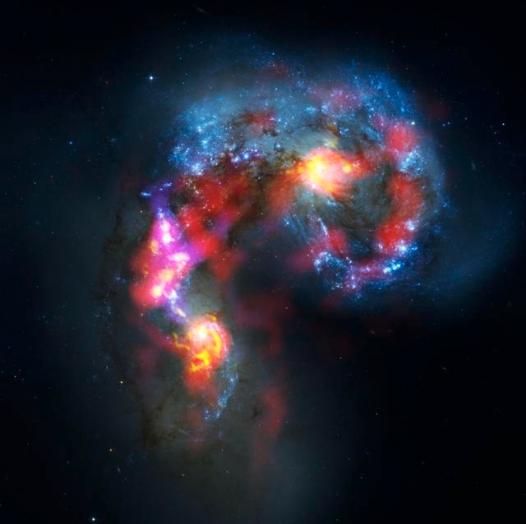
This wow-inducing image was just released by astronomers at the Atacama Large Millimeter/Submillimeter Array, or ALMA, which has finally opened its eyes to the stunning long-wavelength sky. The image, a combination of submillimeter ALMA imaging and optical imaging from the Hubble Space Telescope, shows the stunning Antennae Galaxies — two spiral galaxies in the process of colliding.

The “millimeter/submillimeter” refers to the range of wavelengths of light to which the ALMA instruments are sensitive. Millimeter and submillimeter wavelengths are much longer than the optical wavelengths our eyes detect, and thus can’t be seen by our eyes; but they can be “seen” by ALMA’s instruments, and translated into understandable data, like the image above. Astronomers are keen to observe the sky at these wavelengths, because some important astronomical processes produce light only at these wavelengths, including the births of stars and planets and the fiery birth of our universe.

ALMA is situated at an altitude of more than 16,000 feet on the Chajnantor plain in Chile’s Atacama Desert, the driest desert in the world. This may seem like a strangely inconvenient location for an observatory, but for observational astronomy you want high and dry. This reduces attenuation (dimming) of astronomical light and absorption by molecules in Earth’s atmosphere — mainly CO2, oxygen, and water.

ALMA is currently only partially operational, and not due to be complete until 2013. Once complete, it will have at least 66 radio antennae. Long-wavelength astronomy (this includes radio wavelengths) frequently makes use of arrays, because this is a relatively easy and cost-effective way to simulate a single gigantic antenna. These antennae, or radio dishes, are arranged in a configuration that can be moved in and out to create baselines of different length, essentially allowing the simulated gigantic antenna to change its size.
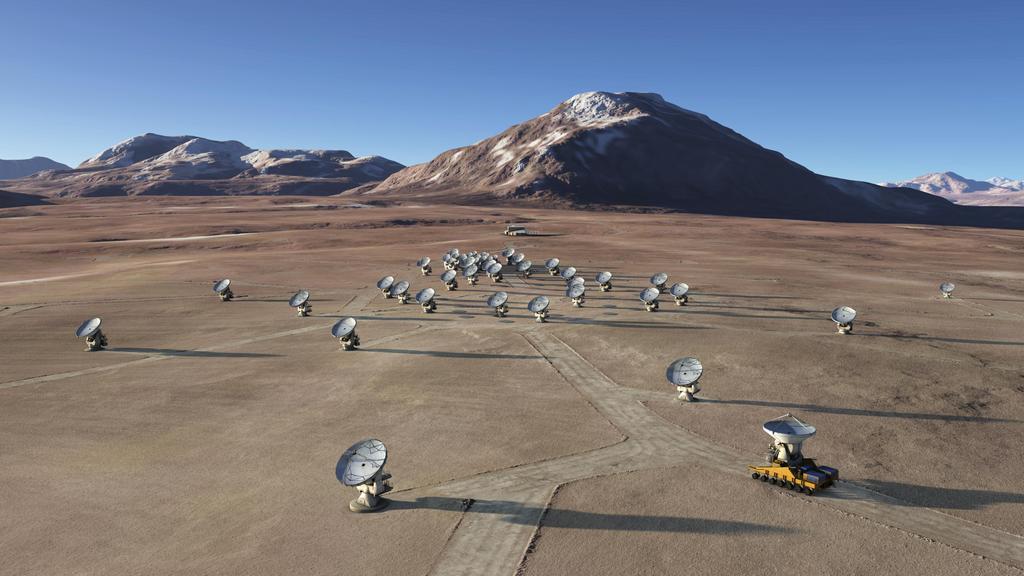
When the baseline of the array is small (~160 m), this allows greater sensitivity for extended sources, such as the Antennae Galaxies shown above. When the baseline is large (16 km), it produces exquisitely fine detail. The length of an array’s baseline typically cycles over a period of several months, as it’s quite a job to move the telescopes in and out.

If any of this seems familiar, it may be that you’ve seen a similar facility in the movie Contact. Some of the movie’s scenes were filmed in the fall of 1996 at the Very Large Array (VLA; soon to be the Extended Very Large Array) near Socorro, New Mexico. The VLA is a sibling of ALMA, whose parent organization is the Virginia-based National Radio Astronomy Observatory.
Continue reading

Astronomers find several new “Super-Earths”

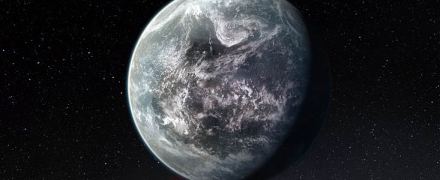
Is our planet alone in its ability to host life? So far, it’s unique in the Solar System, which is dominated by apparently lifeless bodies, but it may not be unique in the universe. Astronomers have long speculated about the presence of extraterrestrial life elsewhere in the cosmos, but thanks to two planet-searching projects — ESO’s HARPS project and NASA’s Kepler mission — they are closer than ever to finding suitable candidate hosts orbiting other stars. Teams for both have announced intriguing discoveries in the last year, the latest of which includes detection by HARPS of a planet that is only 3.6 times the mass of Earth.

While Kepler is a space-based mission that searches for planetary transits — planets periodically passing in front of their host stars — HARPS (High Accuracy Radial velocity Planet Searcher) is part of the land-based La Silla telescope located in the Atacama Desert of Chile. The HARPS spectrograph looks for periodic shifts in the light from stars, tell-tale signs of gravitational tugs by orbiting planets. Most of the planets discovered by Kepler are orbiting distant stars; the planets discovered by HARPS, however, are orbiting nearby stars, and will be much easier to observe in follow-up projects to detect, for instance, spectral signs of water and other substances necessary for life as we know it.

The HARPS team at ESO recently announced the discovery of 50 new extra-solar planets, or exoplanets, including 16 planets designated as “Super-Earths.” A Super-Earth is a planet 2-10 times the mass of the Earth, but not necessarily rocky in composition; such planets could also be gas dwarfs without any discernible solid surface. One of the recently-discovered Super-Earths, designated HD 85512 b, is a rocky planet located just within the habitable zone around its parent star. The habitable zone is the orbital proximity to a parent star that allows the presence of liquid water on a planet’s surface. The holy grail, as it were, of planet searches is an Earth-like planet with the presence of liquid water — the essential ingredient for life as we know it. The mass of HD 85512 b is tantalizingly close to that of Earth — about 3.6 times greater. Professor Dimitar Sasselov, an astronomer at Harvard University (and the scientist who coined the term “Super-Earth”), speculates that such planets may be even better suited for life than our own Earth due to increased tectonic activity and stable rotation.

Astronomers point out that the frequency of exoplanet discoveries is increasing, and we seem to be on the verge of discovering that the universe is awash in potential hosts for life. So what does all this mean for Christians? Personally, I do not rely on the uniqueness of Earth to bolster my belief in a Creator. It may well be that many planets suitable for advanced life exist elsewhere in the universe, and such planets and life would be part of God’s purpose, as the many different continents and the variety of life on Earth are undoubtedly part of God’s purpose. Furthermore, the existence of many potentially life-supporting planets in the vast universe in no way diminishes the power of the fine-tuning argument, which says that the many physical constants and parameters that permit the existence of life as we know it — nearly 100 characteristics as identified by Hugh Ross — are so finely tuned that even the ostensibly atheist astrophysicist, Fred Hoyle, concluded “the universe looks like a put-up job.”

Related posts:

Recommended reading:

Comet Elenin is not a threat to Earth

Comets have historically been regarded as omens, but whether good or bad is not always clear. Halley’s Comet appeared to observers in England in 1066 and was believed to be an omen. Harold II was defeated at the Battle of Hastings later that year, but William the Conquerer prevailed. Bad omen for Harold, good omen for William? In later centuries, Halley’s periodic appearance sometimes coincided with other historically significant events in Christendom, leading some — even prominent Church leaders at the time — to believe that the comet was a harbinger of doom.

We can forgive these people for their superstitions, given how little was known at that time about natural science. But in the 21st century, it is surprising (to me anyway), when so much is known about the natural causes of celestial events and how little physical influence they have on the Earth, that they are still regarded as omens. Take, for instance, the conspiracy theories involving the recently-discovered Comet Elenin. These “theories” mostly seem to predict cataclysmic events on Earth, yet are not based on any of the known facts about Elenin.

Motivated by the strange press surrounding the comet’s appearance, NASA’s Jet Propulsion Laboratory has compiled a list of answers to the most popular questions about Comet Elenin, and explains why it is not a threat to Earth. In short:

  • It is one of many comets that are discovered each year.
  • It is a smallish comet.
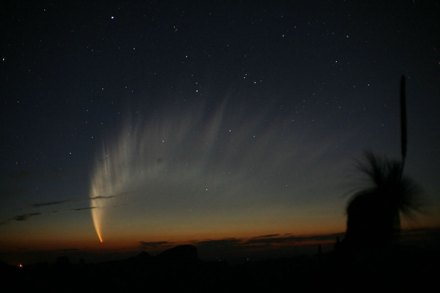
  • It will remain far away. Its closest approach, in mid-October, will bring it 35 million km from Earth — that’s 90 times the distance from the Earth to the Moon. (Ed. note: Comet McNaught, pictured above, came even closer to Earth — 26 million km — in January, 2007.)
  • Its gravitational influence on Earth, even at closest approach, will essentially be zilch.
  • It will not block out any light from the Sun as it passes by.

There is no shortage of genuine disasters — both man-made and natural — that we can worry about. Strike Comet Elenin from the list.

Continue reading

A supercomputer-simulated Milky Way galaxy

Astrophysicists working in California and Zurich have created a virtual Milky Way galaxy using a sophisticated supercomputer simulation that took an astonishing eight months to run.

Even without the need for all that computing time, it’s not easy to create a spiral galaxy. Previous attempts yielded awkward results, but the astrophysicists working on this simulation were able to account for important processes — like supernova winds that push hydrogen gas out of a galaxy and shut down star formation — to produce a galaxy that has the right proportions.

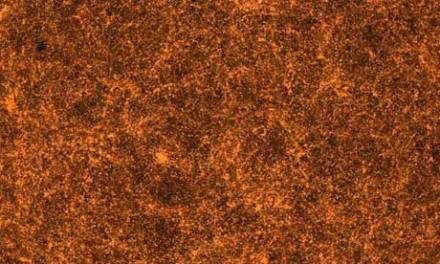
The main challenge was to create the galaxy in the context of current cosmology, which says that the universe is mostly made up of stuff we can’t even see — dark matter and dark energy. Cosmologists (physicists who study the overall structure and evolution of the universe) have calculated what percent of the total ‘stuff’ of the universe is comprised of each major component — visible matter, dark matter, and dark energy. Astrophysicists who study galaxy formation were then tasked with figuring out how to create a Milky Way-like galaxy given these proportions. Here is the model of the universe they were given:

Data from sky surveys, such as the Sloan Digital Sky Survey, show that the universe appears on large scales to be comprised of giant sheets and chains surrounding enormous voids. Galaxies are the visible building blocks of this cosmic web-like structure. Dark matter is posited to be the main gravitational component in creating these sheets and chains, drawing hydrogen gas in to eventually create galaxies. Notice in the simulation how big globs slammed into the galaxy from all directions as it was forming — those were flows of cold hydrogen gas and smaller galaxies crashing into the nascent spiral galaxy.

The following is an excellent (and incredibly beautiful) series of simulations showing the large-scale structure of the universe and how this cosmic web likely formed:

Note: Gpc = gigaparsecs (a billion parsecs); Mpc = megaparsecs (a million parsecs); one parsec = approximately three light-years. (The ‘h’ is a parameter for the Hubble constant, which basically says how fast the universe is expanding. Its value is approximately 1.) The Milky Way is about 100,000 light-years across. The initial scale of the Millenium simulation is therefore HUGE. It’s not until the sim zooms in to the smallest scales that you can discern individual galaxies.

This most recent supercomputer simulation of the Milky Way-like spiral galaxy is a step forward, because it demonstrates that it’s possible to create such a galaxy given the known laws of physics and what we understand about the overall structure of the universe.

Cosmic exclamation mark

Above is a recently released NASA image of two distant galaxies on a collision course. The galaxies, collectively referred to as VV 340 (also Arp 302 and UGC 9618), are 450 million light-years from Earth, and will take millions of years to collide. NASA released an optical image of the cosmic pair taken by the Hubble Space Telescope in 2008. The new image is a composite of an optical image from the Hubble and an X-ray image from the space-based Chandra X-ray Observatory. The X-ray image shows radiation from extremely hot gas (millions of degrees) within the galaxies.

What is apparently striking about this image is that the galaxies form a cosmic exclamation mark. However, celestial sky-writing is nothing new. Below is a cosmic message “written” using a galactic alphabet …

Continue reading

Charcoal-black planet discovered

Astronomers have observed what they believe to be an exceptionally dark planet orbiting a star 750 light-years from Earth. The planet, called TrES-2b, is apparently so dark that it reflects only 1% of the light that reaches it from its parent star. By comparison, the Earth reflects about 30% of the light that reaches it from the Sun. The reflectivity of TrES-2b is so low that it would be outshone by charcoal (reflectivity of 4%).

The new exoplanet was discovered with the Kepler spacecraft, which looks for stars that exhibit periodic dips in the amount of light they shine. These periodic dips are interpreted as the signal of a planet passing in front of its parent star as it orbits. Once Kepler detects such a star, astronomers observe it in greater detail and use the data they collect to calculate properties of the exoplanet candidate, such as mass, radius, orbital distance, surface temperature, and reflectivity.

The data obtained for TrES-2b indicate that it is a “hot Jupiter,” a planet with a mass similar to or greater than Jupiter that orbits very close to its parent star — about 0.02 – 0.5 astronomical units (AU). The orbital distance for TrES-2b is 0.04 AU, far closer to its parent star than Mercury is to the Sun at 0.39 AU. (The Earth orbits the Sun at an average distance of 1 AU, which is about ~150,000,000 km). The close proximity of TrES-2b means its surface temperature is quite high, about 1,000 degrees Celsius, the same as Mercury’s peak temperature on the side facing the Sun.

According to theoretical models of planet formation, a gas giant could not form so close to its parent star, thus astronomers believe that these hot Jupiters form further out in their systems and migrate in over time. Theoretical models that describe the formation of this type of planet predict that they should reflect at least 10% of the light that comes from their parent star, about the same reflectivity as the planet Mercury. The exceptional darkness of TrES-2b has astronomers wondering if their models need to be rethought.

As for what type of substance could cause TrES-2b to be so inky black, astronomers are not sure, but speculate that it could be something exotic.

“Some have proposed that this darkness may be caused by a huge abundance of gaseous sodium and titanium oxide,” [lead astronomer David] Kipping said. “But more likely there is something exotic there that we have not thought of before.

“It’s this mystery that I find so exciting about this discovery.”

Spoken like a true scientist!

Continue reading

New Mars rover will look for signs of liquid water

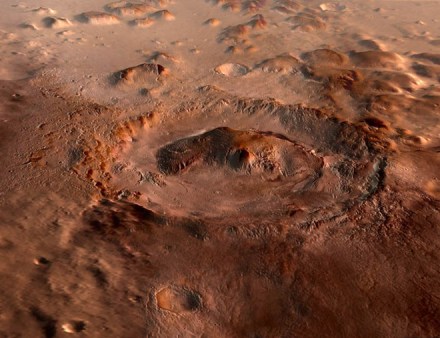
An enhanced-color image of the Gale crater (Credit: NASA/Steven Hobbs)

Scientists at NASA’s Mars Science Laboratory have selected the crater ‘Gale’ as the landing site of the rover, Curiosity, when it visits the Red Planet next year to search for signs of historical liquid water.

This will mark the 15th time the U.S. has visited Mars since it was first photographed by the Mariner 4 orbiter in 19651. Mars is of great interest to scientists, not only because of its proximity to Earth (it’s our second-closest planetary neighbor after Venus), but because the Red Planet has been the subject of intense speculation about the presence of alien life for over 200 years.

Speculation about Martian life started in the late 1700s with German-British astronomers and siblings, William and Caroline Herschel, who observed the Red Planet and noticed that it had some features in common with Earth, including axis tilt, length of day, and seasonal changes in its appearance. Moved by these similarities, William speculated that Mars had inhabitants. From his address to the Royal Society in 1784:

It appears that this planet is not without considerable atmosphere; for besides the permanent spots on the surface, I have often noticed occasional changes of partial bright belts; and also once a darkish one… These alterations we can hardly ascribe to any other cause than the variable disposition of clouds and vapors floating in the atmosphere of the planet… Mars has a considerable but modest atmosphere, so that its inhabitants probably enjoy a situation in many respects similar to our own.

In the late 1800s, Italian astronomer Giovanni Schiaparelli added to this speculation when he observed what he thought were canals on the surface of Mars. Schiaparelli’s observations inspired the construction of the Lowell Observatory in Flagstaff, Arizona to further study the phenomena. Astronomer Percival Lowell, who founded the observatory, became convinced that the canals were signs of advanced, intelligent life on Mars. From there, it wasn’t much of a leap to science fiction stories about Martian life, including H. G. Wells’ dark tale, The War of the Worlds, and C. S. Lewis’ Christian-themed Out of the Silent Planet.

Despite the fervor over possible Martian life, there were astronomers who questioned whether there was any credible visual evidence for the canals. These questions persisted until Mariner 4 was sent to Mars and failed to detect any signs of the infamous canals. Since then, the focus on the search for life on Mars has shifted to evidence for historical, probably much more primitive, forms of life. If such life ever existed on Mars, it would have required the presence of liquid water, which is why scientists are so eager to find signs of the stuff.

Continue reading

Largest ever mass of cosmic water discovered

Turns out water has been present in the universe for most of its history. Astronomers studying a distant quasar — a supermassive black hole actively feeding on gaseous material — detected the presence of water vapor in the cold material surrounding the quasar.

Water vapor has been discovered elsewhere/when in the universe, particularly in water masers emanating from objects as varied as the Saturn system to far-distant galaxies, but this latest observation pushes the earliest detection of water back to a mere 1.6 billion years after the big bang. It’s also the largest mass of water ever discovered — about “140 trillion times more water than all of Earth’s oceans combined.”

Continue reading

Fourth moon discovered around Pluto

Ultraviolet images taken with the Hubble show the location of P4.

Astronomers using the Hubble Space Telescope have discovered another moon orbiting Pluto, joining the ranks of Pluto’s three other known moons. The largest, Charon, was discovered in 1978 at the U.S. Naval Observatory in Flagstaff. The existence of two other moons — Hydra and Nix — was confirmed using the Hubble telescope in 2005. The newly-discovered moon has been given the tentative name P4. (Presumably the discoverers or the IAU will come up with something more interesting once a little more is known about it. I offer ‘Zaphod’ as a candidate. It’s about time we started introducing ephemeral pop culture to outer space.)

Incidentally, Pluto is the only member of the original nine-planet system that has not been explored by an Earth probe; but that will change in 2015 when the New Horizons probe, launched in 2006, flies by to study the dwarf planet and its four (known) moons.

Continue reading