Why do scientists believe in untestable theories?

strings

That is the question being asked by philosophers of science.

Physicists have long relied on a notion advanced by philosopher Karl Popper, that a theory is scientifically valid if it is falsifiable. But in recent years, many serious physicists seem to have abandoned this model. String theory, for example, is one of the most exciting ideas in modern physics. But it’s not testable—so how can physicists be confident that it’s sound?

Physical science is increasingly moving in the direction of accepting ideas that are practically or fundamentally untestable, but, contrary to popular sentiment, the reasons for it are not arbitrary.

According to philosophy of science researcher, Richard Dawid, there are three reasons a physicist will believe in an untestable theory:

  1. the theory is the only game in town; there are no other viable theories.
  2. the theoretical research program has produced successes in the past.
  3. the theory turns out to have even more explanatory power than originally thought.

Any of these arguments by themselves is not enough to convince a physicist that an untested theory has merit, but all three together are pretty powerful. That said, this powerful combination still doesn’t replace empiricism as the gold standard for determining scientific truth. It’s as though we’re circling back to the protoscientific methodology of the ancient Greeks, who relied on thought experiments, because they mistrusted experience. While it’s true that our perceptions can be subjective, the history of science clearly points to the superiority of thought + empiricism over thought alone.

My personal opinion as to why a lack of empirical support in science seems to matter less and less is that the empirical nature of physical science is rooted in Christianity, and science is increasingly divorced from its Christian roots. I’ll discuss this more next week.

Image credit: String Theory II by Digital Blasphemy 3d Wallpaper

Fire Back: Where the Readers Respond

In which we discuss an atheist’s not-so-clever attempt to dismiss the Argument from Contingency and the Kalam Cosmological Argument.

JB is arguing science and faith with an atheist friend and asked for help with the science. JB’s friend sent him a link to “Arizona Atheist,” who attempts to refute two of William Lane Craig’s arguments for God’s existence. Despite AA’s bold claim to have “demolished” Craig’s arguments, it’s such a weak and muddled attempt that it hardly seems worth commenting on. However, since it’s frequently cited by those seeking to refute Craig’s arguments, I’ll get into it.

Arizona Atheist comments first on Craig’s Argument from Contingency:

1. Everything that exists has an explanation of its existence, either in the necessity of its own nature or in an external cause.
2. If the universe has an explanation of its existence, that explanation is God.
3. The universe exists.
4. Therefore, the universe has an explanation of its existence (from 1, 3).
5. Therefore, the explanation of the universe’s existence is God (from 2, 4).

Now this is a logically airtight argument. That is to say, if the premises are true, then the conclusion is unavoidable. It doesn’t matter if we don’t like the conclusion. It doesn’t matter if we have other objections to God’s existence. So long as we grant the three premises, we have to accept the conclusion. So the question is this: Which is more plausible–that those premises are true or that they are false?

Since the logic is airtight, the only way to attack the argument is to show that any of its premises are wrong. AA goes after Premise 1:

According to modern physics, however things can seemingly happen without cause. There are several things we observe that appear to have no cause. For example, “[w]hen an atom in an excited energy level drops to a lower level and emits a photon, a particle of light, we find no cause of that event. Similarly, no cause is evident in the decay of a radioactive nucleus.”

This is a very weak attack on Premise 1, for two reasons:

  1. Just because we find no cause doesn’t mean there is no cause. AA tacitly acknowledges this with hedge words like “seemingly” and “evident.”
  2. AA has misunderstood the argument. The Argument from Contingency doesn’t address events, it addresses existence. The photon exists, and it has a cause — an electron in an atom dropping from a higher energy level to a lower energy level. The products of radioactive decay exist, and they also have a cause — radioactive decay of a nucleus.

Next, AA goes after the Kalam Cosmological Argument:

1. Everything that begins to exist has a cause.
2. The universe began to exist.
3. Therefore, the universe has a cause.

The Kalam Cosmological Argument is similar to the Argument from Contingency, but differs in that it rests on the “controversial” nature of Premise 2. It’s only controversial in the sense that you can sort of dispute the standard interpretation of big bang cosmology if you accept some strange assumptions. AA therefore mostly goes after Premise 2, but not before first dismissing Premise 1, again on the false basis that “things can seem to happen without cause.” Note the weasel words “can seem to.”

AA then goes on to attack Premise 2 in one of the most desperately feeble attempts to dismiss reason and evidence I have ever seen. (Why are atheists constantly held up as champions of reason? I have seen no evidence that this stereotype is warranted.)

Craig supports the validity of Premise 2 with both philosophical and scientific arguments against an infinitely old universe. For the latter, he cites work by theoretical physicist Alexander Vilenkin, who figures prominently in AA’s refutation.

AA awkwardly begins his refutation by stating,

Again, as I’ve said already, just because Craig can’t imagine an infinite universe doesn’t mean it’s impossible. Simply arguing that it’s impossible without any proof is no argument.

Craig rejects an infinitely old universe, not because of a lack of imagination, but because it’s ruled out by physics. At this point, AA needed to show in what way Craig’s philosophical argument for Premise 2 is flawed, or to provide evidence contradicting it, but he doesn’t do this. Instead, he supplies an irrelevant quote from Vilenkin and dismisses the interpretation that Premise 3 implies the cause is necessarily God*.

Now for the part where AA completely abandons any reasonable standard for evidence and reason. The prevailing paradigm of modern physics is that the universe began to exist between 11 and 17 billion years ago in a sudden event called the big bang. There is loads of evidence for the big bang, which is why virtually no one believes the steady-state cosmological model anymore. Now, even though the standard interpretation has been that the big bang represents the creation of the universe from complete and total nothing, there’s a wrinkle: in actuality, it’s not entirely clear what sort of a beginning the big bang represents. In spite of the evidence supporting the big bang, there is a limit to what we can know about it. As physicist Alan Guth put it, the big bang theory “gives not even a clue about what banged, what caused it to bang, or what happened before it banged.”

AA rests his entire case against the Kalam Cosmological Argument on this wrinkle, even after Vilenkin’s commentary should have convinced him otherwise.

Vilenkin is an author of a physical theorem that rules out past-infinite universes. We have every reason to believe the universe has a finite age. But does this necessarily imply a beginning? In a correspondence AA initiated between Vilenkin and the late atheist physicist, Victor Stenger, Vilenkin comments that his theorem does not prove that the universe must have had a beginning, however…

…it proves that the expansion of the universe must have had a beginning. You can evade the theorem by postulating that the universe was contracting prior to some time.

First of all, it doesn’t disprove that the universe had a beginning. Second, what this essentially means is that the big bang could represent, not the beginning, but one of many “beginnings.” If the universe is cyclical, that is, if it bangs and expands and then contracts and crunches, and does this over and over for eternity, then the universe is effectively eternal, and this is what supposedly negates Premise 2.

That could kind of, sort of, maybe present a very weak argument against Premise 2 — its chief drawback being that not only is there no evidence for it, there is no known way to test it — except that AA inexplicably goes on to quote Vilenkin stating that it also happens to be theoretically impossible given what we assume about the nature of time, and that even if we grant that something very weird happens at time = 0 to allow a contracting universe, it still effectively supports Premise 2:

This sounds as if there is nothing wrong with having contraction prior to expansion. But the problem is that a contracting universe is highly unstable. Small perturbations would cause it to develop all sorts of messy singularities, so it would never make it to the expanding phase. That is why Aguirre & Gratton and Carroll & Chen had to assume that the arrow of time changes at t = 0. This makes the moment t = 0 rather special. I would say no less special than a true beginning of the universe.

So, AA’s refutation of Premise 2, his “demolishment” of the Kalam Cosmological Argument, rests not on the standard, accepted interpretation of modern cosmology — that the universe began to exist billions of years ago — but on the untested, unproved possibility that Vilenkin’s theory is wrong, that you can somehow get around a beginning, but at the cost of accepting something that is “no less special than a true beginning of the universe.”

I’m genuinely confused by AA’s response to Vilenkin’s comments. How much do you have to hate evidence and reason to read Vilenkin’s responses to these questions about his theorem and still conclude that it supports your case?

Having gone through this exercise, the absolute worst you can say about the Kalam Cosmological Argument is that Premise 2 is not 100% proven. But we already knew that. If you know anything at all about how science works, you know that nothing in science is a done deal — you can’t ever prove beyond doubt that any scientific theory is true — which is why Craig says “that for an argument to be a good one the premises need to be probably true in light of the evidence.” That is the standard by which all of modern science has operated for centuries. For something to be considered “true,” it only needs to be probably true based on a preponderance of evidence to support it and with no evidence to seriously contradict it. By this standard, it is true that our universe began to exist 13.8 billion years ago — which means we are reasonably assured Premise 2 is true, and therefore the Kalam Cosmological Argument is a legitimate argument. Given the weight of evidence and reason, it is far more supported than an untested — and untestable — theoretical exercise in exploring alternatives.

AA says he does not think philosophy is the best way to get at the truth; it’s reasonable to assume that he thinks science is, and yet he does his best to ignore it to avoid accepting the conclusions of two very powerful arguments in favor of God.

Incidentally, two years after AA posted his attempted refutation of Craig’s arguments, Vilenkin announced, at Stephen Hawking’s 70th birthday celebration, that there is just no getting around a beginning for the universe.

—–

* I don’t know what Vilenkin’s arguments are against Premise 3 implying the cause is necessarily God, but there is a case, however weak, to be made on the basis of an eternally expanding and contracting model of the universe. If it’s correct, it renders God superfluous. However, not only is this model theoretically unlikely, it’s physically untestable.

Astronomy in a nutshell


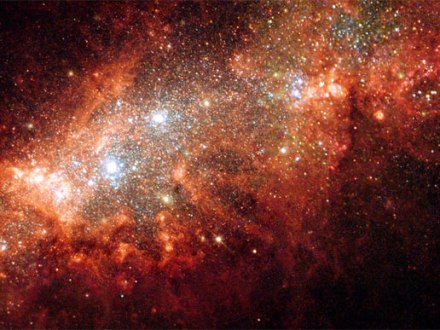
ngc1569

If a flea paused in his epic journey through
the weave of the homespun trews of an ale-sodden
Hebrides husbandman, and bent its thoughts on the
grand design of the cloth, striving to grasp not just
the mechanics of the warp and weft of the loom,
but the overarching vision of the weaver, would
you be surprised?

If a single note in a symphony, battered and whirled
by woodwinds and violins, paused for a heartbeat
to consider and assemble a vision, not just of
the entire piece of music, but the conductor and
composer behind the oeuvre, would that raise an
eyebrow?

Yet, astronomers, the carbon of their cellular
structures the product of some helpless exploding star
aeons ago, look out upon the entire cosmos, and ponder:
niggling away at countless points of light, in
search of a reason for every detail of its component
weave of light and sound; every aspect of its overall
structure bent by their basilisk gaze. All the while,
swept along willy-nilly on a tiny dust-mote planet,
scorched by an incandescent sun, gnawing on other
carbon life-forms for their sustenance, and quenching
their thirst with dihydrogen monoxide and knowledge
(and maybe beer as well).

The cosmos, looking down on this, can only gasp in
amazement at the unmitigated intrepidity, the
sheer audacity, of these tiny beings and their
grandiose goals and dreams. And that courage, that
vision, in a nutshell, is astronomy.

— G. P. Orris

Dwarf galaxy NGC 1569 image credit: NASA/Hubble

There is no modern science without Christianity

How often do you hear that Christianity is not compatible with science? The next time you hear that claim, refer the critic to this list of Christians in science and technology and ask how it’s possible that so many Christians were able to make significant contributions to science and tech in spite of that incompatibility:

John Philoponus
Bede the Venerable
Rabanus Maurus
Leo the Mathematician
Hunayn ibn Ishaq
Pope Sylvester II
Hermann of Reichenau
Hugh of Saint Victor
William of Conches
Hildegard of Bingen
Robert Grosseteste
Pope John XXI
Albertus Magnus
Roger Bacon
Theodoric of Freiberg
Thomas Bradwardine
William of Ockham
Jean Buridan
Nicephorus Gregoras
Nicole Oresme
Nicholas of Cusa
Otto Brunfels
Nicolaus Copernicus
Michael Servetus
Michael Stifel
William Turner
Ignazio Danti
Giordano Bruno
Bartholomaeus Pitiscus
John Napier
Johannes Kepler
Galileo Galilei
Laurentius Gothus
Marin Mersenne
René Descartes
Pierre Gassendi
Anton Maria of Rheita
Blaise Pascal
Isaac Barrow
Juan Lobkowitz
Seth Ward
Robert Boyle
John Wallis
John Ray
Gottfried Leibniz
Isaac Newton
Colin Maclaurin
Stephen Hales
Thomas Bayes
Firmin Abauzit
Emanuel Swedenborg
Carolus Linnaeus
Leonhard Euler
Maria Gaetana Agnesi
Joseph Priestley
Isaac Milner
Samuel Vince
Linthus Gregory
Bernhard Bolzano
William Buckland
Agustin-Louis Cauchy
Lars Levi Læstadius
George Boole
Edward Hitchcock
William Whewell
Michael Faraday
Charles Babbage
Adam Sedgwick
Temple Chevallier
John Bachman
Robert Main
James Clerk Maxwell
Andrew Pritchard
Arnold Henry Guyot
Gregor Mendel
Philip Henry Gosse
Asa Gray
Francesco Faà di Bruno
Julian Tenison Woods
James Prescott Joule
Heinrich Hertz
James Dwight Dana
Louis Pasteur
George Jackson Mivart
Armand David
George Stokes
George Salmon
Henry Baker Tristram
Lord Kelvin
Pierre Duhem
Georg Cantor
Henrietta Swan Leavitt
Dmitri Egorov
Mihajlo Idvorski Pupin
Pavel Florensky
Agnes Giberne
J. J. Thomson
John Ambrose Fleming
Max Planck
Edward Arthur Milne
Robert Millikan
Charles Stine
E. T. Whittaker
Arthur Compton
Ronald Fisher
Georges Lemaître
Otto Hahn
David Lack
Charles Coulson
George R. Price
Theodosius Dobzhansky
Werner Heisenberg
Michael Polanyi
Henry Eyring
Sewall Wright
William G. Pollard
Aldert van der Ziel
Mary Celine Fasenmyer
John Eccles
Carlos Chagas Filho
Sir Robert Boyd
Richard Smalley
Mariano Artigas
Arthur Peacocke
C. F. von Weizsäcker
Stanley Jaki
Allan Sandage
Charles Hard Townes
Ian Barbour
Freeman Dyson
Richard H. Bube
Antonino Zichichi
John Polkinghorne
Owen Gingerich
John T. Houghton
Russell Stannard
R. J. Berry
Gerhard Ertl
Michał Heller
Robert Griffiths
Ghilean Prance
Donald Knuth
George Frances Rayner Ellis
Colin Humphreys
John Suppe
Eric Priest
Christopher Isham
Henry F. Schaefer, III
Joel Primack
Robert T. Bakker
Joan Roughgarden
William D. Philips
Kenneth R. Miller
Francis Collins
Noella Marcillino
Simon Conway Morris
John D. Barrow
Denis Alexander
Don Page
Stephen Barr
Brian Kobilka
Karl W. Giberson
Martin Nowak
John Lennox
Jennifer Wiseman
Ard Louis
Larry Wall
Justin L. Barrett

Nobel laureates are highlighted in red.

roger-bacon-statue

Be sure to emphasize that it was Roger Bacon, a Franciscan monk, who originated the scientific method, and was thus the first modern scientist.

If the critic has any response to this at all, it will likely be to wave his hand and respond that it is in spite of their professed Christian faith that they made their contributions. This is simply untrue; and while it’s not surprising that a critic of Christianity would be ignorant of both this list and of Christianity’s part in the development of modern science, it’s very surprising — to me, anyway — that Christians likewise tend to be ignorant of these facts.

The first time I showed this list to a Christian audience during one of my lectures, there was an audible gasp. Most Christians are not only unaware that the claim of incompatibility is flatly false, but that the long list of Christians in science and technology is a testament to the fact that modern science is a direct product of the Christian faith.

I’ll say it again: Not only is science fully compatible with Christianity, it is extremely doubtful that we would have modern science without Christianity.

Entire volumes have been written on this topic, but the claim essentially rests on two beliefs. There could never be modern science without:

1. the counterintuitive notion of linear time, which was inferred from the Bible by St. Augustine in the 4th century.

2. belief in a deliberately ordered and knowable creation by a rational being (Genesis 1; Psalm 19; Proverbs 8:22-24; Romans 1:20; many more). C. S. Lewis, in his critique of atheist rationality in The Case for Christianity, explained it this way:

Supposing there was no intelligence behind the universe, no creative mind. In that case, nobody designed my brain for the purpose of thinking. It is merely that when the atoms inside my skull happen, for physical or chemical reasons, to arrange themselves in a certain way, this gives me, as a by-product, the sensation I call thought. But, if so, how can I trust my own thinking to be true? It’s like upsetting a milk jug and hoping that the way it splashes itself will give you a map of London. … Unless I believe in God, I cannot believe in thought…

In contemporary terms, this is called the Boltzmann brain idea, which effectively says, in the absence of a conscious creative force, it is statistically much more probable that we are simply “brains in vats” hallucinating these experiences than that we actually inhabit a highly ordered universe. In other words, you have to have faith that even your perceptions and thoughts are accurately reflecting a reality that operates according to non-arbitrary and knowable rules. That’s a given in Christianity, but there is no reason to believe otherwise if you don’t believe in a rational conscious creative force behind the universe.

While it could be argued, in principle, that perhaps the following point is not absolutely necessary for the development of modern science, it nevertheless played a significant role:

3. belief that we must test everything (1 Thessalonians 5:21) and that we must study the natural world to better understand the character and purpose of God (Psalm 19; Romans 1:20). Mitch Stokes, in his biography of Isaac Newton, observed the following about Newton and his contemporaries:

For Newton, “To be constantly engaged in studying and probing into God’s actions was true worship.” This idea defined the seventeenth-century scientist, and in many cases, the scientists doubled as theologians.

Personally, I think it’s extremely doubtful that modern science could have emerged without this third principle, but I’ll save this for a later post.

One of the greatest achievements of modern atheism has been to divorce Christians from their scientific legacy. Modern science is one of the crowning achievements of Western civilization, built upon the foundation of Christian faith, belief, and purpose. But how many Christians are aware of this? Instead of questioning the source, many Christians have willingly accepted the lie that Christianity and science are mutually incompatible. This is the classic mistake of accepting an adversary’s frame. Christians must reject it by educating themselves on the history of their faith and the great part it played in the development of modern science.

Science is a guide to understanding scripture

Reader xdpaul makes the following observation in the comments to the article on pre-Adam hominids:

One of the problems with relying on surviving Christian texts only is that even the most learned of them were a) not native masters of Hebrew b) reliant in the primary on Greek translations of Hebrew and c) not typically focused on man’s origins.

Thus, if you only rely on the very occasional Christian theologian viewpoint on origins, you may very end up short of even the limits of Ussher.

I get emails and comments from people criticizing Schroeder’s interpretation of scripture by insisting that he does not faithfully follow a literal interpretation of scripture, and furthermore we shouldn’t bother trying to “shoehorn” science into scripture. What they mean is that Schroeder doesn’t follow their literal interpretation of scripture. These critics almost always assume that the particular interpretation they personally favor is the only legitimate one, and fail to realize (or acknowledge) that there are significant translation issues with even some of the most widely accepted interpretations.

In any attempt to understand Genesis, we have to account for the fact that it was translated from ancient Hebrew to seventeenth century English and then interpreted according to modern Western, English-speaking sensibilities. This modern, Western point of view not only misses important subtleties in the Hebrew language, but often neglects subtleties in scriptural and historical context. As xdpaul points out, the problem is that the English translators were not native masters of Hebrew, nor were they focused on the deeper scientific meaning of Genesis. Schroeder, however, is, and he relies heavily on commentaries from the three most highly-regarded Jewish scholars — Rashi, Nahmanides, and Maimonides — all of whom were masters in Hebrew and spent decades intensely studying the Torah to discover its meaning. In my opinion, it’s foolishness to disregard these commentaries.

Even then, armed with insights from deep scholarship about the Torah, how do we know we’re on the right track when interpreting Genesis? We can gain some assurance through God’s revelation in the natural world he created. We were given a written account of this creation, but along with that came the admonishment to look for evidence of God’s character within it (Psalm 19; Romans 1:20). For this reason, it bothers me deeply that many well-meaning Christians insist on pitting God’s written record against God’s record in nature. They are complementary, and we are told as much in scripture. These two records should agree; they must agree. And where there is ostensible disagreement, that is the opportunity to gain a deeper understanding of both.


Fire Back: Where the Readers Respond

In which we discuss the ensoulment of a pre-existing hominid with the creation of Adam.

Andrew enjoyed my Six Day slideshow, but took issue with the claim that God chose a pre-existing hominid and breathed a soul into it to create Adam:

Genesis 2 describes a created man formed from dust that God subsequently breathed into his nostrils the breath of life and the man became a living creature. As I read that, I understand that to say there was a man formed out of dust in order to be created for the specific purpose of making us in His image. I agree that our spiritual identity is truly what defines us as in His image, but I stop at the notion that there were physical human beings identical to Adam beforehand that he simply ‘utilized’. As Genesis 2 documents the account, God didn’t go looking around to select some pre-soul ‘animalized’ version of a man that had already been created and arbitrarily deemed him fit to put a soul (the image of God) into him.

For those who haven’t gone through it, my slideshow is based on Gerald Schroeder’s bestselling book, The Science of God. Schroeder does not claim that a man was ‘animalized’; that’s a misleading term. Animal is the initial state of man, followed by ensoulment, and it is ensoulment that transforms him from animal to human being.

Now, do we know for certain from the Genesis 2 account that God didn’t select a pre-soul version of a man for Adam? Schroeder explains that, according to the great Torah commentators and some leading Jewish theologians, there is room for that interpretation. It hinges on two things:

1. The distinction between “making” and “creating” in Genesis. The former means to form something out of preexisting material; the latter means to bring something into existence that did not exist before. From Chapter 9 of Schroeder’s The Science of God:

The fact that Adam was first “made” (Gen. 1:26) and only later “created” (Gen. 1:27) informs us unequivocally that some amount of time passed during which Adam was fashioned. The neshama was implanted only after that vessel was complete. Whether that time was measured in microseconds or millions of earth years is not certain from the text. What is certain is that the making of Adam’s body was not instantaneous and that its making preceded the introduction of the neshama. Making takes time. The ultimate change from the final form into human was instantaneous, the creation of the neshama.

2. A subtlety in the text that is overlooked in English translations of the Bible. From the same chapter:

The closing of Genesis 2:7 has a subtlety lost in the English. It is usually translated as: “… and [God] breathed into his nostrils the neshama of life and the adam became a living soul” (Gen. 2:7). The Hebrew text actually states “… and the adam became to a living soul.” Nahmanides, seven hundred years ago, wrote that the “to” (the Hebrew letter lamed prefixed to the word “soul” in the verse) is superfluous from a grammatical stance and so must be there to teach something. … He concludes his extensive commentary on the implications of this lamed as: “Or it may be that the verse is stating that [prior to receiving the neshama] it was transformed into another man.”

Another man! According to Nahmanides, who is the major kabalistic commentator on the Bible, the biblical text has told us that before the neshama there was something like a man that was not quite a human.

Maimonides also comments on the soulless man. In Part I, Chapter VII of his book, The Guide for the Perplexed — written over 800 years ago, long before he could have been influenced by modern science — he describes the sons of Adam who came after Cain and Abel, but before Seth:

Those sons of Adam who were born before that time were not human in the true sense of the word, they had not “the form of man.” With reference to Seth who had been instructed, enlightened and brought to human perfection, it could rightly be said, “he (adam) begat a son in his likeness, in his form.” It is acknowledged that a man who does not possess this “form” (the nature of which has just been explained*) is not human, but a mere animal in human shape and form.

* In Chapter I, Maimonides explains that “form” means “essence.” Adam’s essence was that which made him distinctly human — the neshama. In other words, the pre-Seth sons lacked a soul. These are the sorts of “mere animals” that would have preceded Adam, and into which God breathed a human soul to create the first human.

Fire Back: Where the Readers Respond

In which we discuss the differences between religions and cults.

NVH, an atheist, asks:

What’s the difference between religions and cults? Aren’t they the same thing?

When I think of cults, I tend to think of Scientology or Heaven’s Gate or the Rajneeshees in Oregon back in the 1980s. These groups seem outwardly rather kooky to most of us, but the question of what really distinguishes them from traditional religion is a legitimate one, especially considering that at least some traditional religions were initially considered very strange by the larger culture (think Christians and Romans). There are similarities between religions and cults — and cults can form within religions — so it can get confusing, but there are three key ways to distinguish between the two. We’ll compare Christianity specifically with cults in general to demonstrate, since that was the context of NVH’s question.

Let’s first look at the similarities:

Christianity explains:

  • the origin of the universe
  • the origin of human life
  • the meaning of life
  • why things are the way they are / how the world works
  • what’s going to happen in the future.

Cults attempt to explain the same things as Christianity or any other religion.

The first key difference is in their truths; in other words, how the explanations are presented. Let’s look at the differences between truths in Christianity and cults.

Christianity’s claimed truths are:

  • often evident in nature, the world, and ourselves; one can arrive at a basic understanding of most of these truths through observation, experience, and reasoning
  • consistent with what we observe in the world
  • preached openly by prophets, who were messengers of God; most were unwilling and/or faced opposition or martyrdom for preaching these truths
  • freely available to everyone.

Cults claimed truths are:

  • often not at all evident in nature, the world, and ourselves; one can only arrive at these truths through special revelation (see third and fourth items below)
  • at best speciously consistent with what we observe in the world, and at worst not consistent at all
  • revealed under special circumstances by spiritual leaders who have exclusive access to a special knowledge of reality; most actively seek to gain adulation, power, and fortune
  • available only to a select group through special revelation by the spiritual leader.

The second key difference is earthly goals and rewards promised by religions and cults.

Goals and rewards of Christian faith:

  • salvation
  • redemption / reconciliation with God
  • eternal life in the new world.

Goals and rewards of cult devotion:

  • material improvement and advancement in this life and/ or
  • greater power or improved status in the next life.

The third key difference is in how these goals and awards are achieved.

How to achieve the goals and merit the rewards of Christian faith:

  • you can’t achieve the goals on your own
  • you will never merit the rewards
  • simply accept that God will grant you these things through Jesus Christ.

How to achieve the goals and merit the rewards of cult devotion:

  • rituals
  • good works
  • payment or other sacrifice to the spiritual leader.

This is what makes Christianity not only distinct from modern cults, but unique amongst traditional religions. I came to Christian faith, despite virtually no contact with traditional religion growing up, through the evidence in nature and the world. That’s straight out of Psalm 19 and Romans 1:20. Ever since, I’ve devoted this ministry to explaining how the truth of Christianity is:

  • often evident in nature, the world, and ourselves; one can arrive at most of these truths through observation, experience, and reasoning
  • consistent with what we observe in the world.

If you’re wondering how, a good place to start is my presentation on the Six Days of Genesis and my comparison of Genesis 1 and Modern science.

Demolishing atheist arguments — clarification on the Third Way

This is a follow-up to Russell’s guest post about Aquinas’ Five Ways. Following a vigorous discussion in the comments, he wanted to clarify his commentary of the Third Way.

My apologies, I’ve muddled up the Third Way a bit here. Let me try it again and unmuddle. If you aren’t satisfied, I’ll double your money back.

The Third Way

The third way is taken from possibility and necessity, and runs thus. We find in nature things that are possible to be and not to be, since they are found to be generated, and to corrupt, and consequently, they are possible to be and not to be. But it is impossible for these always to exist, for that which is possible not to be at some time is not. Therefore, if everything is possible not to be, then at one time there could have been nothing in existence. Now if this were true, even now there would be nothing in existence, because that which does not exist only begins to exist by something already existing. Therefore, if at one time nothing was in existence, it would have been impossible for anything to have begun to exist; and thus even now nothing would be in existence – which is absurd. Therefore, not all beings are merely possible, but there must exist something the existence of which is necessary. But every necessary thing either has its necessity caused by another, or not. Now it is impossible to go on to infinity in necessary things which have their necessity caused by another, as has been already proved in regard to efficient causes. Therefore we cannot but postulate the existence of some being having of itself its own necessity, and not receiving it from another, but rather causing in others their necessity. This all men speak of as God.

The words ‘possibility’ and ‘necessity’ have be used in the context of Aquinas’ time.

‘Possibility’ is used in the Aristotelian sense, that is, the hylemorphic composite nature of something that can possibly be and not to be. This nature is inherent. Whatever form something has now, if it has hylemorphic nature, it will fail to exist in that form given enough time. It lacks the potential for indefinite existence.

By ‘necessity,’ he means the opposite of possibility: something that by its nature is everlasting, it cannot cease to exist no matter how much time passes. It cannot change into something it is not. By its very nature, for example, it cannot become contingent.

Aquinas’ argument starts with establishing the fact that if the hylemorphic somethings of the Universe, be it an entity or an action or a cause or an event or whatever, at some point, given infinite time, never existed, and, again, given infinite time, all things would have never existed, and we wouldn’t be here arguing about why we are here.

He says that’s absurd, and, because we are here, something has to have Necessary Being, which means something that exists is non-temporal and non-contingent. Here he uses being to mean being as existence and as a supreme being that men call God, “I am that I am,” which is of itself Being. He uses being not as one being among other beings, but being qua being. I’m not an expert in Latin, but the tricky passage is here: Ergo necesse est ponere aliquid quod sit per se necessarium, non habens causam necessitatis aliunde, sed quod est causa necessitatis aliis, quod omnes dicunt Deum. Sit per se isn’t complete by itself, so we have to look at necessarium, as well, and that all roughly translates into being as an abstract which has its own necessity, its own everlastingness.

It’s this Necessary Being that sustains all Possible things.

So, Aquinas’ argument then takes care of the Universe always existing, the Universe contracting and expanding forever, and multi-universes for the same reason.

I hope this has unmuddled what I had muddled. Amateur philosophers, sheesh!

Another point is that these Ways are not empirical, scientific proofs, but metaphysical demonstrations. That means none of his arguments are tied to past, current, or future scientific knowledge, because they don’t rest on empirical evidence.

Fire Back: Where the Readers Respond

In which we discuss Everettian multiverses and faith.

DW writes

It was a pleasure encountering your blog, and reading through some of your writings. Your story of your encounter with and transformation by faith in Christ was genuinely inspiring.

I would gently push back on a single thread of thought, one I encountered in your witness on James Bishop’s blog. You talk at some length about the Everettian multiverse, a concept that has been seized upon by anti-theists as “proof” that God neither exists nor is necessary for existence.

Whether a quantum branching multiverse is “theory” at all in the scientific sense is open for debate, but I’d like to suggest…as a practicing practical theologian…that multiversal cosmologies are not inherently antithetical to Christian faith. They are also, for atheism, something of an own goal.

An Everettian multiverse refers to the Many Worlds Interpretation of quantum mechanics developed by the late physicist, Hugh Everett. Everett essentially said that the seemingly probabilistic nature of the quantum world is explained by every possibility actually playing out in different universes.

DW is right that the multiverse cosmologies are not inherently antithetical to Christian faith. RTB’s resident astrophysicist, Jeff Zweerink, discusses this a little in his booklet, Who’s Afraid of the Multiverse? DW offered to send me something he’s written on the topic, so I’m curious to see what he means by the multiverse being an ‘own goal’ for atheism.

As I’ve said repeatedly, the main scientific problem with the multiverse hypothesis is that it is not science, it is science-flavored. It suffers from one insurmountable scientific problem, which is that there is no way to test it, since every universe in the multiverse is causally disconnected from every other universe. That doesn’t mean it isn’t an interesting topic for scientific discussion, since the existence of a multiverse is intriguingly hinted at by some physical theories.

The theological/philosophical dimension is also worth exploring, as it emphasizes the difference between a God-created multiverse and a godless one. As much as some atheists cling to the latter as a comforting alternative to the former, what it actually represents is the end of all hope.

Hugh Everett was a brilliant scientist, but he was also at least partially motivated by his desire for immortality when developing his Many Worlds model. This goes to show, despite claims to the contrary, that atheists can be as emotionally driven in their philosophies as anyone else. That’s not to say it was an unreasonable motivation; I mean, who could blame the man? He knew his godless worldview strongly implied he’d eventually be annihilated by an indifferent universe. It’s a terrifying thing to contemplate. However, a godless multiverse is no better — and in my opinion, considerably worse — than being snuffed out for all eternity by an indifferent universe. If there is an eternal multiverse that wasn’t created by God, then we are all doomed to either pointlessly repeat the same life over and over for eternity or to live out every possibility, which includes an infinite number of both pointlessly enjoyable and pointlessly miserable existences. It is only with a personal Creator that existence has any purpose and any meaning.