Sorry, I got nothin’. Meanwhile, here’s one of Ralph McQuarrie’s concept masterpieces for The Empire Strikes Back. Click on the image for the full version.
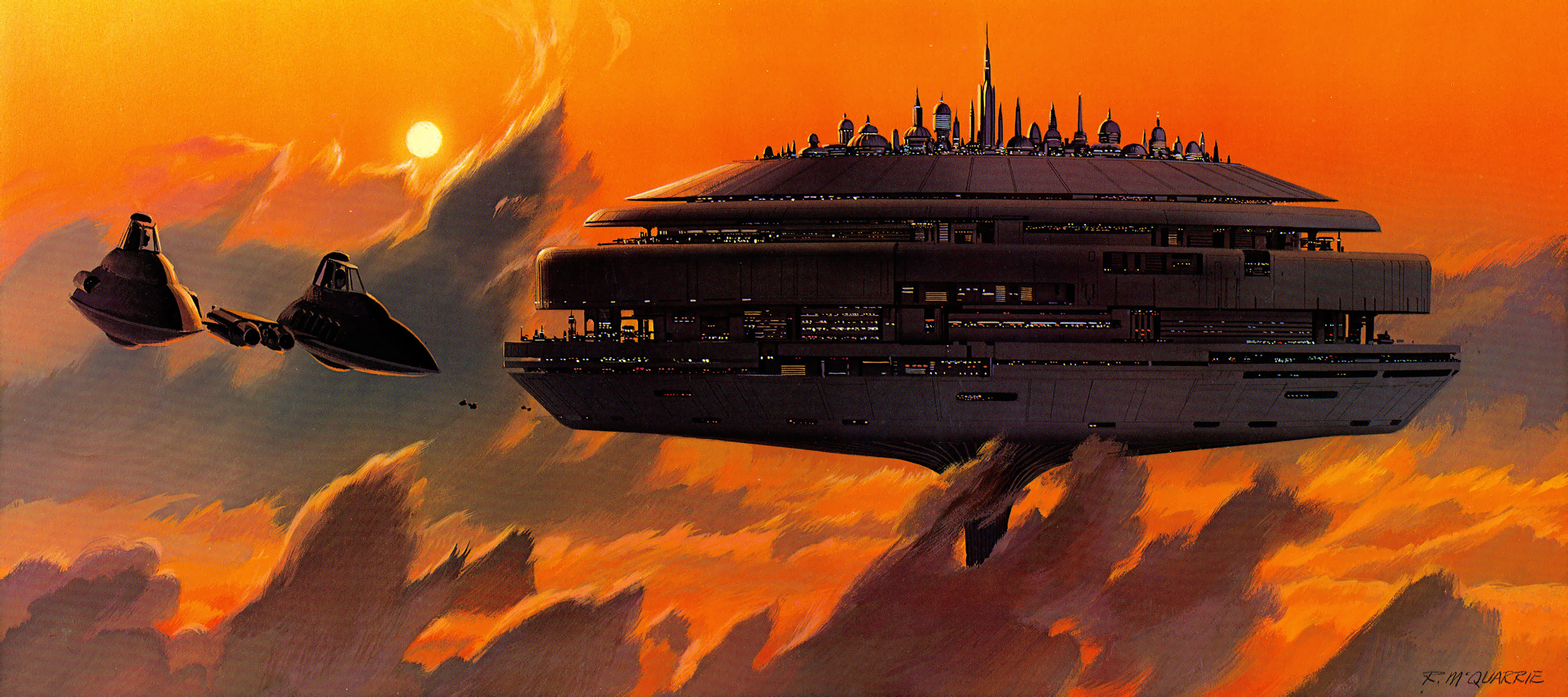

Sorry, I got nothin’. Meanwhile, here’s one of Ralph McQuarrie’s concept masterpieces for The Empire Strikes Back. Click on the image for the full version.
A big thank you to all the folks who came to my talk at Austin Ridge Bible Church last night. The turnout was wonderful, and the response was overwhelming.
There are lots of resources on this website, so please look around. If you’re interested in following up on the material from last night’s lecture, start with the Six Days presentation followed by Genesis 1 and Modern Science. The former is a longer, more detailed, explanation of how Gerald Schroeder reconciles six literal 24-hour Genesis days with an old universe. The second is a discussion of the 26 scientifically-verifiable statements made in Genesis 1 and the odds of getting them in the right order by chance.
If you’re looking for recommended reading, please check out our Library. And if you’re a homeschooling parent with high school-level children, stay tuned for our upcoming curricula for Astronomy & Astrophysics and Physics. These are college-prep laboratory courses that will be offered in both electronic and print form at affordable prices.
If you have any questions about the lecture, or about anything to do with science and the Christian faith, please write to me. One thing we delight in doing here on the SixDay website is answering questions—no question is too weird or too mundane. Just send me an email at sarah [at] sixdayscience [dot] org (with the appropriate symbols substituted for [at] and [dot]; I have to write it like that to discourage spambots), and one of our contributors will post your question along with an answer. Our policy is to post questions anonymously, unless you want us to include your name.
What happens when you wring out a soaking-wet washcloth in space? Think about it before you watch the video. What happens when you wring out a wet washcloth on Earth? Think about what’s different in space and how that would affect the experiment, and then watch this video to see if you’re right.
Stephen Hawking is at it again:
The Big Bang and the subsequent expansion of the Universe did not need God to set it off, theoretical physicist Stephen Hawking suggested to an audience in California this week.
A combination of quantum theory and the theory of relativity [would better] explain our existence than divine intervention, he told a packed auditorium at the California Institute of Technology.
Hawking is doing a tremendous disservice to science. In his later years he is transforming himself from respected physicist and successful author of popular science books to a pathetic amateur philosopher with a grudge against the notion of God. Here are the major problems with what he said in California:
1. The combination of quantum theory and the theory of relativity would explain a great deal. That’s why so many great scientists have tried to unify the two theories for almost a century. The problem is that no one has yet figured out how to combine them. So, Hawking is writing God off on the basis of a scientific achievement that hasn’t occurred and shows no sign that it is even achievable.
2. Even if physicists manage to combine them or figure out some other way to the long sought after theory of everything, it would not provide the ultimate answer to the question of how the universe came to be. At best, we might be able to push back the question of the universe’s origin one step. But, then what? Hawking’s speculation implies the laws of nature pre-date the universe, which raises the question, where did the laws of nature come from? Are they eternal? How would we know? Remember that science is limited to studying our material universe.
3. Far from ruling out God as the creator of the universe, the idea of pre-existing laws of nature is supportive of biblical truth. As Gerald Schroeder points out in his book, God According to God, the Bible tells us that wisdom (the collective laws of the universe) predates the creation of the universe:
John 1:1: “In the beginning was the logos [logic, intellect, word].”
Psalm 33:6: “With the word of God the heavens were made.”
Proverbs 8:12, 22-24: “I am wisdom. … God acquired me [wisdom] as the beginning of His way, the first of His works of old. I [wisdom] was established from everlasting, from the beginning, from before there ever was an earth. When there were no depths I [wisdom] was brought forth.”
Putting these passages together with a translation of the opening words of the Bible more faithful to the ancient Hebrew of Genesis 1:1 (“With a first cause, God created the heavens and the earth.”), the Bible tells us that with the first cause of wisdom (the laws of nature), God created the universe. We already know the laws of nature predate the universe, and with the help of the Bible we know Who acquired those laws.
I have respect for Hawking as a scientist and great admiration for him as an individual who has prevailed over a devastating disease. But, he is tarnishing his reputation and diminishing the public’s respect for science when he abuses the authority that comes with being a physicist by making these silly and unscientific pronouncements about God’s redundancy.
Related post:
The opening scene for Contact is quite possibly the best opening scene in a movie, ever. (When you watch this clip, it’s recommended that you change the resolution to 720p HD and turn up the volume.)
This is a wonderful illustration of the principle that distance (and motion) is equivalent to time. The speed of any signal, whether light or sound or carrier pigeon, is always finite. It takes time for a signal to travel the distance between the source and the receiver, so this means the signal is always telling us something about the past. Back in the days when people communicated with each other using letters, it took a week or two to receive them, depending on how far they had to travel; when the recipients read those letters, they were always reading about something that was recent to the sender, but already one or two weeks in the past for the recipient. Similarly, when we look at the star Betelgeuse, the light that we see has taken time to travel the distance between Betelgeuse and the Earth, and so we are seeing it as it was in the past (at a distance of 400 trillion miles and with light traveling at a speed of 186,000 miles per hour, we are seeing Betelgeuse as it was 640 years in the past). Conveniently, such vast distances are often expressed in units of light-years (the distance light travels in a year), which also tell us at what point in cosmic history we are observing something.
In the opening scene of Contact, the further away we travel from Earth, the older the radio transmissions become. We first hear contemporary (for 1997) music, then the soundtrack gradually shifts to music and news from further and further in our past. Once we get beyond a certain point we hear static, then silence.
But sounds don’t travel through space, I hear some of you saying. True. However, radio signals are light waves, not sound waves. The radio waves, which carry information, are transmitted in all directions and are picked up by a receiver with an antenna (say, an AM/FM radio) that converts the radio signal into the sound you hear. So, in principle, anyone who might be not too far out in space could pick up our terrestrial radio and television signals and learn all kinds of interesting things about the inhabitants of Earth.
Perhaps you are wondering from how far out in space someone could receive intelligent signals from Earth. The scale of the Contact sequence isn’t quite right—it was fudged a bit for creative/dramatic purposes. The truth is, if aliens are zipping past Pluto at this moment, they would receive transmissions from Earth that are from only five and a half hours in the past. Little Green Men near our closest stellar neighbor, Alpha Centauri, would receive transmissions from the year 2009. Civilizations on a planet orbiting the star Alpha Mensae (33 light-years away), however, might catch old episodes of Dallas. Someone passing close to the star 51 Pegasi (50 light-years away) might be aware that someone named John F. Kennedy has been assassinated in a place called Dallas. An alien near the star Regulus (77 light-years away) could be watching images of Hitler opening the Olympic Games in Berlin. Further still, near the star Eta Herculis (112 light-years away), curious beings might just now be detecting Marconi’s radio transmissions. Beyond this distance, the Earth is silent. Considering that our Milky Way galaxy is more than 100,000 light-years across, we’ve barely announced our existence to the neighbors down the street. Not that this is entirely lamentable. Personally, I find it comforting that so little of the universe is aware of the Kardashians.
I got nothin’ for you this week. In lieu of actual content, some fun. What happens if you use online translators to translate a phrase into another language and then back into English 35 times? This:
Newton’s first law: “Every body persists in its state of being at rest or of moving uniformly straight forward, except insofar as it is compelled to change its state by force impressed.”
Translated: “Form or change in this area is for a period of 10 days.”
Newton’s second law: “The change of momentum of a body is proportional to the impulse impressed on the body, and happens along the straight line on which that impulse is impressed.”
Translated: “Forces in the body, and then click OK.”
Newton’s third law: “To every action there is always an equal and opposite reaction: or the forces of two bodies on each other are always equal and are directed in opposite directions.”
Translated: “Always in the direction opposite to the Organization, the President of the movement.”
Simple random statement: “My dog has fleas.”
Translated: “Dog fleas.”
I use online translators occasionally to help translate messages from my Finnish in-laws, but as Bad Translator points out, they’re really only good for getting the gist of a phrase. As you can see, there is potential for the translation to go hilariously wrong.
In starry skies, long years ago,
I found my Science. Heart aglow
I watched each night unfold a maze
Of mystic suns and worlds ablaze,
That spoke: “Know us and wiser grow.”
And with each season’s ebb and flow,
My soul, with faltering steps and slow,
Still wanders up far-glimmering ways
In starry skies.
Nor do I heed Life’s gaudy show,
But onward, upward I shall go,
Until new star-lands meet my gaze,
And where, perhaps in after-days,
I’ll learn the things I long to know
In starry skies.
–Sterling Bunch
Not long ago, someone asked me if I’d seen the documentary, The God Who Wasn’t There (2005), which explores the “Jesus myth” and Christianity in general. It’s been out for several years, and despite the fact that it’s viewable for free on YouTube, I haven’t bothered to watch it, because it looks like an uninspired retread of common challenges to the Christian faith that tend to be very weak. However, from what I can tell, it does perpetuate one historical distortion that is worth refuting. From a partial transcript on IMDb, TGWWT puts forth the idea that it was primarily Christians who were wrong about the Earth-centered universe:
Narrator: The Earth revolves around the Sun. But it wasn’t always that way. The Sun used to revolve around the Earth. It was like that for hundreds of years, until it was discovered to be otherwise, and even for a few hundred years after that. But, ultimately, after much kicking and screaming, the Earth did, in fact, begin to revolve around the Sun. Christianity was wrong about the solar system. What if it’s wrong about something else, too? This movie’s about what happened when I went looking for Jesus.
Or, more likely, what happened when he went looking for anything but Jesus, but never mind. The problem with this statement is that it implies only Christians were wrong about the solar system, when the truth is that just about everyone was wrong about the solar system at one time or another. So why single out Christians? Without having seen the movie, I am fairly confident of the answer (hint: look at who appears in the movie). Unfortunately, the notion that the medieval Church was scientifically ignorant and held back scientific progress is a fairly easy misconception to perpetuate, because people who believe it are usually already eager to believe misconceptions about Christianity and/or they do not know enough to evaluate its validity.
I made a point to cover geocentric theory in my astronomy 101 courses, so let’s explore what my college freshmen students knew about this subject that TGWWT‘s writer/director Brian Flemming apparently did not (or did not want you to know about).
The geocentric model of the solar system, which places the Earth at the center of the universe, is an idea that is found in nearly every ancient culture. In Western Civilization, the idea is usually attributed to the ancient Greek philosopher Aristotle (384 BC – 322 BC), and was later systematized by the Alexandrian astronomer Claudius Ptolemaeus (aka Ptolemy, ~64 AD – 165 AD). The geocentric model persisted for more than 1,700 years, and while medieval interpretation of biblical scripture seemed to loosely support the idea, its formulation had nothing to do with Christianity.
To understand why the geocentric model persisted for so long, I want you to place yourself, just for a moment, in the ancient world where there is no such thing as telescopes, astronauts, or satellites. Your only notion of the Earth’s place in the universe is based on what your human senses tell you about the apparent motions of the heavens. You notice that the Sun and Moon make daily journeys across the sky from east to west, and that the stars at night travel in the same daily east-west direction. The familiar constellations also seem to drift across the sky over the course of weeks and months. To your human senses, it appears that the Earth is stationary and that objects in the heavens move about it in very predictable cycles. Armed only with these observations, it is entirely reasonable to assume that the Earth is at the center of the universe.
We owe a tremendous debt of gratitude to the Greeks, who were the first to seek natural explanations for the phenomena they observed. This reliance on natural explanations heralded the birth of science. But what is science? It is actually a difficult concept to define. Most of us understand science to be the search for knowledge, but knowledge can be acquired by other means. The scientific method works by making observations and asking questions in a very systematic way. One observes a phenomenon in nature (say, the motions of the heavens) and posits an educated guess about the nature of the phenomenon (everything in the heavens orbits the Earth, which is stationary). This educated guess is referred to as an hypothesis. The hypothesis then makes a prediction (where objects in the sky will appear on a certain date), and one carries out tests or observations to determine how well the hypothesis performs. If the hypothesis fails the test or cannot account for new observations, then it must be revised or abandoned in favor of a new hypothesis.
One such test of the geocentric model came in the form of retrograde motions of the planets. The Greeks observed that a handful of objects in the heavens moved in a way that was different from the other objects. For one thing, their positions were not fixed like the stars, but appeared to wander over a period of months. (The word “planet” comes from the Greek word for wanderer.) This retrograde motion, or apparent looping back of the planet’s path in the sky, is now understood in the context of the Sun-centered (heliocentric) model, but in ancient times it represented a significant challenge to the geocentric model. This challenge was resolved by placing each of the planets in a smaller orbit, called an epicycle, upon its larger orbit about the Earth. This was a key feature of the model put forth by Ptolemy, which is referred to as the Ptolemaic model.
The Ptolemaic model persisted for almost two millenia, because, clunky as it was, it made accurate predictions about the motions of the planets. Moreover, several key objections to the heliocentric model were unresolved. Centuries before Ptolemy, the Greek astronomer Aristarchus (310 BC – ~230 BC) proposed a Sun-centered solar system, but was ridiculed by his peers for it. First, the idea that the Earth was moving was counterintuitive, because of the apparent motions of the heavens. But the most significant objection was that stellar parallax was not observed. This is the apparent shifting of position of closer stars relative to more distant background stars, which must occur if the Earth is moving around the Sun. As this was not observed, it was reasonable for Aristarchus’ fellow Greeks to reject his idea.
Fast-forward almost two millennia to Nicolaus Copernicus (1473 – 1543 AD), who was a true Renaissance man. In addition to being an astronomer, he was also a physician, scholar, cleric, and military leader. Like Aristarchus before him, Copernicus went against popular sentiment and proposed a heliocentric system. There is evidence that Copernicus knew he was recycling Aristarchus’ ancient model, but his genius was in recognizing its potential as a much more elegant and compelling model than the geocentric model. It is true that Copernicus’ book stirred some controversy within the Church, but contrary to popular belief, the Church was not monolithically opposed to, but rather divided on, the subject of heliocentrism. Secular scientists at the time likewise held to the Aristotelian school of thought, and mostly rejected Copernicus’ ideas. There was good reason for this, as the major objections to the heliocentric model had not yet been overcome. In particular, since Copernicus used circular orbits for the planets, instead of what we now know to be elliptical orbits, the predictions of the Copernican model were less accurate than those of the Ptolemaic model. Heliocentrists also had to contend with the lack of observed stellar parallax, and there were still more objections based on Aristotelian notions about nature. For instance, long before Newton developed his laws of motion, Aristotle held that all objects naturally come to rest, which meant that if the Earth was moving it would leave airborne objects (birds, clouds, etc.) behind. It was not until Galileo anticipated Newton’s first law (objects in motion tend to stay in motion) with simple experiments and made some key observations with his telescope—among them, that the stars are too far away to observe parallax1—that these objections were overcome and the Copernican Revolution was solidified.
It is important to understand that there was as much objection to the Copernican model from secular scientists as from the Church. Perhaps more. (For instance, it was supposedly a secular rival who reported Galileo to the Inquisition, illustrating that scientific enterprise has always been a little cut-throat.) The objections of the Church were only partially founded on Christian doctrine, which was based at that time on interpretation of scripture that was consistent with the Aristotelian school of thought. There is, in fact, nothing in scripture that dictates an Earth-centered system. The politics of the time also complicated things, with the Catholic Church struggling to come to grips with the tremendous effects of the Reformation. The most influential figure of the Reformation, Martin Luther, strongly objected to the ideas of the “upstart astrologer” Copernicus, and the Catholic Church was anxious to stay abreast with Protestantism on such an important issue. It is also important to understand that Copernicus was eventually shown to be incorrect in his placement of the Sun at the center of the universe; we now understand that there is no ‘center’ to the universe, an idea that is difficult to accept for many people.
What can we conclude from all of this? We can conclude that the most important factor preventing wide-spread acceptance of the heliocentric model was simple human nature. As clever as we sometimes are, we are constrained by limited perspective and emotion. Limited perspective prevented scientists from perceiving the stellar parallax that was predicted by the heliocentric model. Human emotion means cherished ideas often have a powerful hold on people, especially when it comes to accepted ideas that have served mankind well for many centuries. Put these two constraints together and you have the very non-linear progression from old ideas to new ideas that is evident throughout human history.
Having not seen TGWWT, I can only surmise from the partial transcript that either Flemming knows very little about scientific history, classical thought, and theology, or he is being deliberately disingenuous to make Christians look bad. Which is unfortunate, because, with just a few changes to the quote from the transcript, I think we could have turned his movie into a much more interesting narrative on the fallibility of human reason:
Narrator: The Earth revolves around the Sun. But it wasn’t always that way. The Sun used to revolve around the Earth. It was like that for hundreds of years, until it was discovered to be otherwise, and even for a few hundred years after that. But, ultimately, after much kicking and screaming, the Earth did, in fact, begin to revolve around the Sun. Mankind was wrong about the solar system, but eventually figured it out. What is it today that we don’t yet understand that will be obvious to mankind hundreds of years from now? Let’s speculate…
[1] With the advent of larger and more sophisticated telescopes, stellar parallax was indeed observed.
Recommended reading:
When I was a kid in the 1970s–1980s, it was a golden age for movie soundtracks, particularly in science fiction / science fantasy. Jerry Goldsmith and John Williams were giants in the genre, having composed two of the most memorable sci-fi themes of all time. Goldsmith is best known for the theme for Star Trek: The Motion Picture, which later became the theme for the television series, Star Trek: The Next Generation. Williams is known for many popular movie themes, including Raiders of the Lost Ark and Jaws, but is arguably best known for Star Wars. The names of these composers are practically synonymous with science fiction, but these composers could hardly differ more in style.
Goldsmith’s style is grand, remote, cerebral. In my opinion, he’s most responsible for the ‘spacey’ ambiance of hard sci-fi. In this piece from Alien (1979), called “Hypersleep,” there is a vague nautical element—you get the sense of a lonely ship navigating an endless cosmos. Like much of his space-music, it is stark and beautiful. This universe is cold in its beauty—it offers wonder, but no quarter.
In “The Cloud,” a piece from ST:TMP (1979), we get a sense of the enormity of the unknown entity heading for Earth and of the secret it contains. Again, there is a nautical element, highlighted by electronic whooshes that evoke memories of earthly oceans. The music is a little brighter here—the universe of Star Trek is less harsh and hostile than that of Alien, but no less grand and mysterious.
In contrast, Williams’ style is robust, familiar, romantic. It is evocative of adventure, human relationships, and spirituality. Consider this piece from Return of the Jedi (1983), which frames the moment when Luke reveals to Leia that they are brother and sister. This piece, like most of Williams’ compositions, is suffused with warmth and emotion.
“Tales of a Jedi Knight / Learn About the Force” (Star Wars, 1977) is no less filled with awe and mystery than Goldsmith’s “The Cloud,” but it is more optimistic and tinged with a sense of adventure. Here we have the budding relationship between a master and his young apprentice. With Williams, you don’t get the sense of a harsh and hostile universe, but one in which purpose and hope are woven into the fabric of its cosmos, even while it is momentarily under the sway of a dark and oppressive force.
Though Goldsmith and Williams differ in style, they have one element in common—the sense of awe and grandeur they convey through their compositions. It’s impossible to imagine the universes of Alien, Star Trek, and Star Wars without the character and dimension of their music.
According to a book just released in Italy, researchers have established a new date of origin for the Shroud of Turin. Using a method involving spectroscopy and infrared light, researchers are now placing the origin of the shroud between 300 B.C. and 400 A.D., consistent with the lifetime of Jesus (other reports claim a range of 280 B.C. to 220 A.D.). Previous attempts to date the shroud using radiocarbon dating placed its origin between the 13th and 14th centuries, suggesting it had been faked. However, this origin was in dispute, not only because the level of sophistication required to produce such a fake did not exist at that time, but because the sample was apparently contaminated by newer fibers used to repair the shroud after it was damaged in a fire.
Although the Catholic Church has so far not taken an official position on its authenticity, Pope Francis will appear on Italian television today to introduce images of the famous shroud.

