New supernova observation reveals details about massive dying stars

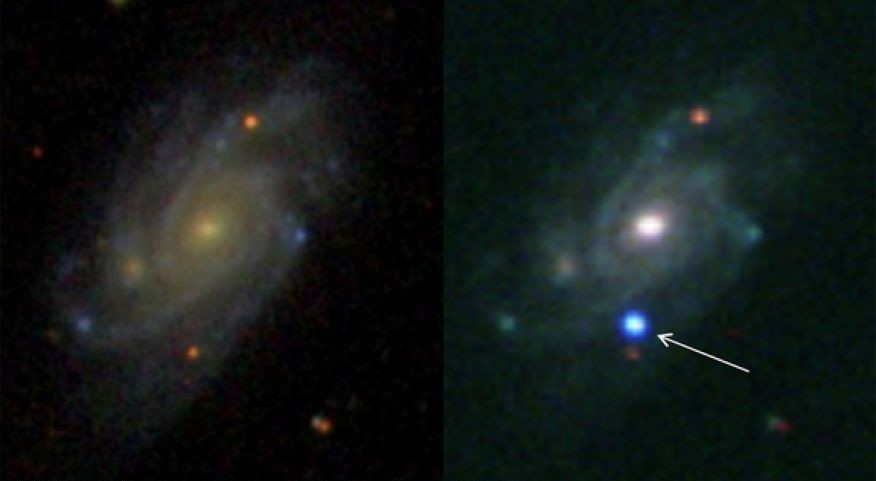
Before and after of supernova SN 2013cu in the galaxy UGC 9379, about 330 million light-years away. The left image is from the Sloan Digital Sky Survey; the right image is from the robotic telescope at the Palomar Observatory. [Credit: Avishay Gal-Yam, Weizmann Institute of Science]

For the first time, scientists have direct evidence that the biggest and brightest stars die in supernova explosions. The evidence comes in the form of SN 2013cu, a gigantic star that scientists were able to virtually catch in the act of going supernova last year. A new robotic sky survey, called the intermediate Palomar Transient Factory (iPTF) scans the sky for supernova events, alerting astronomers to possible supernovae so they can be observed very soon after they happen. The iPTF caught SN 2013cu soon after it detonated, allowing astronomers to make detailed observation of the dying star. Most of the time, astronomers are not aware of what type of star went supernova once they go off, since — for the last 400 years, anyway — all supernovae we’ve observed have gone off in other galaxies and we don’t tend to catalog the different types of stars in other galaxies.

Wolf-Rayet star

Wolf-Rayet star WR 124 [Credit: Yves Grosdidier (University of Montreal and Observatoire de Strasbourg), Anthony Moffat (Universitie de Montreal), Gilles Joncas (Universite Laval), Agnes Acker (Observatoire de Strasbourg), and NASA]

This is what makes this latest discovery so extraordinary. Astronomers were able to tell from the supernova spectrum, obtained very soon after the detonation, that this particular object was what is called a Wolf-Rayet star (see image above), a huge and hot type of star that is so massive, astronomers weren’t even sure if it would go supernova when it died. This particular star became what is called a Type IIb supernova. Astronomers will use this information to better understand the way massive stars change throughout their lifetimes.

The scientific method and ‘real science’

The following is a comment left by a reader at Vox Popoli about a year ago, in response to another reader who was concerned about the current state of science. I had written the following response with the intention of posting it here, and then forgot about it. Surak is about to offer some commentary on a disturbing development in science that bears on this, so I figured now was a good time to dig it up and post it.

To answer your question as to what ever happened to the scientific method, here’s the shocking truth: Science does not operate according to the scientific method unless there’s a crisis. Never did.

Science, just like every other avenue of human endeavor (why should it be different, honestly?) operates under the thrall of a power structure. Always has.

The scientific method only applies when challenges come up against prevailing paradigms. Then, it is utilized, and don’t be a fool understand that every effort is made, always, to doom the challenger and to favor the prevailing paradigm.

The great merit of the scientific method is that under these rare conditions reason and proof hold sway. But please do not be so foolish as to assume that science is governed by the scientific method on a basis, because it is not.

Science is governed by egos. And nothing more.

It is true in a grand Kuhnian sense that crisis precedes advancement. It is also true that egos are a factor in science. But so what? Science is the triumph of the human mind over ego and a multitude of other human failings—limited perspective, misleading emotions, dominant philosophies that act as closed boxes, and the corrupting effects of the universal desire for fame, fortune, and/or political power. The scientific method is the means by which these frailties are remedied. Since these obstacles to advancements in knowledge will always be with us, there will always be a turbulent interplay between human nature and the pursuit of science.

The key element of the scientific method that keeps it from flying off in the direction of wild, unsubstantiated speculation is the peer-review process. If you want to know if the scientific method is alive and well in any branch of science, simply observe how rigorously the peer-review process is being used. I go through the peer-review process on several levels every time I submit a research paper for publication.

The first hoop I have to jump through is the judgment of the referee assigned by the journal in which I hope to have my paper published. The most important thing the referee does is check how well I have accomplished the observe –> hypothesize –> predict –> test –> theorize part of the process. If the judgment is that my work is scientifically sound, the paper is published. Then the whole body of my profession passes judgment on my work by deciding whether or not to cite my work. At the next level of the peer-review process, decisions are made about which scientists are deserving of funding, tenure, and promotions. At the final level, judgments are made about which work is deserving of awards. The end result of this in physics is a steady advance in knowledge where occasional detours from truth are corrected and dead ends are usually recognized and reversed.

I accept that there are some areas of science in which the scientific method does not currently function as it should. So-called “climate change science” is the most obvious example of science being corrupted by politics, money, and dogma. Surak will have something to say about this soon with regard to a disturbing development in this field. Meanwhile, there is a simple test one can apply in this regard: any time the name Al Gore or the terms “scientific consensus” and “the debate has been settled” are used in regard to any branch of science, it has undoubtedly strayed from the scientific method.

Biology certainly suffers from an ego problem to the extent that it is nearly impossible to get a mainstream biologist to utter the words, “Darwin was wrong about some important things.” He was wrong about some important things, and a paradigm shift is long overdue in the field of evolution. But, it must be acknowledged that a multitude of biologists are doing very good work that is firmly based on the scientific method.

The real test of any field’s application of the method is whether that field petrifies into dogma or if it routinely accepts change. I must speak in defense of my field of physics/astrophysics. It has a long history that includes the initial establishment of the scientific method as well as continuous successful applications of its process. After the Copernican revolution and the invention of precision clocks, experimental methods were sufficiently advanced that it didn’t take all that long to accumulate enough evidence to overthrow old ideas and adopt new paradigms. To name but a very few examples: Newton’s uniting the heavens and the earth under one set of laws, Maxwell’s unification of electricity and magnetism, Poincaré’s relativity of time and space, Planck’s quantum, Hubble’s confirmation of other galaxies and the expanding universe, Einstein’s new view of gravity, Lemaître’s big bang theory, Zwicky’s dark matter, and the supernova teams’ accelerating universe.

You say this is rare, but how often do you think this is supposed to happen? How often can it happen on such a large scale? The Hubble/Lemaître paradigm is an especially important example of the scientific method working as well as it possibly can. Most physicists did not like the idea of a universe with a beginning, but the scientific method is so firmly established in physics that the vast majority of them accepted it once there was sufficient evidence to overcome all reasonable objections. Those who clung to the notion of the eternal universe for reasons of ego and non-scientific concerns were discredited for straying from the scientific path.

The application of the scientific method does not have to be perfect to be functional. My own everyday experience in the field of astrophysics has been that the method sometimes proceeds as the classic observe -> hypothesize -> predict -> test -> theory. But quite often it is something very different: observe -> huh? -> observe -> what the … ?! -> hypothesize -> predict -> test -> getting close to a theory! -> test again -> wait, what? -> OH! -> hypothesize -> test, and so on. As long as it is evidence- and prediction-driven throughout the confusion, that’s good enough.

As for the system being set up to doom the challenger, how else would you have it? That’s the way it should be, as long as this resistance is not rooted in ideology (e.g. “climate change science”). It’s not unlike a court of law, where the presumption should be the innocence of the accused and the burden of proof lies with the accuser.

Egos, admittedly, often get in the way of true science, but on the other hand I doubt science could proceed without them. Scientists will always be fully human and infinitely closer in nature to Captain Kirk than to Mr. Spock. The vast majority of people I work with are truly driven by a desire for truth, but also the competitive hope for recognition and reward (which is why science has always been a traditionally masculine endeavor). And yes, they also have an understandable instinct to protect the fruits of their labor.

The point of all this, do not confuse the inevitable imperfect application of the scientific method for its absence.

Kepler’s resurrected!

Kepler spacecraft

Artist’s conception of the Kepler spacecraft [Credit: NASA/Ames/JPL-Caltech]


The space observatory
, that is, not the late great astronomer.

NASA is breathing new life into the currently defunct Kepler spacecraft, which was designed to look for Earth-size exoplanets (planets orbiting other stars) in the Milky Way. Partway through its mission, the Kepler spacecraft lost function in two of the four flywheels it uses to orient itself, and, without the ability to steadily point in a given direction, it became effectively dead.

However, NASA scientists have figured out how to use the pressure from the solar wind to stably orient the spacecraft, and it will hopefully resume its mission of searching out the Milky Way for Earth-size planets. The use of the solar wind to stabilize Kepler will limit where the spacecraft can point itself, but it will still be able to collect a lot of meaningful data.

Physicists getting close to turning light into matter

We’re one step closer to having replicators in our homes. Okay, maybe a slight exaggeration, but physicists are on the verge of transforming light into matter. The process involves high-powered laser beams, a slab of gold, super high-speed electrons, and eventually a stream of photons. The whole apparatus can be thought of as a photon collider. Photons are essentially tiny “packets” of light, and it is hoped that a collision of two of these packets of light will produce a pair of subatomic particles — an electron and its anti-matter counterpart, the positron — particles that are far too tiny to be visible to the naked eye.

Physicists already know that the reverse process — a negatively-charged electron colliding with its positively-charged counterpart, the positron — causes the particles to wipe each other out and produce a burst of light, so the opposite reaction should, in principle, work. The process is governed by Einstein’s famous equation, E = mc2, from his Special Theory of Relativity, which says that energy (light) and matter are essentially the same thing. In fact, during the very, very early history of our universe — the first few fractions of a second — the universe was so hot and dense that energy was converting to matter and back again to energy very rapidly, until the universe cooled down enough for energy to finally “freeze out” into matter. The physics governing this is very simple, but it turns out to be rather difficult to create the conditions in a laboratory for this to happen. Thus, the excitement over this latest experiment to create matter from light.

It’s pretty exciting to think I may see Star Trek-like replicators in my lifetime. First thing I’m ordering when I get one? Tea, Earl Grey, hot.

Saturday morning astronomy news roundup

Scientists are concerned that Earth bacteria are hardy enough to survive the trip to Mars aboard spacecraft and possibly colonize the Red Planet. Scientists at NASA’s Jet Propulsion Laboratory simulated the conditions that the bacteria would be exposed to, both on Mars and in space, and found that some of the spores survived for 18 months—twice the time it takes spacecraft to get to Mars. From a biblical perspective, this is not all that surprising. As ancient biblical commentators pointed out, the universe was created with the potential for life built into it—and as Hugh Ross has explained in great detail in his many books, the universe is undeniably tuned for life. It makes sense that the most basic forms of life would be hardy enough to survive the otherwise harsh conditions beyond the Earth.

Scientists at MIT have created a simulation of the universe that begins from just 12 million years after the Big Bang to now. (Twelve million years may sound like a long time, but in terms of the ~14 billion-year age of the universe, it’s not long at all.) Such simulations are carried out on supercomputers, as they would otherwise take thousands of hours to process on ordinary desktop computers. This newest simulation is an improvement on previous cosmological simulations, because, among other things, it more faithfully produces the mixed population of galaxies observed in the universe, including graceful spirals like our Milky Way, and giant ellipticals like M87, and captures the present-day proportion of hydrogen and heavier elements in galaxies. The universe, itself, is the greatest laboratory ever created, but we are limited in our ability to “experiment” with it. In order to learn about the structure of the universe and the way it has changed with time, scientists have to create simulations and see how well they match up with observations of the universe on different scales of both size and time.

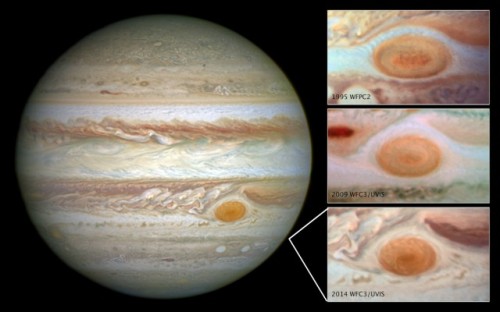
Jupiter’s Great Red Spot continues to shrink

Jupiter's Great Red Spot

It’s as iconic as anything in the solar system—Jupiter’s Great Red Spot, a massive storm that’s been raging on the surface of Jupiter for hundreds of years, maybe longer—but it’s been shrinking since at least the 1800s, and scientists aren’t sure why. Now, at “just” 10,000 miles across, it’s the smallest it’s been since scientists first started measuring the storm. Whatever the cause, personally, I think Congress should legislate something to stop the shrinkage.

Astronomy and Astrophysics curriculum officially announced

Astronomy and Astrophysics

It’s official:

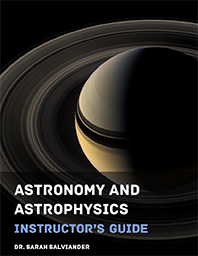
Today we are officially announcing the publication of ASTRONOMY AND ASTROPHYSICS, a curriculum created by Dr. Sarah Salviander, a research scientist whose areas of particular interest are quasars and supermassive black holes. She is a research scientist at the University of Texas, is one of the authors of “Evolution of the Black Hole Mass – Galaxy Bulge Relationship for Quasars in the Sloan Digital Sky Survey Data Release 7” and “Narrow Emission Lines as Surrogates for σ * in Low- to Moderate-z QSOs” in addition to many other scientific papers, and teaches classes as a visiting professor of physics at Southwestern University. Dr. Salviander describes the new curriculum at Castalia House:

“Look around the web for a high-quality, modern-science astronomy homeschool course and you won’t find much. There are a handful of scripture-based astronomy courses that seem to cover little more than the seasons and motions of the night sky, and one very expensive software-based curriculum. I realized there was a need for a comprehensive, modern, and affordable astronomy homeschool curriculum, and set out to develop one based on my years of teaching astronomy at the university level. A couple of years ago, I mentioned this in an offhand way to Vox Day; it turns out Vox had been contemplating offering a series of affordable, electronically-available homeschool curricula, and so we began to discuss the possibility of making astrophysics the first of many such courses.”

The course is suitable for ages 13+ with the appropriate background in mathematics — basic algebra and geometry — but there is no science prerequisite. It was designed primarily with homeschoolers in mind, but it would also work very well in public/private high schools, either as a conventional science course or as an independent study for motivated students. It is also suitable for adults who wish to learn about astronomy and astrophysics in a self-guided continuing education sort of way.

We’ve had at least one person ask whether the course is suitable for students in the Southern Hemisphere. The answer is yes, mostly, with the exception of a couple of lab activities; I’m going to look into adapting the two lab activities that only work in the Northern Hemisphere. If anyone has other questions about the curriculum, don’t hesitate to contact me.

Colliding neutron stars

black_hole

NASA has released a stirring animation depicting the theoretical merger of two neutron stars. Once the stars merge, they form a black hole.

Neutron stars are super-dense remnants of dead high-mass stars. As the name suggests, they are comprised entirely of neutrons, which formed from the merging of protons and electrons during the gravitational collapse of a dying star’s core. Neutron stars have a theoretical upper limit to their mass, beyond which the rules of quantum physics dictate that the stars collapse into black holes. A merger is one way to have a neutron star exceed its theoretical mass limit.

Such mergers would release an enormous amount of energy, which could explain the origin of gamma ray bursts—mysterious flares of ultra-high energy that emanate from deep space.

Replay: The free frontier

Traffic’s up after the informal announcement of the publication of our Astronomy and Astrophysics curriculum, so we’re replaying some of our more important posts from the archives for our new readers.

Yesterday [April 12, 2011], on the 50th anniversary of the first man in space, The Atlantic featured an article by Jim Hodges lamenting the decline of American exceptionalism in space:

[In the 1960s] Americans didn’t talk of their exceptionalism. They did exceptional things, and the world talked about it. In many places around the world, in science labs and classrooms, the NASA “meatball” was as recognizable as the Stars and Stripes.

People remember that President Kennedy said, “I believe that this nation should commit itself to achieving the goal, before this decade [of the 1960s] is out, of landing a man on the moon and returning him safely to the Earth.”

Forgotten is that just before that challenge, he said this as a preamble to it: “I believe we possess all of the resources and talents necessary [to lead the world into space]. But the facts of the matter are that we have never made the national decisions or marshaled the national resources required for such leadership. We have never specified long-range goals on an urgent time schedule, or managed our resources and our time as to insure their fulfillment.”

The government is certainly not doing that now, and we can’t count on it to do these things ever again.

However, I do not see this as occasion to despair. As well-intentioned as NASA has been, government almost always does things slower, costlier, and with less innovation than private enterprise. In fact, while government has been slashing NASA’s budget and scaling back its goals, private companies out in Mojave have been quietly innovating like crazy:

Saturday morning astronomy news roundup

The Cassini spacecraft continues to study the dickens out of Saturn and its satellites, this time snapping some lovely images of the moon, Titan. From billions of miles away, team scientists steered Cassini to within 600 miles of Titan’s surface and caught sight of waves in its seas.

Mark your calendars for May 24, because the Earth may be in for an impressive show from a never-before-seen Camelopardalid meteor shower. In fact, the shower is predicted to be so intense — with up to 200 meteors streaking across the sky per hour — that it’s being referred to as a possible “meteor storm.” The meteor shower is a result of the Earth crossing the trail of debris left by the newly-discovered Comet 209P/LINEAR. The shower should last for hours, since it will emanate from a northern part of the sky (remember, for those in the Northern Hemisphere, the North Star never sets), but the best time to view the show is between the hours of 2:00 am and 4:00 am EDT on the 24th.

NASA’s Mars rover, Curiosity, has begun to drill into Martian rock with the intention of studying a sample on its onboard lab. NASA scientists hope to uncover whether the conditions on Mars were ever appropriate to host life.

Scientists at UT-Austin (high-five!) have found one of the Sun’s long-lost brothers. Dubbed HD 162826, the star very likely formed from the same enormous gas cloud as the Sun, but somehow got separated and the siblings are now 110 light-years apart. It’s unknown whether any planets are orbiting the star, but since it appears to have no Jupiters around it, it’s unlikely that life as we know it would be on any terrestrial planets orbiting HD 162826.