Twisted history

Alex Berezow and James Hannam systematically dismantle a post by atheist evolutionary biologist, Jerry Coyne, who manages to get nearly every one of his claims about science and religion wrong. Example:

Coyne:

If you think of science as rational and empirical investigation of the natural world, it originated not with Christianity but with the ancient Greeks, and was also promulgated for a while by Islam.

Berezow and Hannam:

This is only half-true. Science is a lot more than just reason and observation. You need experiments too. For example, the Greeks, following Aristotle, thought that heavy objects must fall faster than light ones. It takes two seconds to disprove that by an experiment that involves dropping a pebble and a rock. But for a thousand years, no one did. There didn’t seem to be much point in testing a theory they already thought to be true. That’s probably why the Greeks were so good at geometry, as Dr. Coyne notes, because progress in mathematics is largely based on reason alone.

I’ll further point out that Aristotle — hero of humanism and champion of reason — was wrong about just about everything in terms of science, and the acceptance of his model of an eternal geocentric universe in particular held back progress in science for nearly two thousand years. Until it was revolutionized by a bunch of Christians.

Read the whole rebuttal.

The authors have not addressed all of Coyne’s claims, as, they have pointed out, there is “an impressive amount of error and misunderstanding [in] a very small space.” He certainly manages to cram a lot of error into the following unaddressed point:

If religion promulgated the search for knowledge, it also gave rise to erroneous, revelation-based “scientific” conclusions that surely impeded progress. Those include creation ex nihilo, the Great Flood, a geocentric universe, and so on.

By all appearances, the universe was created ex nihilo. Physicists have struggled to explain the origin of the universe in a way that avoids an ex nihilo creation event, without success. As this Reasons to Believe article points out, the Bible mentions a worldwide flood, not a global flood. A Great Flood, as described in Genesis, that wiped out all of human and animal life in the Mesopotamian region — the entire known world at the time — is scientifically plausible. And, geocentric theory began with the ancient Greeks. I suppose you could say that since the Greeks were religious, religion is therefore responsible for geocentric theory, but that would be a gross oversimplification. And, anyway, as Coyne is lumping this in with other biblical conclusions, one can reasonably assume he’s pinning this one specifically on Christianity. But, as we all know, Aristotle was responsible for promulgating the idea, which was later elaborated upon by Ptolemy. Yet, the erroneous notion persists that Christians were to blame for this faulty cosmology. As with the Galileo and Bruno affairs, this is the result of atheist myth-making.

The more commentary I read from atheists, the more I’m convinced that these self-styled champions of fact and reason are anything but.
New superheavy element announced

A new, superheavy element will likely be added to the pantheon of known elements. Created in a lab, and weighing in at 40% heavier than lead, element 117 is highly unstable and has a half-life of less than a second. Nevertheless, its fleeting existence in a lab will likely earn it a permanent place on the periodic table.

The periodic table contains both primordial (elements that have existed on Earth since the planet formed) and synthetic (manmade) elements. Element 117, also temporarily known as ununseptium, is a synthetic element. Despite its lesser atomic number, the announcement of element 117 follows that of element 118 (ununoctium), which was announced years before (and has a bit of a checkered past). Once these elements become approved members of the periodic table, they will be given proper elementy names by their discoverers.

Now, despite using the word “created” above, elements are not created, they are made, whether by nature or by man. We tend to use the term “created” rather loosely, but in terms of the biblical, the distinction between created and made is rather important. Created refers to the instantaneous act of bringing something into existence that did not exist before. Made refers to the process of fashioning something from pre-existing raw material, which takes time. Even the simplest element — primordial hydrogen, with just one proton and one electron — was fashioned over a period of time from pre-existing material. And elements 117 and 118, which took careful planning and execution in a lab, were effectively fashioned the same way.

Asteroid grazes the Earth, humankind almost wiped out!

Or not.

The media have been reporting on a “bus-sized” asteroid that made a close pass by the Earth last Saturday. “Close” is a relative term — in astronomy, it generally means much further than you might think. In this case, the asteroid, called HL 129, came closer than the orbit of the Moon, which is about 240,000 miles away. By way of comparison, the much larger asteroid, 99942 Apophis, is predicted to come much closer to the Earth in the year 2029 — a mere tens of thousands of miles, which will make it visible to the naked eye from some locations on Earth — and yet a collision with the Earth has been mathematically ruled out based on what we currently know about Apophis.

So, maybe this still sounds troubling, but there are two reasons I don’t worry about asteroids hitting the Earth. The first is, unless the asteroid is very large — on the order the size of the one that’s believed to have wiped out the dinosaurs — then its destructive power is limited, and anyway it will most likely land in a large body of water or somewhere else that’s unpopulated by humans. (The likelihood of an asteroid hitting the Earth is inversely proportional to its size.) The second is, there’s not much we can do about an asteroid like HL 129. Despite our best efforts to monitor the skies for such objects, HL 129 was discovered only a few days before it made its close pass. That’s not nearly enough time to do anything about it, as it would take a minimum of a year to several years in order to deflect an asteroid on a collision course with Earth. So, why worry? As Christians, we are told not to worry about tomorrow; I think Matthew 6:25-34 also applies to asteroids.

Christians must reclaim science

Modern science exists because of the Christian faith. That is a provable fact. So, why is there so much conflict over the supposed conflict between science and Christianity? In terms of explaining the atheist myth-making about the supposed conflict — having once been an arrogant atheist, myself — I can tell you that it’s born of either total ignorance (as was the case with me) or the kind of hostility that makes a person blind to the truth or willing to distort it. In terms of Young-Earth Creationism, however, I’m still trying to figure that one out. Modern science is one of the many blessings of the Christian faith, and I can only surmise that YECs have allowed the atheists to frame the argument and have accepted a gross distortion — and outright omission — of historical facts.

The Stand to Reason Blog explains that, in contrast to atheist fables, science and Christianity go way back:

The myth begins with the notion of the “dark ages,” a time when the church suppressed education. It’s just not true. Scholarship was alive and well prior to Copernicus. In fact, scholars were working on heliocentric theories before Copernicus. He learned these in university and built on them when he published in final work. His theory didn’t emerge from a dark vacuum, but from rich science that had been nurtured in the universities, many of them established by the church.

In fact, as the article goes on to point out, sociologist of religion, Rodney Stark, found that 50 out of 52 of the key figures of the scientific revolution were religious.

Hugh Ross goes even further and explains how the scientific method comes straight from the Bible:

The Bible not only commands us to put everything to the test, it shows us how. Christian scholars throughout church history, from early church fathers to present-day evangelical scientists, philosophers, and theologians, have noted a pattern in biblical narratives and descriptions of sequential physical events such as the Genesis creation account. Bible authors typically preface such depictions by stating the narrative or description’s frame of reference or point of view. In the same statement or immediately thereafter comes a listing of the initial conditions for the narrative or description. The narrative or the description itself follows. Finally, the author describes final conditions and conclusions about what transpired.

Furthermore, there is not just one narrative or description of physical events in the Bible. There are dozens. Because the Bible is inspired by God––for whom it is impossible to lie or deceive––these dozens must be consistent with one another. Therefore, each of these dozens of descriptive accounts can be used to test the validity of the interpretation of the others.

In the near future, I’ll be posting an article about the concept of linear time that’s necessary for the emergence of modern science, and how it comes from Christianity.

It’s simple: the pillars upon which modern science stand — the notion of scholarship as a form of true worship, the scientific method, and the concept of linear time / cause-and-effect — were all built by the Christian faith. As the influence of the Christian worldview wanes in the West, replaced by a worldview that actively hammers away at the pillars of science, so will the quality of science diminish. This is why Christians must reclaim science instead of turning away from it.

What about lizard and Spock?

Sheldon Cooper once pointed out a flaw inherent in the game of rock-paper-scissors — that people who know each other can anticipate the most likely outcome — which is why he introduced millions of viewers of The Big Bang Theory to a relatively new twist on the old game. Of course, there’s a weakness with this twist, especially for a certain kind of person:

Chinese scientists, meanwhile, have discovered that even people who don’t know each other can more often than not anticipate the outcome of rock-paper-scissors by observing a tendency called “win-stay lose-shift”

When players won a round, they tended to repeat their winning rock, paper or scissors more often than would be expected at random (one in three).

Losers, on the other hand, tended to switch to a different action. And they did so in order of the name of the game – moving from rock, to paper, to scissors.

Now that you know this, do you think you can consciously avoid making the same strategic error?

Saturday morning astronomy news roundup

Number Five is alive! NASA’s rover, Curiosity, snaps selfies on Mars and looks reminiscent of a certain movie robot from the 1980s.

In other NASA photo news, the Cassini spacecraft, which has been studying the dickens out of Saturn for about 10 years, has snapped a lovely photo of Uranus offset by the rings of Saturn.

And, in even more NASA news, the space agency has unveiled its prototype design for the Mars mission spacesuits. The Z-2, as the suit is called, will include parts that are made in 3-D printers. The first design, the Z-1, looked like something Buzz Lightyear would wear. The Z-2, however, looks kind of TRON-ish with its luminescent design.

Genesis time and the changing length of a day

Scientists have discovered an exoplanet that spins so fast its day is just eight hours long. Beta Pictoris b, which is 65 light-years from Earth, rotates on its axis at a whopping 62,000 miles per hour, about 50 times faster than Earth’s rotation rate (since the exoplanet is much bigger than the Earth, its day is a third as long). Scientists made this calculation using the same method meteorologists use to track earthly weather systems — the Doppler effect.

What is not generally known is that the Earth once had a much shorter day than it does now, due to its changing gravitational interaction with the Moon (and the Sun). Because of tidal friction — the loss of energy due to the gravitational tugging on Earth’s oceans — the Moon is gaining orbital energy at the cost of Earth’s rotational energy. As a result, the length of an Earth day increases. With the extra bit of orbital energy, the Moon’s orbit is increasing by about 4 cm each year and the length of a day increases by a couple of milliseconds per century. It doesn’t sound like much, but over millions and billions of years, it adds up. Computer simulations suggest that billions of years in the past, the Moon was so close to the Earth that an Earth day was a mere six hours long.

Intriguingly, an Earth-day that changes in duration is consistent with Gerald Schroeder’s reconciliation of a literal interpretation of Genesis 1 and an old Earth. Schroeder argues that the length of each Genesis day is 24 actual hours, but only measured from God’s perspective. From our earthly perspective, each of those days is a different length, ranging from billions to millions of years. It isn’t until humans appear on Day 6 that Genesis time comes to agree with Earth time. It would seem God chose a perspective for Genesis that was 24 hours, because that’s how long an Earth day would be once Adam appeared. For a detailed explanation of this reconciliation, see here.

Backyard Astronomy: May 2014

Most of May, peaking May 6-7: Eta Aquariid meteor shower. A meteor shower occurs when the Earth, in its orbit around the Sun, passes through the debris trail of a comet. The Eta Aquariids are associated with Halley’s Comet. Meteor showers are named after the constellation from which they appear to be coming in the sky—in this case, the constellation Aquarius, near Eta Aquarii, one of its brighter stars.

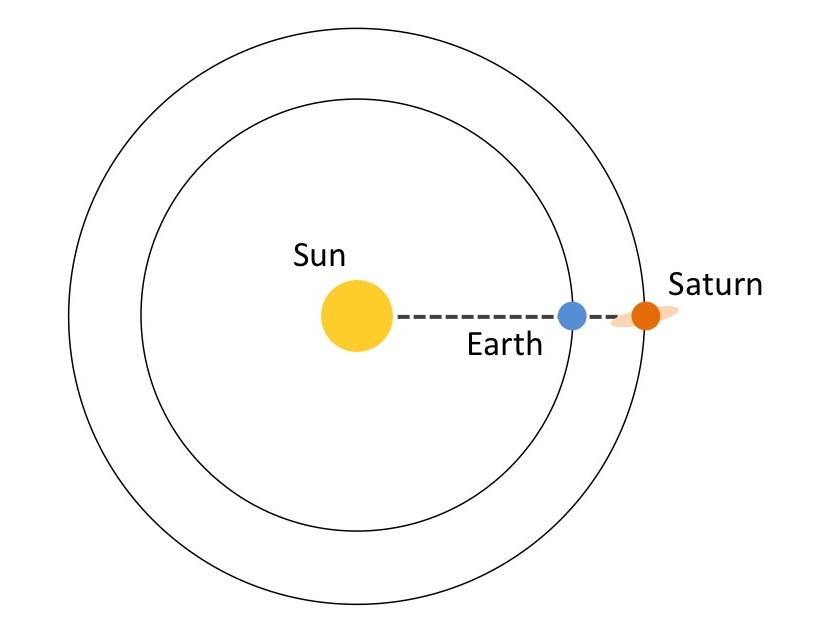
May 10: Saturn at opposition. Opposition is when a planet is on the opposite side of the Earth from the Sun (see below). It’s the best time to view a planet through a telescope.

opposition_saturn


May 24: Meteor shower outburst. When the Earth passes through the debris trail of Comet 209P LINEAR, it promises an exciting meteor “storm.” This burst will appear to originate from the constellation Camelopardalis.

Black hole pair shreds star

Artist's concept of merging black holes [Credit: NASA]

Artist’s concept of merging black holes [Credit: NASA]


Writing about science in a way that not only conveys information accurately, but entertains and captures the imagination, can be pretty tough. The author of this article does a remarkable job of both with a topic that’s near and dear to my heart: supermassive black holes in the process of devouring a star:

In the deep forest of stars that lies at the center of galaxies, a voracious monster lives: a black hole millions or billions of times more massive than the Sun. These cosmic beasts are more ambush predators than hunters, though: they only feed on hapless stars and other objects that get too close. Otherwise, they are content to sit quietly if they can’t get any prey for long times.

This would make a very good opening narration for a documentary about supermassive black holes. The whole thing is worth reading.

As for the actual science, this is pretty neat stuff. I’m a member of a team that’s been hunting black hole pairs for years — I covered the topic here — and can attest to their exceeding rareness. To find one that’s also in the process of ripping apart a star is certainly newsworthy.

Captain Kirk honored by NASA

From Trek News:

On Saturday, NASA awarded Star Trek’s original Captain Kirk, William Shatner, with the Distinguished Public Service Medal, at his annual Hollywood Charity Horse Show in Los Angeles.

The award, presented to Shatner by NASA’s Deputy Associate Administrator, Communications Bob Jacobs, is “the highest award bestowed by the agency to non-government personnel.” and is given “for outstanding generosity and dedication to inspiring new generations of explorers around the world, and for unwavering support for NASA and its missions of discovery.”

“William Shatner has been so generous with his time and energy in encouraging students to study science and math, and for inspiring generations of explorers, including many of the astronauts and engineers who are a part of NASA today, ” said NASA’s associate administrator for the Office of Communications David Weaver. “He’s most deserving of this prestigious award.”

Without question, Star Trek was a big influence on me and my love of all things space, so I can well believe that it — and Captain Kirk, in particular — inspired many people to pursue careers in science. Congratulations to Mr. Shatner.