Science fiction becoming science reality

Physicist Michio Kaku, who has penned several popular books about science, has written a new book called Physics of the Future in which he describes the sorts of innovations we can expect in the 21st century. Among the technological breakthroughs-in-the-making:

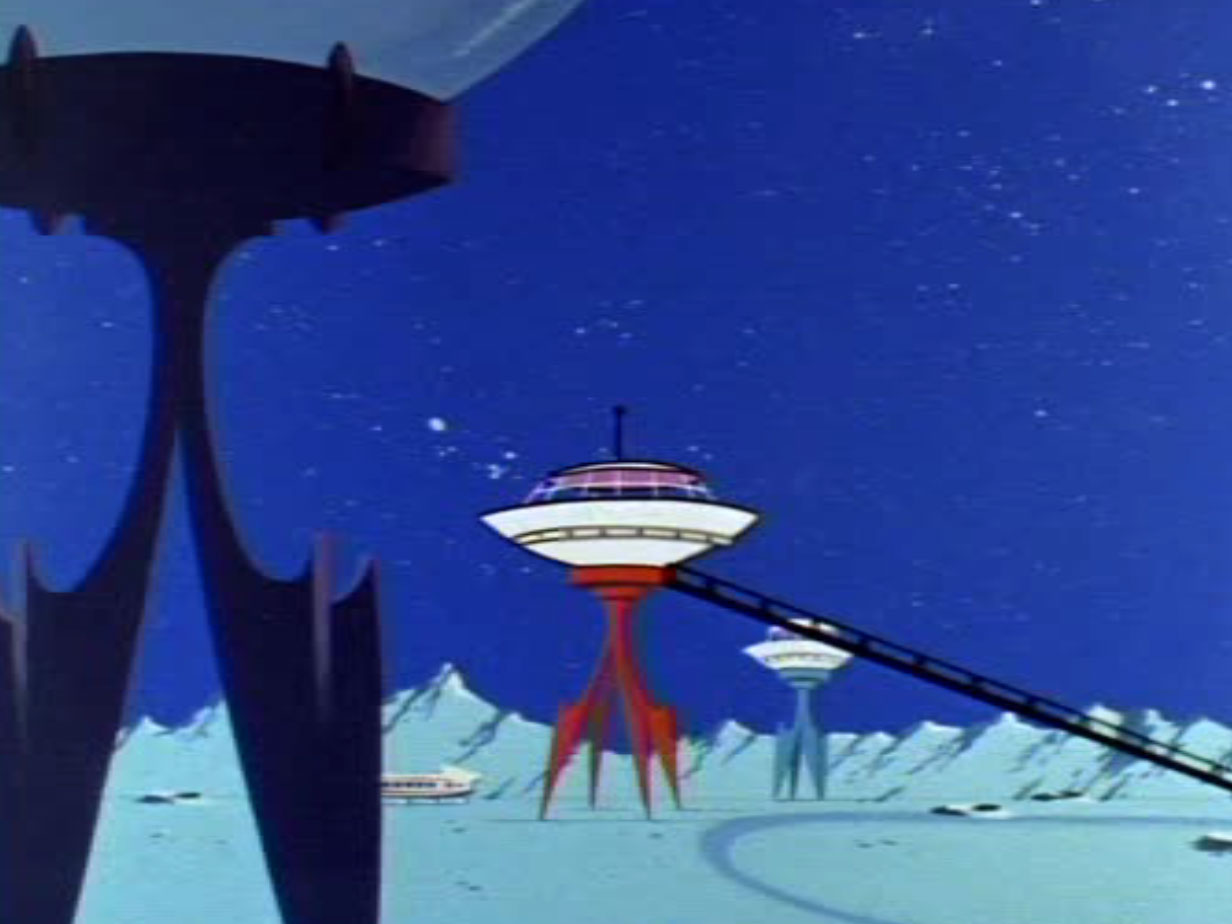
Any science fiction junkie will tell you that all of these ideas have been around for decades in television shows, movies, novels, and short stories. My two favorite TV shows when I was a kid were Star Trek and The Jetsons, and it occurred to me recently that an awful lot of what was imagined in those shows has become reality, or is about to according to Kaku.

I’m not sure which is more impressive — the prescience of the writers who seemingly foretold the future or the genius of the scientists and engineers who are making it all happen — but one thing seems certain: anything we can imagine we can eventually make reality.

Asteroid Apophis on its way to Earth

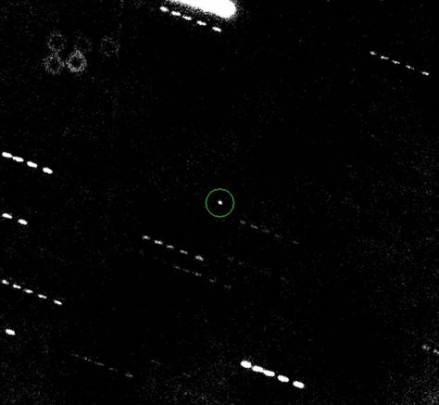
Asteroid Apophis is followed with a camera in a series of five photos as it moves against a background of stars. The rings in the upper left are from a dust grain on the telescope instrument. (Credit: D. Tholen, M. Micheli, G. Elliott, UH Institute for Astronomy)

Astronomers are keeping an eye on asteroid Apophis, which was recently caught in a series of photos made from a telescope on Hawaii’s Mauna Kea mountaintop observatory. In April of 2029 the orbit of the 900-ft space rock will bring it closer to Earth than some of our satellites, but a collision with either the Earth or the Moon has been ruled out. There is a very slight chance that the flyby in 2029 could put it on a collision course with Earth in 2036, but the odds of a collision are deemed quite small — about 1 in 250,000. Apophis will come close to Earth two more times in the 21st century, again with small probabilities of actually making an impact.

Continue reading

All eyes on nuclear reactors in the aftermath of Japan quake

Nuclear power is used by many countries to produce electricity, including Japan where the 8.9-magnitude earthquake that shook the country on Friday has caused the Fukushima I facility’s backup safety systems for two of its eight reactors to fail. The No. 1 reactor suffered an explosion, likely fueled by hydrogen gas, that has apparently not affected the reactor containment structure.  The USAF has supplied emergency coolant to the reactors, but the situation is critical enough that tens of thousands of residents within a 20 km radius of the plant have been evacuated.

Experts from around the world, including the deputy director of the Chernobyl nuclear safety center, have said this will not be a repeat of the Chernobyl disaster that occurred in Ukraine in 1986. Japan’s 54 nuclear reactors, and all Western civil nuclear facilities, are designed with better safety standards than the Chernobyl facility. Still, it seems the extent of the damage to the Fukushima facility is unclear, and residents are understandably nervous.

Please keep the Japanese people in your prayers.

Continue reading

Prune fingers lead to insights on structural strength

Have you ever thought about how incredible it is that our skin not only doesn’t dissolve after being submerged in water for a long time, but retains its strength? Mathematicians are thinking about it, and are hoping the study of pruny skin will shed light on new ways to provide structural stability. Myfanwy Evans, an Australian mathematician who specializes in topology — a branch of math that studies how geometric figures remain unchanged even after they have been bent and stretched — has used her experience with strange shapes called gyroids1 to come up with a “stringy skin model” that may explain how our skin works. This model could lead to the development of new materials that provide the same structural stability as human skin.

Continue reading

Mars orbiter spots Mars rover

The Mars Reconnaissance Orbiter captured the progress of the Mars Exploration Rover Opportunity as it investigates a 90-meter crater on the Martian surface. A few months ago the rover was on one side of the crater, and it’s apparently made its way to the other side. See if you can spot it below. (No word on whether any hrossa or pfifltriggi have been seen.)


(Click on the photo to see a larger version.)

Continue reading

But you look so … old

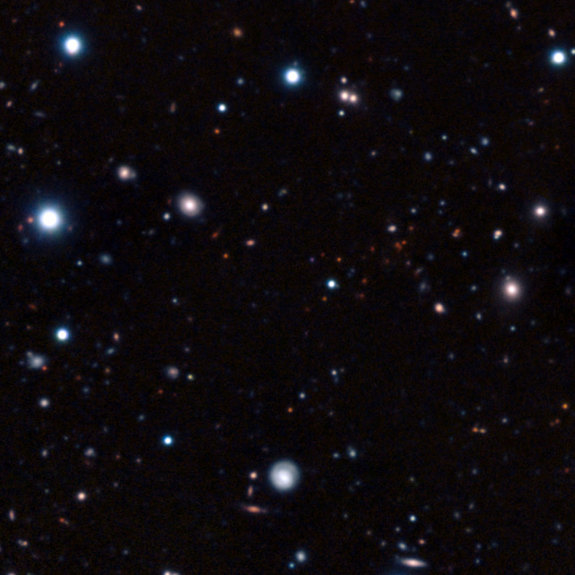
Galaxy cluster CL J1449+0856 (Credit: ESO)

When I turned 40 recently, people kindly told me, “But you still look young.” So, what do you tell someone who is young but looks old? This is my brilliant segue into a description of a strange discovery by astronomers who observed a galaxy cluster that’s only three billion years old but looks much older. Here’s a neat vid showing its location in the sky (but don’t bother looking for it tonight unless you’ve got a world-class telescope):

Galaxy clusters are the main structures of the universe. A single cluster can contain thousands of galaxies, all gravitationally bound to each other. Because this particular cluster is so far away, astronomers are seeing it as it was when it was very young. (The idea in astronomy is that the further away you look in space, the earlier in time you’re observing the universe. That’s because light, although extremely fast, travels at a finite speed.) Astronomers therefore expected to see typical signs of youth in the cluster — stars actively forming in the galaxies and very little hot, X-ray emitting gas. Instead, what they observed was an older population of stars with very little star formation, and a significant amount of X-ray emitting gas, which usually takes time to accumulate and get trapped in the cluster. Astronomer Raphael Gobat comments, “Such clusters are expected to be very rare according to current theory, and we have been very lucky to spot one. But if further observations find many more, then this may mean that our understanding of the early universe needs to be revised.”

That’s how science works. Observe, hypothesize, observe, theorize, observe, revise … .

Continue reading

A final welcome home for Discovery

Space Shuttle Discovery made its final landing yesterday. Astronaut Michael Barratt noted it was “about time” for the shuttle to retire, but at the same time he and the rest of the crew expressed sadness at the occasion:

“This is a pretty bittersweet moment for all of us,” [Commander] Lindsey said on the runway. “As the minutes pass, I’m getting sadder and sadder about this being the last flight. And I know all the folks involved in the shuttle program feel the same way.”

A lot of that feeling comes from the knowledge that there is no new spacecraft to replace the aging fleet of shuttles.

Space Shuttle Endeavour is scheduled to make its final journey into the great beyond in April, followed by Atlantis in June.

Continue reading

Summary of Gerald Schroeder event

As previously announced here, acclaimed scientist and theologian, Dr. Gerald Schroeder, presented a lecture last evening in Austin on the origins of humankind from a scientific and biblical perspective. By my count, over 150 people attended the lecture, with the audience skewing very young. Dr. Robb Wilson of The Scholar Redeemer audio-recorded the lecture, and we should have a podcast of sorts available here within the next few days. In the meantime, here is a brief summary of the event.

Dr. Schroeder began with his explanation for reconciling the biblical calendar with the scientifically-calculated age of the universe of 14 billion years using the well-studied phenomenon of time dilation that arises from the expansion of the universe. His explanation hinges on an ancient interpretation of Genesis 1, which says that the first six days are distinct and separate from the rest of the biblical calendar. He argued that these six days actually contain billions of years if looked at properly. Genesis time stops partway through the sixth day with a special event — the creation of Adam — at which point the conventional biblical calendar starts. Dr. Schroeder then segued into the main topic by announcing that Adam had parents. I suspect some people were rather shocked by this notion, but Dr. Schroeder laid out the overwhelming scientific evidence for pre-Adam hominids as well as evidence from the Bible itself. The key point was that the creation of Adam was a spiritual creation, not a physical one. Human-like beings existed prior to Adam, but they were not human because they lacked the neshama (which we may be tempted to call the “soul,” but it’s more than that). After Adam received the neshama, he is described as becoming a “communicating spirit.” This tells us that the defining quality of Adam as a human being, what separated him from his predecessors, was the ability to communicate with God.

The lecture ran slightly long, which unfortunately only left time for half a dozen questions from the audience. But they were all good, substantive questions; one in particular (which I can’t remember, but will hopefully be audible on the recording) was of particular interest to Dr. Schroeder. Several young people approached Dr. Schroeder after the lecture with more questions and comments and requests for book signings. I noticed that several of them were also taking photos of the diagrams he made on the whiteboard during his talk. For any of our readers who were present at the lecture and would like to know more about the information in those diagrams, I strongly encourage you to read his best-selling book, The Science of God.

Update: Due to some unforeseen difficulties posting the audio recording, there will be no podcast of the lecture. Sorry.

Continue reading

Space missions for the next decade

Photo of the Jovian moon, Europa, taken by the Galileo spacecraft

To infinity and beyond! Well, to the middle-outer reaches of the solar system, anyway. If we can afford it. The National Research Council’s top recommendations for big space missions in the next decade:

  • visit Mars to determine if it ever had life
  • visit Jupiter’s moon, Europa, which likely has a liquid ocean underneath its icy surface that may harbor life
  • check out the atmosphere of ice giant, Uranus

I got a little excited when I saw the title of the TechNewsWorld article, thinking we were planning manned visits to Mars and Europa, but alas these visits would all be carried out with unmanned probes. Still, these missions would bring back important information about our nearest neighbors and the potential for life beyond Earth.

Continue reading