Lucky you had access to the bible or you never would have figured it out. How long would have kept researching if the bible was not available for your diversion into public speaking?
Yes, it was lucky I was born more than 1500 years after Christianity began to spread all over the world and more than five hundred years after the invention of movable type allowed the Bible to be mass-produced and available pretty much everywhere except North Korea. That was a close call!
Now, something tells me that our godless commenter here is not entirely sincere in asking this question. However, despite his attempt to score a rhetorical point, it is a legitimate question that seekers—and sometimes Christians— struggle to answer.
Disclaimer: I am a scientist who is Christian. I have not had any special training in theology, and I do not represent any kind of religious or theological authority. The following represents only my own personal understanding. There are many very good resources out there if you wish to pursue the topic further.
General Revelation
The first and most important thing to keep in mind is that God is merciful and just. For this reason, he has made himself manifest in nature, so that we can all discover God just by experiencing the natural world. This is why I post weekly reminders of Psalm 19. We are also reminded in the New Testament that God has revealed himself generally in nature with Romans 1:20, so that there is no excuse for rejecting God.
This is part of what’s referred to as General Revelation. As I explain in my testimony, that’s exactly how I came to my belief in God despite the fact that I had almost zero contact with religion for the first quarter-century of my life. I figured out that God existed without so much as ever picking up a Bible.
Special Revelation
What our commenter is alluding to, however, is Special Revelation. This refers to the knowledge that Jesus Christ died to atone for our sins, and that we are saved—that is, reconciled to God even though we’re sinful—solely through Jesus Christ.
It is not unreasonable for a sincere person to be concerned that this leaves a lot of people throughout history and even today out of receiving God’s promise of redemption and eternal life through Jesus Christ. First of all, it’s worth noting that by now that there are probably vanishingly few people anywhere in the world who have not heard of God or the Bible or Jesus. I have seen Inuit people in the remotest parts of Alaska praying in the name of Jesus. Christianity is spreading like wildfire through China despite the brutal efforts of the Communist Party to crush it. This is due in large part to the efforts of missionaries who have been fearless and tireless in spreading the gospel throughout the world. But it also shows, where there is a will to know, there is a way.
There is a good case to be made that God gives Special Revelation to those who are open to receiving it, even in the most unlikely circumstances. There are reports of Jesus appearing in visions and dreams to hundreds of thousands of Muslims in the Middle East amidst the most horrible chaos and suffering. Those who have converted to Christianity will proselytize others who are open to hearing the gospel.
I think that every prayer which is sincerely made even to a false god, or to a very imperfectly conceived true God, is accepted by the true God and that Christ saves many who do not think they know him. For He is (dimly) present in the good side of the inferior teachers they follow. In the parable of the Sheep and Goats [Matthew 25:34-40] those who are saved do not seem to know that they have served Christ.
God is loving, merciful, and just. Everyone who desires to know God and to be close to him will be given the opportunity.
Modern atheists like to paint a picture of Christianity as inherently anti-intellectual. It’s a powerful way to dissuade people from faith, particularly young people, and I’m sorry to say it worked on me when I was a young atheist. However, once I started to emerge from the intellectual fog of atheism, all it took was a little research to discover that this view of Christianity simply isn’t true. In fact, it’s quite the opposite.
The list of Christian intellectuals throughout history is impressively long and populated by people who were giants in their respective fields. For instance, it was Isaac Newton, and his predecessor Galileo, who transformed the field of physics from a quasi-scientific undertaking into a powerful evidence-based enterprise that depends on observation and experiment.
Another revolutionary in science, German physicist, Max Planck, is widely regarded as the father of quantum mechanics. Planck was also a committed and passionate Christian who commented on his faith in the context of his scientific work. Some of his better known quotes have graced the pages of this blog, but some of the lesser known quotes remain obscured from the English-speaking world. The following quote, from a lecture delivered to his fellow scientists, is inexplicably one of the latter.
Gentlemen, as a physicist, the whole of whose life is one of sober science, the dedicated research of matter, surely I am free from any suspicion of holding any illusions.
And so I say this after my explorations of the atom: there is no matter as such.
All matter evolves and there is only one force, which causes everything from the oscillation of atoms, up to the smallest solar system of the universe [the atom] to hold together. Since there exists in the whole universe neither an intelligent force nor an eternal force, and humanity has not succeeded in discovering any long-awaited cause of perpetual motion—so we must hypothesize a deliberate intelligent spirit behind this force. This spirit is the foundation of all matter. A visible but not corruptible matter is real, true, authentic, because matter without the spirit cannot be—but the invisible, immortal Spirit is the reality! Also since a spirit cannot exist by itself, but every spirit belongs to an entity, we are forced to assume that there exist spiritual beings. However, since spirit beings cannot come into being by themselves, but must be created, so I am not shy to designate this mysterious creator, as him, whom all civilizations of the earth have called in earlier millennia: God! In this, the physicist, in dealing with the subject matter of the will, must travel from the kingdom of the substance to the realm of the Spirit. And so that is our task in the end, and we must place our research in the hands of philosophy.
Planck methodically deduced from his work on the nature of matter that God exists. Decades later, scientists realized that the logical inference from the big bang is that the realm of the supernatural must exist. It is not the Christian who believes, but the atheist who denies this, who is anti-intellectual.
The original quote can be found in the journal, Lebendige Erde, No 3/84 p 133. I gratefully acknowledge G.P. Orris, who translated this passage by request.
Image credit: Jonas Schmöle, Vienna Quantum Group.
A male engineering student wrote this painfully ingratiating letter to the editor claiming that because the women in his classes face obstacles he doesn’t, they are “unequal” to men (but in a way that implies women are better).
Of course, it’s getting a lot of attention and approval in the media. The author of a Huffington Post article discussing the letter—who doesn’t appear to be a woman in a hard science—confidently asserts in the title of her piece, “Male Engineering Student Perfectly Explains Why Female Classmates Aren’t His Equals.” However, as an actual woman in a hard science, I found Mr. Mauldin’s letter mostly divorced from reality.
Let’s take this point by point.
I did not, for example, grow up in a world that discouraged me from focusing on hard science.
When I think of girls in hard science, I think of the girls in my International Baccalaureate high school program, who comprised about half of the students in the physics and chemistry classes. My brother’s high school physics lab partner, who was probably the smartest student in the IB program, went on to get her PhD in astrophysics from Harvard. Nobody discouraged her. And I, as the not-smartest student in the program, went on to get my PhD in astrophysics from another top-ten department. Nobody discouraged me.
The truth is, girls are saturated in encouragement to try hard science. Every science scholarship and program that I’ve ever applied for as a student, or promoted to my students as a professor, has included the statement “Women and minorities are strongly encouraged to apply.” I received a scholarship from my alma mater without even applying just for being a woman in physics. I see this kind of stuff everywhere. To assess the extent of it, I typed “girls in stem programs” (STEM = science, technology, engineering, and math) and “girls in stem outreach” into Google, and found an astonishing number of institutions with programs meant to engage girls in STEM, including the White House, Girl Scouts, The Huffington Post, NASA, the Department of Energy, the YWCA, Verizon, and Intel. There are also countless programs through schools and universities, as well as non-profits devoted solely to promoting girls in STEM.
Accenture PLC
Adobe Systems Inc.
Akamai Technologies Inc.
AOL Inc.
AppNexus Inc.
AT&T Inc.
Capital One Financial Corp.
Electronic Arts Inc.
Expedia Inc.
Facebook Inc.
FiscalNote Inc.
General Electric Co.
Goldman Sachs Group Inc.
IAC/InterActiveCorp.
International Business Machines Corp.
Indeed.com
JPMorgan Chase & Co.
LinkedIn Corp.
Microsoft Corp.
Pinterest
Prudential Financial Inc.
Qualcomm Inc.
Sephora
Square Inc.
Twitter Inc.
Viacom Inc.
Nor did I live in a society that told me not to get dirty, or said I was bossy for exhibiting leadership skills.
What does this have to do with hard science? I don’t know what point Mr. Mauldin’s trying to make with this, but you don’t need leadership skills to do well academically, nor do you need to do anything that will get you dirty. In fact, the opposite is true. Stereotypical science nerds are shy and awkward, and they don’t tend to be rugged and outdoorsy.
In grade school I never had to fear being rejected by my peers because of my interests.
Kids are jerks. The worst ones will try to outgroup you for any reason, no matter how petty. I remember being viciously mocked for having braces and for wearing an “I (heart) Def Leppard” pin on my jacket. But I don’t remember ever being rejected by my peers because of my interest in science. But maybe that’s because I didn’t care enough to notice. I had such passion for my interests, that nothing would have deterred me from them. Ask anyone who has a passion for what they do — they either didn’t care what others thought or they persevered through the fear of rejection. If you quit doing something because you feared being rejected, there’s a very good chance you simply didn’t have enough interest to do it in the first place.
Nevertheless, my experience isn’t everyone else’s experience. Mr. Mauldin’s claim is fundamentally dishonest, and if you’ve ever watched The Big Bang Theory, you know why.
A lot of the appeal of The Big Bang Theory is its authenticity and relatability. Leonard and Sheldon represent an extreme, but we can identify with them, because we’ve all experienced rejection by our peers for who we are. The difference between boys and girls, however, is that boys are far more likely to experience that rejection in the form of physical violence than girls are. What girl ever got an atomic wedgie for being a science nerd?
Of course, nothing beats Revenge of the Nerds for blowing the lid off the tortured world of the male high school nerd:
The shy and awkward boys I grew up with feared being rejected by their peers because of their interest in science. I was surprised to read that even someone like Will Smith feared it. Yes, that Will Smith. When he was a high school student in Philadelphia, he carried his school books home in a pizza box, because he didn’t want to be taunted by his peers for studying.
If you were a popular kid in school who never experienced rejection for an interest in science, then you are probably unaware of the geek underground that exists in most schools as a “safe space” for nerdy students to pursue their interests. This was perfectly captured in an episode of The Simpsons, when Bart found himself temporarily transformed into a nerd. Running for his life from bullies, we see Bart pulled into a hiding place by other nerds. They explain to him that this hiding place is a “refuge of the damned,” “a place where we can work on our extra-credit assignments without fear of reprisal.”
This isn’t fiction; these refuges exist. When I was in school, they were often the A/V clubs:
Just about everyone fears being rejected by their peers for something. It’s not predominantly a girl thing. Boys experience just as much if not more rejection for their interest in science.
I was not bombarded by images and slogans telling me that my true worth was in how I look…
He’s right about this. But it’s mostly other females who bombard girls with images and slogans telling them their true worth is in how they look. There’s an entire industry devoted to it, and it’s largely run and supported by women. Moreover, the largely unspoken secret of girl-world is that girls are brutally mean to each other; and when girls attack other girls, they don’t tell them they’re terrible at science, they tell them they’re fat and ugly.
… and that I should abstain from certain activities because I might be thought too masculine.
Where are the images and slogans telling girls they should abstain from science because they might be thought too masculine? I’ve never seen them. In fact, the sexy scientist in TV and movies is so common that it’s become a trope. Remember Dr. Jones, nuclear physicist, from The World Is Not Enough?
Girls, don’t try to be like her. You will be rejected for being too masculine.
Maybe these images and slogans telling women science is too masculine exist, but I’ve never seen anything like that, so they can’t be very common. In fact, from what I’ve seen, the opposite is true. We’re bombarded with images and slogans telling girls that they can (and should) do science. For example, I typed “girls in science” into a Google image search, and was bombarded with countless images of feminine girls happily doing science.
I was not overlooked by teachers who assumed that the reason I did not understand a tough math or science concept was, after all, because of my gender.
Perhaps this happens, but I’ve never experienced it, and neither did any of the other girls in my classes.
Also, women tend to miss that men are harder on each other than they are on women, but in different ways. For a woman, being ignored stings. For a man, being told you’re an idiot in front of the entire class stings. I’ve seen it happen. Some of my male professors related stories of the astonishingly harsh treatment they received from their professors when they were students, including public humiliation. The difference is, boys don’t take harsh treatment as a personal attack; they tend to accept it and use it as motivation to stick with it and improve.
I have had no difficulty whatsoever with a boys club mentality, and I will not face added scrutiny or remarks of my being the “diversity hire.” When I experience success the assumption of others will be that I earned it.
Mr. Mauldin’s not wrong about this. Nobody assumes a male in STEM was a “diversity hire,” because there are no policies to admit boys to a STEM program, advance them, and hire them, solely on the basis of being male.
If you don’t want women to face added scrutiny for being the “diversity hire,” then eliminate the diversity policies that admit and hire them on the basis of being female.
***
If you’re a man in STEM who wants to improve the lot of girls interested in hard science, don’t bother with letters like Mr. Mauldin’s. You may get some attention on social media, but after that blows over, it won’t have provided any measurable benefit to anyone.
Instead, explain to these girls what it is you love about science, and ask them if they feel the same way. Ask them how much time they spend thinking about and doing science. If it’s not as much as you, tell them they aren’t as interested as they think they are. In fact, girls are so saturated with pro-girls-in-STEM information that, in my experience, some of them may be feeling pressure to engage in science more than they actually want to, and are feeling bad as a result. Tell them it’s okay to pursue other fields of study, and that STEM isn’t the only worthwhile thing to do in life.
If, on the other hand, they love science as much as you do, they’ll find a way to succeed, just like you did and just like I did.
As I’ve gotten older, I’ve been surprised many times to discover the hidden messages of faith in my favorite childhood movies. Don’t be deceived by the lack of overt themes of Christianity. As Ralph Wood explains in The Gospel According to Tolkien, his treatise on Tolkien’s deeply Christian fantasy world, the subtle infusion of theology is the most effective way to convey the message:
Tolkien’s work is all the more deeply Christian for not being overtly Christian. He would have violated the integrity of his art — and thus the faithfulness of his witness — if he had written a 1,200-page novel to illustrate a set of ideas that he could have expressed apart from the story itself. This is a principle not only of good art but also of good theology.
Look for the hidden messages of faith in movies. So strong is the influence of Christianity in the West that these messages often find their way into popular entertainment almost subconsciously. Although, sometimes, the message is so allegorical that there can be little doubt of the filmmakers’ intentions.
One such movie is Tron (1982). I knew almost nothing about religion when I was a kid seeing this movie for the first time, but I was still intrigued by the idea of the quasi-supernatural Users and the Master Control Program’s campaign to stamp out any “superstitious” belief in them. Watching this movie again many years later, the message became clear:
Flynn may be a sort a Christ-figure, but so is Tron, the program who teams up with him to defeat the Master Control Program. In addition to his miracles, Flynn sacrifices himself in a way that evokes both the descent of Christ into hell as well as his ascension, while in another scene, Tron communicates with his user in a way that resembles the opening of the heavens at the baptism of Christ. And all of this takes place in an environment in which programs who believe in their users are persecuted for being ‘religious fanatics,’ and are sent to their deaths in video-game battles that resemble ancient Roman gladiatorial fights. (From a now-defunct link at Canadian Christianity)
And of course the villain—whose name, “Sark,” is the Greek word for “flesh”—is the allegorical Satan figure of the movie.
Tron is not a perfect allegory, but its basis in the Christian faith is unmistakable.
Computer-generated images are now so de rigueur in movies that we take them for granted. It must be remembered that Tron was made at a time when computers were a decade away from becoming household items, and constituted both a source of fascinated hope and a cause for concern (cf. War Games, released a year after Tron). Disney was ahead of the curve in creating the computer graphics, which were astonishing at the time, and captured perfectly the cold, electronic quality of a computer world. An intriguing counterpoint to the message of the gospel.
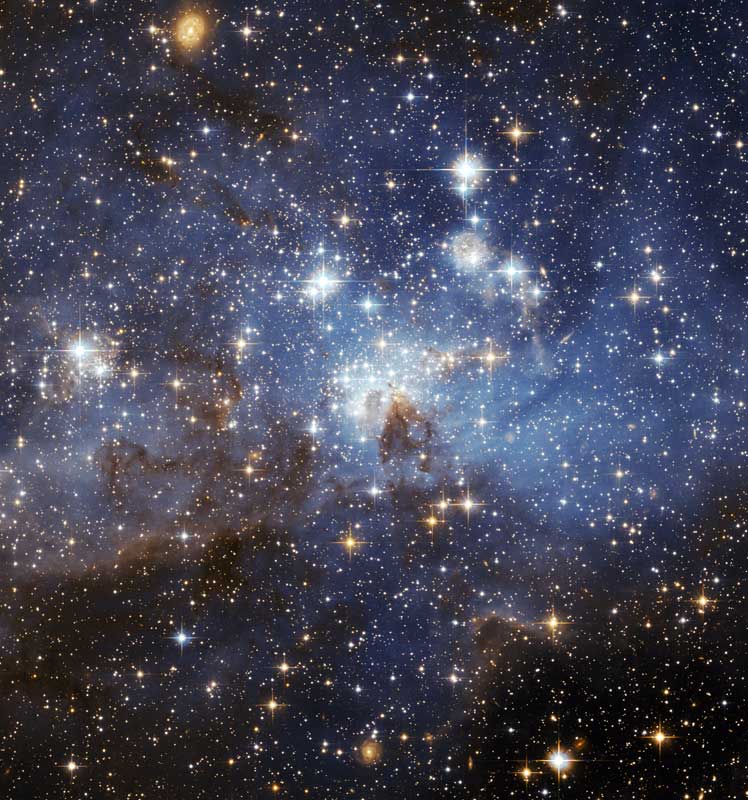
Here is your weekly reminder of Psalm 19 — star forming region, LH 95.
LH 95 is a stellar nursery, a region in which star formation is actively occurring, in the Large Magellanic Cloud (LMC). The LMC is a small, irregular satellite galaxy orbiting the Milky Way, but visible only from the Southern Hemisphere. LMC’s close proximity allows detailed views of stars and nebulae in a galaxy outside of our own.
Astronomers have identified thousands of baby stars in their initial stages of development in this nursery, providing a detailed picture of how star formation in the early Milky Way likely occurred. The blue color in LH 95 is starlight from very large, hot stars reflecting off hydrogen gas. This glowing gas is surrounded by the cold, dusty molecular gas out of which new stars form.
Image credit: NASA, ESA, and the Hubble Heritage Team (STScI/AURA)-ESA/Hubble Collaboration.
Stephen Hawking is back in the news making a fool out of himself. In an interview with a Spanish newspaper, Hawking is quoted as saying, “The laws of science are sufficient to explain the origin of the universe. It is not necessary to invoke God.”
Hawking could only be referring to the multiverse as this explanation, as there are no other “scientific” explanations for the origin of the universe. The problem is, as eminent physicist George F. R. Ellis puts it, the multiverse is just “scientifically based philosophical speculation.” Or, as I like to say, the multiverse isn’t science, it’s merely science flavored.
Surak dismantled Hawking’s specious argument the last time he claimed science had usurped God, so I won’t rehash that. What I want to do, is take this opportunity to contrast the modern, secular scientism so evident in Hawking’s claim with the classical, Newtonian view of science. Consider the following, written by John Maynard Keynes in his essay, “Newton, the Man”:
Because he [Isaac Newton] looked on the whole universe and all that is in it as a riddle, as a secret which could be read by applying pure thought to certain evidence, certain mystic clues which God had laid about the world to allow a sort of philosopher’s treasure hunt to the esoteric brotherhood. He believed that these clues were to be found partly in the evidence of the heavens and in the constitution of elements … but also partly in certain papers and traditions handed down by the brethren in an unbroken chain back to the original cryptic revelation in Babylonia. He regarded the universe as a cryptogram set by the Almighty—just as he himself wrapt the discovery of the calculus in a cryptogram when he communicated with Leibniz. By pure thought, by concentration of mind, the riddle, he believed, would be revealed to the initiate.
In his biography of Newton, Mitch Stokes commented further:
Most modern scientists pride themselves on having purged themselves of thoughts of mystery and magic, while unwittingly using theories that are as mystical as they are “scientific.” Newton, believing that the world is full of magic, found that it *is* full of magic. He, in turn, revealed some of his discoveries to us.
If you take the particular atheistic view of the universe that there is no God and that only science can reveal the true nature of the universe, then it is one of the great ironies of the world that a classical mystic who thought he was working magic ended up being the greatest practitioner of science who ever lived, while a modern secular hero of science who thinks he’s practicing science is really just working magic.
Here is your weekly reminder of Psalm 19 — a “supermoon” lunar eclipse.
Last Sunday, many of us were treated to a rare combination of a lunar eclipse and a “supermoon.” A supermoon occurs when a full moon phase coincides with the Moon being at its closest point in its slightly elliptical orbit around the Earth, making our lunar companion look slightly larger (~14% in diameter) in the sky than normal. What really makes a supermoon “super” is its increased brightness — owing to its closeness to the Earth, a supermoon is 30% brighter than a regular full moon.
A lunar eclipse occurs when the Earth moves between the Sun and the Moon, blocking out the sunlight that normally reflects off of a full moon.
When I teach introductory astronomy, the students who are really paying attention will ask why we don’t always get a lunar eclipse during a full moon phase. The answer is, the plane of the Moon’s orbit (outlined with the green circle above) is slightly tilted with respect to the Earth’s orbital plane (outlined in blue), so that most of the time the Earth does not block light coming from the Sun. Rarely, we’ll get the Sun, the Earth, and the Moon lining up when the Moon is in the Earth’s orbital plane, and that’s when we experience a lunar eclipse.
The next time a supermoon will coincide with a lunar eclipse is in the year 2033.
Here are several fun astronomical events you and your family can enjoy in the month of October — plus, a reminder for the lunar eclipse at the end of September. All you need is an inexpensive telescope or binoculars for most of these events, but some of them are viewable with the naked eye.
Reminder! September 27-28: Total Lunar Eclipse. A total lunar eclipse occurs when the Earth moves between the Sun and the Moon (see below). Unlike a solar eclipse, in which the Moon moves between the Sun and the Earth, you don’t need any protective eyewear to watch a lunar eclipse. During the eclipse, the Moon will gradually get darker, ultimately turning red in color. The lunar eclipse will be visible from the Americas, Europe, Africa, and parts of Asia. See here to determine visibility and times in your part of the world.
October 1: Comet C/2013 US10 Catalina. This comet was discovered on Halloween 2013. It could be bright enough to be visible with the naked eye in the Southern hemisphere by the beginning of October. By mid-November, it should be bright and visible in the North.
October 8: Draconids Meteor Shower. Meteor showers occur when the Earth moves through a cloud of debris left behind by a comet. The Draconids are debris from Comet 21P Giacobini-Zinnere, and appear to radiate from the constellation Draco. As meteor showers go, this one is kind of paltry with a modest 10 meteors per hour at its peak. The shower runs every year from October 6th to October 10th, but will peak in the early evening of the 8th.
October 16: Mercury at Greatest Western Elongation. Mercury will be at its greatest apparent distance from the Sun in the sky (~18 degrees). Mercury is best observed in the morning, just before sunrise.
October 21,22: Orionids Meteor Shower. The Orionids are debris from Comet Halley, and appear to radiate from the constellation Orion. As meteor showers go, this one is average with 20 meteors per hour at its peak. The shower runs every year from October 2nd to November 7th, but will peak the night of the 21st and early morning of the 22nd.
October 26: Venus at Greatest Eastern Elongation. Venus will be at its greatest apparent distance (~46 degrees) from the Sun in the sky. It’s a great time to observe Venus, because it’ll be highest in the sky in the morning, just before sunrise.
October 26: Conjunction of Jupiter and Venus. A conjunction occurs when two or more planets overlap, or appear very close together, in the sky. This is the second conjunction of these two planets this year (the closest occurred in July). In the early morning of the 26th, just before sunrise, Jupiter and Venus will appear within 1 degree of each other on the sky, which is the same distance as two Moon diameters.
October 28: Conjunction of Jupiter, Mars, and Venus. This is a rare three-planet conjunction, in which Jupiter, Mars, and Venus form a 1-degree triangle on the sky. It will be visible in the early morning of the 28th, just before sunrise.
Here is your weekly reminder of Psalm 19 — the planet Mercury.
Mercury is the smallest planet, as well as the planet closest to the Sun. It has a remarkably long day — a Mercury day lasts 88 Earth days — and a relatively short year (116 Earth days). Because of the peculiar ratio of its orbital period to its rotational period, a hypothetical observer on Mercury would experience only one day for every two years.
Mercury has no atmosphere, so the range of surface temperatures is extreme — -280 F during the night (the part of Mercury that faces away from the Sun) and up to 800 F during the day (the part of Mercury that faces toward the Sun).
Mercury has the most eccentric orbit in the Solar System, which means that out of all the planets, its orbit is the most like an ellipse. The part of its orbit closest to the Sun (the perihelion) precesses, which means Mercury’s orbit spirals around the Sun like a spirograph. Newton’s version of gravity could account for some of this precession, but not all of it. The reason for the discrepancy remained a mystery for centuries, until Einstein formulated his General Theory of Relativity, which explained the precession in terms of the way the Sun warps space around Mercury.






 SixDay Science
