Mars orbiter spots Mars rover

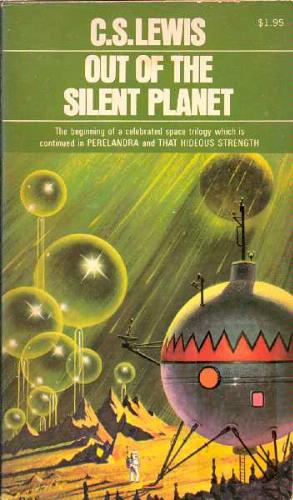
The Mars Reconnaissance Orbiter captured the progress of the Mars Exploration Rover Opportunity as it investigates a 90-meter crater on the Martian surface. A few months ago the rover was on one side of the crater, and it’s apparently made its way to the other side. See if you can spot it below. (No word on whether any hrossa or pfifltriggi have been seen.)


(Click on the photo to see a larger version.)

Continue reading

But you look so … old

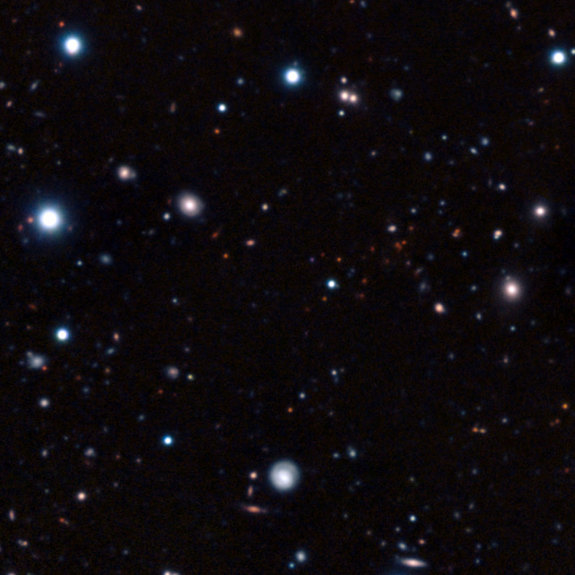
Galaxy cluster CL J1449+0856 (Credit: ESO)

When I turned 40 recently, people kindly told me, “But you still look young.” So, what do you tell someone who is young but looks old? This is my brilliant segue into a description of a strange discovery by astronomers who observed a galaxy cluster that’s only three billion years old but looks much older. Here’s a neat vid showing its location in the sky (but don’t bother looking for it tonight unless you’ve got a world-class telescope):

Galaxy clusters are the main structures of the universe. A single cluster can contain thousands of galaxies, all gravitationally bound to each other. Because this particular cluster is so far away, astronomers are seeing it as it was when it was very young. (The idea in astronomy is that the further away you look in space, the earlier in time you’re observing the universe. That’s because light, although extremely fast, travels at a finite speed.) Astronomers therefore expected to see typical signs of youth in the cluster — stars actively forming in the galaxies and very little hot, X-ray emitting gas. Instead, what they observed was an older population of stars with very little star formation, and a significant amount of X-ray emitting gas, which usually takes time to accumulate and get trapped in the cluster. Astronomer Raphael Gobat comments, “Such clusters are expected to be very rare according to current theory, and we have been very lucky to spot one. But if further observations find many more, then this may mean that our understanding of the early universe needs to be revised.”

That’s how science works. Observe, hypothesize, observe, theorize, observe, revise … .

Continue reading

A final welcome home for Discovery

Space Shuttle Discovery made its final landing yesterday. Astronaut Michael Barratt noted it was “about time” for the shuttle to retire, but at the same time he and the rest of the crew expressed sadness at the occasion:

“This is a pretty bittersweet moment for all of us,” [Commander] Lindsey said on the runway. “As the minutes pass, I’m getting sadder and sadder about this being the last flight. And I know all the folks involved in the shuttle program feel the same way.”

A lot of that feeling comes from the knowledge that there is no new spacecraft to replace the aging fleet of shuttles.

Space Shuttle Endeavour is scheduled to make its final journey into the great beyond in April, followed by Atlantis in June.

Continue reading

Summary of Gerald Schroeder event

As previously announced here, acclaimed scientist and theologian, Dr. Gerald Schroeder, presented a lecture last evening in Austin on the origins of humankind from a scientific and biblical perspective. By my count, over 150 people attended the lecture, with the audience skewing very young. Dr. Robb Wilson of The Scholar Redeemer audio-recorded the lecture, and we should have a podcast of sorts available here within the next few days. In the meantime, here is a brief summary of the event.

Dr. Schroeder began with his explanation for reconciling the biblical calendar with the scientifically-calculated age of the universe of 14 billion years using the well-studied phenomenon of time dilation that arises from the expansion of the universe. His explanation hinges on an ancient interpretation of Genesis 1, which says that the first six days are distinct and separate from the rest of the biblical calendar. He argued that these six days actually contain billions of years if looked at properly. Genesis time stops partway through the sixth day with a special event — the creation of Adam — at which point the conventional biblical calendar starts. Dr. Schroeder then segued into the main topic by announcing that Adam had parents. I suspect some people were rather shocked by this notion, but Dr. Schroeder laid out the overwhelming scientific evidence for pre-Adam hominids as well as evidence from the Bible itself. The key point was that the creation of Adam was a spiritual creation, not a physical one. Human-like beings existed prior to Adam, but they were not human because they lacked the neshama (which we may be tempted to call the “soul,” but it’s more than that). After Adam received the neshama, he is described as becoming a “communicating spirit.” This tells us that the defining quality of Adam as a human being, what separated him from his predecessors, was the ability to communicate with God.

The lecture ran slightly long, which unfortunately only left time for half a dozen questions from the audience. But they were all good, substantive questions; one in particular (which I can’t remember, but will hopefully be audible on the recording) was of particular interest to Dr. Schroeder. Several young people approached Dr. Schroeder after the lecture with more questions and comments and requests for book signings. I noticed that several of them were also taking photos of the diagrams he made on the whiteboard during his talk. For any of our readers who were present at the lecture and would like to know more about the information in those diagrams, I strongly encourage you to read his best-selling book, The Science of God.

Update: Due to some unforeseen difficulties posting the audio recording, there will be no podcast of the lecture. Sorry.

Continue reading

Space missions for the next decade

Photo of the Jovian moon, Europa, taken by the Galileo spacecraft

To infinity and beyond! Well, to the middle-outer reaches of the solar system, anyway. If we can afford it. The National Research Council’s top recommendations for big space missions in the next decade:

  • visit Mars to determine if it ever had life
  • visit Jupiter’s moon, Europa, which likely has a liquid ocean underneath its icy surface that may harbor life
  • check out the atmosphere of ice giant, Uranus

I got a little excited when I saw the title of the TechNewsWorld article, thinking we were planning manned visits to Mars and Europa, but alas these visits would all be carried out with unmanned probes. Still, these missions would bring back important information about our nearest neighbors and the potential for life beyond Earth.

Continue reading

Of robots and revulsion

I am generally positive about high technology, and as a science fiction fan I have never had a problem with the concept of androids — until now. Check this thing out:

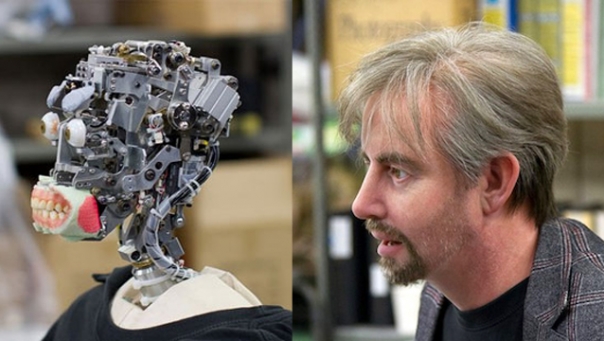
The guy on the right is not a real person, it’s a very sophisticated robot, called Geminoid DK, created by Japanese researchers. It seriously creeps me out:

Why am I disturbed by this thing instead of curious about it or even sympathetic to it the way I am with Data, the android from Star Trek: The Next Generation? Because, underneath all the makeup, I know Data is a real person. (Plus, the more you think about his character, the more you realize how unintentionally human he is.) But the Geminoid robot? I know it’s not a real person.

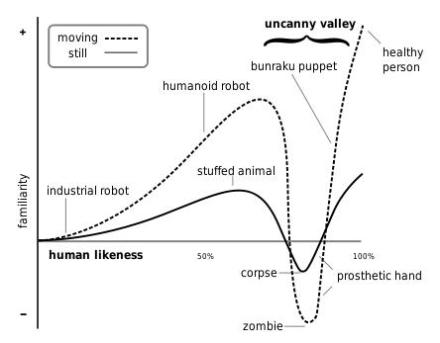
There is supposedly an explanation for this revulsion. It’s called the “uncanny valley,” and it says that our feelings of sympathy for a robot are proportional to how human-like it is, up until a point where the similarities rapidly become repulsive. Then as the robot becomes indistinguishable from a human, our feelings of sympathy rise again. The effect is enhanced if the robot moves. The graph below shows what this looks like:

Human emotional response to objects as a function of how human-like they are. (From the Wikipedia entry on "uncanny valley.")

The problem with this explanation is that until now, we haven’t had any robots that were anywhere close to indistinguishable from humans, so there could not have been direct testing of how humans react to such robots. Furthermore, when I showed the video to some relatives, they didn’t think anything of it until they realized it wasn’t human. Then they were horrified. There seems to be something within us that is innately repelled by an object that looks and acts human and yet lacks both animal intelligence and a soul.

I don’t see the Geminoid robot as a wonderful technological breakthrough. In fact, for the first time I am deeply troubled about the prospect of androids ever serving humanity. I don’t think the outcome would be like Data, but something more like the replicants from Blade Runner.

Continue reading

When philosophy dominates science

** Written by “Surak” **

Dr. Robb Wilson, who blogs at The Scholar Redeemer, commented on my article “Separating philosophy from science,” and made the following important points:

“good science is NOT aphilosophical”

“a blanket statement that philosophy corrupts science is misleading … there is a philosophy at the root of methodological naturalism as well.”

In light of his excellent comment, I would like to take another shot at what I intended to say.

Ancient Greek philosophy was indeed the solid and necessary foundation on which the first scientific efforts took place, and it was the Judeo-Christian worldview that made modern science possible. I fully accept that whenever and wherever the dominant philosophy/religion of the day acted as a rational foundation on which something higher and broader could be constructed, science flourished. But sometimes the dominant worldview has included beliefs that act like confining walls and a low ceiling on science. The most obvious example is the ancient belief that the Earth was the center of the universe, which helped delay modern science by about 1,800 years.

The point I wanted to make in my original article is that there is today a philosophy that dominates most Western centers of learning, and elements of that philosophy threaten to delay desperately-needed scientific advances in fields such as biology, medicine, psychology, and social behavior. My fears seem to be confirmed by an article published in the February 7, 2011 online edition of the New York Times, titled “Social Scientist Sees Bias Within” by John Tierney. The article quotes Jonathan Haidt, a social psychologist at the University of Virginia, regarding what he describes as a liberal bias in his field:

“This is a statistically impossible lack of diversity,” Dr. Haidt concluded, noting polls showing that 40 percent of Americans are conservative and 20 percent are liberal. In his speech and in an interview, Dr. Haidt argued that social psychologists are a “tribal-moral community” united by “sacred values” that hinder research and damage their credibility — and blind them to the hostile climate they’ve created for non-liberals.

While Tierney and Haidt appear to see the problem largely in political terms as part of a liberal vs. conservative struggle, the root of the problem for this branch of science is really philosophical because the “sacred values” cited by Dr. Haidt are those of humanism.  Our original article on ‘transcranial magnetic stimulation’ was an attempt to demonstrate that a similar philosophical problem exists in biology.

There is also evidence that humanist dominance is causing severe problems in the field of anthropology, for example, the controversial decision last year by the American Anthropological Association to remove the word “science” from an official statement of its long-range plan. The problem extends to general psychology, as well. In their 2005 book, Destructive Trends in Mental Health: The Well-Intentioned Path to Harm, Rogers H. Wright and Nicholas A. Cummings identify some distressing developments in behavioral science. In the preface they include the following statements:

Why, after decades of fighting to establish the rightful role of professionalism in psychology, do we now question the validity and integrity of some of the prevalent practices in our profession? The answer is simple: psychology and mental health have veered away from scientific integrity and open inquiry, as well as from compassionate practice in which the welfare of the patient is paramount.

These taboo topics typically unleash a silencing array of unwarranted charges ranging from political incorrectness, insensitivity, and lack of compassion to (in the extreme) bigotry. We are troubled that disciplines such as psychology, psychiatry, and social work, which pride themselves on diversity, scientific inquiry, intellectual openness, and compassion for those who need help, have created an atmosphere in which honest, albeit controversial, points of view are squelched.

We decry the extremism on the right, but we do not address it in this volume because that is not the problem within organized mental health today. Psychology, psychiatry, and social work have been captured by an ultraliberal agenda, much of which we agree with as citizens. However, we are alarmed with the damaging effect it is having on our science, our practice, and our credibility.

It [American Psychological Association] is no longer perceived as an authority that presents scientific evidence and professional facts. The APA has chosen ideology over science, and thus diminished its influence on the decision makers in our society.

Within the profession of psychology there is currently debate over treatment techniques and interventions that have not been scientifically validated.

It is obvious that we need a greater diversity of ideas and a counterbalance to the prevailing ideologies within mental health circles today. … We must broaden the debated by reducing the ridicule and intimidation of ideas contrary to the thinking of the establishment in the field of psychology.

Once again, the ultra-liberalism identified by the authors is best understood as the political manifestation of a relatively new philosophical orthodoxy, and the indisputable truth is that humanism is the philosophy that dominates many if not most universities and colleges in America today. I believe a strong case can be made that some humanists are guilty of many of the same transgressions against science that Christians have long been accused of, including

  • Attempting to establish a new orthodoxy verging on dogma
  • Stifling of descent
  • Condemning and purging those with non-humanist views
  • Corrupting science for political, social and economic goals

If psychology and the social ‘sciences’ continue to be dominated by a philosophy hostile to the free exploration and exchange of ideas, how will they ever develop desperately needed casual understanding about the human condition? A delay in the behavioral sciences similar to the delay in the physical sciences that occurred between Aristarchus and Copernicus would be more than a scientific tragedy; it would be a disaster for humankind. Our hope has to be that the study of human behavior will somehow break through the confining walls of humanism, undergo a cathartic paradigm shift, and become true science.

Continue reading

Alien life and the Christian view of Creation

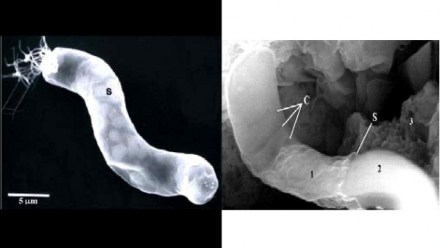
A bacterium from the meteorite (right) is similar in size and structure to the terrestrial bacterium Titanospirillum velox (left) (Riccardo Guerrero / Richard B. Hoover / Journal of Cosmology)

Fascinating:

Dr. Richard B. Hoover, an astrobiologist with NASA’s Marshall Space Flight Center, has traveled to remote areas in Antarctica, Siberia, and Alaska, amongst others, for over ten years now, collecting and studying meteorites. He gave FoxNews.com early access to the out-of-this-world research, published late Friday evening in the March edition of the Journal of Cosmology. In it, Hoover describes the latest findings in his study of an extremely rare class of meteorites, called CI1 carbonaceous chondrites — only nine such meteorites are known to exist on Earth.

Though it may be hard to swallow, Hoover is convinced that his findings reveal fossil evidence of bacterial life within such meteorites, the remains of living organisms from their parent bodies — comets, moons and other astral bodies. By extension, the findings suggest we are not alone in the universe, he said.

Claims like this have been made before, and while previous claims turned out to be unsupported by the evidence, they always give rise to the question of whether the presence of life elsewhere in the universe undermines the Judeo-Christian view of Creation. The best answer is the simplest one: it doesn’t. Ancient and medieval Jewish scholars of the Genesis account of creation maintained that the universe was created with the potential for life built into it. This agrees with the growing scientific evidence that the universe is undeniably tuned for life. Working from both perspectives, I would be surprised if we did not eventually find evidence of at least the most basic forms of life elsewhere.

The religiously pivotal question is whether or not we ever find intelligent or even conscious life elsewhere since, according to the Judeo-Christian view, these would have to be deliberate creations by God. As physicist and theologian Gerald Schroeder points out in his book The Science of God, two different verbs are used in Genesis when describing key events: “created” and “made.” The former refers to the instantaneous act of bringing something into existence from nothing. Genesis uses this word only three times: first for the creation of the universe on day one, then for the creation of animal (intelligent) life on the fifth day, and for the last time on the sixth day when Adam is endowed with a human soul. For the remaining events of the six days of Genesis, including the third day when life first appears, the word “made” is used, as though something that already existed was merely being restructured. Non-intelligent forms of life, like the primitive bacteria discovered by Dr. Hoover, would fall under the category of “made.” Intelligent and conscious forms of life would fall under the category of “created.”

With this in mind, let’s ask a revised version of the key question, “Would the discovery of conscious beings elsewhere in the universe undermine the Judeo-Christian view of Creation?” It would if Genesis stated that the creation of Adam is a unique event, not to be repeated elsewhere in space or time. I have not seen anything in scripture to suggest this is the case. In fact, the great Christian apologist, C. S. Lewis, laid out a plausible scenario for conscious life on other planets within the context of the Judeo-Christian view in The Space Trilogy. In these novels, humans encounter alien beings on other planets in the solar system that, though they have some things in common with us, are wonderfully unfallen and thus enjoy direct communication with the Creator.

This brings us to one of the great problems for the materialist view that humans have no spiritual component: the need to explain why an overwhelming majority of humans throughout history have demonstrated a deep longing for the spiritual. The prevailing explanation seems to be that it is an evolutionary tic, an unfortunate byproduct of an otherwise beneficial genetic mutation. So let’s engage in a bit of speculation to turn the tables: would the discovery of conscious beings on another planet who turn out to be as spiritually-inclined as humans undermine the materialist view of existence? Seems to me it would, given the immense improbability of two entirely different species of conscious beings developing the same evolutionary tic independently.

Continue reading