Evidence for jet mechanism of black hole Cygnus X-1

Artist's conception of material from a nearby star forming a plasma disk around black hole Cygnus X-1. Credit: ESA

Astrophysicists have observed what appears to be direct evidence of strong magnetic fields around a black hole, supporting a popular theory about the production of plasma-and-radiation jets observed to emanate from these mysterious objects. The evidence comes from seven years of data showing high-energy polarized light radiated from a region near the event horizon of Cygnus X-1, the first black hole ever observed.

Polarized light is light that vibrates in a specific pattern, and it can be a signature of radiation from charged particles that are sped up in a magnetic field. The magnetic field is a product of super-hot plasma — material torn from a nearby star — that’s smeared into a disk around the black hole. The twisting of the magnetic field lines as the black hole rotates is believed to be the mechanism for producing jets.

Cygnus X-1 was discovered as a mysterious X-ray source in the 1960s, but it was many years later when astrophysicists reached consensus that it was a black hole1. The discovery and speculation as to its nature inspired the prog-rock band, Rush, to write a song about Cygnus X-1 in the late 1970s, complete with some of the best rock-song lyrics of all time:

Continue reading

Quantum physics could explain our sense of smell

Did you know that nobody really knows how the nose knows? But some scientists think our sense of smell could come down to quantum physics:

The key, [scientists] say, is tiny packets of energy, or quanta, lost by electrons.

Experiments using tiny wires show that as electrons move on proteins within the nose, odour molecules could absorb these quanta and thereby be detected.

The way our brains translate raw data from our noses into a smell is apparently understood, but how our noses recognize odor molecules in the first place is still largely unknown. The quantum explanation, once highly debatable, now appears to be more plausible with the results from these experiments.

Continue reading

Coldest-ever brown dwarf discovered

Astronomers have discovered the coldest-ever failed star with a surface temperature of 100o C. To give you some perspective, consider: 1) the hardiest Finns can easily withstand 120o C saunas; and 2) our Sun, a relatively mediocre star, has a surface temperature of almost 5,500o C.

This lukewarm object, called CFBDSIR J1458+1013B, appears to be a brown dwarf, a class of objects somewhere between star and super-planet. The distinction between star and brown dwarf is clear — a star is only a star if it undergoes nuclear fusion in its core — but the distinction between brown dwarf and super-planet isn’t as clear.  Brown dwarfs are all about the same size as Jupiter, but they pack a lot of mass into that space — at the high end of the range, they can be 90 times the mass of Jupiter — and unlike planets, they sometimes emit X-rays. CFBDSIR J1458+1013B is at the lower end of the range with a mass of about 6-15 Jupiter-masses. With its super-cool surface temperature, astronomers speculate that it could even have water clouds in its atmosphere.

Continue reading

Radiation dose chart

I’m encountering a lot of people who are understandably concerned about radiation leakage from the damaged Fukushima plant in Japan. But very few of them seem to know the extent to which exposure to radiation is a fact of life on Earth. Did you know, for instance, that you’ll be exposed to more radiation by eating a banana than by living within 50 miles of a nuclear power plant for a year?

Randall Munroe, who pens the hilariously geeky webcomic, xkcd, has teamed up with a friend at the Reed Research Reactor to create a visual aid for understanding radiation exposure levels. As Munroe cautions, the situation at Fukushima seems to be changing by the hour, but this should at least help put things in perspective.

Click on the image to enlarge.

Stars caught in the act of merging

It appears a close binary system — a pair of stars orbiting so close they were touching — has finally merged into a single stellar object, producing an enormous flash of light in the process. The pair, called V1309 Sco, was observed by astronomers to briefly reach a luminosity 10,000 times greater than normal (30,000 times more luminous than the Sun) before settling back down to its normal brightness. Astronomers believe the unusual flash corresponded to the moment when the two stars merged — the first time such an event has been directly observed.

It is not known how common such close pairs are, but multiple-star systems of larger separation are quite common. This vid features animation (apparently using real data) showing the orbits of several known binary star systems.

Continue reading

Nerve cells link up through tiny tubes

The affinity of nerve cells for exploring tiny tubes could lead to futuristic neuroscience developments:

Nerve-cell tendrils readily thread their way through tiny semiconductor tubes, researchers find, forming a crisscrossed network like vines twining toward the sun. The discovery that offshoots from nascent mouse nerve cells explore the specially designed tubes could lead to tricks for studying nervous system diseases or testing the effects of potential drugs. Such a system may even bring researchers closer to brain-computer interfaces that seamlessly integrate artificial limbs or other prosthetic devices.

The technology required to interface the brain with a computer is apparently still a long way off, but every step in the right direction counts. (Unless of course this is one more step toward a Borg future, in which case prepare to be assimilated.)

“Super Moon” visible tonight

If you happen to be outside this evening, check out the Moon when it’s close to the horizon — it’s going to appear slightly larger than usual, thanks to a (somewhat) rare alignment of the Moon’s position in its orbit around Earth relative to the Sun.

The media are referring to it as a “Super Moon.” So, what exactly makes it “super”? The Moon has a slightly elliptical orbit around the Earth, which means sometimes it’s a little closer to the Earth (this position is called “perigee”) and sometimes a little further away (“apogee”). The difference is about 42,000 km, which sounds like a lot, but it’s only about 10% of the Moon’s average distance from the Earth. Today’s perigee is a smidgen1 closer than usual, but not enough to have any significant impact on ocean tides, earthquakes, or volcanic activity. Anyway, when the Moon’s perigee is especially close and coincides with a full moon, that seems to be a “Super Moon.” But it really amounts to a not-so-super 14% increase in the Moon’s apparent size in the sky compared with its apogee size. (I think I just broke the record for how many times the word “moon” can be crammed into a blog post.)

This NASA vid explains it all with nifty images:

DIY Science: If you’re an empirical kind of person, you can try the following: hold up a ruler or some other reference object at arm’s length (steady your arm on a stable surface) and carefully measure the apparent size of the Moon tonight, then do the same on October 12th when there is another full moon, but this time its close to apogee. See if you can detect a slight difference. If you have a telescope equipped with an eyepiece with a linear-scale reticle, this should be a piece of cake.

Continue reading

MESSENGER probe locks into orbit around Mercury

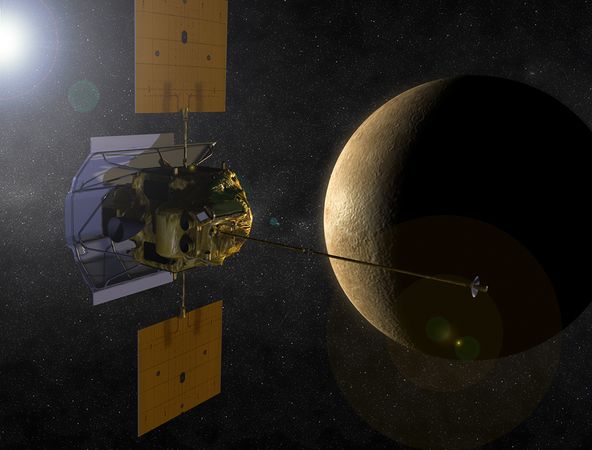
Artist's conception of MESSENGER approaching Mercury (Credit: NASA)

For the first time ever, we have a probe orbiting the planet Mercury. The MESSENGER probe was successfully maneuvered into orbit around Mercury yesterday following a six-and-a-half-year series of gravitational flybys past Earth, Venus, and Mercury, to nudge it into course. Starting in April, MESSENGER will make two orbits of Mercury per (Earth) day, collecting information to send back to scientists on Earth.

Previous missions to Mercury include the Mariner 10 spacecraft, which gathered data as it quickly flew past Mercury three times in 1974-1975, and three data-collecting flybys of Mercury by the MESSENGER probe in 2008-2009.

NASA scientists hope the mission will help answer several questions about Mercury, including why the tiny planet is so dense, what its geological history is, and whether there is actually ice at its poles.

Continue reading

Methane rain on Titan

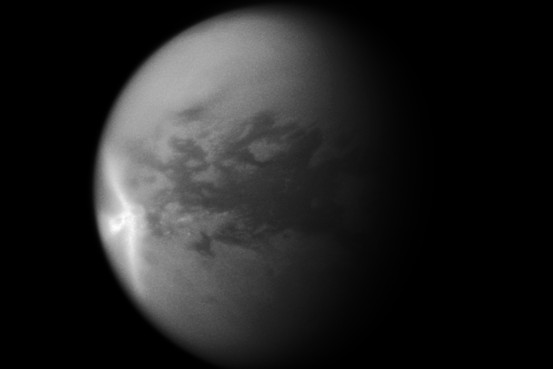
NASA's Cassini spacecraft snapped this infrared photo of equatorial rainfall on Titan (Credit: NASA/JPL/Space Science Institute)

Spring has sprung on Saturn’s largest moon, Titan, and that means rain showers. But not the kind of spring showers that bring flowers — on Titan it rains methane:

Instead of water, as on Earth, Titan’s cycles of precipitation, evaporation and cloud formation involve hydrocarbons such as methane and ethane, which at the extremes of cold on Titan pool as liquids in thousands of lakes around its north and south poles. Indeed, scientists estimate that Titan holds hundreds of times more liquid hydrocarbons than all the known oil and natural gas reserves on Earth.

Outer space may seem hostile to advanced life, but the solar system is rich in natural resources needed to survive. If we ever venture out into the solar system with long-term or permanent manned space missions, we should have little trouble availing ourselves of necessities like bulk building materials, hydrocarbon fuels, water, and oxygen.

Update: APOD has featured an artist’s conception of what it might look like from the surface of Titan (not very inviting).

Continue reading