Well, that’s that. Space Shuttle Atlantis has landed safely, bringing a close to NASA’s space shuttle program after more than 30 years. It was inevitable and necessary, but depressing nonetheless. I can’t bring myself to say more on the subject, so I’ll leave you with the encouraging words of Bill Whittle on the future of space travel.
Fourth moon discovered around Pluto

Ultraviolet images taken with the Hubble show the location of P4.
Astronomers using the Hubble Space Telescope have discovered another moon orbiting Pluto, joining the ranks of Pluto’s three other known moons. The largest, Charon, was discovered in 1978 at the U.S. Naval Observatory in Flagstaff. The existence of two other moons — Hydra and Nix — was confirmed using the Hubble telescope in 2005. The newly-discovered moon has been given the tentative name P4. (Presumably the discoverers or the IAU will come up with something more interesting once a little more is known about it. I offer ‘Zaphod’ as a candidate. It’s about time we started introducing ephemeral pop culture to outer space.)
Incidentally, Pluto is the only member of the original nine-planet system that has not been explored by an Earth probe; but that will change in 2015 when the New Horizons probe, launched in 2006, flies by to study the dwarf planet and its four (known) moons.
The flying car is here!
If you’ve got a driver’s license, a light-aircraft license, and about $230,000 in spare cash, you can put in an order for a Terrafugia Transition, which is supposed to be available by late 2012 (supply delays have pushed this date back from the planned 2011 roll-out date).
You won’t be able to use it to fly out of traffic (or back in time), but you can drive it to the airport and take off from there. A particularly nice feature is that it runs on plain old unleaded gasoline whether you’re driving it or flying it.
Final voyage of Atlantis marks the end of the shuttle program

Space Shuttle Atlantis roared into space at 11:30 EDT this morning, marking the final launch in a program that started three decades ago.
This pretty well sums up my sentiments on this day:
“It’s kind of a letdown knowing we now have to rely on foreign interests” to launch American astronauts into space, said Terry Deguentz, a firefighter from St. Louis who said he was friends with one of Atlantis’s astronauts, mission specialist Sandy Magnus. “American ingenuity has been downplayed in the last decade. Once we let it go, I wonder if we can get it back.”
Guess the object
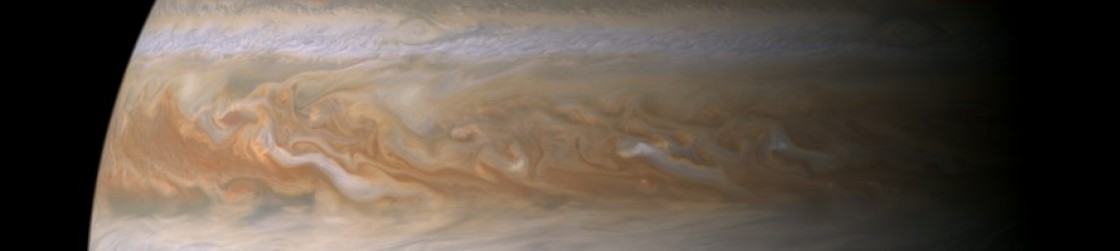
What’s 15,000 km by 300,000 km in size and looks like this?

Why, a seasonal storm, of course. But on which planet?
The universe is (very probably) not holographic
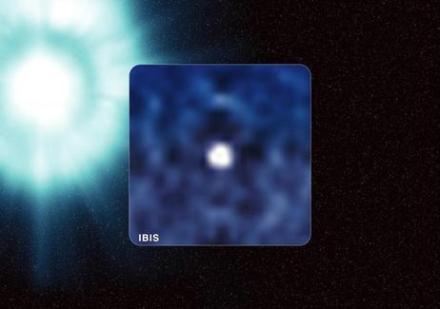
Remember a couple of years ago when physicists thought the universe might be a hologram? No? Well, anyway, it turns out the universe is (almost certainly) not a hologram.
Liquid metal pen allows hand-drawn circuits
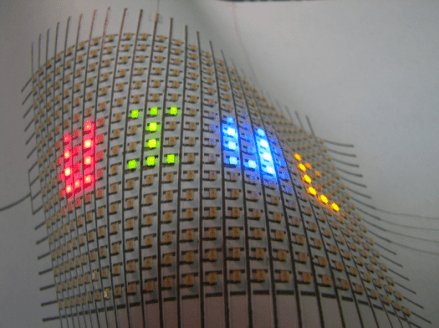
Researchers at the University of Illinois at Urbana-Champaign have developed a liquid metal “ink” that, when used in a ballpoint pen, allows circuits to be hand-drawn. Circuits can be drawn on flat surfaces, like paper, as well as irregular surfaces. In the photo above, researchers used the pen to hand-draw circuits that connected to LEDs (light-emitting diodes) powered by a battery connected to the paper. During testing it was shown that a circuit drawn on a piece of paper using the liquid metal ink could survive intact even if the paper was folded thousands of times.
The practical upshot:
“Pen-based printing allows one to construct electronic devices ‘on-the-fly’,” says Jennifer Lewis, one of the engineering profs who came up with the new pen at Illinois uni. “This is an important step toward enabling desktop manufacturing (or personal fabrication) using very low cost, ubiquitous printing tools.”
Would you like fries with that?
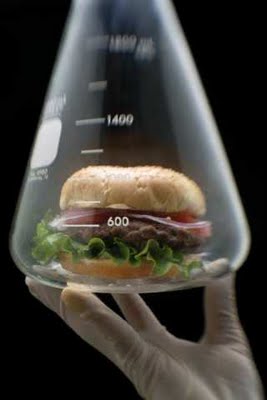
Dutch scientists believe they are about one year away from producing the first “test-tube hamburger” — that is, beef grown from stem cells.
I’m all for technology, and hamburgers are just about my favorite food, but this doesn’t sound at all appetizing. It doesn’t help that the lead scientist for the project isn’t too keen to be the first person to try it, either.
Close encounters of the rocky kind
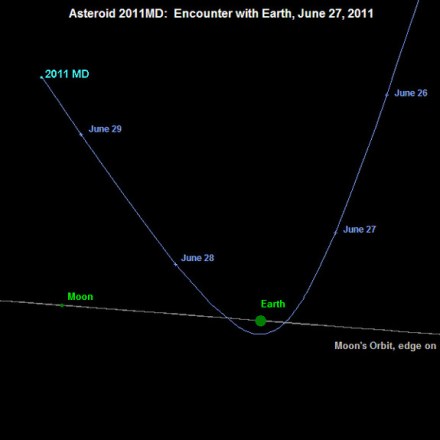
A bus-sized asteroid will “just” miss the Earth today around noon CDT. Asteroid 2011 MD, which is estimated to be 9-30 meters in size, will come within about 7,500 miles of the surface of the Earth, pretty close as far as asteroid encounters go, and well within the 22,000 mile radius of geosynchronous satellite orbits. But for comparison, it is well beyond the 220-mile orbit of the International Space Station. Even at its closest approach, the asteroid will not be visible to the naked eye, but may appear as a bright dot to sharp-eyed observers with medium-sized telescopes.
NASA scientists, who have been tracking asteroid 2011 MD since June 22, say there is “no chance” it will strike the Earth. Even if it did, its rocky composition means it would very likely break apart and burn up in the atmosphere (over Antarctica). The ones you have to watch out for are the rocks made up of iron, which are more likely to survive the trip through the atmosphere.
This isn’t the first close-encounter we’ve had this year. Asteroid 2011 CQ1 came within 3,400 miles of Earth in February, and set a new record as the closest recorded pass ever. NASA estimates that moderate-sized asteroids make close flybys about six times a year, and they have not been able to track all of them — asteroid 2011 CQ1 wasn’t discovered until hours before its closest approach. But the truth is, the Earth is struck by stuff from outer space all the time, and we haven’t experienced a catastrophic event for a very long time. Approximately 500 small meteors make it all the way to the surface of the Earth each year, and it is estimated that about one small asteroid (1-10 meters in size) reaches the Earth per year. The latter usually break up and vaporize in the upper atmosphere. Fortunately, there is an inverse relationship between the size of an object and the frequency with which it is likely to strike the Earth. In other words, the bigger they are, the less likely we are to be hit by one. Here is a comparison of asteroid radius and strike frequency:
- 10 m: every year
- 50 m: every 1,000 years
- 1 km: every 500,000 years
- 5 km: every 10 million years
- 10 km: every 100 million – 1 billion years
The last known very large impact event involving an asteroid about 10 km in size is the one that is believed to have wiped out the dinosaurs 65 million years ago. We’re not due for even a 1 km event until the year 2880 when asteroid (29075) 1950 DA has a possibility of hitting the Earth. So it’s probably okay to carry on with civilization for a while longer.
Friday
It’s the end of the week, and I got nothin’.

 SixDay Science