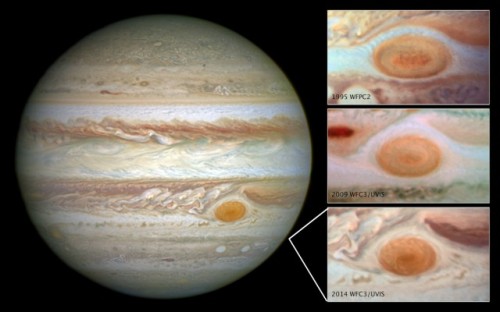
It’s as iconic as anything in the solar system—Jupiter’s Great Red Spot, a massive storm that’s been raging on the surface of Jupiter for hundreds of years, maybe longer—but it’s been shrinking since at least the 1800s, and scientists aren’t sure why. Now, at “just” 10,000 miles across, it’s the smallest it’s been since scientists first started measuring the storm. Whatever the cause, personally, I think Congress should legislate something to stop the shrinkage.
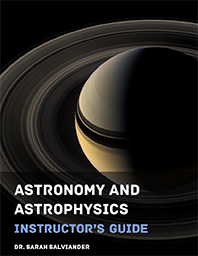
Astronomy and Astrophysics curriculum officially announced
Today we are officially announcing the publication of ASTRONOMY AND ASTROPHYSICS, a curriculum created by Dr. Sarah Salviander, a research scientist whose areas of particular interest are quasars and supermassive black holes. She is a research scientist at the University of Texas, is one of the authors of “Evolution of the Black Hole Mass – Galaxy Bulge Relationship for Quasars in the Sloan Digital Sky Survey Data Release 7” and “Narrow Emission Lines as Surrogates for σ * in Low- to Moderate-z QSOs” in addition to many other scientific papers, and teaches classes as a visiting professor of physics at Southwestern University. Dr. Salviander describes the new curriculum at Castalia House:
“Look around the web for a high-quality, modern-science astronomy homeschool course and you won’t find much. There are a handful of scripture-based astronomy courses that seem to cover little more than the seasons and motions of the night sky, and one very expensive software-based curriculum. I realized there was a need for a comprehensive, modern, and affordable astronomy homeschool curriculum, and set out to develop one based on my years of teaching astronomy at the university level. A couple of years ago, I mentioned this in an offhand way to Vox Day; it turns out Vox had been contemplating offering a series of affordable, electronically-available homeschool curricula, and so we began to discuss the possibility of making astrophysics the first of many such courses.”
The course is suitable for ages 13+ with the appropriate background in mathematics — basic algebra and geometry — but there is no science prerequisite. It was designed primarily with homeschoolers in mind, but it would also work very well in public/private high schools, either as a conventional science course or as an independent study for motivated students. It is also suitable for adults who wish to learn about astronomy and astrophysics in a self-guided continuing education sort of way.
We’ve had at least one person ask whether the course is suitable for students in the Southern Hemisphere. The answer is yes, mostly, with the exception of a couple of lab activities; I’m going to look into adapting the two lab activities that only work in the Northern Hemisphere. If anyone has other questions about the curriculum, don’t hesitate to contact me.
Colliding neutron stars
NASA has released a stirring animation depicting the theoretical merger of two neutron stars. Once the stars merge, they form a black hole.
Neutron stars are super-dense remnants of dead high-mass stars. As the name suggests, they are comprised entirely of neutrons, which formed from the merging of protons and electrons during the gravitational collapse of a dying star’s core. Neutron stars have a theoretical upper limit to their mass, beyond which the rules of quantum physics dictate that the stars collapse into black holes. A merger is one way to have a neutron star exceed its theoretical mass limit.
Such mergers would release an enormous amount of energy, which could explain the origin of gamma ray bursts—mysterious flares of ultra-high energy that emanate from deep space.
Zombie science
There’s a simple reason for the corruption of biology and the social sciences: these studies are not based on Christian beliefs and faith the way science originally was and must always be. Modern science developed in only one place—Christian Europe. If you look up the great pioneers of physics and astronomy, you will find that they were almost all devout Christians, from Copernicus to Galileo to Newton to Maxwell to Planck to Lemaître.
The one glaring exception was Einstein, but even he famously said, “I want to know His thoughts; the rest are details.” Even though Einstein was not Christian, he was the product of the Christian European culture that gave birth to science, and he was a willing participant in a process based on Christian principles:
But science can only be created by those who are thoroughly imbued with the aspiration toward truth and understanding. This source of feeling, however, springs from the sphere of religion. To this there also belongs the faith in the possibility that the regulations valid for the world of existence are rational, that is, comprehensible to reason. I cannot conceive of a genuine scientist without that profound faith. The situation may be expressed by an image: science without religion is lame, religion without science is blind. (Albert Einstein, 1941)
The prime motivation of Einstein and so many other great figures in science was to uncover divine truth and know the mind of God. People who feel they are doing God’s work are far less likely to succumb to human frailties and engage in activities that corrupt the search for truth. That tradition remains strong in physics, the original science. That is why the field of astrophysics was able to resist the degenerative effects of an increasingly atheist society. When the devout Lemaître conceived of the primeval atom (aka big bang theory) and demonstrated that the Genesis account of a universe with a beginning was scientifically sound, the stubborn resistance of scientists with a hatred for the idea of God was quickly overcome by the evidence.
The other branches of science have not fared as well. Atheists stole science from Christians in the mid and late 19th century with the false social science of Marx and behavioral science of Freud as well as the misuse of Darwin’s theory of evolution and the gross misrepresentation of Christian scripture. Over the last century and a half, secular humanists have successfully alienated Christians from the scientific method the faithful created and taken over most of its areas of study. Physics still has a substantial minority of Christians (and people with a general belief in God), and much good work is still being done. The social and behavior studies, on the other hand, are the tools of secular humanism and the zombies of the scientific world—active but not alive. Biology was bitten long ago and is gradually succumbing to the humanist infection. There is an easy way to tell a zombie biologist from a true biological scientist; ask him to say the following words, “Darwin was seriously wrong about some important things.” If he can’t bring himself to say this, you are speaking with one of the walking dead. Climate change ‘scientists’ are just garden-variety corrupt hacks who have sold out for money, prestige, and political favors. Bundle up for the coming ice age or thank the polluters for preventing it.
The lesson here is that the further any area of study is from the Christian foundations of true science, the more corrupt it is. The United States has been the source of a great deal of the productive science done in the 20th and early 21st centuries. It is also the most Christian of all developed countries. If atheists succeed in turning the United States into anything similar to what the formerly Christian European nations now are, science will die and humankind will experience a dark age.
Replay: The free frontier
Traffic’s up after the informal announcement of the publication of our Astronomy and Astrophysics curriculum, so we’re replaying some of our more important posts from the archives for our new readers.
Yesterday [April 12, 2011], on the 50th anniversary of the first man in space, The Atlantic featured an article by Jim Hodges lamenting the decline of American exceptionalism in space:
[In the 1960s] Americans didn’t talk of their exceptionalism. They did exceptional things, and the world talked about it. In many places around the world, in science labs and classrooms, the NASA “meatball” was as recognizable as the Stars and Stripes.
People remember that President Kennedy said, “I believe that this nation should commit itself to achieving the goal, before this decade [of the 1960s] is out, of landing a man on the moon and returning him safely to the Earth.”
Forgotten is that just before that challenge, he said this as a preamble to it: “I believe we possess all of the resources and talents necessary [to lead the world into space]. But the facts of the matter are that we have never made the national decisions or marshaled the national resources required for such leadership. We have never specified long-range goals on an urgent time schedule, or managed our resources and our time as to insure their fulfillment.”
The government is certainly not doing that now, and we can’t count on it to do these things ever again.
However, I do not see this as occasion to despair. As well-intentioned as NASA has been, government almost always does things slower, costlier, and with less innovation than private enterprise. In fact, while government has been slashing NASA’s budget and scaling back its goals, private companies out in Mojave have been quietly innovating like crazy:
Saturday morning astronomy news roundup
The Cassini spacecraft continues to study the dickens out of Saturn and its satellites, this time snapping some lovely images of the moon, Titan. From billions of miles away, team scientists steered Cassini to within 600 miles of Titan’s surface and caught sight of waves in its seas.
Mark your calendars for May 24, because the Earth may be in for an impressive show from a never-before-seen Camelopardalid meteor shower. In fact, the shower is predicted to be so intense — with up to 200 meteors streaking across the sky per hour — that it’s being referred to as a possible “meteor storm.” The meteor shower is a result of the Earth crossing the trail of debris left by the newly-discovered Comet 209P/LINEAR. The shower should last for hours, since it will emanate from a northern part of the sky (remember, for those in the Northern Hemisphere, the North Star never sets), but the best time to view the show is between the hours of 2:00 am and 4:00 am EDT on the 24th.
NASA’s Mars rover, Curiosity, has begun to drill into Martian rock with the intention of studying a sample on its onboard lab. NASA scientists hope to uncover whether the conditions on Mars were ever appropriate to host life.
Scientists at UT-Austin (high-five!) have found one of the Sun’s long-lost brothers. Dubbed HD 162826, the star very likely formed from the same enormous gas cloud as the Sun, but somehow got separated and the siblings are now 110 light-years apart. It’s unknown whether any planets are orbiting the star, but since it appears to have no Jupiters around it, it’s unlikely that life as we know it would be on any terrestrial planets orbiting HD 162826.
Twisted history
Alex Berezow and James Hannam systematically dismantle a post by atheist evolutionary biologist, Jerry Coyne, who manages to get nearly every one of his claims about science and religion wrong. Example:
Coyne:
If you think of science as rational and empirical investigation of the natural world, it originated not with Christianity but with the ancient Greeks, and was also promulgated for a while by Islam.
Berezow and Hannam:
This is only half-true. Science is a lot more than just reason and observation. You need experiments too. For example, the Greeks, following Aristotle, thought that heavy objects must fall faster than light ones. It takes two seconds to disprove that by an experiment that involves dropping a pebble and a rock. But for a thousand years, no one did. There didn’t seem to be much point in testing a theory they already thought to be true. That’s probably why the Greeks were so good at geometry, as Dr. Coyne notes, because progress in mathematics is largely based on reason alone.
I’ll further point out that Aristotle — hero of humanism and champion of reason — was wrong about just about everything in terms of science, and the acceptance of his model of an eternal geocentric universe in particular held back progress in science for nearly two thousand years. Until it was revolutionized by a bunch of Christians.
The authors have not addressed all of Coyne’s claims, as, they have pointed out, there is “an impressive amount of error and misunderstanding [in] a very small space.” He certainly manages to cram a lot of error into the following unaddressed point:
If religion promulgated the search for knowledge, it also gave rise to erroneous, revelation-based “scientific” conclusions that surely impeded progress. Those include creation ex nihilo, the Great Flood, a geocentric universe, and so on.
By all appearances, the universe was created ex nihilo. Physicists have struggled to explain the origin of the universe in a way that avoids an ex nihilo creation event, without success. As this Reasons to Believe article points out, the Bible mentions a worldwide flood, not a global flood. A Great Flood, as described in Genesis, that wiped out all of human and animal life in the Mesopotamian region — the entire known world at the time — is scientifically plausible. And, geocentric theory began with the ancient Greeks. I suppose you could say that since the Greeks were religious, religion is therefore responsible for geocentric theory, but that would be a gross oversimplification. And, anyway, as Coyne is lumping this in with other biblical conclusions, one can reasonably assume he’s pinning this one specifically on Christianity. But, as we all know, Aristotle was responsible for promulgating the idea, which was later elaborated upon by Ptolemy. Yet, the erroneous notion persists that Christians were to blame for this faulty cosmology. As with the Galileo and Bruno affairs, this is the result of atheist myth-making.
The more commentary I read from atheists, the more I’m convinced that these self-styled champions of fact and reason are anything but.
New superheavy element announced
A new, superheavy element will likely be added to the pantheon of known elements. Created in a lab, and weighing in at 40% heavier than lead, element 117 is highly unstable and has a half-life of less than a second. Nevertheless, its fleeting existence in a lab will likely earn it a permanent place on the periodic table.
The periodic table contains both primordial (elements that have existed on Earth since the planet formed) and synthetic (manmade) elements. Element 117, also temporarily known as ununseptium, is a synthetic element. Despite its lesser atomic number, the announcement of element 117 follows that of element 118 (ununoctium), which was announced years before (and has a bit of a checkered past). Once these elements become approved members of the periodic table, they will be given proper elementy names by their discoverers.
Now, despite using the word “created” above, elements are not created, they are made, whether by nature or by man. We tend to use the term “created” rather loosely, but in terms of the biblical, the distinction between created and made is rather important. Created refers to the instantaneous act of bringing something into existence that did not exist before. Made refers to the process of fashioning something from pre-existing raw material, which takes time. Even the simplest element — primordial hydrogen, with just one proton and one electron — was fashioned over a period of time from pre-existing material. And elements 117 and 118, which took careful planning and execution in a lab, were effectively fashioned the same way.
Asteroid grazes the Earth, humankind almost wiped out!
Or not.
The media have been reporting on a “bus-sized” asteroid that made a close pass by the Earth last Saturday. “Close” is a relative term — in astronomy, it generally means much further than you might think. In this case, the asteroid, called HL 129, came closer than the orbit of the Moon, which is about 240,000 miles away. By way of comparison, the much larger asteroid, 99942 Apophis, is predicted to come much closer to the Earth in the year 2029 — a mere tens of thousands of miles, which will make it visible to the naked eye from some locations on Earth — and yet a collision with the Earth has been mathematically ruled out based on what we currently know about Apophis.
So, maybe this still sounds troubling, but there are two reasons I don’t worry about asteroids hitting the Earth. The first is, unless the asteroid is very large — on the order the size of the one that’s believed to have wiped out the dinosaurs — then its destructive power is limited, and anyway it will most likely land in a large body of water or somewhere else that’s unpopulated by humans. (The likelihood of an asteroid hitting the Earth is inversely proportional to its size.) The second is, there’s not much we can do about an asteroid like HL 129. Despite our best efforts to monitor the skies for such objects, HL 129 was discovered only a few days before it made its close pass. That’s not nearly enough time to do anything about it, as it would take a minimum of a year to several years in order to deflect an asteroid on a collision course with Earth. So, why worry? As Christians, we are told not to worry about tomorrow; I think Matthew 6:25-34 also applies to asteroids.
Christians must reclaim science
Modern science exists because of the Christian faith. That is a provable fact. So, why is there so much conflict over the supposed conflict between science and Christianity? In terms of explaining the atheist myth-making about the supposed conflict — having once been an arrogant atheist, myself — I can tell you that it’s born of either total ignorance (as was the case with me) or the kind of hostility that makes a person blind to the truth or willing to distort it. In terms of Young-Earth Creationism, however, I’m still trying to figure that one out. Modern science is one of the many blessings of the Christian faith, and I can only surmise that YECs have allowed the atheists to frame the argument and have accepted a gross distortion — and outright omission — of historical facts.
The Stand to Reason Blog explains that, in contrast to atheist fables, science and Christianity go way back:
The myth begins with the notion of the “dark ages,” a time when the church suppressed education. It’s just not true. Scholarship was alive and well prior to Copernicus. In fact, scholars were working on heliocentric theories before Copernicus. He learned these in university and built on them when he published in final work. His theory didn’t emerge from a dark vacuum, but from rich science that had been nurtured in the universities, many of them established by the church.
In fact, as the article goes on to point out, sociologist of religion, Rodney Stark, found that 50 out of 52 of the key figures of the scientific revolution were religious.
Hugh Ross goes even further and explains how the scientific method comes straight from the Bible:
The Bible not only commands us to put everything to the test, it shows us how. Christian scholars throughout church history, from early church fathers to present-day evangelical scientists, philosophers, and theologians, have noted a pattern in biblical narratives and descriptions of sequential physical events such as the Genesis creation account. Bible authors typically preface such depictions by stating the narrative or description’s frame of reference or point of view. In the same statement or immediately thereafter comes a listing of the initial conditions for the narrative or description. The narrative or the description itself follows. Finally, the author describes final conditions and conclusions about what transpired.
Furthermore, there is not just one narrative or description of physical events in the Bible. There are dozens. Because the Bible is inspired by God––for whom it is impossible to lie or deceive––these dozens must be consistent with one another. Therefore, each of these dozens of descriptive accounts can be used to test the validity of the interpretation of the others.
In the near future, I’ll be posting an article about the concept of linear time that’s necessary for the emergence of modern science, and how it comes from Christianity.
It’s simple: the pillars upon which modern science stand — the notion of scholarship as a form of true worship, the scientific method, and the concept of linear time / cause-and-effect — were all built by the Christian faith. As the influence of the Christian worldview wanes in the West, replaced by a worldview that actively hammers away at the pillars of science, so will the quality of science diminish. This is why Christians must reclaim science instead of turning away from it.