Weekly Psalm 19: The Antennae Galaxies

Here is your weekly reminder of Psalm 19 — the Antennae Galaxies.

hs-2006-46-a-large_web

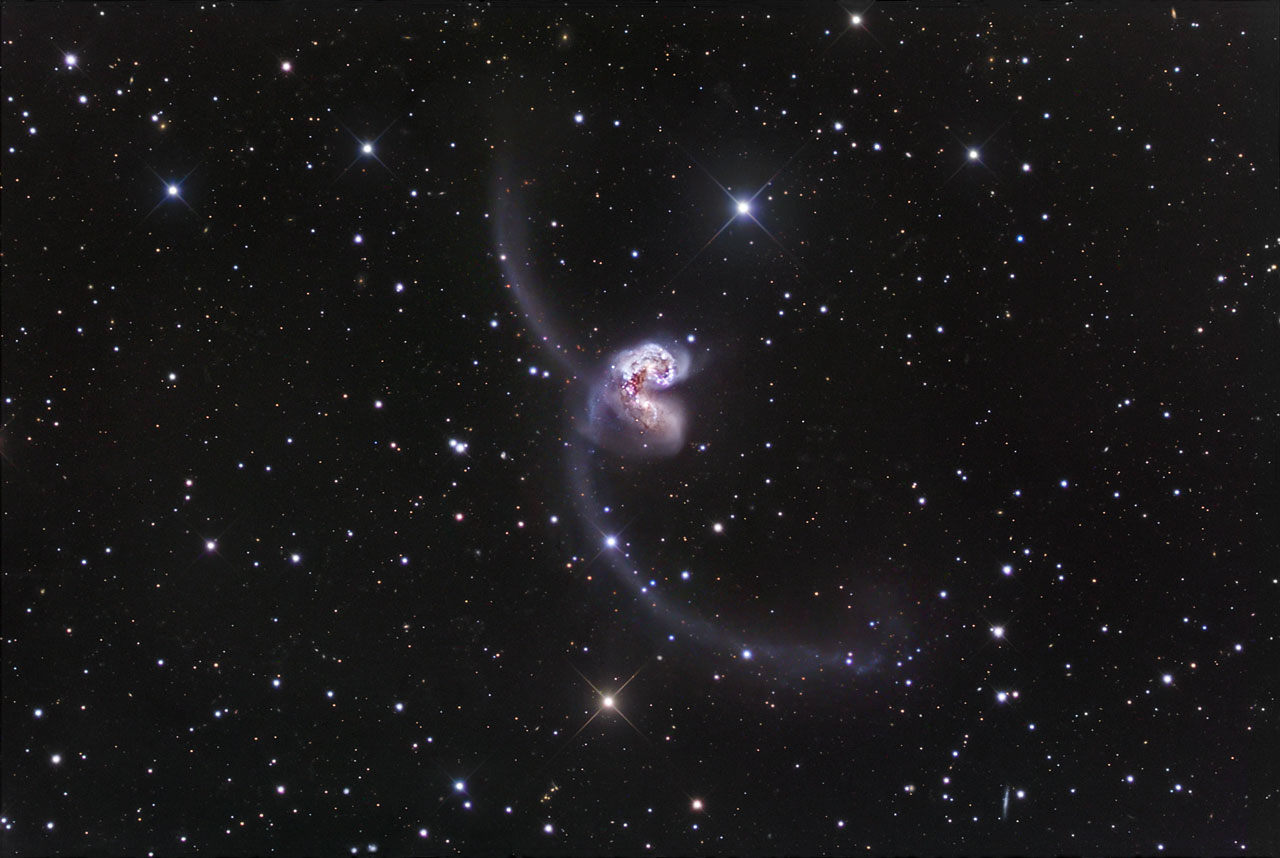
This spectacular pair of colliding spiral galaxies is located 45 million light-years from Earth. They started their encounter a few hundred million years ago, but the entire collision will likely last a couple billion years. Drawn together by their mutual gravitational attraction, they will undergo several passes and collisions before their stars and gas finally settle down to make a new, single galaxy. The interaction has sparked intense star formation, visible as the blue regions, surrounded by excited hydrogen gas, visible in pink.

The Antennae Galaxies derive their name from the long streams of stars that extend from the galaxies like antennae, seen in wider-field images, like the one below.

The Milky Way Galaxy is on a collision course with its nearest neighbor, the Andromeda galaxy. At some point during this future encounter, the collision will probably look much the same as the Antennae Galaxies:

Top image of the Antennae Galaxies, credit: NASA, ESA, and the Hubble Heritage Team (STScI/AURA)-ESA/Hubble Collaboration. The wide-field ground-based image was taken by Robert Gendler.

The wisdom of Yoda

Back in the good old days before George Lucas came up with “midichlorians,” the Force was something quite mystical and spiritual. Watch how beautifully Yoda explains the Force and the true nature of conscious beings to Luke in this scene from The Empire Strikes Back:

“Luminous beings are we, not this crude matter.”

Long before I even considered becoming Christian, I liked that idea. Now it evokes Paul’s vision of the heavenly man:

If there is a natural body, there is also a spiritual body. So it is written: “The first man Adam became [to] a living being”; the last Adam, a life-giving spirit. The spiritual did not come first, but the natural, and after that the spiritual. The first man was of the dust of the earth; the second man is of heaven. As was the earthly man, so are those who are of the earth; and as is the heavenly man, so also are those who are of heaven. And just as we have borne the image of the earthly man, so let us bear the image of the heavenly man.

1 Corinthians 15:44-49

Weekly Psalm 19: Jupiter and Io

Here is your weekly reminder of Psalm 19 — Jupiter and Io.

11701190_10153525386639973_7998910615058072110_n
Last week, we were reminded of God’s handiwork with little Pluto, as imaged by the New Horizons spacecraft. New Horizons was launched in January 2006, and a little more than a year later it made a flyby of Jupiter, using the giant planet’s gravity to gain speed and shorten its journey to Pluto by three years. NASA made the most of that flyby to take images of Jupiter and its moons with unprecedented detail. The above image is a composite of Jupiter in infrared and its moon, Io, in true color. The blue and red in Jupiter’s atmosphere show high- and low-altitude clouds, respectively. The blueish flare on the night side of Io shows scattered sunlight off of a volcanic plume.

Image of Jupiter and Io, credit: NASA/Johns Hopkins University Applied Physics Laboratory/Southwest Research Institute/Goddard Space Flight Center.

Stars

“Stars”
by Valerie Worth

While we
Know they are
Enormous suns,
Gold lashing
Fire-oceans,
Seas of heavy silver flame,

They look as
Though they could
Be swept
Down, and heaped,
Cold crystal
Sparks, in one
Cupped palm.

The pentaquark

This has been a big week for news of all kinds, not least of which is the arrival of the New Horizons spacecraft at Pluto after its decade-long, three-billion-mile journey through the solar system. But forget all that. The really big news — what all the cool kids are talking about — is the pentaquark.

Ordinary matter, the stuff you and I, and everything else we can see and touch, is made of particles called hadrons. The two best-known examples of hadrons are the proton and the neutron. These particles are each made up of three quarks1 and thus could be called triquarks. (As far as we can tell, quarks represent the fundamental bits of matter, which means, unlike molecules, atoms, and protons, you can’t break them up into smaller bits.) Another type of hadron is the meson, which is made up of a quark and an anti-quark2 (a biquark?).

A new class of hadron was proposed by physicist Murray Gell-Mann in 1964, and, like the Higgs boson, seemed quite clever in eluding particle physicists for many years. However, that has apparently changed with what scientists at the Large Hadron Collider are pretty sure is the pentaquark. Unlike a proton or a neutron, the pentaquark, as the name suggests, is made of five quarks2. A boring old proton is made of 2 up quarks and 1 down quark1. A neutron is made of 2 down quarks and 1 up quark1. In principle, you could have a lot of different kinds of pentaquarks, all made of different combinations of quarks. The one discovered by LHC is made of 2 up quarks, 1 down quark, 1 charm quark, and 1 anti-charm quark2,3.

What’s important about this discovery is that it: a) further validates what is called the Standard Model, the prevailing theory governing particle physics; and b) raises new questions, which is music to a physicist’s ears. There is nothing better in science than a new question. One of the new questions is, what holds a pentaquark together? The quarks in a proton are bound tightly together by gluons, however it’s not clear what holds a pentaquark together. Is it tightly bound by its gluons like a proton or is it made up of a proton and a meson that are, themselves, somehow bound together? This’ll keep particle physicists busy for a while.

—–

1. Plus zillions of gluons and zillions of quark-antiquark pairs. (Yes, gluons are called gluons, because they glue quarks together.)

2. Plus, presumably, zillions of gluons and zillions of quark-antiquark pairs.

3. The six known ‘flavors’ of quark are called: up, down, top, bottom, charm, and strange. As counterintuitive as it may seem, the top quark is the strangest quark of them all.

Weekly Psalm 19: Pluto

Here is your weekly reminder of Psalm 19 — Pluto.

NH-Pluto-color-NewHorizons-20150713

After nearly 10 years and three billion miles, the New Horizons spacecraft has arrived at Pluto. This image was taken by New Horizons yesterday (July 13) before it made its closest approach of about 8,000 miles.

Pluto is perhaps best known in recent times for its demotion from the ninth planet in the solar system to dwarf planet or “plutoid.” It orbits the Sun at about 40 times the Earth’s orbital distance. It is likely the largest and most massive member of the Kuiper Belt, a large collection of icy-rocky objects in the outer region of the solar system.

Pluto imaged by New Horizons. Credit: NASA / JHUAPL / SwRI.

Humility

May the Force be with all of us

In 1977 my father took my brother and me to see Star Wars, and what I saw transformed me. On that screen, which seemed so big to a little kid, I was swept away from my Earth-bound existence and became conscious for the first time of our universe.  This was the defining moment in my life and it occurred when I was six years old.

Now that I am an adult, I realize how short on science the movie was, but I will be forever grateful for the way it got me thinking about outer space in a significant way. Space was all I could think about for years after: the awe, the mystery, the unlimited possibilities. From that moment onward, a life dedicated to the study of space science was inevitable for me.

Almost four decades later, I’m a professional astrophysicist. I have Jodie Foster-in-Contact moments whenever I go to a remote observatory and watch the transcendent night sky. Every time, it transports me back to 1977 and reignites the sheer wonder and indescribable joy I felt at the sight of a sky filled with thousands of far-off suns. But the wonder is deeper and more complex than it was when I was six years old, because of what I know. I now know what powers each of those suns, I know how they formed, when they formed, that most have planets orbiting them, and, though the stars appear to extend infinitely in all directions, I know that I’m really only looking at the outskirts of the vast Milky Way galaxy. But most important of all, I now know that all of this was deliberately created.

My brother and I were brought up with little in the way of religious instruction or experiences. He and I found God after long journeys on separate paths. It was the intense love my brother felt for his children and his need to believe they would have eternal life that brought him to God. What led me to God was my love of all things space and everything I learned as a student about the creation of the universe and the way nature is so exquisitely fine-tuned for intelligent life.  Science continues to be the basis of my unshakable conviction that nothing as beautiful and orderly as our universe could be an accident.

Whenever I stand on the peak of Mount Locke wrapped in the awe of a perfect night sky, I am infused by a feeling of complete humility. But, I understand in those moments what a little girl couldn’t possibly have understood forty years ago, that I am feeling humility in the midst of God’s divine work as I view proof of Psalm 19:1, “The heavens declare the glory of God; the skies proclaim the work of his hands.”

Insignificance

Whenever I teach introductory astronomy, I hand out a questionnaire to my students and ask them to describe their main challenge (if any) with astronomy in terms of their religious or philosophical worldviews. Some students are troubled by the apparent conflict between science and their religious beliefs, but the most common response by far is a feeling of insignificance in the face of their new awareness of the vast scale of the universe.

Their answers reflect an intense humility, but it is often different from what I feel. Their humility, combined with the sense of insignificance, seems to lead many of them to disturbing feelings of meaninglessness and hopelessness. I realized some time ago that people who do not believe in God feel the same degree of humility when they look at the night sky as I do, but they often turn the humility inward where it is translated into feelings of personal worthlessness. This feeling is not unique to the young and uninitiated in science. Physicist and Nobel laureate Steven Weinberg lamented in his book, Dreams of a Final Theory, “The more the universe seems comprehensible, the more it also seems pointless.”

I am fortunate to know that our vast universe is exactly the size it has to be to give rise to intelligent life.  Just about every scientist knows this, but the unfortunate non-believers are materialists for whom the vastness of the universe is also a constant reminder of the cold and deadly indifference of nature. Some non-believers, like the late astronomer Carl Sagan, hope for something after death, but largely accept the materialist view that this existence is all that there is. They retreat to gratitude for the moment, which is an intellectual evasion of their terrible truth.

Other scientifically informed people evade thoughts about the creation and fine tuning of the universe in a different manner, by pushing it beyond the bounds of investigation. They maintain that ours is one of an infinite number of universes—the multiverse—which we can never observe. They argue that we must have simply won the multiverse lottery and the jackpot was all of the conditions necessary for life. It seems to me that if people feel insignificant and hopeless in a vast universe, they aren’t going to feel any better being part of an even bigger multiverse. A darker road is taken by a few, like biologist William Provine, who simply accept their insignificance and acknowledge that a godless universe can have no meaning. It is an honest assessment for a materialist, but one that is filled with despair.

The deliberately more optimistic atheist will talk of his awe of the universe, but I know from experience that is only what he says in public to make his case. If he is capable of taking the next step in his reasoning, he can’t help but move to terrifying thoughts. He may feel wonder at the universe, but if he knows its history he can’t escape the understanding that nature doesn’t care about him. His awe, humility, and fear must all be based on the inescapable realization that ultimately the cosmos will bring about his destruction and the eventual annihilation of the entire human species. Nothing that he or anyone else does will ever have any meaning.  The atheist who looks at outer space as merely a pretty picture is deluding himself. If there is no loving God as Creator of the universe, what the atheist is really looking at in the heavens is the end of all hope or meaning.

There is no need for such a dim view of existence. Because I believe in a loving and purposeful God, when I look at outer space, I see something created with mankind in mind. I know that I am small in physical size, but huge in significance. My awe and humility expand my being through the knowledge that there is a divine power guided by God’s love for all of us. His love changes space into something more like Star Wars: a wonderful challenge that we can meet with joy because of our God-given spirit and intellect.

When I consider your heavens,
the work of your fingers,
the moon and the stars,
which you have set in place,

What is man that you are mindful of him,
the son of man that you care for him?

You made him a little lower than the heavenly beings
and crowned him with glory and honor.

You made him ruler over the works of your hands;
you put everything under his feet

Psalm 8:1-6
Weekly Psalm 19: Carina Nebula

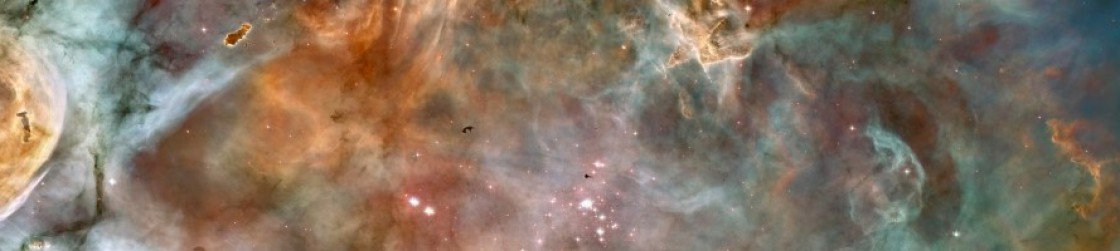
Here is your weekly reminder of Psalm 19 — the Carina Nebula.

Carina_Nebula

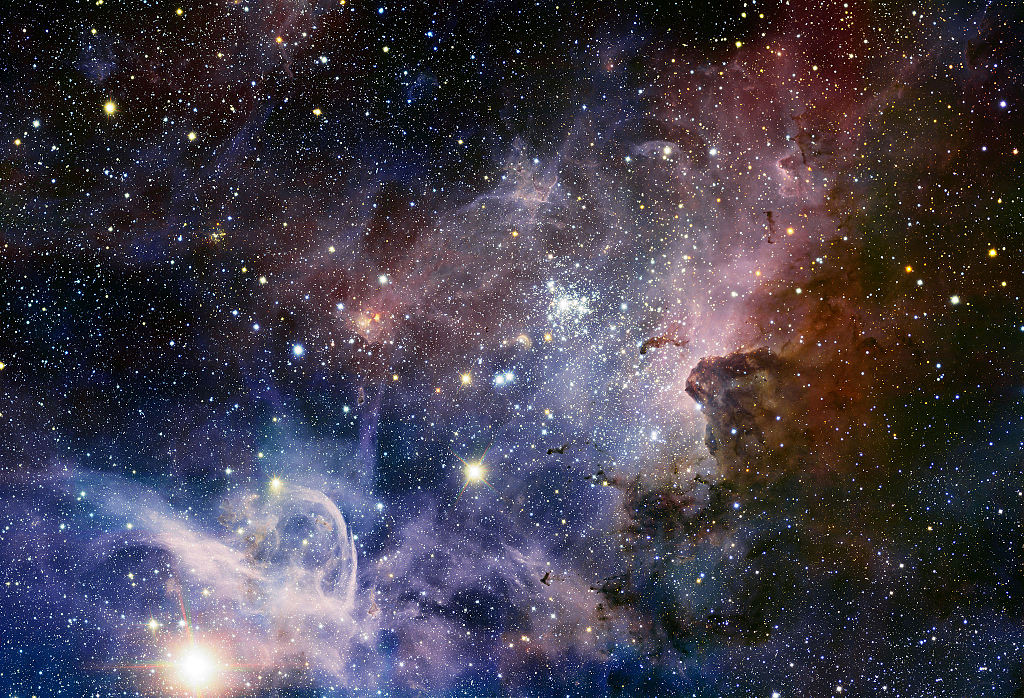
The Carina Nebula is a giant diffuse cloud of gas spanning almost 500 light-years and containing many large, bright, hot stars. It’s about three times larger than the great nebula in Orion, but is not as well known, because it’s only visible from the Southern Hemisphere. This is one of my personal favorites, and a portion of it appears in the right-hand menu bar if you scroll down.

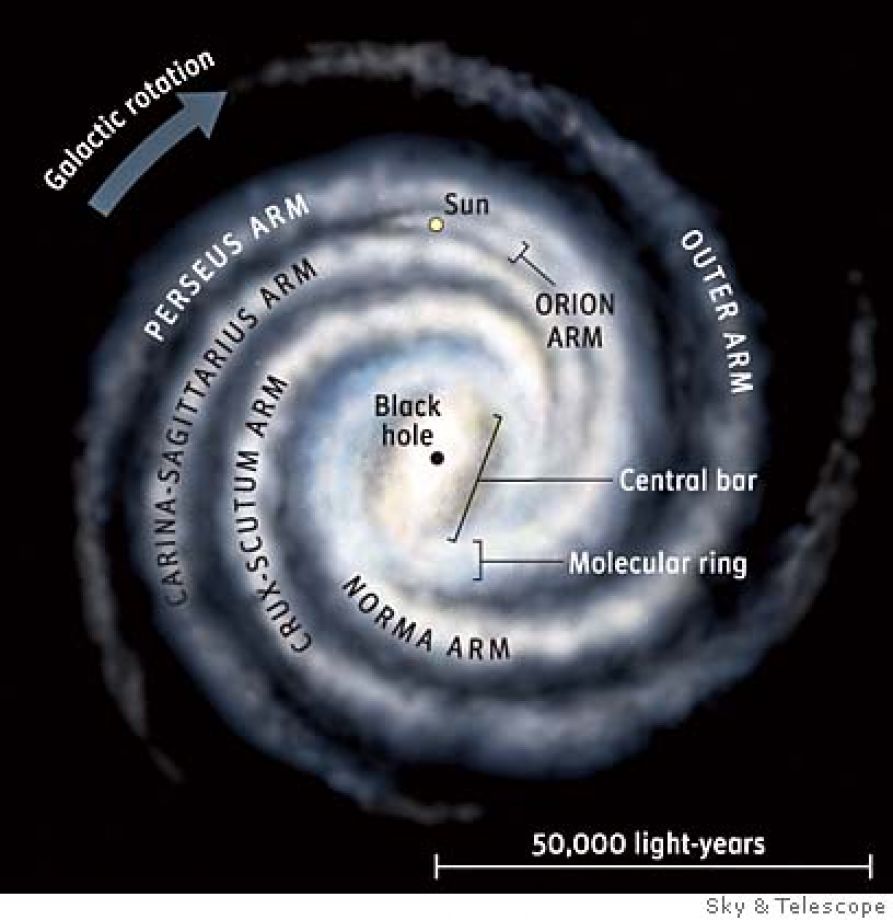
This nebula is located on the sky in the constellation Carina (hence its name), and is physically located about 7,000 to 10,000 light-years away in the Carina-Sagittarius spiral arm of the Milky Way Galaxy. For reference, our Solar System is in the adjacent Orion arm. (See below.)

920x920

Carina Nebula image credit: ESO/T.

In their own words — Robert Jastrow

jastrow

Robert Jastrow. Credit: Unknown.

Robert Jastrow was an American astrophysicist who headed NASA’s Goddard Space Flight Center for many years. He was an enthusiastic popularizer of science who frequently appeared on television to talk about science and the space program. He was also a noted skeptic of human-caused climate change. Jastrow was an agnostic and non-believer, but his assessment of mankind’s current state of knowledge led him to make some surprisingly frank observations about science and religion. The following, taken from God and the Astronomers, is perhaps the quote for which he is best known.

At this moment it seems as though science will never be able to raise the curtain on the mystery of creation. For the scientist who has lived by his faith in the power of reason, the story ends like a bad dream. He has scaled the mountain of ignorance; he is about to conquer the highest peak; as he pulls himself over the final rock, he is greeted by a band of theologians who have been sitting there for centuries.

No evidence needed

If you ever doubt that atheists can be as blind-faith-driven as they claim Christians are, just ask them to justify their assumptions.

This is part of the ongoing discussion I’m having with this particular atheist over the fine tuning argument. See here for background.

There are only three possible explanations for why the universe is so finely tuned as to permit the existence of complex, intelligent life: necessity, chance, or design. Necessity means that there are physical laws requiring the universe to take on the very precise values for things like the physical constants. Chance means the universe won a very, very lucky roll of the dice and just happened to land upon the precise values for things like the physical constants. Design means someone/something deliberately chose the precise values for things like the physical constants. Note that these aren’t necessarily mutually exclusive. However, once you have ruled out one, you can only consider the other two.

The problem for JW is that there is no physical theory that anyone is aware of that requires the universe to take on the very precise values for things like the physical constants that we measure. JW asked for an example, and I gave him the density of dark energy. Dark energy is a mysterious form of energy in the universe, causing it to accelerate in its expansion. The Standard Model, the name given to the theory of particle physics, predicts that dark energy could have a range of about 10115 GeV/cm3. That’s a 1 with 115 zeroes after it. At the risk of understatement, that’s an enormous range. If the density of dark energy was a bit more than what it is, the universe would’ve expanded too rapidly and no stars could form. If it was a bit less, the universe would’ve collapsed on itself before life could emerge. And yet the density of dark energy is precisely the “right” value for life to emerge. This is why the fine tuning argument is such a focal point for debate.

What we’re left with is chance or design, and thus the argument boils down to multiverse or God. JW seems to think most physicists are “mad” for holding to this very logical conclusion, and steadfastly refuses to accept it. Ironically, he clings to his belief in exactly the same manner many atheists accuse Christians of clinging to their belief.