A final roll-out for Shuttle Atlantis

And a final roll-out for the shuttle program. From Astronomy Picture of the Day (APOD), which you really should be checking out every day:

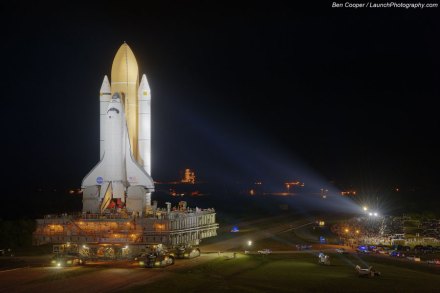
In the final move of its kind, NASA’s space shuttle Atlantis was photographed earlier this month slowly advancing toward Launch Pad 39A, where it is currently scheduled for a July launch to the International Space Station. The mission, designated STS-135, is the 135th and last mission for a NASA space shuttle. Atlantis and its four-person crew will be carrying, among other things, the Multi-Purpose Logistics Module Raffaello to bring key components and supplies to the ISS. Pictured above, the large Shuttle Crawler Transporter rolls the powerful orbiter along the five-kilometer long road at less than two kilometers per hour. Over 15,000 spectators, some visible on the right, were on hand for the historic roll out.

Click on the link to get the beautiful hi-res version of the photo.

Saturday science smorgasbord

Danish inventors successfully launch homemade rocket.

Using money from private donations, space enthusiasts and at least one former NASA employee constructed and successfully launched their own rocket from a floating platform in the sea. The prototype cost $73,000 — extremely cheap as far as rockets go, and no wonder: the components included a hair dryer that was intended to keep a valve from freezing. The rocket was dubbed ‘Heat-1X Tycho Brahe’ after the famous 16th century Danish astronomer.

‘Gang of four’ awarded a $500,000 cosmology prize for their work in dark matter.

Dark matter was first posited to exist in 1934 by astronomer Fritz Zwicky to explain the strange behavior of visible matter spinning around in galaxies. Since that time, detailed observations and complex computer simulations, like those of the prize-winning cosmologists, have helped pin down exactly how much dark matter is in the universe and how it’s distributed.

Thirty years ago, nobody really knew how matter was distributed in the universe on a large scale. Today we know from observations that matter is distributed in cosmic clumps, chains, and filaments surrounding enormous voids. Results from computer models reproduced these features using slow-moving massive dark matter particles, giving cosmologists confidence that dark matter was indeed a major constituent of the universe.

Infrared mapping “masterpiece” shows the universe in 3D.

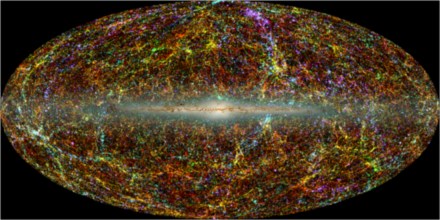
The map shows two dimensions in terms of celestial longitude and latitude, with a third dimension added by redshift, an indicator of cosmic distance. The map is a culmination of decades of survey work that includes 45,000 galaxies in the local universe.

Continue reading

An emotional ending

One final space shuttle launch to go, and the mood around NASA is decidedly melancholy. With nothing concrete on the horizon to replace the shuttle, this is an understandable state of mind. A lot of people in the “space shuttle family” are nevertheless trying to be optimistic about the future of the space program, because people need hope in order to function well. Personally, I believe that hope lies with the private sector.

Continue reading

SpaceX’s Dragon capsule ready for Mars

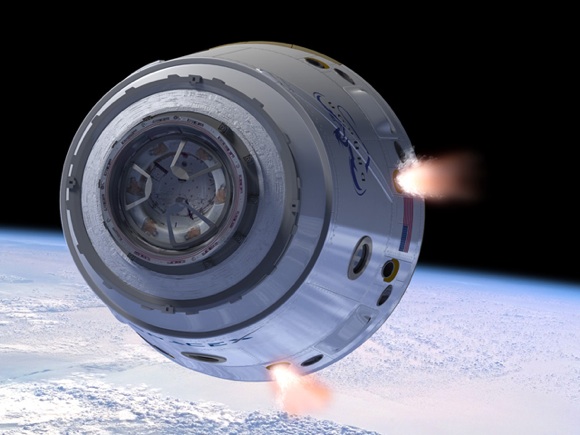
Artist's conception of the SpaceX Dragon capsule in space

As NASA’s Space Shuttle program winds down, the next generation of space ships is shaping up, most notably with SpaceX’s “Dragon” capsule. The Dragon capsule, intended in the near-term for unmanned supply missions to the International Space Station, has already been tested with a successful launch into space with SpaceX’s Falcon 9 rocket.

SpaceX also plans to make the capsule rated for manned missions. According to Elon Musk, the “nerdwealth” millionaire who is financing SpaceX, the Dragon capsule is capable of landing on other planets. In fact, Musk’s ultimate plans are to have colonies on Mars as soon as possible, and presumably the Dragon will play a role in getting people there.

Remarkably, only nine years after its inception, SpaceX is already reported to be operating at a level comparable to the European Space Agency, a collaboration between 19 European nations established 36 years ago. This is why I believe the future of space is with free enterprise. Motivated by competition and profit, private companies tend to operate far more efficiently and with more innovation than government agencies.

Continue reading

Endeavour’s last mission and strange physics

Shuttle flight #134 out of 135 is set to launch this Friday, April 29, when Space Shuttle Endeavour will blast into space for the last time. During its last mission, the Endeavour crew will deliver a special physics instrument to the International Space Station.

The instrument, called the Alpha Magnetic Spectrometer (AMS), is designed to make detections of exotic phenomena that are not observable from the surface of the Earth, including antimatter, dark matter, strangelets, and cosmic ray counts. These are all important for testing various theories and for practical reasons.

Antimatter

Big bang theory requires that equal amounts of matter and antimatter existed in the very early history of the universe. The matter and antimatter would collide and annihilate, producing a burst of energy. The great mystery is why our galaxy and everything we observe appears to be made of matter. Actually, the great mystery is why there is any matter at all, for if there was an equal amount of antimatter, all of it should have been annihilated. Some theories propose a tiny asymmetry, with slightly more matter than antimatter, but these theories raise problems of their own. It is important to determine whether any antimatter still exists in the universe, and this is where AMS comes in. AMS is designed to be highly sensitive to antimatter detections all the way to the “edge” of the observable universe.

Dark Matter

Anyone who has been fortunate enough to view the night sky free from the glow of city lights knows that the sky appears to be awash in stars. It’s tempting to think the entire universe looks this way, but this view is misleading. Our night sky provides a local view of a particularly dense area of the universe, the inside of a galactic disk of stars. Even the lovely visage of seemingly endless galaxies in the Hubble Ultra Deep Field may tempt the viewer into thinking the universe is overflowing with galactic material. The (theoretical) reality is that the vast majority of the “stuff” of the universe can’t be seen at all. In fact, according to the latest results from WMAP, stars and gas make up less than 5% of the total stuff out there. Dark matter is theorized to make up 23% of the total stuff (with dark energy making up the biggest chunk at 72% of the total). Even though it’s supposed to be a major constituent of the universe, dark matter has never been directly detected. AMS will look for neutralinos, the leading candidate for the dark matter particle. Theory predicts that when neutralinos collide, they produce other charged particles and energy, which can be detected by AMS.

Strangelets

One of the great discoveries of particle physics was the quark, the basic building block of matter. “Normal” matter (also called baryonic matter) comprises the familiar things of existence, from people to planets to stars. Normal matter is made of two kinds of quarks, called “up” and “down” quarks, bound together in groups of three. Four other types of quarks — called charm, strange, top, and bottom — were predicted to exist and subsequently discovered in particle accelerators. Some of these quarks are known to combine into other types of hadrons, or heavy particles. One theory predicts that strange quarks may group with up and down quarks to make extremely heavy “strange matter” particles called strangelets. Theory predicts that if strange matter comes into contact with normal matter, it could convert the normal matter into strange matter. AMS is designed to make detections of these strangelets if they do in fact exist.

Cosmic Ray Counts

If we have any hope of sending a manned mission to Mars we will need an accurate measurement for the rate of cosmic rays in our solar system. Cosmic rays are charged particles accelerated to near-light speeds, and they represent a major hazard to astronauts who would be exposed to them in space long term without the protection of the Earth’s atmosphere. AMS will make accurate counts of cosmic rays in the solar system so that scientists and engineers can devise appropriate protection for Mars-bound astronauts.

Continue reading

NASA goes commercial

The SpaceX Falcon 9 rocket

NASA is trying to go commercial for its space delivery vehicles by awarding $269M toward private development

The awards, part of what NASA calls its commercial crew development program, are a bet, pushed by the Obama administration, that commercial companies will be able to get people to and from orbit more quickly and less expensively.

If all goes as planned, NASA anticipates commercial spacecraft will be able to deliver astronauts to the International Space Station mid-decade.

Continue reading

The free frontier

Yesterday, on the 50th anniversary of the first man in space, The Atlantic featured an article by Jim Hodges lamenting the decline of American exceptionalism in space:

[In the 1960s] Americans didn’t talk of their exceptionalism. They did exceptional things, and the world talked about it. In many places around the world, in science labs and classrooms, the NASA “meatball” was as recognizable as the Stars and Stripes.

People remember that President Kennedy said, “I believe that this nation should commit itself to achieving the goal, before this decade [of the 1960s] is out, of landing a man on the moon and returning him safely to the Earth.”

Forgotten is that just before that challenge, he said this as a preamble to it: “I believe we possess all of the resources and talents necessary [to lead the world into space]. But the facts of the matter are that we have never made the national decisions or marshaled the national resources required for such leadership. We have never specified long-range goals on an urgent time schedule, or managed our resources and our time as to insure their fulfillment.”

The government is certainly not doing that now, and we can’t count on it to do these things ever again.

However, I do not see this as occasion to despair. As well-intentioned as NASA has been, government almost always does things slower, costlier, and with less innovation than private enterprise. In fact, while government has been slashing NASA’s budget and scaling back its goals, private companies out in Mojave have been quietly innovating like crazy:

Continue reading

108 minutes that changed the world

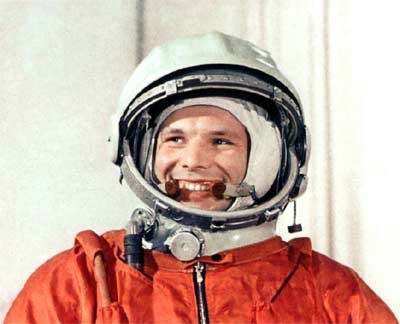
Tomorrow will mark the 50th anniversary of the first man in space. On April 12, 1961 Soviet cosmonaut, Yuri Gagarin, spent 108 minutes in space aboard the Vostok 1 spacecraft. It would be his only space flight. Gagarin continued his career designing spacecraft and training other cosmonauts. He died in 1968 when a jet he was piloting crashed.

Gagarin received many honors for his achievement, but perhaps none so great as being immortalized in musical form by French techno-artiste Jean-Michel Jarre:

Continue reading

MESSENGER’s first image from orbit

The MESSENGER probe began sending images of Mercury back to Earth yesterday. Here is the historic first image from orbit:

Click on the image to go to the MESSENGER website and download a larger version.

The large feature with rays, near the top of the photo, is an impact crater named Debussy. The crater is about 85 km across, with the rays stretching hundreds of km, covering much of the southern half of the planet. Radio images of the crater and rays indicate that it’s a relatively young crater, though astronomers don’t know how young.

Image of impact crater Debussy taken by MESSENGER during a previous flyby of Mercury

Continue reading

MESSENGER probe locks into orbit around Mercury

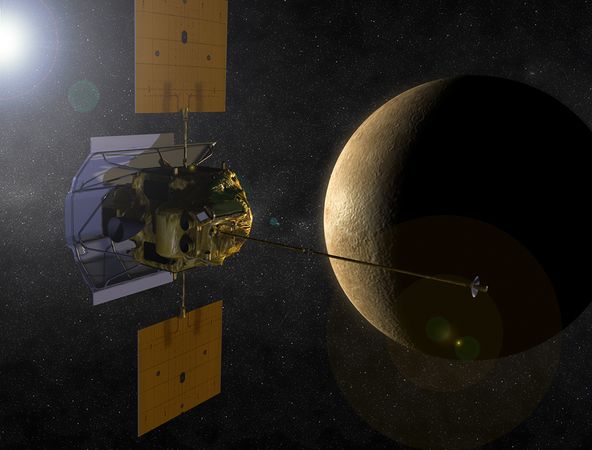
Artist's conception of MESSENGER approaching Mercury (Credit: NASA)

For the first time ever, we have a probe orbiting the planet Mercury. The MESSENGER probe was successfully maneuvered into orbit around Mercury yesterday following a six-and-a-half-year series of gravitational flybys past Earth, Venus, and Mercury, to nudge it into course. Starting in April, MESSENGER will make two orbits of Mercury per (Earth) day, collecting information to send back to scientists on Earth.

Previous missions to Mercury include the Mariner 10 spacecraft, which gathered data as it quickly flew past Mercury three times in 1974-1975, and three data-collecting flybys of Mercury by the MESSENGER probe in 2008-2009.

NASA scientists hope the mission will help answer several questions about Mercury, including why the tiny planet is so dense, what its geological history is, and whether there is actually ice at its poles.

Continue reading