Rethinking the origin of cosmic rays

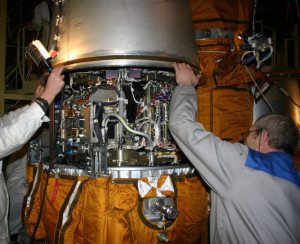
The PAMELA instrument. Credit: Piergiorgio Picozza

New results from an Italian space-based experiment have astronomers puzzled about the origins of cosmic rays. Cosmic rays are charged particles — protons and other atomic nuclei — that are accelerated to near-light speeds and continue on through the universe. The Earth is awash in them, with dozens of cosmic rays passing through your body every second of every day. Until now, the prevailing explanation for their origin was that they are accelerated by the remnants of supernovae, the spectacular final moments of dying high-mass stars. However, evidence gathered by the exquisitely sensitive Italian space-based instrument, called PAMELA, suggests this is not the case. It seems that different types of particles are accelerated in different ways, contrary to what is expected if they are accelerated by the same source.

It’s another entry in the “We didn’t expect that” file, which is part of what science is all about. And theorists always like the extra business.
Continue reading

Aussie physicists produce the first cold-atom laser

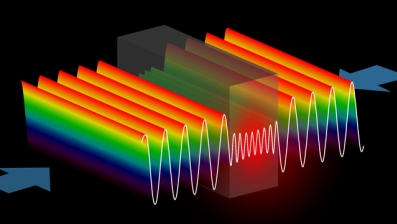
This is quite a year for laser breakthroughs. First we had the anti-laser, and now Australian physicists have created an atom laser from extremely cold helium atoms. Conventional lasers (LASER = Light Amplification by Stimulated Emission of Radiation) produce coherent light, that is light comprised of photons that are evenly spaced instead of clustered together in groups. The Aussie physicists have managed to produce atoms that behave the same way by super-cooling them to a millionth of a degree above absolute zero (even outer space isn’t that cold). Atom lasers can be applied to nifty things like holography, which means we’re one (tiny) step closer to every Trekkie’s fantasy of visiting a Holodeck.

Continue reading

Science faction

The Scientific Curmudgeon ponders whether theoretical physics is going soft:

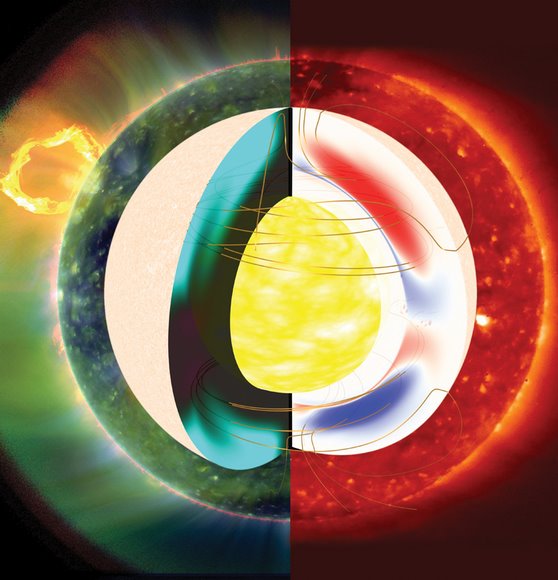
Roger Penrose and V. G. Gurzadyan recently proposed that minute ripples in the cosmic microwave background- the afterglow of the big bang- originated from the collision of monster black holes in another universe that preceded our cosmos, and may have spawned it; moreover, our universe might be just one of an infinite series spawned by such cataclysms.

My reaction to reading about this idea was: Far out! Penrose, one of the most famous, creative physicists in the world, along with Gurzadyan had dusted off the old oscillating universe theory of the cosmos, which I always liked. But not for a nanosecond did I think their proposal was true. The proposal is literally too far out; it can never be confirmed in the way that the existence of quarks has been confirmed or the big bang itself.

This is the problem I’ve always had with the various proposed “theories” of the multiverse: if a proposal can’t be confirmed, it’s not science.

Physics is at a real crossroads with the multiverse. If the majority of physicists accept it as science, the field of physics is doomed; if the majority relegate it to speculation, physics will continue on the path of genuine science.

Stay tuned for a mega-post on the multiverse in the coming months.

Continue reading