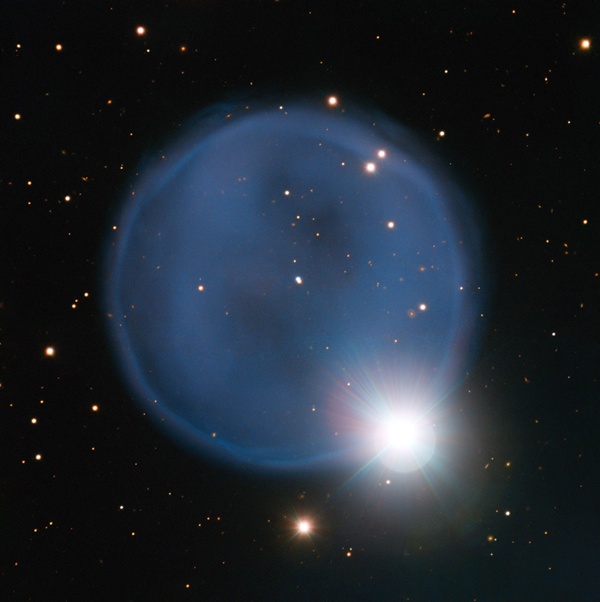
A chance alignment of a planetary nebula — the blown-off outer layers of a dead low-mass star — and a bright star give the illusion of a diamond ring in space:
[Image credit: ESO]
A chance alignment of a planetary nebula — the blown-off outer layers of a dead low-mass star — and a bright star give the illusion of a diamond ring in space:
[Image credit: ESO]
Thanks to Facebook, this game is becoming popular with my colleagues:

The goal is to see if you can create a stable planetary system that includes, not just a few piddly Earth-mass planets, but giant ice planets and stellar companions, as well. Stable, in this case, means the system lasts at least 500 years without any planets crashing. It helps if you know a bit about Newtonian mechanics, but even if you know nothing about physics, you can gain some intuition just by playing the game. (Read more about the game here.)
So, how many planets can you cram into two Earth orbits?
“Fossil” galaxy, Segue 1, is a satellite of the Milky Way and, with just a few hundred stars, it’s so tiny that it’s not clear whether it’s actually a galaxy or just a globular cluster (a tightly-packed grouping of old stars that orbits in the halo of our galaxy). What makes Segue 1 interesting is that, unlike other galaxies, it appears to have stopped changing with time almost immediately after it formed. Galaxies go through periods of intense activity throughout their lifetimes — e.g. bursts of star formation — but not so with Segue 1.
Elements heavier than helium are almost entirely produced inside the cores of stars or during supernovae, and are expelled back into space via red giant winds or supernova explosions, where these elements mix with what’s called the interstellar medium (mostly hydrogen and helium). The next generation of stars forms out of this mixed gas, therefore we expect to find heavier elements in the atmospheres of younger stars, and that’s what astronomers indeed observe. The stars in Segue 1, however, are pristine and comprised almost entirely of hydrogen and helium — its stars contain 300 times less heavy elements than our Sun. It appears that star formation in this tiny galaxy shut off almost as soon as it began. Astronomers refer to it as a “fossil” galaxy, because it’s been preserved just as it was nearly 13 billion years ago, and as such it should give some important insights into the conditions of the early universe.
It may look like abstract art, but it’s actually an image of the entire sky in the X-ray part of the spectrum.

The ROSAT All-Sky Survey Map
This image was produced by the ROSAT survey. ROSAT is an X-ray observatory that, like its sister, the Hubble Space Telescope, is in orbit around Earth. The only way to observe celestial X-rays is from extremely high altitudes or in space, since Earth’s atmosphere absorbs them.
The curved blue stripe in the image is the disk of the Milky Way galaxy, and the bright white spots are supernova remnants.
Recommended reading:
NASA has released images of an M-class flare on the Sun taken by its Solar Dynamics Observatory. Solar flares are bursts of energy released from the surface of the Sun, in which charged particles like electrons and ions, as well as neutral atoms, are expelled. These flares are energetic enough that the particles are able to zip across the approximately 150 million kilometers from the Sun to the Earth in just a couple of days. M-class flares are mid-level in intensity—the highest are X-class—and are not directly harmful to life on the surface of the Earth. These flares can, however, disrupt satellites in Earth orbit.
This particular flare occurred on April 2nd.
The evidence for dark matter mounts: gamma rays (very high energy particles) observed coming from dwarf galaxies suggest the annihilation of dark matter particles that collide with each other. The problem: calculations show that these particles would have to be heavier than previously believed, which is at odds with hints from earthly experiments designed to detect the mysterious particles.
One of Saturn’s moons, Enceladus, appears to have a liquid ocean beneath its frozen crust. Scientists are searching for liquid water on solar system bodies other than the Earth, because life as we know it can’t exist without liquid water.
NASA’s Lunar Atmosphere and Dust Environment Explorer (LADEE) probe is expected to crash into the Moon on April 21. The probe, which has been in orbit around the Moon since October of last year, has been gathering data on the Moon’s extremely thin atmosphere (I bet you didn’t know the Moon has an atmosphere—so does Mercury). Very soon, LADEE will run out of fuel and its orbit will decay, sending it crashing onto the surface of the Moon.
The big, fat ‘El Gordo’ galaxy cluster is bigger than previously thought. New Hubble Space Telescope data, showing how much the giant cluster is warping the space around it, has allowed a more precise calculation of its mass, which now appears to be three million billion times the mass of the Sun (3 x 10¹⁵ solar masses). What makes El Gordo so interesting is not necessarily its large mass—there are other massive clusters in the universe—but that it got so massive so early in the history of the universe. Like all galaxy clusters, the majority if its mass is comprised of dark matter, not the visible stuff you can see.
Here are some fun astronomical events you can watch from your own backyard.
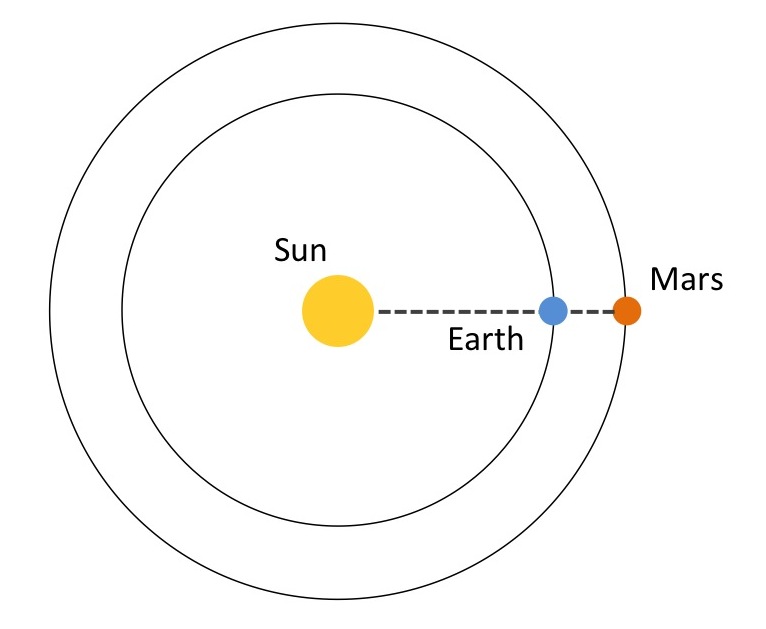
April 8: Mars at opposition. Opposition is when a planet is on the opposite side of the Earth from the Sun (see below). It’s the best time to view a planet through a telescope.
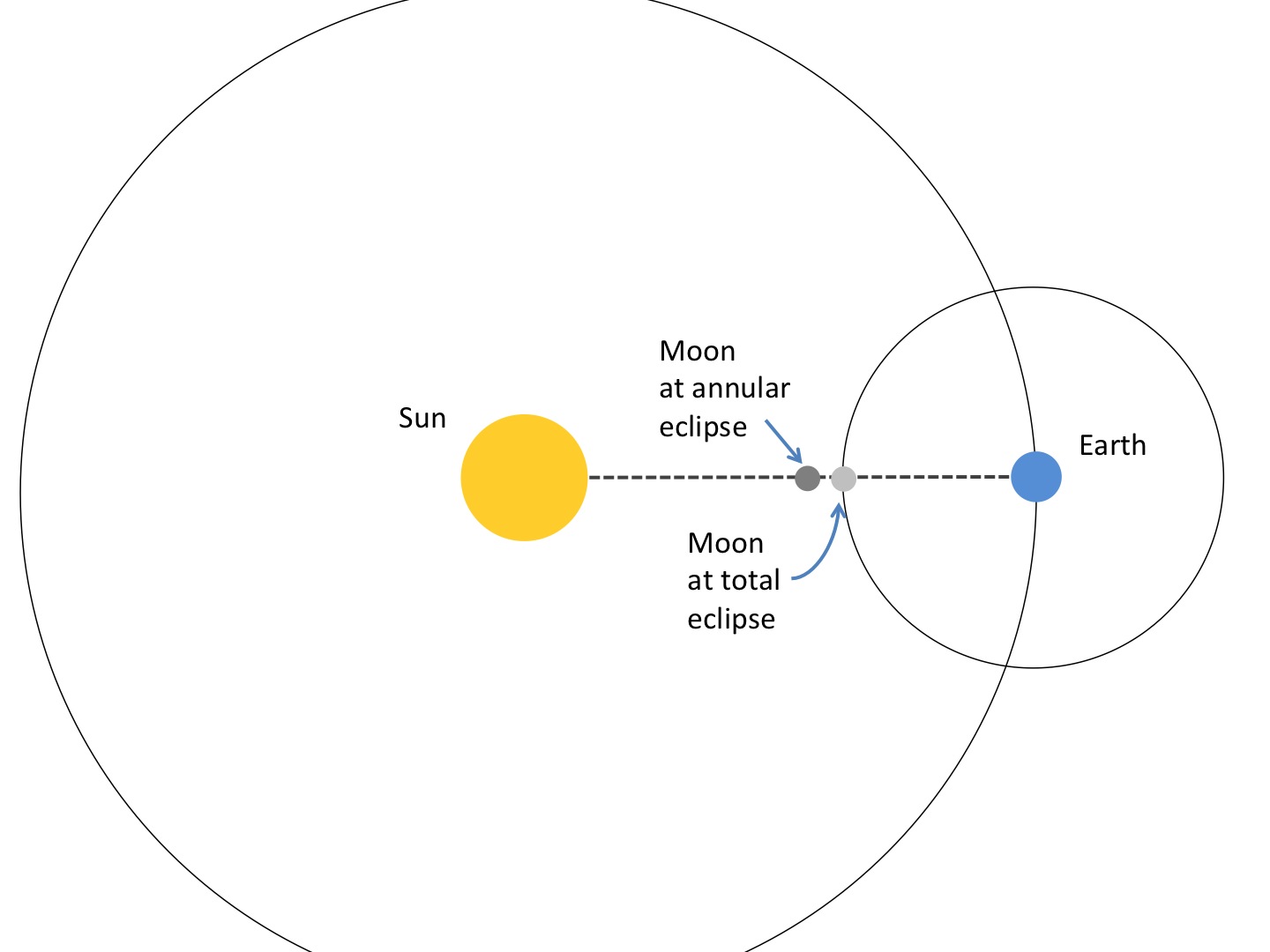
April 15: Total lunar eclipse. A total lunar eclipse occurs when the Earth moves between the Sun and the Moon (see below). Unlike a solar eclipse, in which the Moon moves between the Sun and the Earth, you don’t need any protective eyewear to watch a lunar eclipse.

April 28-29: Annular solar eclipse. This is also known as a “ring of fire” eclipse, due to the way the Moon only partially blocks the Sun. During a total solar eclipse, the Moon moves between the Sun and the Earth and is at just the right distance from the Earth to completely block out the Sun. An annular solar eclipse occurs when the Moon moves between the Sun and the Earth, but the Moon is far enough away from the Earth that it appears slightly smaller in the sky than the Sun. Protective eyewear is required to safely view an annular solar eclipse.
Scientists are puzzled over the water content of the Moon:
The amount of water present in the moon may have been overestimated by scientists studying the mineral apatite, says a team of researchers led by Jeremy Boyce of the UCLA Department of Earth, Planetary and Space Sciences.
Boyce and his colleagues created a computer model to accurately predict how apatite would have crystallized from cooling bodies of lunar magma early in the moon’s history. Their simulations revealed that the unusually hydrogen-rich apatite crystals observed in many lunar rock samples may not have formed within a water-rich environment, as was originally expected.
The prevailing model for how the Moon formed involves a Mars-sized planet crashing into the Earth, ejecting bits of the Earth into space, and some of these bits coalescing into what is now the Moon. If that’s the case, then the Moon should be similar in composition to the Earth — except that lighter elements, like hydrogen (which is a component of water), are believed to have escaped the Moon’s relatively weak gravity and drifted off into space, leaving the Moon rather dry.
In 2010, scientists took samples from the Moon and found apatite crystals, which contained a lot of hydrogen, suggesting that the Moon wasn’t as dry as previously thought. Now, however, with scientists concerned that the amount of hydrogen in these crystals overestimates the amount of water on the Moon, the “giant impact” theory of how the Moon formed is called into question:
“We had 40 years of believing in a dry moon, and now we have some evidence that the old dry model of the moon wasn’t perfect,” Boyce said. “However, we need to be cautious and look carefully at each piece of evidence before we decide that rocks on the moon are as wet as those on Earth.”
This study shows that scientists still have much to learn about the composition and environment of the early moon.
“We’re knocking out one of the most important pillars of evidence regarding the conditions of the formation and evolution of the moon,” Boyce said. “Next, we plan to determine how badly apatite has distorted our view of the moon and how we can best see past it to get at the moon’s origin.”
This is how science works. New evidence refines — or sometimes completely blows away — a theory/hypothesis. You can never be so wedded to an idea that you overlook important evidence that contradicts your model. It’ll be interesting to see if this latest evidence overturns the giant impact theory, and, if so, what the next favored model will be.
A common claim about the superiority of science over other ways of knowing is that science is self-correcting; science may take wrong turns from time to time, but it eventually finds its way back on the right road. As a supporter of science, I believe in the power of the scientific method; and generally speaking, it’s true that science self-corrects. However, it’s important to understand how human limitations—scientists are human, after all—sometimes undermine the process of self-correction.
Science will never give full understanding of anything. All that we can hope for are useful approximations of the objective reality we hope is out there. Under ideal circumstances, science is certainly self-correcting in the sense that it provides a process for arriving at consistently closer approximations. But, in too many instances the self-correcting potential of ideal science cannot overcome common human frailties. The most famous example from the field of astronomy will illustrate this.
Physics, like all of the sciences, started out as ‘natural philosophy,’ which functioned as an integrated branch of the whole philosophy/religion of the ancient Greeks. Science in its rudimentary form was thus shackled to the Greek worldview that placed humans forever at the center of the universe and effectively limited scientific thought to what would become Ptolemaic theory. This geocentric view of mankind’s place in the universe also prevailed because it conformed nicely to what the ancients observed with their limited senses, and because it had a powerful appeal to human emotions that subsequent theories could never have.
It is testimony to the power of the human mind and the potential of science that at least one individual was able to overcome all of this and figure out a closer approximation of the truth. An ancient Greek astronomer named Aristarchus proposed a heliocentric universe in the 3rd century B.C. Unfortunately his hypothesis was quickly squashed by contemporaries who condemned his idea as impious and foolish—in other words, it didn’t conform to the dominant philosophy/religion of the day. The Copernican revolution did finally take place, 1,800 years later, but those who have faith that science is the best way (or only way) to know things shouldn’t take much comfort from this example. Yes, the scientific method was eventually successful, but the self-correction was at best tragically slow.
This example has some scary implications, because the weak sister of modern science, the study of human behavior, is currently at a stage comparable to physics 2,000 years ago and shows no signs of correcting itself. With all of the social and behavioral problems facing an increasingly complex and technological world, it is possible that modern society cannot survive another 2,000 years without viable theories of individual and group behavior. So, it is important that all of us who depend on science to solve (or at least mitigate) the world’s problems understand how the three major things that prevented physics from correcting itself for about 2,000 years—the debilitating effects of ideology, the limiting nature of human perspective, and the immense power of emotions to mislead—are still at work today preventing the newer branches of science from correcting themselves.
To appreciate the ways in which science’s ability to self-correct can be thwarted, one has to be very clear about the basics of the scientific method. They can be outlined in rudimentary form in the following manner:
The two parts of this process that make self-correction possible are the brainstorming and peer review stages. Unfettered brainstorming makes it possible for scientists to consider all possibilities—that’s how we got Einstein and Georges Lemaître, the father of the big bang1. If religion or philosophy makes some ideas unthinkable, the brainstorming stage will be inhibited, and ‘unpopular’ possibilities will be missed. The humanist philosophy that dominates the behavior and social sciences departments today is making the self-correction in those fields impossible just as much as the philosophy of the ancient Greeks made physics impossible.
The peer review process makes it possible to challenge popular but false notions. In modern times this stage has become highly susceptible to the negative influences of politics and government funding. The controversy over global warming / climate change is a good example. Regardless of a person’s views on climate change, it should be deeply disturbing that one side of what should be a scientific debate has been corrupted by government funding into political advocacy. When any scientist becomes an advocate of policy, he is no longer a scientist, because science can only serve one master—the search for truth. It is even more disturbing that those on the other side of the scientific debate have been tagged with the vicious label of ‘deniers.’ Those who use this label in such a pejorative manner are trying to preemptively shut down the peer review process and mandate scientific orthodoxy.
It is dangerous, therefore, to assume that science has an inherent ability to overcome human failings to the point that we can depend on it to be self-correcting. That it can effectively reach that goal is demonstrated by the fairly rapid acceptance of big bang theory in the mid-20th century over the strong objections of those who were philosophically opposed to it. But what has only recently become true of a branch of science that is over 450 years old, is not true of the newer sciences. Biology, psychology, and the social sciences are nowhere near the stage where self-correction is automatic.
Now, there is one assumption I’ve made in this discussion, that self-correction means we’re making better and better approximations of reality. But there is another issue: what if there isn’t always an objective truth that we can get closer to by self-correction? That’s an altogether different topic, but let me say that relativity and quantum mechanics do suggest that this might be true. This is a topic for another article.
[1] “Father” in more than one sense: Lemaître was also a priest.
Recommended reading:
The opening scene for Contact is quite possibly the best opening scene in a movie, ever. (When you watch this clip, it’s recommended that you change the resolution to 720p HD and turn up the volume.)
This is a wonderful illustration of the principle that distance (and motion) is equivalent to time. The speed of any signal, whether light or sound or carrier pigeon, is always finite. It takes time for a signal to travel the distance between the source and the receiver, so this means the signal is always telling us something about the past. Back in the days when people communicated with each other using letters, it took a week or two to receive them, depending on how far they had to travel; when the recipients read those letters, they were always reading about something that was recent to the sender, but already one or two weeks in the past for the recipient. Similarly, when we look at the star Betelgeuse, the light that we see has taken time to travel the distance between Betelgeuse and the Earth, and so we are seeing it as it was in the past (at a distance of 400 trillion miles and with light traveling at a speed of 186,000 miles per hour, we are seeing Betelgeuse as it was 640 years in the past). Conveniently, such vast distances are often expressed in units of light-years (the distance light travels in a year), which also tell us at what point in cosmic history we are observing something.
In the opening scene of Contact, the further away we travel from Earth, the older the radio transmissions become. We first hear contemporary (for 1997) music, then the soundtrack gradually shifts to music and news from further and further in our past. Once we get beyond a certain point we hear static, then silence.
But sounds don’t travel through space, I hear some of you saying. True. However, radio signals are light waves, not sound waves. The radio waves, which carry information, are transmitted in all directions and are picked up by a receiver with an antenna (say, an AM/FM radio) that converts the radio signal into the sound you hear. So, in principle, anyone who might be not too far out in space could pick up our terrestrial radio and television signals and learn all kinds of interesting things about the inhabitants of Earth.
Perhaps you are wondering from how far out in space someone could receive intelligent signals from Earth. The scale of the Contact sequence isn’t quite right—it was fudged a bit for creative/dramatic purposes. The truth is, if aliens are zipping past Pluto at this moment, they would receive transmissions from Earth that are from only five and a half hours in the past. Little Green Men near our closest stellar neighbor, Alpha Centauri, would receive transmissions from the year 2009. Civilizations on a planet orbiting the star Alpha Mensae (33 light-years away), however, might catch old episodes of Dallas. Someone passing close to the star 51 Pegasi (50 light-years away) might be aware that someone named John F. Kennedy has been assassinated in a place called Dallas. An alien near the star Regulus (77 light-years away) could be watching images of Hitler opening the Olympic Games in Berlin. Further still, near the star Eta Herculis (112 light-years away), curious beings might just now be detecting Marconi’s radio transmissions. Beyond this distance, the Earth is silent. Considering that our Milky Way galaxy is more than 100,000 light-years across, we’ve barely announced our existence to the neighbors down the street. Not that this is entirely lamentable. Personally, I find it comforting that so little of the universe is aware of the Kardashians.
 SixDay Science