Saturday morning astronomy news roundup

Scientists are concerned that Earth bacteria are hardy enough to survive the trip to Mars aboard spacecraft and possibly colonize the Red Planet. Scientists at NASA’s Jet Propulsion Laboratory simulated the conditions that the bacteria would be exposed to, both on Mars and in space, and found that some of the spores survived for 18 months—twice the time it takes spacecraft to get to Mars. From a biblical perspective, this is not all that surprising. As ancient biblical commentators pointed out, the universe was created with the potential for life built into it—and as Hugh Ross has explained in great detail in his many books, the universe is undeniably tuned for life. It makes sense that the most basic forms of life would be hardy enough to survive the otherwise harsh conditions beyond the Earth.

Scientists at MIT have created a simulation of the universe that begins from just 12 million years after the Big Bang to now. (Twelve million years may sound like a long time, but in terms of the ~14 billion-year age of the universe, it’s not long at all.) Such simulations are carried out on supercomputers, as they would otherwise take thousands of hours to process on ordinary desktop computers. This newest simulation is an improvement on previous cosmological simulations, because, among other things, it more faithfully produces the mixed population of galaxies observed in the universe, including graceful spirals like our Milky Way, and giant ellipticals like M87, and captures the present-day proportion of hydrogen and heavier elements in galaxies. The universe, itself, is the greatest laboratory ever created, but we are limited in our ability to “experiment” with it. In order to learn about the structure of the universe and the way it has changed with time, scientists have to create simulations and see how well they match up with observations of the universe on different scales of both size and time.

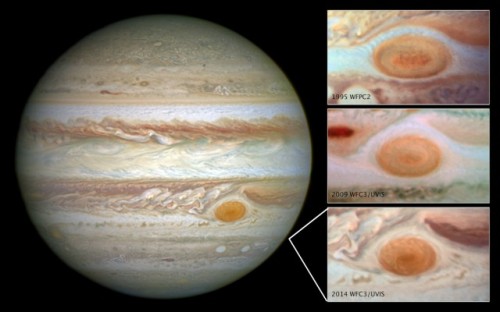
Jupiter’s Great Red Spot continues to shrink

Jupiter's Great Red Spot

It’s as iconic as anything in the solar system—Jupiter’s Great Red Spot, a massive storm that’s been raging on the surface of Jupiter for hundreds of years, maybe longer—but it’s been shrinking since at least the 1800s, and scientists aren’t sure why. Now, at “just” 10,000 miles across, it’s the smallest it’s been since scientists first started measuring the storm. Whatever the cause, personally, I think Congress should legislate something to stop the shrinkage.

Astronomy and Astrophysics curriculum officially announced

Astronomy and Astrophysics

It’s official:

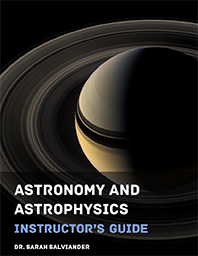
Today we are officially announcing the publication of ASTRONOMY AND ASTROPHYSICS, a curriculum created by Dr. Sarah Salviander, a research scientist whose areas of particular interest are quasars and supermassive black holes. She is a research scientist at the University of Texas, is one of the authors of “Evolution of the Black Hole Mass – Galaxy Bulge Relationship for Quasars in the Sloan Digital Sky Survey Data Release 7” and “Narrow Emission Lines as Surrogates for σ * in Low- to Moderate-z QSOs” in addition to many other scientific papers, and teaches classes as a visiting professor of physics at Southwestern University. Dr. Salviander describes the new curriculum at Castalia House:

“Look around the web for a high-quality, modern-science astronomy homeschool course and you won’t find much. There are a handful of scripture-based astronomy courses that seem to cover little more than the seasons and motions of the night sky, and one very expensive software-based curriculum. I realized there was a need for a comprehensive, modern, and affordable astronomy homeschool curriculum, and set out to develop one based on my years of teaching astronomy at the university level. A couple of years ago, I mentioned this in an offhand way to Vox Day; it turns out Vox had been contemplating offering a series of affordable, electronically-available homeschool curricula, and so we began to discuss the possibility of making astrophysics the first of many such courses.”

The course is suitable for ages 13+ with the appropriate background in mathematics — basic algebra and geometry — but there is no science prerequisite. It was designed primarily with homeschoolers in mind, but it would also work very well in public/private high schools, either as a conventional science course or as an independent study for motivated students. It is also suitable for adults who wish to learn about astronomy and astrophysics in a self-guided continuing education sort of way.

We’ve had at least one person ask whether the course is suitable for students in the Southern Hemisphere. The answer is yes, mostly, with the exception of a couple of lab activities; I’m going to look into adapting the two lab activities that only work in the Northern Hemisphere. If anyone has other questions about the curriculum, don’t hesitate to contact me.

Colliding neutron stars

black_hole

NASA has released a stirring animation depicting the theoretical merger of two neutron stars. Once the stars merge, they form a black hole.

Neutron stars are super-dense remnants of dead high-mass stars. As the name suggests, they are comprised entirely of neutrons, which formed from the merging of protons and electrons during the gravitational collapse of a dying star’s core. Neutron stars have a theoretical upper limit to their mass, beyond which the rules of quantum physics dictate that the stars collapse into black holes. A merger is one way to have a neutron star exceed its theoretical mass limit.

Such mergers would release an enormous amount of energy, which could explain the origin of gamma ray bursts—mysterious flares of ultra-high energy that emanate from deep space.

Zombie science

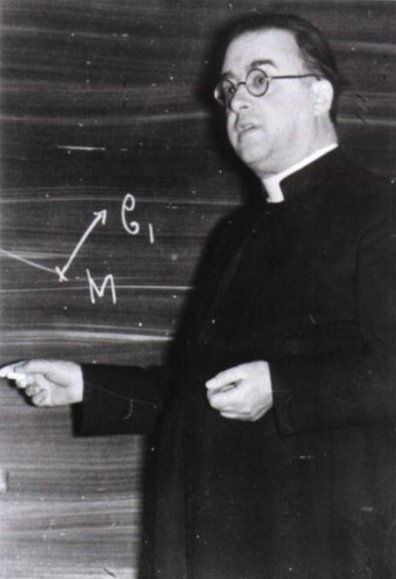
There’s a simple reason for the corruption of biology and the social sciences: these studies are not based on Christian beliefs and faith the way science originally was and must always be. Modern science developed in only one place—Christian Europe. If you look up the great pioneers of physics and astronomy, you will find that they were almost all devout Christians, from Copernicus to Galileo to Newton to Maxwell to Planck to Lemaître.

The one glaring exception was Einstein, but even he famously said, “I want to know His thoughts; the rest are details.” Even though Einstein was not Christian, he was the product of the Christian European culture that gave birth to science, and he was a willing participant in a process based on Christian principles:

But science can only be created by those who are thoroughly imbued with the aspiration toward truth and understanding. This source of feeling, however, springs from the sphere of religion. To this there also belongs the faith in the possibility that the regulations valid for the world of existence are rational, that is, comprehensible to reason. I cannot conceive of a genuine scientist without that profound faith. The situation may be expressed by an image: science without religion is lame, religion without science is blind. (Albert Einstein, 1941)

The prime motivation of Einstein and so many other great figures in science was to uncover divine truth and know the mind of God. People who feel they are doing God’s work are far less likely to succumb to human frailties and engage in activities that corrupt the search for truth. That tradition remains strong in physics, the original science. That is why the field of astrophysics was able to resist the degenerative effects of an increasingly atheist society. When the devout Lemaître conceived of the primeval atom (aka big bang theory) and demonstrated that the Genesis account of a universe with a beginning was scientifically sound, the stubborn resistance of scientists with a hatred for the idea of God was quickly overcome by the evidence.

The other branches of science have not fared as well. Atheists stole science from Christians in the mid and late 19th century with the false social science of Marx and behavioral science of Freud as well as the misuse of Darwin’s theory of evolution and the gross misrepresentation of Christian scripture. Over the last century and a half, secular humanists have successfully alienated Christians from the scientific method the faithful created and taken over most of its areas of study. Physics still has a substantial minority of Christians (and people with a general belief in God), and much good work is still being done. The social and behavior studies, on the other hand, are the tools of secular humanism and the zombies of the scientific world—active but not alive. Biology was bitten long ago and is gradually succumbing to the humanist infection. There is an easy way to tell a zombie biologist from a true biological scientist; ask him to say the following words, “Darwin was seriously wrong about some important things.” If he can’t bring himself to say this, you are speaking with one of the walking dead. Climate change ‘scientists’ are just garden-variety corrupt hacks who have sold out for money, prestige, and political favors. Bundle up for the coming ice age or thank the polluters for preventing it.

The lesson here is that the further any area of study is from the Christian foundations of true science, the more corrupt it is. The United States has been the source of a great deal of the productive science done in the 20th and early 21st centuries. It is also the most Christian of all developed countries. If atheists succeed in turning the United States into anything similar to what the formerly Christian European nations now are, science will die and humankind will experience a dark age.

Saturday morning astronomy news roundup

The Cassini spacecraft continues to study the dickens out of Saturn and its satellites, this time snapping some lovely images of the moon, Titan. From billions of miles away, team scientists steered Cassini to within 600 miles of Titan’s surface and caught sight of waves in its seas.

Mark your calendars for May 24, because the Earth may be in for an impressive show from a never-before-seen Camelopardalid meteor shower. In fact, the shower is predicted to be so intense — with up to 200 meteors streaking across the sky per hour — that it’s being referred to as a possible “meteor storm.” The meteor shower is a result of the Earth crossing the trail of debris left by the newly-discovered Comet 209P/LINEAR. The shower should last for hours, since it will emanate from a northern part of the sky (remember, for those in the Northern Hemisphere, the North Star never sets), but the best time to view the show is between the hours of 2:00 am and 4:00 am EDT on the 24th.

NASA’s Mars rover, Curiosity, has begun to drill into Martian rock with the intention of studying a sample on its onboard lab. NASA scientists hope to uncover whether the conditions on Mars were ever appropriate to host life.

Scientists at UT-Austin (high-five!) have found one of the Sun’s long-lost brothers. Dubbed HD 162826, the star very likely formed from the same enormous gas cloud as the Sun, but somehow got separated and the siblings are now 110 light-years apart. It’s unknown whether any planets are orbiting the star, but since it appears to have no Jupiters around it, it’s unlikely that life as we know it would be on any terrestrial planets orbiting HD 162826.

Asteroid grazes the Earth, humankind almost wiped out!

Or not.

The media have been reporting on a “bus-sized” asteroid that made a close pass by the Earth last Saturday. “Close” is a relative term — in astronomy, it generally means much further than you might think. In this case, the asteroid, called HL 129, came closer than the orbit of the Moon, which is about 240,000 miles away. By way of comparison, the much larger asteroid, 99942 Apophis, is predicted to come much closer to the Earth in the year 2029 — a mere tens of thousands of miles, which will make it visible to the naked eye from some locations on Earth — and yet a collision with the Earth has been mathematically ruled out based on what we currently know about Apophis.

So, maybe this still sounds troubling, but there are two reasons I don’t worry about asteroids hitting the Earth. The first is, unless the asteroid is very large — on the order the size of the one that’s believed to have wiped out the dinosaurs — then its destructive power is limited, and anyway it will most likely land in a large body of water or somewhere else that’s unpopulated by humans. (The likelihood of an asteroid hitting the Earth is inversely proportional to its size.) The second is, there’s not much we can do about an asteroid like HL 129. Despite our best efforts to monitor the skies for such objects, HL 129 was discovered only a few days before it made its close pass. That’s not nearly enough time to do anything about it, as it would take a minimum of a year to several years in order to deflect an asteroid on a collision course with Earth. So, why worry? As Christians, we are told not to worry about tomorrow; I think Matthew 6:25-34 also applies to asteroids.

Replay: Our analysis of “The Great Debate: Is There Evidence for God?”

Traffic’s up after the informal announcement of the publication of our Astronomy and Astrophysics curriculum, so in the coming weeks we’re going to replay some of our more important posts from the archives for our new readers.

On March 30, 2011, Christian theologian and philosopher William Lane Craig debated atheist physicist Lawrence Krauss at North Carolina State University. The topic was, “The Great Debate: Is There Evidence for God?” Video of the rather lengthy event is here. What follows is our analysis of the debate. 

** Written by Sarah and “Surak” **

The two opposing sides of the scientific debate over the God hypothesis were well represented on Wednesday by Dr. William Lane Craig (Christian Philosopher and Theologian from Talbot School of Theology) and Dr. Lawrence Krauss (Theoretical Physicist from Arizona State University). Dr. Craig’s argument was based on the clearly-stated and logical assertion that if God’s existence is more probable given certain information, that information meets the essential criterion for evidence. Dr. Krauss was equally clear in his definition of evidence: it must be falsifiable to be scientific. We find both standards to be very useful.

There was some confusion on the part of the moderator as to whether the topic of the debate was the existence of any evidence for God or the existence of enough evidence to prove God’s existence. We think the moderator erred in his statement of the debate’s purpose, since no one could reasonably argue that there is proof or disproof of God’s existence. As Dr. Krauss correctly stated, science cannot falsify God; so, the question can only be, “Is God likely?”

We will assess the debate in terms of whether or not there is any evidence for the existence of God, although Dr. Krauss tried to set the bar unfairly high with his assertion that a highly extraordinary proposition, such as the God hypothesis, requires extraordinary evidence. However, we think defenders of the God hypothesis can accept and meet this challenge.

Dr. Krauss acknowledges that the big bang is fact and one of science’s great achievements. The big bang theory establishes that the universe had a beginning, and that the universe was created from nothing. There was some debate and confusion about the meaning of “nothing.” It can mean the absence of matter, such as in “empty” space, or it can mean no space, no matter, and no time. The big bang involves the second notion of nothing, which is about as much of a nothing as most human minds can conceive of.

The appearance of our universe from this nothing makes it an undeniable instance of creation – something coming from nothing – as opposed to an example of making, which is something being fashioned from something that’s already there. Science is based on the premise that everything has a cause, especially if it has a beginning. Since the universe had a beginning, it must have a cause, and a reasonable extension of the big bang theory is that the cause must be something greater than and outside of the universe.

The cause of our universe must therefore be a transcendent or super-natural cause. This ultimate cause must include not only the difficult idea that some entity “exists” outside our universe, but also the humanly inconceivable idea that it has as part of its nature the capacity to exist and make other things come into existence. In other words, there must be something that is its own cause and the essence of existence. We humans can never understand such an entity, but it’s the only way to avoid a common patch of logical quicksand that threatens to swallow anyone who attempts to discuss the origins of our universe.

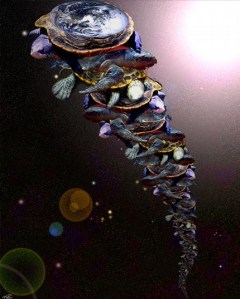
This danger to fruitful discussion is best illustrated by a story that appeared in Stephen Hawking’s A Brief History of Time. One of the greats of science, probably Bertrand Russell, had given a lecture on astronomy. He described how the Earth orbits around the Sun and how our solar system is part of a much larger galaxy. After the lecture, he was approached by a little old lady who informed him that the Earth is really sitting on the back of a giant tortoise. Russell replied, “What is the tortoise standing on?” “You’re very clever, young man, very clever,” said the old lady. “But everyone knows it’s turtles all the way down!” We must accept that at the bottom of any conceivable pile of cosmic turtles, there must ultimately be one that has as part of its nature the power of existence.
There is perhaps only one relevant or useful question humans can pose about this scientifically unknowable causal agent of the universe, “Is it conscious or unconscious?” If the transcendent cause of the universe is conscious, God is the most useful name we can give it. If the cause of the universe is unconscious, then it is some kind of super-nature. The best known and most likely candidate for the super-natural is the ‘eternal multiverse.’

This brings us to what we thought was the best question from the audience: What testable prediction does the God hypothesis make? Let’s examine this question in light of two things that Dr. Krauss said:

  1. Truly scientific evidence must be falsifiable.
  2. The big bang is established fact.

The Judeo-Christian God hypothesis includes a prediction made over 3,000 years ago in Genesis 1 that the universe had a beginning. This prediction ran counter to the theory of an eternal universe that dominated philosophical and scientific thinking until the 1960s. The great physicist and Jesuit priest, Georges Lemaître, developed the big bang theory in part because of his belief in the Genesis account of Creation. This Genesis prediction was testable and turned out to be true.  So, at least one major testable prediction of the God hypothesis meets the standard for scientific evidence.
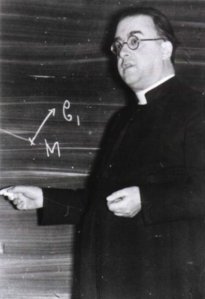
The Father of the Big Bang, Georges Lemaître

It is not proof of God, but it is undeniable evidence for God that meets even the “extraordinary” benchmark set by Dr. Krauss. The prediction that the universe had a beginning is more than ordinary evidence because it is so ancient. It turns Dr. Krauss’s somewhat derisive comment about Bronze Age peasants back on his own argument: how indeed could such scientifically ignorant people have boldly stated what would three millennia later become astonishing fact?

Apply the same test to the best super-nature alternative: what testable prediction(s) does the multiverse hypothesis make? We are still learning about the different multiverse hypotheses, but there are at least two predictions that we’re aware of. The first involves an explanation for the weakness of gravity, which is by far the weakest of the four fundamental forces of nature. Some physicists predict that gravity is weak, because gravitons – the particles responsible for conveying the force of gravity – escape our universe into parallel universes.

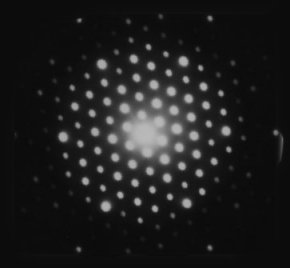
The second prediction is the existence of “ghost particles” from parallel universes. Some physicists believe these particles must exist in order explain one of the great mysteries of quantum physics, the interference pattern observed when electrons pass through a double-slit. Interference is behavior we expect from waves, not particles; moreover, the pattern is observed even if electrons are fired at the double-slit one at a time, ruling out any possibility that two electrons, each going through a different slit, are interfering with each other. The interference pattern must arise, the prediction goes, from the electrons in our universe interfering with ghost electrons in a parallel universe.

Electron interference pattern

There are two insurmountable problems with these predictions. Not only do they contradict Dr. Krauss’ assertion that parallel universes are causally disconnected from each other, but neither of these predictions is testable. The evidence for the multiverse does not rise to the level of the scientific — not because we currently lack the knowledge or technology to perform the experiments, but because they are not falsifiable in principle. Science is limited to the study of this universe. The multiverse idea as it is currently framed is not scientific, it is metaphysical.

It seems that at this time the God hypothesis is superior in evidence to the best “natural” alternative.

The evidence in favor of the God hypothesis is even stronger than what Dr. Craig presented. We at SixDay Science propose that the Genesis 1 account of Creation makes at least 26 scientifically testable statements. All 26 are compatible with modern science and they are in the correct order. A discussion of this is available here. We believe this evidence is so extraordinary that it comes close to being something akin to J. B. S. Haldane’s “Precambrian rabbit” in the sense that a creation story which succeeded in anticipating so much of modern science by 3,000 years is just as out of place in time as a fossilized rabbit in 600 million year old rock.

Saturday morning astronomy news roundup

Number Five is alive! NASA’s rover, Curiosity, snaps selfies on Mars and looks reminiscent of a certain movie robot from the 1980s.

In other NASA photo news, the Cassini spacecraft, which has been studying the dickens out of Saturn for about 10 years, has snapped a lovely photo of Uranus offset by the rings of Saturn.

And, in even more NASA news, the space agency has unveiled its prototype design for the Mars mission spacesuits. The Z-2, as the suit is called, will include parts that are made in 3-D printers. The first design, the Z-1, looked like something Buzz Lightyear would wear. The Z-2, however, looks kind of TRON-ish with its luminescent design.

Genesis time and the changing length of a day

Scientists have discovered an exoplanet that spins so fast its day is just eight hours long. Beta Pictoris b, which is 65 light-years from Earth, rotates on its axis at a whopping 62,000 miles per hour, about 50 times faster than Earth’s rotation rate (since the exoplanet is much bigger than the Earth, its day is a third as long). Scientists made this calculation using the same method meteorologists use to track earthly weather systems — the Doppler effect.

What is not generally known is that the Earth once had a much shorter day than it does now, due to its changing gravitational interaction with the Moon (and the Sun). Because of tidal friction — the loss of energy due to the gravitational tugging on Earth’s oceans — the Moon is gaining orbital energy at the cost of Earth’s rotational energy. As a result, the length of an Earth day increases. With the extra bit of orbital energy, the Moon’s orbit is increasing by about 4 cm each year and the length of a day increases by a couple of milliseconds per century. It doesn’t sound like much, but over millions and billions of years, it adds up. Computer simulations suggest that billions of years in the past, the Moon was so close to the Earth that an Earth day was a mere six hours long.

Intriguingly, an Earth-day that changes in duration is consistent with Gerald Schroeder’s reconciliation of a literal interpretation of Genesis 1 and an old Earth. Schroeder argues that the length of each Genesis day is 24 actual hours, but only measured from God’s perspective. From our earthly perspective, each of those days is a different length, ranging from billions to millions of years. It isn’t until humans appear on Day 6 that Genesis time comes to agree with Earth time. It would seem God chose a perspective for Genesis that was 24 hours, because that’s how long an Earth day would be once Adam appeared. For a detailed explanation of this reconciliation, see here.