Weekly Psalm 19: The Pleiades

Here is your weekly reminder of Psalm 19 — the Pleiades.

Pleiades_large

The Pleiades star cluster. Credit: NASA, ESA, AURA/Caltech, Palomar Observatory.

The Pleiades is an open cluster of stars that forms an asterism — a recognizable pattern of stars — in the sky. The cluster is about 440 light-years from Earth, making it close enough and large enough to be easily observed with the naked eye. It’s also quite lovely through a good pair of binoculars.

The Pleiades is known by many different names, including the Maia Nebula and the Seven Sisters. In Japan, it’s known as Subaru. (You probably recognize the asterism in a certain car company logo now.)

These large, hot stars are relatively young at just 100 million years (our own Sun is 4.5 billion years old), but are already halfway through their main stage of life. The general principle with stars is that the bigger and more luminous the star, the faster it lives.

The cluster is currently passing through a cloud of dusty gas. The light from the stars reflects and scatters off the dust, creating the ethereal glowing wisps surrounding the stars.

Never trust an unstable AGB star…

The best passage from The Lord of the Rings and an astronomical reference to kick off the weekend.

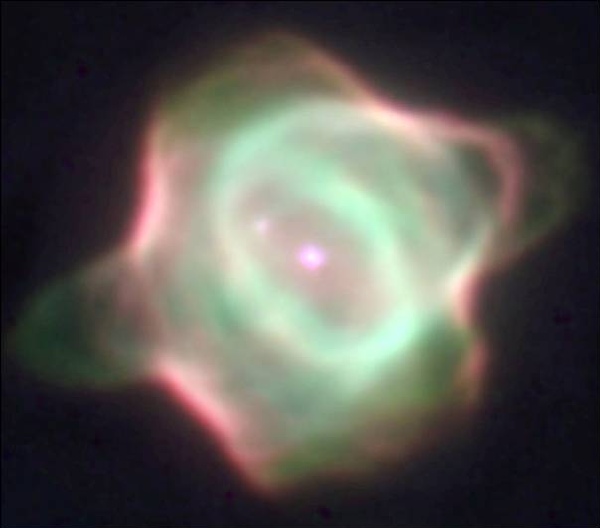
An unstable asymptotic giant branch star is a low- to medium-mass star, like our Sun, in its final phase of fusing hydrogen into helium. At this point, it has burned through all of the hydrogen in its core and is only burning hydrogen in an outer layer. It becomes unstable when it begins to pulsate, after which it will puff off its outer layer into what’s called a planetary nebula. This is the fate of our Sun.

Here’s the Stingray Nebula, in case you were curious.

The Stingray Nebula. Credit: NASA, Matt Bobrowsky (Orbital Sciences Corporation).

Scientific revenge poetry

There are few things more annoying for a scientist presenting at a conference than to be scheduled as the last presenter. A lot of attendees have lost interest by then or have left the conference, leaving you with a sparse and worn-out audience. When Australian astrophysicist, J. W. V. Storey, found himself in this unenviable situation in the 1980s, he got his revenge by presenting his research in the form of a poem and then later submitting his paper to the conference proceedings in poem-form.

Here is a sample:

I wrote my abstract, sent it in,
With words that don’t offend.
Imagine my horror to find that I
Am scheduled at the end.

Let me say, to be last speaker,
There are very few things worse.
And so this talk, to get revenge,
Will be entirely in verse.

The subject I address today
Is that of star formation.
And what we’ve found out recently
About the situation.

Stars start out as clouds of gas and
Dust and bits of spinning stuff.
Collapsing gravitationally
Until they’re dense enough.

They form themselves in little lumps,
(Or so says this bloke Jeans).
‘Dynamic Instabilities’
Whatever that term means.

It goes on for quite a while and includes figures, some of them charmingly hand-drawn. But the story doesn’t end there.

Last year, Storey’s family shared the following with one of my colleagues, which shows that the referee assigned to review Storey’s paper — who can now be identified as John Whiteoak — responded in kind, by producing his own poem to express his commentary (“Dick-Ed” is Richard McGee, the proceedings editor):

Whiteoak review


Weekly Psalm 19: The Needle Galaxy

Here is your weekly reminder of Psalm 19 — the Needle Galaxy.

This galaxy, also known by its catalog name, NGC 4565, is about as fine an example of an edge-on spiral galaxy as you’ll ever see. If the Milky Way were to be seen at the same distance of 43 million light-years and on its edge, it would look very much like this.

Edge-on spiral galaxy NGC 4565, also known as the Needle Galaxy. Credit: Bruce Hugo and Leslie Gaul/Adam Block/NOAO/AURA/NSF.

The puffy part in the center is the bulge of the galaxy and the extended part is the disk. The dark strip running the length of the galaxy is a dust lane. Dust typically makes up about 10% of the gaseous stuff between the stars in the disk of a spiral galaxy, which doesn’t sound like much, but it’s enough to block a lot of the intense starlight coming from the galaxy.

Weekly Psalm 19: Jupiter

Here is your weekly reminder of Psalm 19 — the planet Jupiter.

Anyone who has looked up at the night sky is acquainted with Jupiter. It’s the third-brightest object in our sky after the Sun and Venus. It’s also the largest planet in our solar system, a gaseous giant comprised almost entirely of hydrogen and helium. Interestingly, its size, in terms of orders of magnitude, places it exactly in the middle between the Earth and the Sun — it is almost exactly 10 times smaller than our Sun, but just over 10 times larger than the Earth.

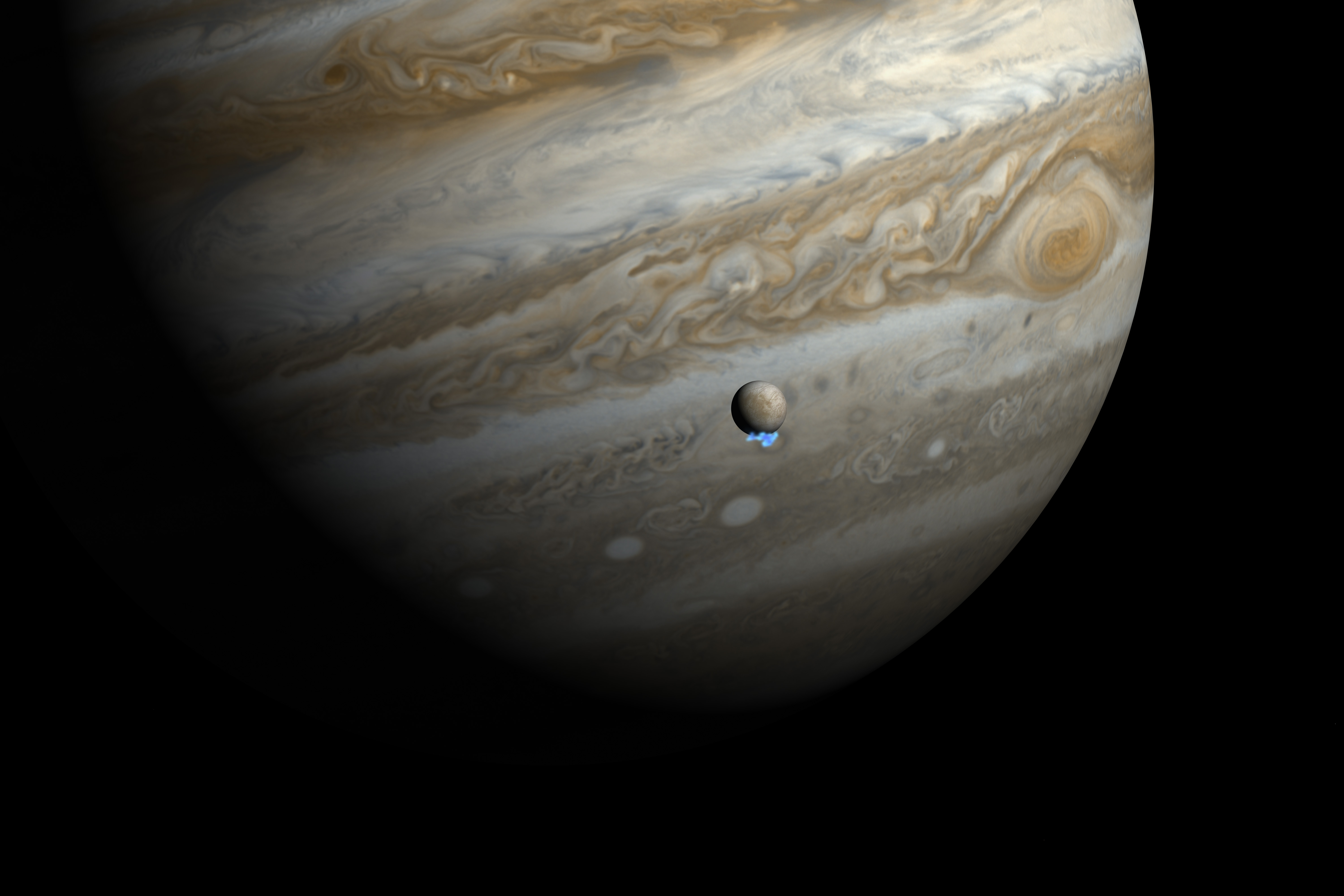
This artist's impression shows Jupiter and its moon Europa using actual Jupiter and Europa images in visible light. The Hubble ultraviolet images showing the faint emission from the water vapour plumes have been superimposed, respecting the size but not the brightness of the plumes. Astronomers using Hubble have detected signs of water vapour being vented off this moon, creating variable plumes near its south pole — the first observational evidence of water vapour being ejected off the moon's surface.

An artist’s impression showing Jupiter and its moon Europa using actual Jupiter and Europa images in visible light with ultraviolet images of water vapor plumes superposed on Europa. Credit: NASA, ESA, and M. Kornmesser.

Some call Jupiter a failed star, but that’s an exaggeration. The defining characteristic of a star is that nuclear fusion is occurring in its core; however, Jupiter would need about 80 times more mass for this to occur, so it falls well short of the star limit. Still, it’s pretty massive as planets go, outweighing all of the other planets in our solar system combined by more than a factor of two.

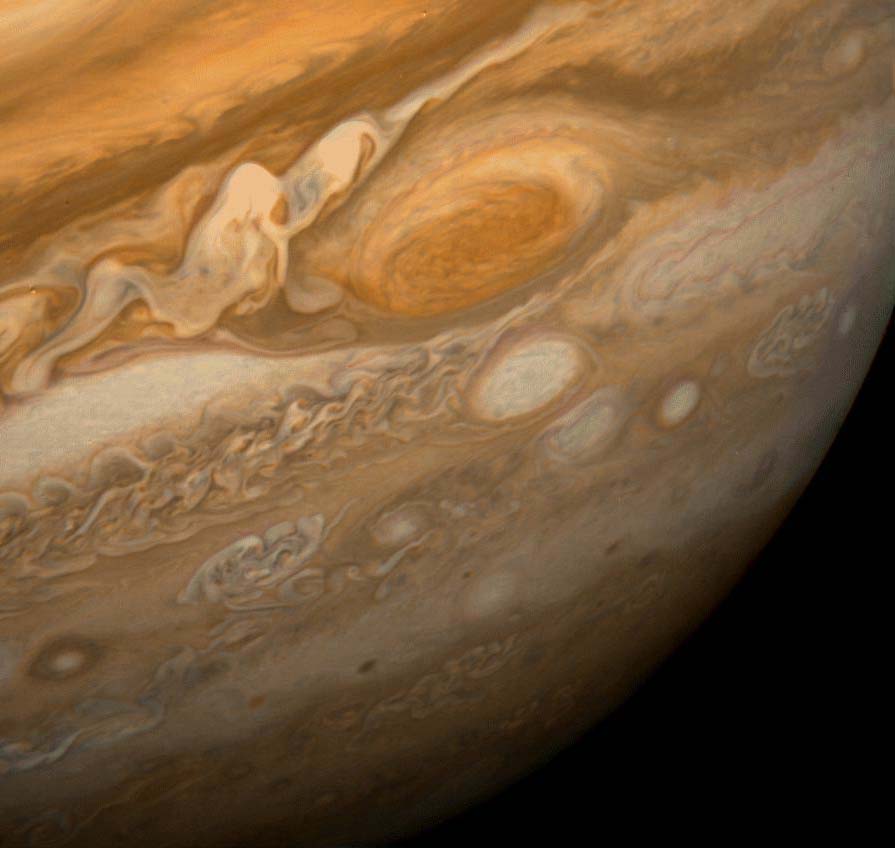
Jupiter is a visual treat for the astronomer for a number of reasons: its colorful bands of clouds, its Galilean moons, and its Great Red Spot. The bands represent regions of rising and descending clouds. The Galilean moons — Callisto, Europa, Ganymede, and Io — were discovered by (you guessed it) Galileo in the 17th century, and are visible through even small amateur telescopes. The Great Red Spot is a turbulent storm that has been raging on Jupiter for hundreds of years. To give you some perspective on size, consider that two Earths could fit inside the Great Red Spot.

Great_Red_Spot_From_Voyager_1

The Great Red Spot as seen from Voyager 1. Credit: NASA.

Weekly Psalm 19: The Helix Nebula

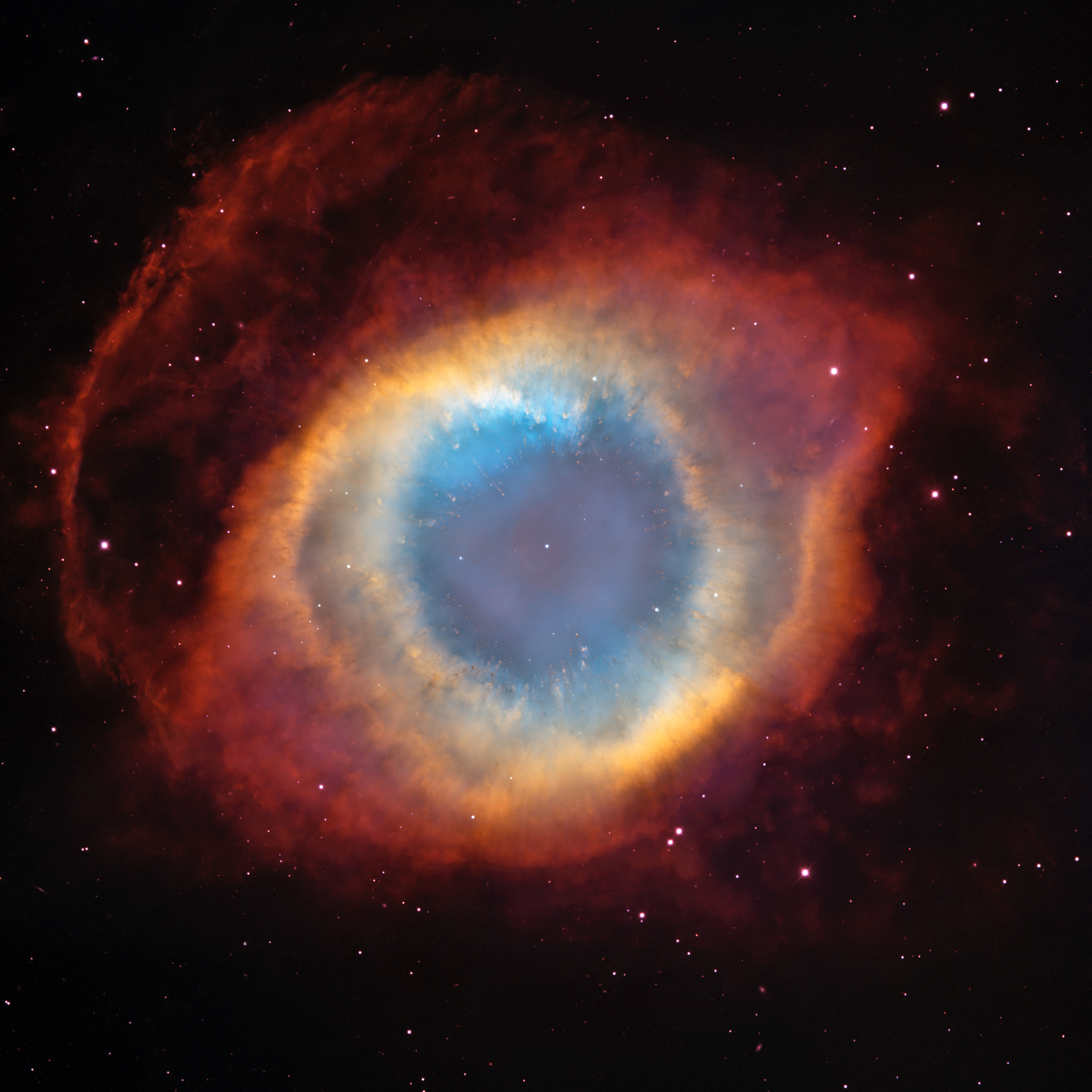
Here is your weekly reminder of Psalm 19–the Helix Nebula, also known as the Eye of God.

The Helix Nebula. Credit: NASA, NOAO, ESA, the Hubble Helix Nebula Team, M. Meixner (STScI), and T.A. Rector (NRAO)


This is my favorite nebula. It’s a planetary nebula (PN), so-called because astronomers hundreds of years ago, looking through their not-so-good telescopes, thought these might have been planets. They were wrong, but the name stuck. A PN is actually the cast-off outer layers of a dying low-mass star like our Sun. (High-mass stars die in spectacular light-shows called supernovae.) In the very center of the Helix Nebula you can see the glowing core of the dead star in the process of becoming what’s called a white dwarf.

The Helix Nebula is one of the closest PNs to Earth, and if it were bright enough for you to see it with the naked eye, it would span a distance across the sky almost as big as a full Moon. It looks like a bubble from our vantage point, but that’s a bit of an illusion–we’re really looking at two disks oriented nearly perpendicular to each other.

Astronomers discovered mysterious “cometary knots” appearing to radiate from the center of the nebula in a spoke pattern, and later found these same knots in other PNs. To give you some perspective on the size of the Helix, each knot, excluding the tail, is about the size of our solar system.

Close up of Helix Nebula

“Close-Up of the Helix Nebula” by NASA, NOAO, ESA, the Hubble Helix Nebula Team, M. Meixner (STScI), and T.A. Rector (NRAO)


Weekly Psalm 19: Pillars of Creation

Here is your weekly reminder of Psalm 19—the Pillars of Creation.

Pillars of Creation

The Pillars of Creation. Image credit: NASA, ESA, and the Hubble Heritage Team (STScI/AURA)


This is arguably NASA’s most famous image, first taken with detail in 1995 by two graduate students at Arizona State University.

The so-called Pillars of Creation are a huge conglomerate of interstellar gas and dust in the Eagle Nebula, some 6,500 light-years from Earth. “Creation” refers to the ongoing formation of stars in the pillars; although NASA has also referred to them as the Pillars of Destruction, since ultraviolet light from the newly-forming stars is gradually boiling off the cool gas in the clouds.

The longest pillar (on the left) is four light-years in height. To give you a sense of scale, that means you could fit over 3,000 solar systems end-to-end in that pillar.

NASA recently commemorated the 25th anniversary of the iconic image by releasing a high-def version (above) earlier this year.

Mailbag: More on Schroeder’s biblical cosmology

Physicist, Gerald Schroeder, has written four books on the relation of biblical wisdom to modern science. In his book, The Science of God, he explains his biblical cosmology in detail. I’ve created an illustrated slideshow here (see also the “Six Days” tab at the top) that covers the basics of his model. The gist is that Schroeder is able to convincingly reconcile a literal interpretation of Genesis 1 –six 24-hour days of creation –with a universe that is billions of years old by invoking the phenomenon known as time dilation. That’s the slowing down of time in one reference frame as observed from another reference frame. It’s a scientifically sound model, but it’s also a bit difficult for the average scientific layperson to understand, because it involves one of the trickiest concepts in science — the nature of time. There are also other details that can be confusing to a reader not deeply versed in science, so I’m answering questions about the model sent in by readers. 

LH sends in another question from a forum discussion on Schroeder’s biblical cosmology:

At any point in time, the CMBR is not a single frequency, but a continuous spectrum of frequencies — to choose the “average” frequency, which doesn’t correspond to any single photon, to define a clock is questionable (unlike the frequency used to define a second, which is that of an actual photon). Also, the usual way of using light of a particular frequency to act as a clock is by defining the unit of time to be a fixed number of cycles or oscillations of the light wave (this is what is done in defining the second). Since the CMBR at early times has a higher frequency (shorter wavelength), it takes less time to go through a fixed number of cycles, so the unit of time (a “Day”) defined using the CMBR in the early universe is shorter in terms of years than it would be now, i.e. the Genesis days measured in Earth time should be getting progressively longer, not shorter (7 billion years, 3.5 billion years, 1.8 billion years, …).

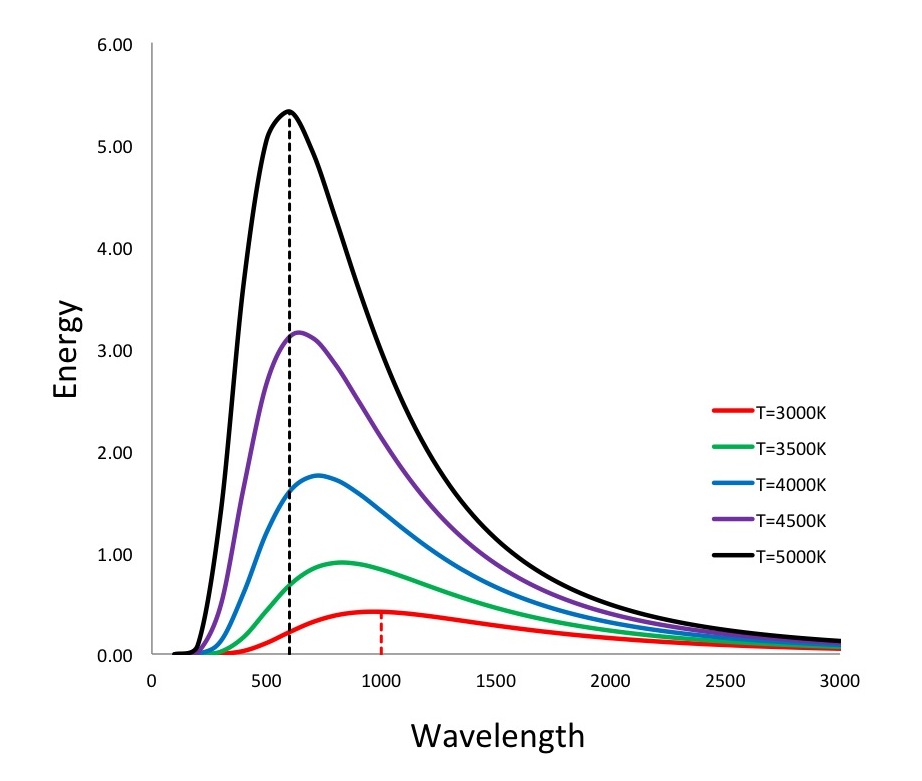
It’s true the CBR has a blackbody spectrum with a distribution of frequencies, but, like every blackbody, it is characterized by a peak frequency (or wavelength, as shown below) that corresponds to its temperature. Every blackbody has one, and only one, peak frequency that corresponds to its temperature. This is why astronomers refer to just one color for the surface of a star. Stars can be approximated as blackbodies, they have a distribution of frequencies in the radiation from their surfaces, but they still have just one characteristic peak frequency that corresponds to surface temperature. And, in terms of redshift, anything that happens to one of those frequencies is going to happen in the exact same way to the other frequencies. I don’t see this as a valid criticism of Schroeder’s approach.

Blackbody spectra

Blackbody spectra for various temperatures

In terms of the length of a day, this person is mistakenly assuming that the number of cycles in a Genesis day is fixed — it’s not. The problem arises from not choosing the correct reference frames for comparison. We must compare one Genesis day with another from the point of view of our position on Earth today looking backward in time. I have an example that illustrates by analogy how we should be looking at it.

Let’s take the example of the flow of time for two different reference frames where gravitational redshift is creating a time dilation effect. The duration of a second is defined as ~9.2 billion cycles based on a particular transition of the cesium atom. This is as measured from a particular reference frame — the surface of the Earth. But let’s consider another reference frame, that of an observer in a spaceship orbiting some distance from the surface of the Earth. Let’s say the spaceship guy also has a cesium atom and is measuring the same transition, and that he is also able to measure the radiation coming from the cesium transition in the lab on the surface of the Earth. Now, in the time it takes the spaceship guy to count off 9.2 billion cycles for his spaceship cesium atom, he measures fewer than 9.2 billion cycles coming from the Earth’s cesium atom. In other words, in his one second of spaceship time is “faster” than one second of Earth time. The same number of cycles are both are experienced as one second by observers within their respective reference frames, but the cycles from Earth have been stretched by some factor corresponding to the effect of Earth’s gravity as measured by the guy in his spaceship reference frame.

Now, let’s extreme-ify this example by considering a planet — Planet X — for which the gravity is so extreme that, instead of the tiny time dilation effect observed due to Earth’s gravity, time near the surface of Planet X flows at half the rate as time for a spaceship orbiting Planet X. Let’s posit hypothetical observers on the surface of Planet X and in the spaceship, respectively. The guy on Planet X has a telescope he can use to peer into the spaceship and observe everything the spaceship guy is doing. He notices that the spaceship guy is doing everything twice as fast as he is on Planet X. He notices that a day passes on Planet X while two days pass for the guy on the spaceship. Note that the same number of cycles are not taking place on Planet X and on the spaceship during this little scenario; there is no requirement that this happen.

The difference in the flow of time in the previous two examples is due to gravitational redshifting, but we can take the same principle of time getting stretched out when viewed from different reference frames and apply it the expansion of the universe. In this case, however, instead of two reference frames that differ in location, we’ll consider two reference frames that differ in time.

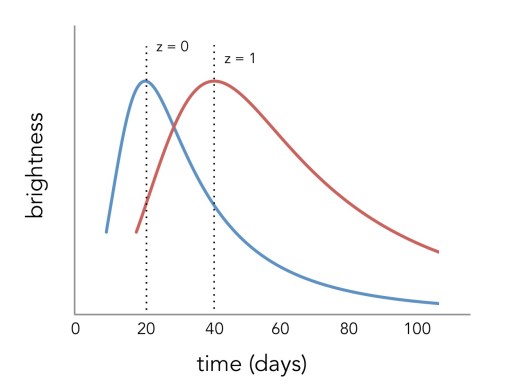
Let’s consider time dilation as measured from the light curves of identical supernovae. A light curve is the brightness of a supernova as a function of time (usually measured in days). Type Ia supernovae have characteristic light curves that are always the same, because they all originate from the same type of star — this is what makes them excellent standards by which we measure cosmological effects. We can observe a nearby (roughly corresponding to the present time) Type 1a supernova and see that it takes about 20 days for the supernova to fade appreciably from peak brightness. If we observe another Type 1a supernova that’s at a distance corresponding to when the universe was about half its present age, the light curve makes it appear as though it takes 40 days for its brightness to fade by the same amount — twice as long for the exact same type of supernova. This is the time dilation effect due to the expansion of the universe. The light we receive now from an event that happened billions of years ago has been stretched to half the frequency — time appears to be flowing at half the rate now that it was when the light was emitted then. Again, there is no requirement that the number of cycles be made to equal each other in this comparison.

sn_light_curves

Light curves for nearby (blue) and distant (red) supernovae.

In the last example, we are comparing the flow of time at two different times in cosmic history from the point of view of the Earth, looking backward in time. There is no requirement that the number of cycles be the same for each day. Each successive day, when compared this way, is shorter than the previous day, because the flow of time has slowed down compared with the previous day. This forms the basis of Schroeder’s biblical cosmological model.

Previous: Mailbag: Time dilation in Schroeder’s biblical cosmology

Replay: “All the evidence we have says that the universe had a beginning”

Traffic’s up after the announcement of the publication of our Astronomy and Astrophysics curriculum, so we’re replaying some of our more important posts from the archives for our new readers. This article was originally posted on February 21, 2012

So says Tufts University physicist, Alexander Vilenkin, who made this statement at a meeting in January in honor of Stephen Hawking’s 70th birthday. (I’m a little late getting around to this, but it’s worth commenting on.)

To fully appreciate the magnitude of this statement, consider that the prevailing view of cosmology for more than two thousand years was that of an eternal universe. This view began to change in the 1920s, when astronomer Edwin Hubble discovered that the spectra of most galaxies are redshifted, and the further away a galaxy is from the Milky Way, the more its spectrum is redshifted. What this means in plain English is that almost all of the galaxies he observed are rushing away from each other, and those that were further away are rushing away faster. Incredibly, it appeared the universe was not only changing, but expanding. If you imagine running the expansion in reverse, so that galaxies rush toward one another as you go back in time, you end up with a point at which the expansion started — a beginning in time and space.
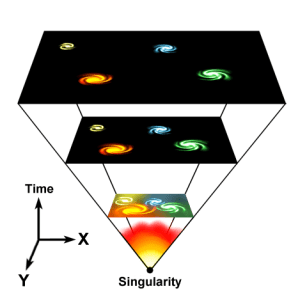
Belgian physicist and priest, Georges Lemaître, anticipated this discovery with what he called the “hypothesis of the primeval atom,” based on his solution to the Einstein field equations. The universe’s beginning was predicted to have been very energetic and violent, and was therefore dubbed as the “big bang.” Four decades later, physicists Arno Penzias and Robert Wilson discovered the predicted afterglow of this big bang, which eventually earned them Nobel prizes. By the late 1980s, sophisticated satellites were mapping the tiny fluctuations in the intensity of the big bang afterglow, which allowed physicists to calculate an age for the universe. By the end of the 20th century, there was near-consensus that the universe had a beginning that occurred some 11-17 billion years ago. (The cosmological model-based number is ~14 billion years.)

The big bang has had its detractors. It was astrophysicist Fred Hoyle, out of deep skepticism for the idea, who sarcastically applied the term “big bang” to this cosmological model. (Let it not be said that physicists are overly sensitive — the term stuck and has been used in all seriousness ever since.) Hoyle’s collaborator, astrophysicist Geoffrey Burbidge, famously ridiculed physicists who had hopped on the big bang bandwagon as “rushing off to join the First Church of Christ of the Big Bang.” There were two reasons scientists reacted this way. First, some scientists found the idea of a universe with a beginning uncomfortably close to the Genesis account of creation. Second, from the point of view of physics, mathematics, and philosophy, a universe with a beginning is far more messy to deal with than an eternal universe, which requires no explanation. Even still, the evidence for a beginning is now so overwhelming that most physicists have come to accept it, and the big bang has become the prevailing paradigm governing all of physics.
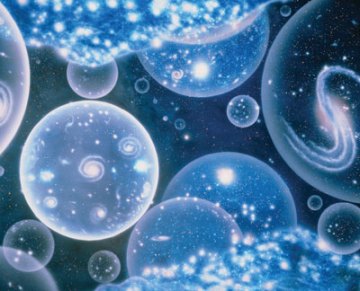
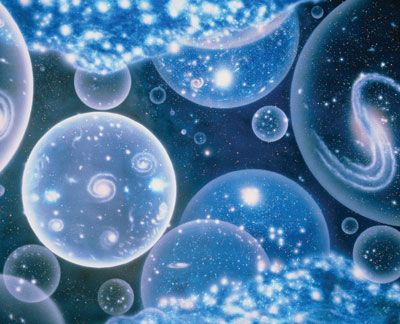
Nevertheless, some physicists had not given up on the idea of an eternal universe, but the focus changed to devising sophisticated models for an eternal universe that fit the observed data — in other words, an eternal universe that incorporated key features of the big bang model. Some of these features are explainable by invoking what’s called inflation, which refers to an early period of exceedingly rapid expansion. This idea was proposed by Alan Guth in the 1980s, and it can also be applied to an eternally inflating universe in which regions of the universe undergo localized inflation, creating “pocket universes.” This inflation continues forever, both in the past and into the future, and so in a sense it represents an eternal universe. Another idea was the cyclical universe, which posited that the universe is eternally expanding and contracting. In this way, the big bang that occurred 14 billion years ago would be just one of an infinite number of big bangs followed by ‘big crunches.’

All of the evidence indicates ours is a universe undergoing perpetual change. To replace Aristotle’s age-old idea of an eternal, unchanging universe, physicists came up with hypothetical eternal universes that were perpetually changing. This was an ingenius approach, but as Vilenkin announced last month, they just don’t work. Guth’s idea turns out to predict eternal inflation in the future, but not in the past. The cyclical model of the universe predicts that with each big bang, the universe becomes more and more chaotic. An eternity of big bangs and big crunches would lead to a universe of maximum disorder with no galaxies, stars, or planets — clearly at odds with what we observe.

As the journal New Scientist reports, physicists can’t avoid a creation event. Vilenkin’s admission exemplifies the reason physics is the king of all the sciences — physicists are generally willing to admit when their cherished ideas don’t work, and they eventually go where the data and logic lead them. Whether this particular realization will pave the way to serious discussion of God and consistency with the Genesis account of creation remains to be seen. Physicists can be a stubborn bunch. As Nobel laureate George P. Thomson observed, “Probably every physicist would believe in a creation if the Bible had not unfortunately said something about it many years ago and made it seem old-fashioned.” Still, some physicists are open to the idea. Gerald Schroeder, who is also an applied theologian, has written profoundly on the subject. His book, The Science of God, is an illuminating discussion of how the Bible and biblical commentary relate to the creation of the universe.
Mailbag: Time dilation in Schroeder’s biblical cosmology

LH asked for clarification on the biblical cosmology of Gerald Schroeder. There was some question of the nature of the redshift and how to relate that to cosmological time dilation. 

Physicist Gerald Schroeder has written four books on the relation of biblical wisdom to modern science. His book, The Science of God, explains his biblical cosmology in detail. I’ve created an illustrated slideshow here (see also the “Six Days” tab at the top) that covers the basics of his model. The gist is that Schroeder is able to convincingly reconcile a literal interpretation of Genesis 1 –six 24-hour days of creation –with a universe that is billions of years old by invoking the phenomenon known as time dilation. That’s the slowing down of time in one reference frame as observed from another reference frame. It’s a scientifically sound model, but it’s also a bit difficult for the average scientific layperson to understand, because it involves one of the trickiest concepts in science — the nature of time.

Even scientifically-literate people get tripped up by the effect of time dilation, because the effect can occur for different reasons. So, it’s no surprise that one of the most commonly misunderstood aspects of Schroeder’s biblical cosmology is the nature of the time dilation effect that gives us six 24-hour days in one frame of reference and 14 billion years in another. It is not due to gravitational effects or comparing two different physical reference frames within the universe. Rather it arises from the following:

  1. God’s reference frame existing beyond space and time, which regards the universe as a whole
  2. the expansion of the universe
  3. comparison of the flow of time between different moments in cosmological history

Schroeder assumes Genesis 1 is told from God’s perspective. God’s reference frame is not any one place within the universe, but from outside the universe, regarding the universe in its entirety. So, to find something to form the basis of the Genesis clock, Schroeder looked for something that takes into account the three points above. He chose the cosmic background radiation (CBR), because it permeates the entire universe, it has existed virtually since the beginning of the universe, and encoded in its properties are the history of the expansion of the universe.

The time dilation for Genesis 1 is based on the expansion of the universe. This is neither special relativity nor a gravitational effect; it is merely a consequence of the stretching of the CBR light waves as the universe expands. This is a well-established effect in cosmology, and one I have to take into account in my own research on distant quasars. For simplicity, if you think of the CBR light waves as a sine wave, then the frequency of the sine wave represents the beat of the Genesis clock. The higher the frequency, the faster the clock ticks off time. If you think of drawing this sine wave on a piece of stretchable fabric representing the fabric of the universe and then stretching this fabric, the length between the peaks on the sine wave gets longer, and hence the ticks of the clock get longer (i.e. slower). So, what’s happening is that as the universe ages and expands, the frequency of the CBR light decreases, and the ticks of the Genesis clock for each moment in time get slower compared with previous moments in time.

That’s how we can measure, from our earthly perspective looking backward in time, 14 billion years, while God measures, from his perspective regarding the universe as a whole looking forward in time, six 24-hour days.