“Super Moon” visible tonight

If you happen to be outside this evening, check out the Moon when it’s close to the horizon — it’s going to appear slightly larger than usual, thanks to a (somewhat) rare alignment of the Moon’s position in its orbit around Earth relative to the Sun.

The media are referring to it as a “Super Moon.” So, what exactly makes it “super”? The Moon has a slightly elliptical orbit around the Earth, which means sometimes it’s a little closer to the Earth (this position is called “perigee”) and sometimes a little further away (“apogee”). The difference is about 42,000 km, which sounds like a lot, but it’s only about 10% of the Moon’s average distance from the Earth. Today’s perigee is a smidgen1 closer than usual, but not enough to have any significant impact on ocean tides, earthquakes, or volcanic activity. Anyway, when the Moon’s perigee is especially close and coincides with a full moon, that seems to be a “Super Moon.” But it really amounts to a not-so-super 14% increase in the Moon’s apparent size in the sky compared with its apogee size. (I think I just broke the record for how many times the word “moon” can be crammed into a blog post.)

This NASA vid explains it all with nifty images:

DIY Science: If you’re an empirical kind of person, you can try the following: hold up a ruler or some other reference object at arm’s length (steady your arm on a stable surface) and carefully measure the apparent size of the Moon tonight, then do the same on October 12th when there is another full moon, but this time its close to apogee. See if you can detect a slight difference. If you have a telescope equipped with an eyepiece with a linear-scale reticle, this should be a piece of cake.
Continue reading

MESSENGER probe locks into orbit around Mercury

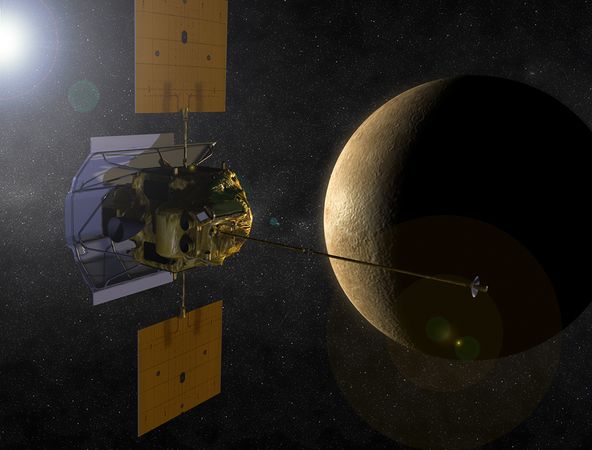
Artist's conception of MESSENGER approaching Mercury (Credit: NASA)

For the first time ever, we have a probe orbiting the planet Mercury. The MESSENGER probe was successfully maneuvered into orbit around Mercury yesterday following a six-and-a-half-year series of gravitational flybys past Earth, Venus, and Mercury, to nudge it into course. Starting in April, MESSENGER will make two orbits of Mercury per (Earth) day, collecting information to send back to scientists on Earth.

Previous missions to Mercury include the Mariner 10 spacecraft, which gathered data as it quickly flew past Mercury three times in 1974-1975, and three data-collecting flybys of Mercury by the MESSENGER probe in 2008-2009.

NASA scientists hope the mission will help answer several questions about Mercury, including why the tiny planet is so dense, what its geological history is, and whether there is actually ice at its poles.

Continue reading

Methane rain on Titan

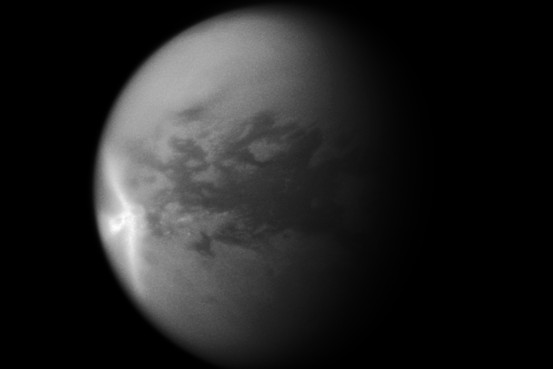
NASA's Cassini spacecraft snapped this infrared photo of equatorial rainfall on Titan (Credit: NASA/JPL/Space Science Institute)

Spring has sprung on Saturn’s largest moon, Titan, and that means rain showers. But not the kind of spring showers that bring flowers — on Titan it rains methane:

Instead of water, as on Earth, Titan’s cycles of precipitation, evaporation and cloud formation involve hydrocarbons such as methane and ethane, which at the extremes of cold on Titan pool as liquids in thousands of lakes around its north and south poles. Indeed, scientists estimate that Titan holds hundreds of times more liquid hydrocarbons than all the known oil and natural gas reserves on Earth.

Outer space may seem hostile to advanced life, but the solar system is rich in natural resources needed to survive. If we ever venture out into the solar system with long-term or permanent manned space missions, we should have little trouble availing ourselves of necessities like bulk building materials, hydrocarbon fuels, water, and oxygen.

Update: APOD has featured an artist’s conception of what it might look like from the surface of Titan (not very inviting).

Continue reading

More support for the existence of dark energy

The case for dark energy is looking stronger, thanks to new results from the recently-installed Wide Field Camera 3 instrument aboard the Hubble Space Telescope. Dark energy has been hypothesized as the mysterious force causing the expansion of the universe to speed up, but competing models suggest other reasons for the accelerated expansion. A leading competitor is a bubble model that suggests our Milky Way galaxy sits at the center of a relatively sparse region of the universe, and the resulting weaker gravity is causing our local “bubble” to expand more rapidly than the universe as a whole. However, astrophysicists at the Space Telescope Science Institute claim that refined measurements made with the WFC3 have ruled out the bubble model, which predicts a different expansion rate than what is observed.

There are philosophical objections to the bubble model, as well. Ever since Copernicus put forth his Sun-centered model of the solar system, scientists have tended to reject the notion that we occupy any special place in the universe. A model that requires Earth-observers to be at the center of a cosmic bubble makes us a little too special for comfort for most scientists. This alone doesn’t disprove the model (we must never be locked into a conclusion by our philosophy), but it can certainly offer guidance. Adam Riess, head of the research team publishing the new results, comments,

“I know that a lot of people have not taken that theory very seriously because of a major problem with it,” he said. “We tend to believe theories where we don’t live in any special place in the universe. That would be very strange – why should we be in a special place?”

Now that scenario is even less likely to be true, Riess said.

“But on the other hand, dark energy’s pretty weird too,” he said.

Every revolutionary idea in science seems weird at first. If the dark energy model survives the rigors of scientific testing, people a hundred years from now probably won’t find it any weirder than we find the electromagnetic theory of light.

Continue reading

Asteroid Apophis on its way to Earth

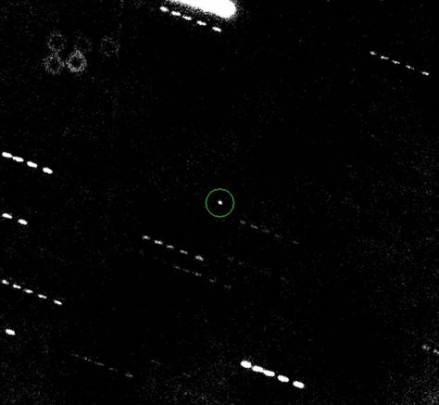
Asteroid Apophis is followed with a camera in a series of five photos as it moves against a background of stars. The rings in the upper left are from a dust grain on the telescope instrument. (Credit: D. Tholen, M. Micheli, G. Elliott, UH Institute for Astronomy)

Astronomers are keeping an eye on asteroid Apophis, which was recently caught in a series of photos made from a telescope on Hawaii’s Mauna Kea mountaintop observatory. In April of 2029 the orbit of the 900-ft space rock will bring it closer to Earth than some of our satellites, but a collision with either the Earth or the Moon has been ruled out. There is a very slight chance that the flyby in 2029 could put it on a collision course with Earth in 2036, but the odds of a collision are deemed quite small — about 1 in 250,000. Apophis will come close to Earth two more times in the 21st century, again with small probabilities of actually making an impact.

Continue reading

Mars orbiter spots Mars rover

The Mars Reconnaissance Orbiter captured the progress of the Mars Exploration Rover Opportunity as it investigates a 90-meter crater on the Martian surface. A few months ago the rover was on one side of the crater, and it’s apparently made its way to the other side. See if you can spot it below. (No word on whether any hrossa or pfifltriggi have been seen.)


(Click on the photo to see a larger version.)

Continue reading

But you look so … old

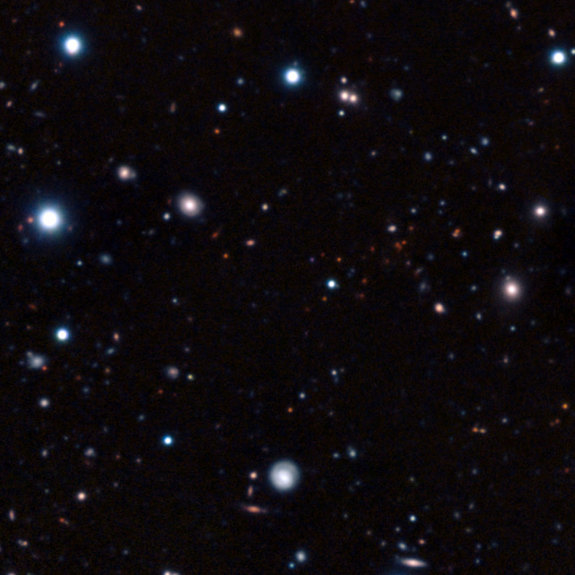
Galaxy cluster CL J1449+0856 (Credit: ESO)

When I turned 40 recently, people kindly told me, “But you still look young.” So, what do you tell someone who is young but looks old? This is my brilliant segue into a description of a strange discovery by astronomers who observed a galaxy cluster that’s only three billion years old but looks much older. Here’s a neat vid showing its location in the sky (but don’t bother looking for it tonight unless you’ve got a world-class telescope):

Galaxy clusters are the main structures of the universe. A single cluster can contain thousands of galaxies, all gravitationally bound to each other. Because this particular cluster is so far away, astronomers are seeing it as it was when it was very young. (The idea in astronomy is that the further away you look in space, the earlier in time you’re observing the universe. That’s because light, although extremely fast, travels at a finite speed.) Astronomers therefore expected to see typical signs of youth in the cluster — stars actively forming in the galaxies and very little hot, X-ray emitting gas. Instead, what they observed was an older population of stars with very little star formation, and a significant amount of X-ray emitting gas, which usually takes time to accumulate and get trapped in the cluster. Astronomer Raphael Gobat comments, “Such clusters are expected to be very rare according to current theory, and we have been very lucky to spot one. But if further observations find many more, then this may mean that our understanding of the early universe needs to be revised.”

That’s how science works. Observe, hypothesize, observe, theorize, observe, revise … .

Continue reading

Summary of Gerald Schroeder event

As previously announced here, acclaimed scientist and theologian, Dr. Gerald Schroeder, presented a lecture last evening in Austin on the origins of humankind from a scientific and biblical perspective. By my count, over 150 people attended the lecture, with the audience skewing very young. Dr. Robb Wilson of The Scholar Redeemer audio-recorded the lecture, and we should have a podcast of sorts available here within the next few days. In the meantime, here is a brief summary of the event.

Dr. Schroeder began with his explanation for reconciling the biblical calendar with the scientifically-calculated age of the universe of 14 billion years using the well-studied phenomenon of time dilation that arises from the expansion of the universe. His explanation hinges on an ancient interpretation of Genesis 1, which says that the first six days are distinct and separate from the rest of the biblical calendar. He argued that these six days actually contain billions of years if looked at properly. Genesis time stops partway through the sixth day with a special event — the creation of Adam — at which point the conventional biblical calendar starts. Dr. Schroeder then segued into the main topic by announcing that Adam had parents. I suspect some people were rather shocked by this notion, but Dr. Schroeder laid out the overwhelming scientific evidence for pre-Adam hominids as well as evidence from the Bible itself. The key point was that the creation of Adam was a spiritual creation, not a physical one. Human-like beings existed prior to Adam, but they were not human because they lacked the neshama (which we may be tempted to call the “soul,” but it’s more than that). After Adam received the neshama, he is described as becoming a “communicating spirit.” This tells us that the defining quality of Adam as a human being, what separated him from his predecessors, was the ability to communicate with God.

The lecture ran slightly long, which unfortunately only left time for half a dozen questions from the audience. But they were all good, substantive questions; one in particular (which I can’t remember, but will hopefully be audible on the recording) was of particular interest to Dr. Schroeder. Several young people approached Dr. Schroeder after the lecture with more questions and comments and requests for book signings. I noticed that several of them were also taking photos of the diagrams he made on the whiteboard during his talk. For any of our readers who were present at the lecture and would like to know more about the information in those diagrams, I strongly encourage you to read his best-selling book, The Science of God.

Update: Due to some unforeseen difficulties posting the audio recording, there will be no podcast of the lecture. Sorry.

Continue reading