
Looking for easy answers

warning

According to the site stats, more than a few students looking for homework answers are being directed by search engines to this blog (probably because this site hosts an online astronomy textbook). WordPress’ site stats show me the exact search terms used, which can be rather amusing. Here is a small sample of the search terms (verbatim) that brought students here:

5. using kepler’s third law of planetary motion, determine the distance in astronomical units the planet jupiter is from the sun, knowing that jupiter takes approximately 11.86 years to orbit the sun one time

Here’s a wild idea: try using Kepler’s third law of planetary motion to determine the distance. The equation is p2 = a3, and you’ve been given p. If you don’t know how to determine a, I suggest you ask your middle school math teachers for a refund.

given that the moon has an angular diameter of about 0.5 and an average distance of about 380,000 km from earth, calculate its actual diameter. (hint: recall the angular separation formula)

When I was teaching university classes, it amazed me how often students would overlook the hints I gave them, as though they contained superfluous information (“hint: breathe in and out”). On the contrary, the hints are always meant to be helpful, and often they practically give the answer away, as is the case with the question above. The angular separation formula is basic trigonometry, which you should have mastered in high school; it contains three variables, two of which have been given to you. If this is really beyond your ability to figure out, you should rethink university; it’s only going to get tougher.

how does retrograde motion play a crucial role in defining the differences between the geocentric and heliocentric model?

It’s almost certain you’ve been given this information in a lecture and in the textbook. If you’re going to skip the lectures, at the very least you should scan the book for this information.

knowing that the surface gravity of jupiter is approximately 2.5 that of the earth what would be the approximate weight of a 125 pound person on jupiter

Three variables, two of which have been given. Yes, it’s rocket science (sort of), but the junior version. My 11 year-old homeschooled nephew could do this in his sleep.

the radius of the earth’s orbit around the sun is 1.5 *10^ 11m.if the sun suddenly enlarged

… ?? We’ll never know for sure, but this sounds like a common homework question, which asks how the Earth’s orbit would change if the Sun suddenly enlarged to X size. This is slightly more advanced than the above questions, because it involves thinking about a concept rather than just plugging numbers into a formula or rewording a passage from the textbook. Again, it’s almost certain your textbook covers this concept — time to exercise that grey lump between your ears.

What strikes me as odd about these searches is that the questions are entered word-for-word, which indicates the person searching doesn’t even know what s/he’s being asked. As many years of university-level teaching have shown me, a great many students are not only deficient in the basics (reading, writing, math, and factual information), they aren’t taught how to think, to the point that they cannot parse a very simple problem. These are people who are going to struggle in life.

If you are a student who is too lazy to expend the necessary effort or who struggles with the basics, consider whether you should be spending your time and money on university. It is a serious endeavor that requires your full devotion. If you feel like you’re in over your head, talk to your advisor and be 100% forthright about your struggles. It may be that you should spend a couple of years mastering the basics in community college and/or developing a work ethic before you return to university. There is no shame in acknowledging your deficiencies; on the contrary, it’s a sign of strength.

Runaway black hole?

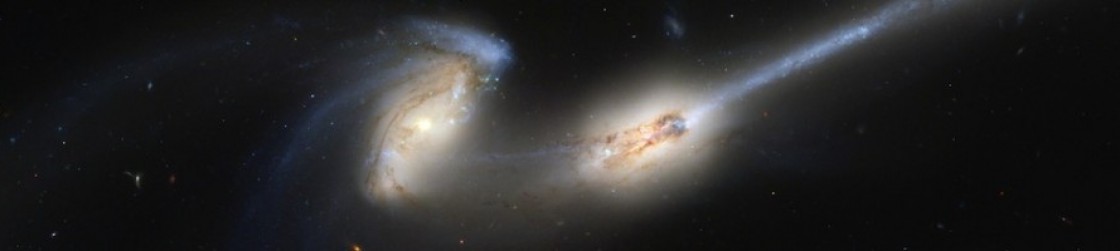
Galaxy NGC 1275. [Credit: NASA, ESA, and the Hubble Heritage (STScI/AURA)-ESA/Hubble Collaboration]

Galaxy NGC 1275. [Credit: NASA, ESA, and the Hubble Heritage (STScI/AURA)-ESA/Hubble Collaboration]

Sometimes theoretical science is stranger than science fiction

The most massive black hole ever measured may be an intergalactic hitchhiker that escaped from one galaxy before getting captured by another. If this scenario, laid out in a paper posted February 18 at arXiv.org, is proven correct, it would be the first time astronomers have definitively spotted a black hole that was expelled from its original galactic home.

A supermassive black hole lives in the center of just about every galaxy, including our own Milky Way. Most of the time, these black holes aren’t doing much, but when two galaxies collide — a rather common event — their black holes find each other and merge. Simulations involving relativity predict that under certain circumstances these merging black holes can be flung around and even kicked out of the merging galaxies. To understand how this can happen, we have to consider one of the fundamental properties of a black hole — its spin. Most (perhaps all) black holes are spinning, and this spin has a direction — you can think of black holes as kind of like spinning tops. If you bring two spinning black holes together, and their spins are going in the same direction, the pair coalesces into a single black hole inside of the merged galaxy as this simulation demonstrates:

The disks surrounding each of the black holes in the simulation are probably accretion disks — gaseous material rapidly spiraling down onto the black holes — that, in any case, show the direction of the black hole spin.

But what happens if you bring two spinning black holes together, and their spins are not going in the same direction? Turns out, this will cause the merging pair to flail around, sometimes with enough energy to kick the merged black hole out of the merged galaxy. The kicked black hole could carry gaseous material with it, if the material is gravitationally bound to the black hole, but the black hole would essentially wander the universe homeless.

The study above (authored by two of my long-time collaborators) proposes that the overly massive black hole residing in the relatively modest galaxy NGC 1277 was flung out of the neighboring galaxy, NGC 1275, long ago as it underwent a merger. Instead of wandering the universe homeless, however, the merged black hole pair found a new home in NGC 1277. What makes this scenario appealing is the close correlation between the masses of black holes and the masses of their host galaxies. Black holes are typically about 0.1% of the mass of their hosts, but NGC 1277 is a significant outlier from this relationship: this ho-hum galaxy hosts the most massive black hole ever observed, which weighs in at a stunning 14% of the galaxy’s mass. Adding to the appeal is the fact that NGC 1277 has a close galactic neighbor with a much greater mass, NGC 1275, a more likely original home for the excessively massive black hole.

Now that astrophysicists have a plausible theoretical explanation for NGC 1277’s outsized black hole, the search will be on for observational data supporting this idea.

“All the evidence we have says that the universe had a beginning”

So says Tufts University physicist, Alexander Vilenkin, who made this statement at a meeting in January in honor of Stephen Hawking’s 70th birthday. (I’m a little late getting around to this, but it’s worth commenting on.)

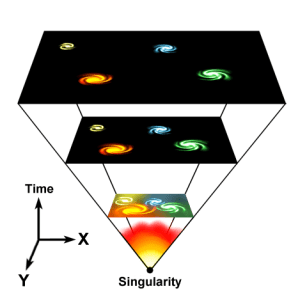
To fully appreciate the magnitude of this statement, consider that the prevailing view of cosmology for more than two thousand years was that of an eternal universe. This view began to change in the 1920s, when astronomer Edwin Hubble discovered that the spectra of most galaxies are redshifted, and the further away a galaxy is from the Milky Way, the more its spectrum is redshifted. What this means in plain English is that almost all of the galaxies he observed are rushing away from each other, and those that were further away are rushing away faster. Incredibly, it appeared the universe was not only changing, but expanding. If you imagine running the expansion in reverse, so that galaxies rush toward one another as you go back in time, you end up with a point at which the expansion started — a beginning in time and space.

Belgian physicist and priest, Georges Lemaître, anticipated this discovery with what he called the “hypothesis of the primeval atom,” based on his solution to the Einstein field equations. The universe’s beginning was predicted to have been very energetic and violent, and was therefore dubbed as the “big bang.” Four decades later, physicists Arno Penzias and Robert Wilson discovered the predicted afterglow of this big bang, which eventually earned them Nobel prizes. By the late 1980s, sophisticated satellites were mapping the tiny fluctuations in the intensity of the big bang afterglow, which allowed physicists to calculate an age for the universe. By the end of the 20th century, there was near-consensus that the universe had a beginning that occurred some 11-17 billion years ago. (The cosmological model-based number is ~14 billion years.)

The big bang has had its detractors. It was astrophysicist Fred Hoyle, out of deep skepticism for the idea, who sarcastically applied the term “big bang” to this cosmological model. (Let it not be said that physicists are overly sensitive — the term stuck and has been used in all seriousness ever since.) Hoyle’s collaborator, astrophysicist Geoffrey Burbidge, famously ridiculed physicists who had hopped on the big bang bandwagon as “rushing off to join the First Church of Christ of the Big Bang.” There were two reasons scientists reacted this way. First, some scientists found the idea of a universe with a beginning uncomfortably close to the Genesis account of creation. Second, from the point of view of physics, mathematics, and philosophy, a universe with a beginning is far more messy to deal with than an eternal universe, which requires no explanation. Even still, the evidence for a beginning is now so overwhelming that most physicists have come to accept it, and the big bang has become the prevailing paradigm governing all of physics.

Nevertheless, some physicists had not given up on the idea of an eternal universe, but the focus changed to devising sophisticated models for an eternal universe that fit the observed data — in other words, an eternal universe that incorporated key features of the big bang model. Some of these features are explainable by invoking what’s called inflation, which refers to an early period of exceedingly rapid expansion. This idea was proposed by Alan Guth in the 1980s, and it can also be applied to an eternally inflating universe in which regions of the universe undergo localized inflation, creating “pocket universes.” This inflation continues forever, both in the past and into the future, and so in a sense it represents an eternal universe. Another idea was the cyclical universe, which posited that the universe is eternally expanding and contracting. In this way, the big bang that occurred 14 billion years ago would be just one of an infinite number of big bangs followed by ‘big crunches.’

All of the evidence indicates ours is a universe undergoing perpetual change. To replace Aristotle’s age-old idea of an eternal, unchanging universe, physicists came up with hypothetical eternal universes that were perpetually changing. This was an ingenius approach, but as Vilenkin announced last month, they just don’t work. Guth’s idea turns out to predict eternal inflation in the future, but not in the past. The cyclical model of the universe predicts that with each big bang, the universe becomes more and more chaotic. An eternity of big bangs and big crunches would lead to a universe of maximum disorder with no galaxies, stars, or planets — clearly at odds with what we observe.

As the journal New Scientist reports, physicists can’t avoid a creation event. Vilenkin’s admission exemplifies the reason physics is the king of all the sciences — physicists are generally willing to admit when their cherished ideas don’t work, and they eventually go where the data and logic lead them. Whether this particular realization will pave the way to serious discussion of God and consistency with the Genesis account of creation remains to be seen. Physicists can be a stubborn bunch. As Nobel laureate George P. Thomson observed, “Probably every physicist would believe in a creation if the Bible had not unfortunately said something about it many years ago and made it seem old-fashioned.” Still, some physicists are open to the idea. Gerald Schroeder, who is also an applied theologian, has written profoundly on the subject. His book, The Science of God, is an illuminating discussion of how the Bible and biblical commentary relate to the creation of the universe.

Aurora in Norway

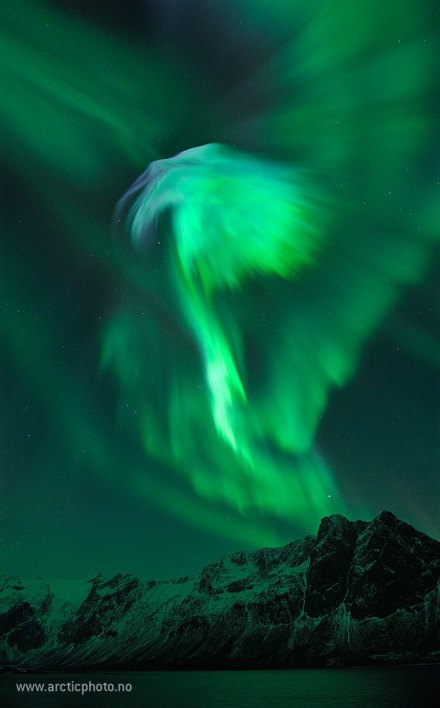
It is said that life sometimes imitates art, and today’s Astronomy Picture of the Day is a stunning example of that. This photo of an aurora over Norway looks very angelic to me. However, there’s a perfectly natural explanation for this phenomenon, which is a common occurrence at high latitudes. Auroras are the result of charged particles ejected from the Sun interacting with the Earth’s magnetosphere. Five days ago, a coronal mass ejection from the Sun hurled these particles toward Earth. An even more powerful solar flare occurred yesterday, and will likely produce another spectacular northern light show once the particles arrive at Earth tonight.

Continue reading

Transit of Venus

Mark your calendars, folks. Venus will pass between the Earth and the Sun — what is known as a transit — on the evening of June 5th (as seen from North America). On this date (and with the proper eyewear) you can watch Venus move across the face of the Sun. This is a rare event — the next Venus transit will occur over one hundred years from now.

Tons of details — including how to safely observe the transit — are here.

How Hubble offers a view of galaxies in their youth

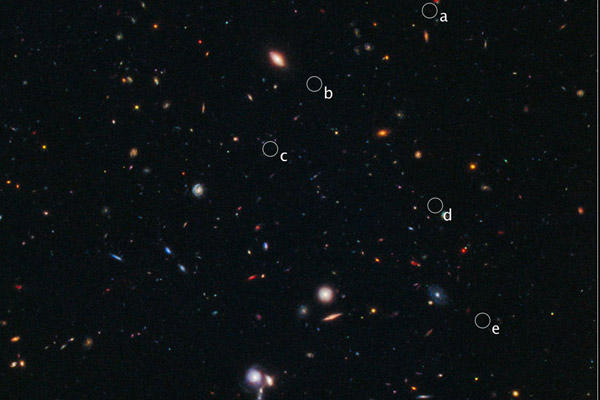
Astronomers have discovered the new record-holder for the most distant developing cluster of galaxies. Images of the cluster from the Hubble Space Telescope offer a glimpse of the universe as it was a mere 600 million years after the big bang. (The extremely faint galaxies are identified in the composite image above by the circles labeled a-e.)

Galaxies are the building blocks of the large-scale structure of the universe, and most of them reside in groups or clusters. Our own Milky Way is part of what’s known as the Local Group, a collection of about 50 galaxies, which is itself a part of the Virgo Supercluster of galaxies.

In order to understand the development of the universe over cosmic time, astronomers try to observe galaxies over a wide range of cosmic history, stretching back to the earliest stages of formation. It’s important to find extremely distant galaxies, such as the newly-discovered members of the protocluster above, but their extreme faintness render these galaxies extraordinarily difficult to detect.

The favored method of detection, and the one that revealed the presence of the protocluster galaxies, is a process called the Lyman-break method. “Lyman” refers to a particular series of absorption or emission lines for neutral hydrogen, which is by far the most abundant element in the universe. The Lyman limit is the shortest wavelength possible in this series, and it corresponds to the energy required to strip the electron from a hydrogen atom1. A Lyman-break galaxy is a galaxy whose spectrum shows a steep drop-off at the Lyman limit wavelength. This drop-off occurs because most stars do not emit very much light at shorter wavelengths, and the neutral hydrogen surrounding star forming regions in galaxies tends to absorb what little there is.

Since the stretching of the wavelength of light from a distant object is proportional to its distance from us, all astronomers have to do is measure where in the spectrum this drop-off occurs to estimate how far away the object is. The problem is, when you’re fishing around an enormous cosmos for very distant galaxies, it’s far too impractical to find them with spectra, which require pin-point accuracy. This is why the Lyman-break method uses images, which can capture comparatively large swaths of the sky.

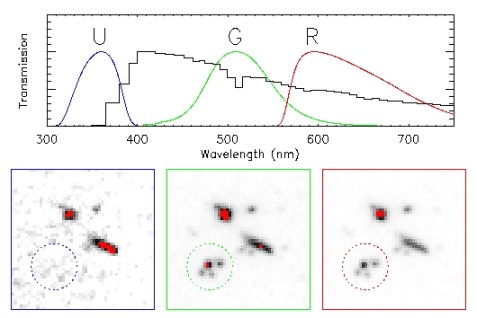
To see how this works, look at this spectrum of a distant Lyman-break galaxy followed by some images at different wavelengths:

The wavelength of light from this distant galaxy has been stretched by the expansion of the universe. The Lyman limit, which would appear at 91.2 nm if you lived inside the galaxy, has been stretched to about 400 nm. Instead of using a spectrum, astronomers can simultaneously detect the presence of a Lyman-break galaxy and get a rough estimate of its distance by observing at what wavelength the Lyman break occurs photometrically — that is, at what point it disappears from images. The galaxy above was imaged in three different “bands” — astronomers often use filters to block all light from an object except for a narrow range (or band) of wavelengths — corresponding to ultraviolet, green, and red. The above galaxy is apparent in the G-band image but disappears in the U-band image. So, from the images alone, astronomers would know that the Lyman break must occur somewhere between 350 and 500 nm, and could estimate a range for its distance accordingly.

Since the Lyman-break method provides only a rough estimate of the distance, astronomers usually follow-up such detections by observing a spectrum — now that the locations of the galaxies are known — which will not only give a more precise distance, but will tell astronomers other things about the galaxies in the protocluster, such as chemical composition and the types of stars developing in the galaxies.

Continue reading

Astronomy news round-up

Crab is emitting super-energetic gamma rays

Here’s another chapter for the books of “Persistence Pays Off” and “Who Woulda Thought?” A team of astronomers has discovered very energetic gamma-ray pulses emanating from the core of the Crab Nebula, in defiance of current theory. The nebula, a remnant of a 1,000 year-old supernova, is a semi-chaotic mass of gas surrounding a type of neutron star called a pulsar, the source of the gamma rays. Like all neutron stars, a pulsar is the tiny, extremely dense, collapsed core of a progenitor star; what makes these objects special is that the axis of rotation is offset from the bright magnetic poles, so that every time they spin they are observed to emit a pulse, like a lighthouse. Given its relative young age and close proximity to Earth — a mere 6,500 light-years — the Crab pulsar has been well-studied by astronomers. Theorists thought it was not possible for a pulsar to emit such energetic gamma-ray pulses, leading some of their colleagues to tell members of the team they were “crazy” for even trying to observe them. But the astronomers’ persistence paid off, and the new discovery is already changing how theorists think about these objects.

“We thought we understood the gamma-ray emission, and this was really becoming a foundational feature of our models, but that’s now thrown out,” [one of the authors of the study, Andrew] McCann explained. “The reason why this is so exciting is that it’s turning things around in the field.”

You gotta love how astronomers and physicists get excited every time a new discovery shoots down current theory. That’s exactly the kind of attitude that moves science forward.

Uranus pummeled by other planets?

The distant gaseous planet has long been a puzzle to astronomers, who have been trying to explain its peculiar axis tilt ever since it was discovered.

Most of the planets in the solar system exhibit axis tilt — this is where the axis of a planet’s rotation is at an angle to an imaginary line that runs perpendicular to the planet’s orbital plane. Mercury is alone in that it has virtually zero axis tilt, though Jupiter’s is also diminutive at just 3 degrees. The Earth’s axis tilt is 23.5 degrees, and Venus is nearly upside down with its rotation axis pointing almost completely downward (this is also somewhat of a mystery to astronomers).

Uranus is the strangest of all, as it rotates flopped over on its side. Some astronomers have hypothesized that Uranus was pummeled by another planet in the early history of the solar system, and this collision resulted in Uranus’ 98-degree axis tilt. However, another collision might be required to explain the spin of Uranus’ moons, which should otherwise spin backwards. A new simulation created by astronomers indicates that collisions with two Earth-sized planets could explain Uranus’ observed configuration. The main problem with this idea, however, is to explain where the two Earth-sized planets came from.

Evidence for water on Mars?

Astronomers have discovered seasonal dark streaks on the surface of Mars that could be signs of melted water running across the surface. Meanwhile, NASA’s Curiosity rover is slated to visit Mars next year to look for signs of water in the Gale crater. The discovery of liquid water on Mars will greatly facilitate any plans to establish future colonies there.

Nobel news

Physics

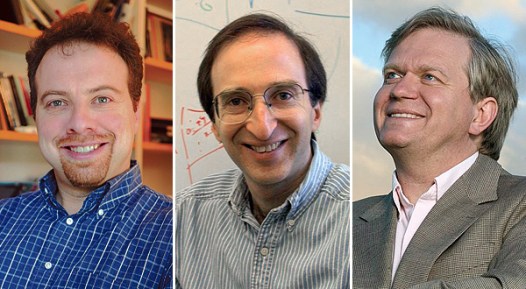
Three American scientists have been awarded the Nobel Prize in physics for their discovery that the universe is expanding at an accelerating rate. Saul Perlmutter will share the prize with Brian Schmidt and Adam Riess.

The discovery of the accelerating expansion of the universe followed an unexpected observational discovery in 1998. Astronomers in two different groups — the Supernova Cosmology Project (Perlmutter) and the High-z Supernova Search Team (Schmidt and Riess) — were observing the characteristic light signature of a certain type of supernova, called a Type 1a supernova, to probe the expansion history of the universe.

Let’s pause the story for a moment to explore the significance of these objects. Type 1a supernovae are a special subclass of exploding stars. Other types of supernovae occur when a massive star runs out of fuel, causing the core to collapse; their intrinsic brightness depends on a variety of factors, including the mass of the progenitor star. Type 1a supernovae occur when a white dwarf — the exposed core of a dead less-massive star — reaches a mass limit, called the Chandrasekhar limit. The mass limit can be reached if a white dwarf siphons matter from a companion star (see the header image above) or if two white dwarfs in a binary system collide. Since the resulting explosion always occurs at roughly the same mass, these supernovae always have roughly the same intrinsic brightness. This predictable brightness makes Type 1a supernovae excellent probes of distance and cosmic history.

Back to our story. The astronomers were using Type 1a supernovae to test the idea that the universe was slowing down in its expansion. If their idea was right, then the supernovae would appear to be brighter than expected, meaning they would be closer to the Earth than they would be if the universe had been expanding at a uniform rate. But they found the opposite: the supernovae appeared significantly dimmer than expected, meaning these exploding stars were further away than they would be for a uniform expansion. The astronomers concluded that the expansion of the universe was not slowing down, but rather speeding up. This conclusion was further supported by discoveries from other cosmological experiments, including mapping of the cosmic microwave background.

These discoveries led to the hypothesis that a mysterious force, called dark energy, is driving the accelerated expansion. Very little is currently known about this force, but several experiments, including HETDEX, Destiny, and SNAP, are underway to hopefully shed some light (as it were) on the subject.

Chemistry

Israeli scientist, Dan Schechtman, has been awarded the Nobel Prize in chemistry for his discovery of quasicrystals. What makes this award particularly interesting is the degree to which Schechtman persisted to make his discovery known. He worked for years in the face of skepticism and ridicule — two-time Nobel laureate, Linus Pauling, evidently referred to Schechtman as a “quasi-scientist” — before he managed to convince the scientific community that his observations overturned the prevailing model for how atoms and molecules can be arranged in solids.

A crystal is a type of material in which the arrangement of atoms is ordered and periodic. Scientists have probed crystalline structures using electron diffraction experiments in which beams of electrons are passed through crystal layers, producing an interference pattern. When Schechtman performed similar experiments on a different type of material, he found a peculiar interference pattern that seemed to defy the known laws of nature, since it indicated an ordered but non-periodic pattern in the arrangement of atoms. This is similar to the mosaic tile patterns found in medieval Islamic shrines.

Since Schechtman’s discovery, many quasicrystals have been synthesized and studied, and a naturally-occurring quasicrystal was discovered in Russia in 2009. Quasicrystals possess some useful properties, including a non-stick surface, low heat conduction, and hardness, that make them useful material for many products, from frying pans to surgical instruments.

In spite of his vindication and receiving the highest of accolades, Schechtman remains endearingly modest:

“The main lesson that I have learned over time is that a good scientist is a humble and listening scientist and not one that is sure 100 percent in what he read in the textbooks.”

Just as it’s difficult to be a devoted Christian in the face of skepticism, mockery, and exclusion, it’s difficult to be a devoted scientist under such conditions, as well. Schechtman deserves his award all the more for his determination and perseverance.