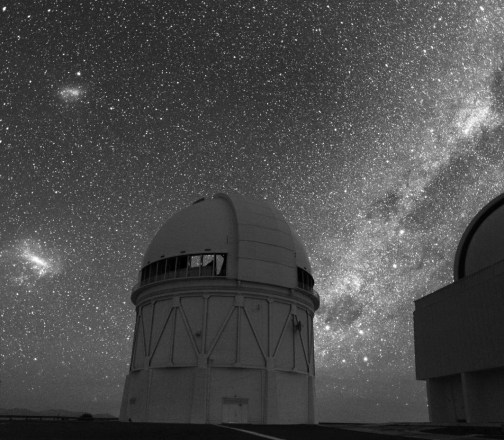
In Starry Skies

CTIO

In starry skies, long years ago,
I found my Science. Heart aglow
I watched each night unfold a maze
Of mystic suns and worlds ablaze,
That spoke: “Know us and wiser grow.”

And with each season’s ebb and flow,
My soul, with faltering steps and slow,
Still wanders up far-glimmering ways
In starry skies.

Nor do I heed Life’s gaudy show,
But onward, upward I shall go,
Until new star-lands meet my gaze,
And where, perhaps in after-days,
I’ll learn the things I long to know
In starry skies.

–Sterling Bunch

Christianity and the center of the universe

Not long ago, someone asked me if I’d seen the documentary, The God Who Wasn’t There (2005), which explores the “Jesus myth” and Christianity in general. It’s been out for several years, and despite the fact that it’s viewable for free on YouTube, I haven’t bothered to watch it, because it looks like an uninspired retread of common challenges to the Christian faith that tend to be very weak. However, from what I can tell, it does perpetuate one historical distortion that is worth refuting. From a partial transcript on IMDb, TGWWT puts forth the idea that it was primarily Christians who were wrong about the Earth-centered universe:

Narrator: The Earth revolves around the Sun. But it wasn’t always that way. The Sun used to revolve around the Earth. It was like that for hundreds of years, until it was discovered to be otherwise, and even for a few hundred years after that. But, ultimately, after much kicking and screaming, the Earth did, in fact, begin to revolve around the Sun. Christianity was wrong about the solar system. What if it’s wrong about something else, too? This movie’s about what happened when I went looking for Jesus.

Or, more likely, what happened when he went looking for anything but Jesus, but never mind. The problem with this statement is that it implies only Christians were wrong about the solar system, when the truth is that just about everyone was wrong about the solar system at one time or another. So why single out Christians? Without having seen the movie, I am fairly confident of the answer (hint: look at who appears in the movie). Unfortunately, the notion that the medieval Church was scientifically ignorant and held back scientific progress is a fairly easy misconception to perpetuate, because people who believe it are usually already eager to believe misconceptions about Christianity and/or they do not know enough to evaluate its validity.

I made a point to cover geocentric theory in my astronomy 101 courses, so let’s explore what my college freshmen students knew about this subject that TGWWT‘s writer/director Brian Flemming apparently did not (or did not want you to know about).

The geocentric model of the solar system, which places the Earth at the center of the universe, is an idea that is found in nearly every ancient culture. In Western Civilization, the idea is usually attributed to the ancient Greek philosopher Aristotle (384 BC – 322 BC), and was later systematized by the Alexandrian astronomer Claudius Ptolemaeus (aka Ptolemy, ~64 AD – 165 AD). The geocentric model persisted for more than 1,700 years, and while medieval interpretation of biblical scripture seemed to loosely support the idea, its formulation had nothing to do with Christianity.

To understand why the geocentric model persisted for so long, I want you to place yourself, just for a moment, in the ancient world where there is no such thing as telescopes, astronauts, or satellites. Your only notion of the Earth’s place in the universe is based on what your human senses tell you about the apparent motions of the heavens. You notice that the Sun and Moon make daily journeys across the sky from east to west, and that the stars at night travel in the same daily east-west direction. The familiar constellations also seem to drift across the sky over the course of weeks and months. To your human senses, it appears that the Earth is stationary and that objects in the heavens move about it in very predictable cycles. Armed only with these observations, it is entirely reasonable to assume that the Earth is at the center of the universe.

We owe a tremendous debt of gratitude to the Greeks, who were the first to seek natural explanations for the phenomena they observed. This reliance on natural explanations heralded the birth of science. But what is science? It is actually a difficult concept to define. Most of us understand science to be the search for knowledge, but knowledge can be acquired by other means. The scientific method works by making observations and asking questions in a very systematic way. One observes a phenomenon in nature (say, the motions of the heavens) and posits an educated guess about the nature of the phenomenon (everything in the heavens orbits the Earth, which is stationary). This educated guess is referred to as an hypothesis. The hypothesis then makes a prediction (where objects in the sky will appear on a certain date), and one carries out tests or observations to determine how well the hypothesis performs. If the hypothesis fails the test or cannot account for new observations, then it must be revised or abandoned in favor of a new hypothesis.

One such test of the geocentric model came in the form of retrograde motions of the planets. The Greeks observed that a handful of objects in the heavens moved in a way that was different from the other objects. For one thing, their positions were not fixed like the stars, but appeared to wander over a period of months. (The word “planet” comes from the Greek word for wanderer.) This retrograde motion, or apparent looping back of the planet’s path in the sky, is now understood in the context of the Sun-centered (heliocentric) model, but in ancient times it represented a significant challenge to the geocentric model. This challenge was resolved by placing each of the planets in a smaller orbit, called an epicycle, upon its larger orbit about the Earth. This was a key feature of the model put forth by Ptolemy, which is referred to as the Ptolemaic model.

The Ptolemaic model persisted for almost two millenia, because, clunky as it was, it made accurate predictions about the motions of the planets. Moreover, several key objections to the heliocentric model were unresolved. Centuries before Ptolemy, the Greek astronomer Aristarchus (310 BC – ~230 BC) proposed a Sun-centered solar system, but was ridiculed by his peers for it. First, the idea that the Earth was moving was counterintuitive, because of the apparent motions of the heavens. But the most significant objection was that stellar parallax was not observed. This is the apparent shifting of position of closer stars relative to more distant background stars, which must occur if the Earth is moving around the Sun. As this was not observed, it was reasonable for Aristarchus’ fellow Greeks to reject his idea.

Fast-forward almost two millennia to Nicolaus Copernicus (1473 – 1543 AD), who was a true Renaissance man. In addition to being an astronomer, he was also a physician, scholar, cleric, and military leader. Like Aristarchus before him, Copernicus went against popular sentiment and proposed a heliocentric system. There is evidence that Copernicus knew he was recycling Aristarchus’ ancient model, but his genius was in recognizing its potential as a much more elegant and compelling model than the geocentric model. It is true that Copernicus’ book stirred some controversy within the Church, but contrary to popular belief, the Church was not monolithically opposed to, but rather divided on, the subject of heliocentrism. Secular scientists at the time likewise held to the Aristotelian school of thought, and mostly rejected Copernicus’ ideas. There was good reason for this, as the major objections to the heliocentric model had not yet been overcome. In particular, since Copernicus used circular orbits for the planets, instead of what we now know to be elliptical orbits, the predictions of the Copernican model were less accurate than those of the Ptolemaic model. Heliocentrists also had to contend with the lack of observed stellar parallax, and there were still more objections based on Aristotelian notions about nature. For instance, long before Newton developed his laws of motion, Aristotle held that all objects naturally come to rest, which meant that if the Earth was moving it would leave airborne objects (birds, clouds, etc.) behind. It was not until Galileo anticipated Newton’s first law (objects in motion tend to stay in motion) with simple experiments and made some key observations with his telescope—among them, that the stars are too far away to observe parallax1—that these objections were overcome and the Copernican Revolution was solidified.

It is important to understand that there was as much objection to the Copernican model from secular scientists as from the Church. Perhaps more. (For instance, it was supposedly a secular rival who reported Galileo to the Inquisition, illustrating that scientific enterprise has always been a little cut-throat.) The objections of the Church were only partially founded on Christian doctrine, which was based at that time on interpretation of scripture that was consistent with the Aristotelian school of thought. There is, in fact, nothing in scripture that dictates an Earth-centered system. The politics of the time also complicated things, with the Catholic Church struggling to come to grips with the tremendous effects of the Reformation. The most influential figure of the Reformation, Martin Luther, strongly objected to the ideas of the “upstart astrologer” Copernicus, and the Catholic Church was anxious to stay abreast with Protestantism on such an important issue. It is also important to understand that Copernicus was eventually shown to be incorrect in his placement of the Sun at the center of the universe; we now understand that there is no ‘center’ to the universe, an idea that is difficult to accept for many people.

What can we conclude from all of this? We can conclude that the most important factor preventing wide-spread acceptance of the heliocentric model was simple human nature. As clever as we sometimes are, we are constrained by limited perspective and emotion. Limited perspective prevented scientists from perceiving the stellar parallax that was predicted by the heliocentric model. Human emotion means cherished ideas often have a powerful hold on people, especially when it comes to accepted ideas that have served mankind well for many centuries. Put these two constraints together and you have the very non-linear progression from old ideas to new ideas that is evident throughout human history.

Having not seen TGWWT, I can only surmise from the partial transcript that either Flemming knows very little about scientific history, classical thought, and theology, or he is being deliberately disingenuous to make Christians look bad. Which is unfortunate, because, with just a few changes to the quote from the transcript, I think we could have turned his movie into a much more interesting narrative on the fallibility of human reason:

Narrator: The Earth revolves around the Sun. But it wasn’t always that way. The Sun used to revolve around the Earth. It was like that for hundreds of years, until it was discovered to be otherwise, and even for a few hundred years after that. But, ultimately, after much kicking and screaming, the Earth did, in fact, begin to revolve around the Sun. Mankind was wrong about the solar system, but eventually figured it out. What is it today that we don’t yet understand that will be obvious to mankind hundreds of years from now? Let’s speculate…

[1] With the advent of larger and more sophisticated telescopes, stellar parallax was indeed observed.

Recommended reading:

  • What’s So Great About Christianity by Dinesh D’Souza

Canis Major

Ground-based image of Orion, Canis Minor and Canis major [Credit: Akira Fujii]

Ground-based image of Orion, Canis Minor and Canis Major [Credit: Akira Fujii]


The great Overdog
That heavenly beast
With a star in one eye
Gives a leap in the east.

He dances upright
All the way to the west
And never once drops
On his forefeet to rest.

I’m a poor underdog,
But to-night I will bark
With the great Overdog
That romps through the dark.

–Robert Frost

The universe is a little older than previously thought

Scientists using data from the ESA Planck mission have measured the age of the universe to be a little older — about 100 million years older — than previously thought. The official age, based on measurements of the cosmic microwave background, is now 13.8 billion years. Also, the proportions of matter and dark energy have changed a little, with slightly more matter (‘normal’ matter + dark matter) and slightly less dark energy than previously measured.

Related posts:

Questions from Christian Students, Part 8

Sarah was recently invited, along with two other scientists, to take part in a panel discussion for a group of mostly Christian students. After the main discussion, students were invited to submit questions via text message; there was very little time to address them, so only a few were answered. The questions were quite good, so over the next few weeks, Surak and Sarah will answer most of them here. All of the questions are listed in the Intro to this series. See also: Part 1Part 2Part 3Part 4Part 5Part 6; Part 7

What is the most important piece of knowledge you have come to learn about evolution since becoming a believer?

Darwin was a great scientist and pioneer in the field of biology. In that regard he is similar to Copernicus in the field of physics. Physicists honor Copernicus, but they also recognize and readily admit his shortcomings. He helped accomplish the first great paradigm shift that set science on its present course of discovery. What a great thing to do! But he was wrong about some important things; the Sun is not the center of the universe, and planets do not travel in perfectly circular orbits. We forgive Copernicus for his mistakes, because he did his work before the basic tools and higher mathematics of astronomy were developed. How could he be expected to get everything right four hundred years ago?

Darwin worked under similar limitations decades before the revolutionary discoveries of the Burgess Shale fossils and genes. So, once again, how could the great pioneer in the field of biology have gotten everything right all the way back in the mid 1860s? That would not be a fair expectation on the part of either supporters or detractors of Darwin.

The main principles of Darwinism are common descent, random mutation, natural selection, and gradualism. Each of these components is a necessary part of current evolutionary theory, which is important because people often confuse evolution theory for just one of these parts—the common descent of all animal life. It is true that common descent has all but been ‘proven,’ about as well as any scientific belief can be proven, and there can be little remaining doubt about it. But, the massive evidence in favor of common descent neither establishes the truth of evolution theory as a whole nor undercuts Christian beliefs. The most that can be said is that Darwin’s championing of this principle counts as a great success of the same magnitude as Copernicus’ heliocentric theory.

But, Darwin, just like Copernicus, got some things wrong. The fossil evidence does not support gradualism. In the words of one of the most respected biologists of modern times, Niles Eldredge, curator at the American Museum of Natural History in New York City: “The fossil record we were told to find for the past 120 years does not exist.”

It was Darwin who told biologists what to expect in the fossil record, and this mistake was a significant failure on his part.

In fact, the fossil evidence contradicts Darwin so badly, it compelled Eldridge and his more famous partner, Stephen Jay Gould, to offer something they called ‘punctuated equilibrium’ as an alternative to strict Darwinism. There are other serious problems with Darwinism (the mathematics of random mutations doesn’t work and there is a fatal lack of empirical evidence for natural selection), but, for the sake of brevity, it is enough to say that without gradualism Darwinism is seriously undone. In other words, Darwin was wrong about at least one major thing.

In light of this, the most important thing any scientist can come to learn about evolution is that biologists are generally incapable of saying the following words: “Darwin was wrong.”

Physicists can say without hesitation that there were times when “Galileo was wrong, Newton was wrong, and Einstein was wrong.” In spite of their mistakes, Galileo, Newton, and Einstein are still considered giants in the field of physics. Why can’t biologists make the same and obviously true statement about Darwin? I believe it is because strict Darwinism has become anti-Christian gospel, and many biologists are betraying science by promoting and defending this dogma.

Would the discovery of intelligent life on another planet disprove the existence of God?

Why would God be limited to creating one group of beings with souls in just one part of a vast universe? While the Bible is addressed to and concerned about the conscious beings inhabiting the Earth, there is nothing in the Bible that says that life was created only on Earth. “In my Father’s house are many rooms” (John 14:2). See here and here for further discussion.

Questions from Christian Students, Part 4

Sarah was recently invited, along with two other scientists, to take part in a panel discussion for a group of mostly Christian students. After the main discussion, students were invited to submit questions via text message; there was very little time to address them, so only a few were answered. The questions were quite good, so over the next few weeks, Surak and Sarah will answer most of them here. All of the questions are listed in the Intro to this series. See also: Part 1Part 2Part 3

You mentioned the big bang.  In your interpretation, does the big bang coincide with the moment of creation? / How does scientific proof of the big bang line up with the biblical teaching of creationism?

The scientific theory of the big bang is in every way consistent with the Genesis account of creation. These two very different ways of understanding the origin of the universe agree on all of the basics:

  • The universe had a beginning.
  • The universe was created out of nothing (nothing material).
  • What came before the big bang is scientifically unknowable.
  • There was no matter in the universe just after creation.
  • Something scientifically inexplicable happened just after the big bang. Physicists believe that something unusual (and so far unexplained) happened, and they call this one-time event ‘inflation.’ In scripture this one-time act of God is a miracle.
  • After this one-time event, light came into existence.
  • Darkness was created as something more than just the absence of light—in science this phenomenon is studied as dark matter and dark energy.
  • Our universe is constructed out of what scientists call fluids and the Bible calls ‘waters’ (ancient Hebrew vocabulary was very limited—about 3000 words—and didn’t have a different word for fluids).
  • The stars and galaxies were formed after light appeared.
  • The Earth was formed after stars first appeared.
  • Bodies of water and continents formed on Earth.
  • Life almost immediately came into existence after these bodies of water formed.
  • There was a progression in life forms.
  • When the atmosphere became oxygen-rich it became transparent, which made the Sun, Moon, and stars visible from the Earth’s surface for the first time.
  • Life first developed in water and eventually spread to dry land.
  • Winged insects appeared.
  • Dinosaurs lived (in the ancient Hebrew of Gen. 1:21 they are called e·thninm e·gdlim—the reptiles great).
  • Other winged creatures besides insects appear.
  • Mammals appear.
  • Hominids appear.
  • Conscious man appears.

When convincing evidence for the big bang was presented in the 1960s, newspaper headlines declared that the Bible had been vindicated1.

However, we must be careful not to overstate what science has done or is capable of doing. Science has not and cannot ‘prove’ that the big bang occurred. There is nothing in any branch of science that has been proven once and for all. Anyone searching for finality in understanding will be disappointed with science. Scientists have found evidence of the big bang that is so compelling that the theory is now accepted by most in the scientific community. But like every other theory in science it has gaps and unanswered questions.

Most important of all, science is the study of our material universe. It cannot directly address questions about what may or may not be outside the universe. The existence of God is therefore not scientifically provable or disprovable. What has been accomplished since the discovery of relativity, particle physics, and the big bang is the overthrow of the false argument that science and scripture are incompatible. That is enough.

—–

[1] Several newspapers reported on astronomical observations, presented at the Royal Astronomical Society’s February 1961 meeting, that appeared to rule out steady-state theory. The Evening Standard published an article with the headline “‘How it all began’ fits in with Bible story” (Peter Fairley, 10 February 1961), and the Evening News and Star featured an article headlined, “The Bible was right,” (Evening News Science Reporter, 10 February 1961).

Ancient martian flood channels revealed in 3D

Ancient martian water channels revealed in 3D by the SHARAD instrument aboard the Mars Reconnaissance Orbiter. [Image Credit: NASA/JPL-Caltech/Sapienza University of Rome/Smithsonian Institution/USGS]

Ancient martian water channels buried beneath the volcanic region, Elysium Planitia, are revealed in 3D by the SHARAD radar instrument aboard the Mars Reconnaissance Orbiter. [Image Credit: NASA/JPL-Caltech/Sapienza University of Rome/Smithsonian Institution/USGS]


A team of scientists has used data from the SHARAD radar instrument aboard the Mars Reconnaissance Orbiter spacecraft to create 3D maps of buried water channels on Mars, and in the process discovered that the channels are twice as deep as previously thought. The channels were carved out billions of years ago by an ancient megaflood, but have since been covered by lava from volcanic activity. Radar allows scientists to penetrate the layers of lava to obtain information about the depth of the channels underneath. More details about this discovery at the Smithsonian blog.

Related posts:

Questions from Christian Students, Part 3

Sarah was recently invited, along with two other scientists, to take part in a panel discussion for a group of mostly Christian students. After the main discussion, students were invited to submit questions via text message; there was very little time to address them, so only a few were answered. The questions were quite good, so over the next few weeks, Surak and Sarah will answer most of them here. All of the questions are listed in the Intro to this series; Part 1 is here; Part 2 is here

Has an effort by students to share their faith with you ever made an impact on you in any way?

Yes.

I had a student approach me after a lecture to ask if it was okay to be Christian and a scientist. She was a devoted Christian, and was interested in science, but had been told by one of her professors that she could not be religious and believe in science. She was distressed by this professor’s proclamation, and it struck me then that most students do not have the training or resources available to them to counter such attacks. It was after talking to this student that I decided to start a ministry to help people like this young woman maintain their faith.

Have you ever had a student challenge an idea during class?

I never had a student challenge an idea with respect to religion. I did have students very occasionally challenge a scientific/philosophical idea, but it didn’t happen very often in the intro classes I taught, which is not good. A lot of what is taught in science—particularly in physics and astronomy—should seem weird to students who are introduced to it for the first time, and they should be asking serious questions about it; but it was rare for students to challenge ideas. I did have one student who was annoyed when I explained that no scientific theory is watertight, and that all ideas are subject to refinement and replacement with new ideas. He (not unreasonably) responded to this by asking why he had to bother learning science at all, when its ideas were subject to change at any time. This started a fruitful discussion, and hopefully got other students in the class to think about the nature of human knowledge.

Do you wish you could talk about your faith in the classroom / office hours? If so, what keeps you from doing it?

When I was teaching, I had no desire to bring up my faith in the classroom, aside from a brief statement on the first day of class that I am a believing professor. My approach is not to push—I prefer students to initiate the discussion. If any student had wanted to start a discussion about science and religion in class, and it pertained to the subject of the lecture, I would have obliged; but it never happened. I did, however, have students approach me outside of class time to discuss how science relates to the Christian faith, and I was always happy to do so.

Questions from Christian Students

Sarah was recently invited, along with two other scientists, to take part in a panel discussion for a group of mostly Christian students. After the main discussion, students were invited to submit questions via text message; there was very little time to address them, so only a few were answered. The questions were quite good, so over the next few weeks, Surak and Sarah will answer most of them here. They are listed below, in no particular order. (Despite the title of this post, at least two of the questions appear to be from students who are currently struggling with belief.) 

Since becoming a Christian and living in an environment where your faith is tested every day, have you experienced doubt? If so, what has brought you through those doubts? (Part 9)

Was Adam the first man created or was he chosen from an already existing population? (Part 2)

Has an effort by students to share their faith with you ever made an impact on you in any way? (Part 3)

Have you ever had a student challenge an idea during class? (Part 3)

How does evolution relate to belief in a creator? And please address the time frame. / Please address the timing of evolution and the Bible. / How do you reconcile biologists teaching evolution and coming from apes with the creation story in Genesis? (Part 11)

What was it about Christianity that made you feel hostile towards it before you read the Bible? (Part 5)

Do you wish you could talk about your faith in the classroom / office hours? If so, what keeps you from doing it? (Part 3)

How do you account for the Higgs boson particle? (Part 1)

How hard is it to work in the field of academia in an anti-Christian environment from a faith perspective? (Part 9)

How do you recommend Christian students react to professors who are intolerant of their Christian faith? (Part 9)

You mentioned the big bang. In your interpretation, does the big bang coincide with the moment of creation? / How does scientific proof of the big bang line up with the biblical teaching of creationism? (Part 4)

Within your field of study what has been the most remarkable observation that you have made that reinforces your faith? (Part 1)

What was the most difficult specific objection to faith (particularly Christianity) that you had to get past? / What was the biggest stumbling block to faith that you had to overcome? / For new believers, how do you get past the line of ‘the Bible is just a story’ into faith? I’ve accepted that there is a God, but I’m struggling with accepting Jesus. (Part 7)

Outside of the creation story, have you found other parts of the Bible that support what you have observed scientifically? (Part 10)

What’s the most remarkable, undeniable discovery you have used to prove or disprove the faiths of different persons? (Part 1)

What’s the most common scientific argument you encounter against Christianity? How have you responded? (Part 6)

What is the most important piece of knowledge you have come to learn about evolution since becoming a believer? (Part 8)

What is your colleagues’ biggest reason for thinking the Gospel is not worth believing? (Part 5)

Would the discovery of intelligent life on another planet disprove the existence of God? (Part 8)

What would you say to someone who can’t believe in Christianity because of its exclusive claims, that no one enters the gates of Heaven without first meeting Jesus? (Part 12)