SETI is once again listening for E.T.

Dr. Frank Drake, author of the famous Drake Equation, estimates there are at least 10,000 advanced civilizations in the Milky Way galaxy alone. Drake came up with this equation more than 50 years ago, at a time when astronomers weren’t even sure there were planets beyond our solar system. Now that we have observational evidence of more than a thousand planets orbiting other stars — and there is reason to believe that most of the 200 billion or more stars in the Milky Way host planetary systems — Drake’s estimate doesn’t seem so far-fetched.

However, contact with any advanced civilizations that may be out there may depend on whether we here on Earth are listening. One group that’s been listening for decades is SETI (Search for Extraterrestrial Intelligence), but their efforts were halted last year due to a lack of funding. Thanks to donations solicited through its website — including a sizable donation from actress Jodie Foster — SETI is now back up and running at the Allen Array in Hat Creek, California, and it plans to keep listening for as long as funding holds out. Negotiations are currently underway for the U.S. Air Force to share the array for tracking satellites and space junk, which would give the SETI program the financial stability it needs to continue for the foreseeable future.

Continue reading

Mapping the human brain

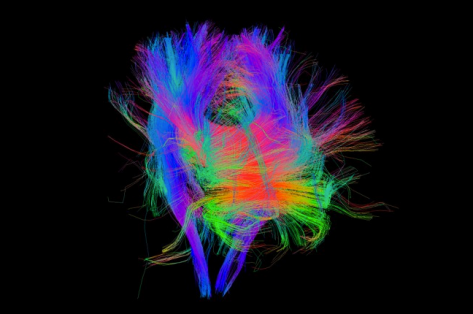
Scientists are making strides in their understanding of how the human brain is wired, but given its complexity they’ve still got a long way to go:

Among the most complex structures in the universe, the average brain contains about 100 billion specialized cells called neurons—as many cells as stars in the Milky Way— linked by 150 trillion or so connections known as synapses. By current means, it could take researchers years to trace the 10,000 or so synapses that branch from just a single neuron. By comparison, the scientists who sequenced the first human genome had to map only three billion base-pair sequences of DNA.

Where in this structure will consciousness be found? It’s one of the greatest mysteries of existence.

This is Surak’s field of interest, but my thought on this is, as we improve our ability to build sophisticated machines and other functioning things, we’re producing closer approximations of what already exists in nature. Someday in the far future, when we’ve constructed the perfect machine, I think we’ll be shocked to discover that all we’ve managed to do is recreate the human body.

Continue reading

Aurora in Norway

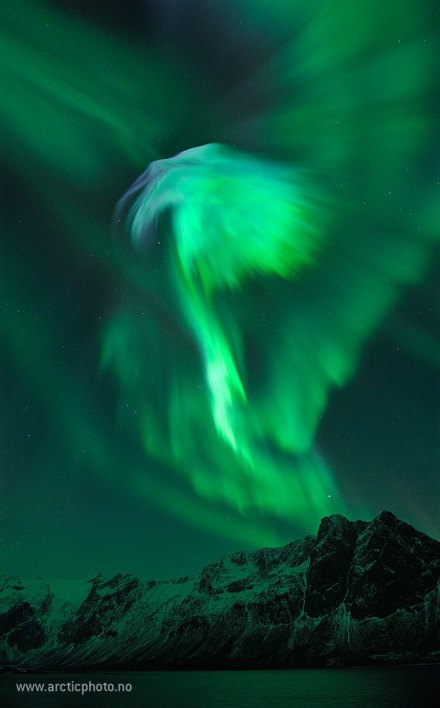
It is said that life sometimes imitates art, and today’s Astronomy Picture of the Day is a stunning example of that. This photo of an aurora over Norway looks very angelic to me. However, there’s a perfectly natural explanation for this phenomenon, which is a common occurrence at high latitudes. Auroras are the result of charged particles ejected from the Sun interacting with the Earth’s magnetosphere. Five days ago, a coronal mass ejection from the Sun hurled these particles toward Earth. An even more powerful solar flare occurred yesterday, and will likely produce another spectacular northern light show once the particles arrive at Earth tonight.

Continue reading

Transit of Venus

Mark your calendars, folks. Venus will pass between the Earth and the Sun — what is known as a transit — on the evening of June 5th (as seen from North America). On this date (and with the proper eyewear) you can watch Venus move across the face of the Sun. This is a rare event — the next Venus transit will occur over one hundred years from now.

Tons of details — including how to safely observe the transit — are here.

An invalid equation

Scientists working in the Netherlands and the U.S. who developed a more transmissible strain of the deadly bird flu have temporarily suspended their work to allow governments around the world time to assess the risks to “biosecurity.” The Dutch and American scientists, who produced their work separately, have submitted their results for publication. The National Institutes of Health, which funded the research, has requested the omission of important details over fears that the information could be used by terrorists to unleash a potentially genocidal attack in the future.

Keep this in mind as you consider what atheist writer and neuroscientist, Sam Harris, says about his “extinction equation”:

religion + science = human extinction.

He argues that religion is the source of all great conflict. Continued conflict with the destructive tools provided by science will result in the destruction of humankind. Therefore, all those who are dedicated to science must work to eliminate religion if humankind is to avoid extinction.

Yet as Christian writer, Vox Day, stated in his book, The Irrational Atheist, if we take Sam Harris’ Extinction Equation seriously, historical evidence shows that the most prudent action we can take is to eliminate science. As a professional astrophysicist who has dedicated her life to science, I must grudgingly concede that Day is correct if we are limited to an either/or choice between religion and science.

From a purely pragmatic point of view, it’s not difficult to choose which variable to set equal to 0 in Harris’ Extinction Equation. It would be exceedingly difficult, if not impossible, to eliminate religion, which has existed in myriad forms for at least several thousands of years. Even religion’s greatest opponents, secular humanists devoted to Darwinism, recognize that the human species demonstrates a deep and enduring need for religion, so much so that even today as much as 90% of people in the world claim to be religious in some form or fashion.

Science by comparison has only been around in its modern form since the time of Galileo. It is understood, supported, and practiced by vastly fewer people around the world than religion is. The scientific method does not come easily to most people, which is why it takes many years of education and training to effectively instill it even in the small minority of humans who are predisposed to it. Science would simply be much easier to eliminate from humankind than religion.

Historical evidence also shows that religion, all by itself, poses far less of a threat to humankind than science does. It is true that throughout history religious groups have made war against each other. But the whole truth is that humans have always fought one another for territory and dominance beginning long before the appearance of modern religions. There is little or no evidence of peaceful coexistence on Earth at any time or place with or without religion. Monotheistic religion is therefore not a basic cause of conflict, but rather a relatively recently added element in the ongoing chaos and conflict of human affairs.

During the thousands of years that religion has existed, the human population has risen from a few million to almost seven billion. Since the time of the Reformation, human prosperity has improved to the point where 75% of humankind has risen out of its natural state of poverty, and there is a well-founded hope that the remaining 25% will follow in the next 50 years. The only threats to human survival during the time of religion were the possibility of an errant asteroid, such as the one that is believed to have wiped out the dinosaurs, and naturally-arising contagious diseases that periodically ravaged civilizations.

Science and technology has changed all of that — there can be no doubt that they’ve had a much greater and more negative impact on human violence than religion ever had. An explosion of technology beginning in the 15th century made it possible for the ongoing conflict to enter the era of modern warfare resulting in new levels of slaughter which eventually led to the horrors of the First World War. The determination of the Nazis to use science to destroy its enemies in World War II rushed humankind to the point where scientific knowledge could result in its utter destruction.

Realistically speaking, and regardless of the dangers, we can’t put the scientific genie back in the bottle. Nor can humans live without some spiritual/moral system. As the world seems on the brink of a preemptive attack (possibly nuclear in nature) to eliminate Iran’s nuclear capability, there is good reason to be pessimistic about the future of humankind. Some kind of moral system must function to prevent scientific knowledge from causing the end of conscious life on Earth. As Vox Day observes, “the more pressing question facing the technologically advanced societies today is Quis eprocuratiet ipsos scientodes? Who will supervise the scientists?”

Does such a moral system exist? Yes, and that’s why I don’t think we face Harris’ either/or choice. Surak explains why here.
How Hubble offers a view of galaxies in their youth

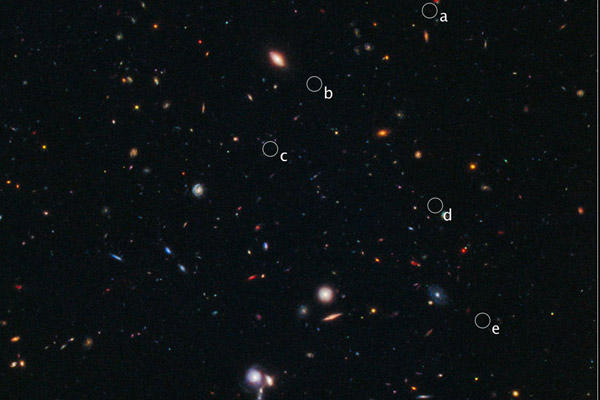
Astronomers have discovered the new record-holder for the most distant developing cluster of galaxies. Images of the cluster from the Hubble Space Telescope offer a glimpse of the universe as it was a mere 600 million years after the big bang. (The extremely faint galaxies are identified in the composite image above by the circles labeled a-e.)

Galaxies are the building blocks of the large-scale structure of the universe, and most of them reside in groups or clusters. Our own Milky Way is part of what’s known as the Local Group, a collection of about 50 galaxies, which is itself a part of the Virgo Supercluster of galaxies.

In order to understand the development of the universe over cosmic time, astronomers try to observe galaxies over a wide range of cosmic history, stretching back to the earliest stages of formation. It’s important to find extremely distant galaxies, such as the newly-discovered members of the protocluster above, but their extreme faintness render these galaxies extraordinarily difficult to detect.

The favored method of detection, and the one that revealed the presence of the protocluster galaxies, is a process called the Lyman-break method. “Lyman” refers to a particular series of absorption or emission lines for neutral hydrogen, which is by far the most abundant element in the universe. The Lyman limit is the shortest wavelength possible in this series, and it corresponds to the energy required to strip the electron from a hydrogen atom1. A Lyman-break galaxy is a galaxy whose spectrum shows a steep drop-off at the Lyman limit wavelength. This drop-off occurs because most stars do not emit very much light at shorter wavelengths, and the neutral hydrogen surrounding star forming regions in galaxies tends to absorb what little there is.

Since the stretching of the wavelength of light from a distant object is proportional to its distance from us, all astronomers have to do is measure where in the spectrum this drop-off occurs to estimate how far away the object is. The problem is, when you’re fishing around an enormous cosmos for very distant galaxies, it’s far too impractical to find them with spectra, which require pin-point accuracy. This is why the Lyman-break method uses images, which can capture comparatively large swaths of the sky.

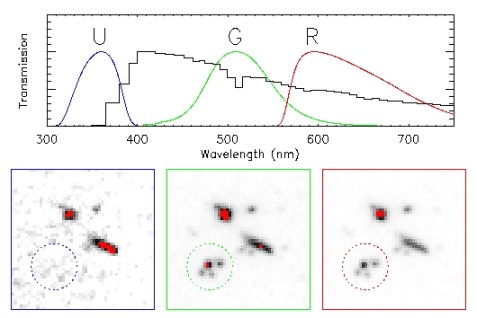
To see how this works, look at this spectrum of a distant Lyman-break galaxy followed by some images at different wavelengths:

The wavelength of light from this distant galaxy has been stretched by the expansion of the universe. The Lyman limit, which would appear at 91.2 nm if you lived inside the galaxy, has been stretched to about 400 nm. Instead of using a spectrum, astronomers can simultaneously detect the presence of a Lyman-break galaxy and get a rough estimate of its distance by observing at what wavelength the Lyman break occurs photometrically — that is, at what point it disappears from images. The galaxy above was imaged in three different “bands” — astronomers often use filters to block all light from an object except for a narrow range (or band) of wavelengths — corresponding to ultraviolet, green, and red. The above galaxy is apparent in the G-band image but disappears in the U-band image. So, from the images alone, astronomers would know that the Lyman break must occur somewhere between 350 and 500 nm, and could estimate a range for its distance accordingly.

Since the Lyman-break method provides only a rough estimate of the distance, astronomers usually follow-up such detections by observing a spectrum — now that the locations of the galaxies are known — which will not only give a more precise distance, but will tell astronomers other things about the galaxies in the protocluster, such as chemical composition and the types of stars developing in the galaxies.

Continue reading

The not-so-brief hiatus

I realize the brief hiatus has turned into a long hiatus. This was due to a convergence of several factors, or what is more aptly termed “the perfect storm.” Now that things are settling down, I plan to resume posting in the next week or two.

One exciting development is the we’ve officially started work on a home school curriculum for modern astronomy, which will be offered for a very reasonable price. More on this later, but our goal is to have it available for the 2012-2013 academic year.

Meanwhile, Happy New Year, and see you back here soon!

Brief hiatus

Just a note to let y’all know that there won’t be much posting here for a while as I finish up the analysis on my latest research project and write the paper.

Astronomy news round-up

Crab is emitting super-energetic gamma rays

Here’s another chapter for the books of “Persistence Pays Off” and “Who Woulda Thought?” A team of astronomers has discovered very energetic gamma-ray pulses emanating from the core of the Crab Nebula, in defiance of current theory. The nebula, a remnant of a 1,000 year-old supernova, is a semi-chaotic mass of gas surrounding a type of neutron star called a pulsar, the source of the gamma rays. Like all neutron stars, a pulsar is the tiny, extremely dense, collapsed core of a progenitor star; what makes these objects special is that the axis of rotation is offset from the bright magnetic poles, so that every time they spin they are observed to emit a pulse, like a lighthouse. Given its relative young age and close proximity to Earth — a mere 6,500 light-years — the Crab pulsar has been well-studied by astronomers. Theorists thought it was not possible for a pulsar to emit such energetic gamma-ray pulses, leading some of their colleagues to tell members of the team they were “crazy” for even trying to observe them. But the astronomers’ persistence paid off, and the new discovery is already changing how theorists think about these objects.

“We thought we understood the gamma-ray emission, and this was really becoming a foundational feature of our models, but that’s now thrown out,” [one of the authors of the study, Andrew] McCann explained. “The reason why this is so exciting is that it’s turning things around in the field.”

You gotta love how astronomers and physicists get excited every time a new discovery shoots down current theory. That’s exactly the kind of attitude that moves science forward.

Uranus pummeled by other planets?

The distant gaseous planet has long been a puzzle to astronomers, who have been trying to explain its peculiar axis tilt ever since it was discovered.

Most of the planets in the solar system exhibit axis tilt — this is where the axis of a planet’s rotation is at an angle to an imaginary line that runs perpendicular to the planet’s orbital plane. Mercury is alone in that it has virtually zero axis tilt, though Jupiter’s is also diminutive at just 3 degrees. The Earth’s axis tilt is 23.5 degrees, and Venus is nearly upside down with its rotation axis pointing almost completely downward (this is also somewhat of a mystery to astronomers).

Uranus is the strangest of all, as it rotates flopped over on its side. Some astronomers have hypothesized that Uranus was pummeled by another planet in the early history of the solar system, and this collision resulted in Uranus’ 98-degree axis tilt. However, another collision might be required to explain the spin of Uranus’ moons, which should otherwise spin backwards. A new simulation created by astronomers indicates that collisions with two Earth-sized planets could explain Uranus’ observed configuration. The main problem with this idea, however, is to explain where the two Earth-sized planets came from.

Evidence for water on Mars?

Astronomers have discovered seasonal dark streaks on the surface of Mars that could be signs of melted water running across the surface. Meanwhile, NASA’s Curiosity rover is slated to visit Mars next year to look for signs of water in the Gale crater. The discovery of liquid water on Mars will greatly facilitate any plans to establish future colonies there.