Fire Back: Where the Readers Respond

In which we examine a curious claim about quantum mechanics and the creation of the universe.

JH writes:

[How can Christians respond to the] claim that almost every atheist is clinging to right now, namely that quantum mechanics proves something can come from nothing?

JH is referring to the common atheist tactic of explaining how the universe could be created ex nihilo without a cause (aka a Creator) by invoking a phenomenon in quantum mechanics known as virtual particle production.

Virtual particle production refers to particles suddenly popping into existence from the vacuum of space. For those of us used to the decidedly Newtonian appearance of the world, this seems very strange, but it’s a real phenomenon in the quantum mechanical world. Atheists like to invoke it when arguing about who or what caused the universe: the claim is, these particles are uncaused and come from nothing, therefore it’s possible for things like universes to pop into existence uncaused and from nothing, therefore God is superfluous. The problem with this claim is that virtual particles are neither uncaused nor do they come from nothing. Let’s examine the latter claim first.

If you were able to look at the universe at the quantum mechanical level, you’d notice it was a very jittery place, with virtual particles fluctuating into and out of existence. In order for these virtual particles to fluctuate into existence, they must “borrow” energy from the vacuum energy, which is the background energy of space. This is because, according to Einstein’s famous equation, E = mc2, matter and energy are two sides of the same coin. If you want to make matter, you use energy (the reverse is also true, which is how nuclear fusion works). Even though we’re accustomed to thinking of a vacuum as nothing, in this case it is definitely something. The vacuum energy of space is something, so right away this tells us that virtual particles don’t come from nothing.

But there’s another problem — these particles don’t exist for very long. The Heisenberg Uncertainty Principle — which tells us that we can’t simultaneously know the precise amount of energy and the precise duration of time for an event — allows virtual particles to borrow energy from the vacuum energy provided they return that energy in a very short amount of time. Here’s the key: the more energy they borrow, the more quickly they must return it.

Let’s look at a practical example using a particle called a meson with a mass about 1/10th that of a proton. (Protons reside in the nucleus of an atom, and have a mass of about 2 x10-27 kg.) For a meson to pop into existence, it could only borrow the required energy for about 10-23 second. Written out in decimal form, that’s 0.00000000000000000000001 second. Remember, the more energy a particle borrows, the more quickly it has to return it. A conservative estimate for the number of protons in the observable universe is 1080 (which I am not going to write out in decimal form), which means that for a “virtual universe” to fluctuate into existence, it would exist for an extraordinarily short amount of time — just 10-103 second, which is far shorter than the 14 billion years we’ve measured for the age of the universe.

Now let’s examine the claim that virtual particles pop into existence uncaused. That’s just false. As theoretical physicist Matt Strassler explains on his wonderful blog, virtual particles are disturbances in space caused by the presence of other particles in that space. They’re not even really particles, which is why they’re called “virtual particles.” The upshot is, if certain conditions must exist in order for something to happen, then that something is not uncaused.

Short-short version:

  • When atheists invoke quantum mechanics to try to explain how the universe could be created from nothing naturalistically, they are abusing the notion of nothing.
  • Virtual particles borrow energy from the background energy of space, therefore they do not come from nothing.
  • For something to fluctuate into existence, the more massive it is, the briefer its lifetime. According to the Heisenberg Uncertainty Principle, the observable universe could only exist for 10-103 second, far shorter than the 14 billion years we measure.
  • Virtual particles are caused by the presence of other particles, therefore they are not uncaused.
  • There is no physical evidence of anything in the universe ever coming into existence uncaused and from nothing.

Backyard Astronomy: July 2015

Here are some fun astronomical events you and your family can enjoy in the month of July. All you need is an inexpensive telescope or binoculars for most of these events, but some of them are viewable with the naked eye.

July 1: Conjunction of Jupiter and Venus. A conjunction occurs when two or more planets overlap, or appear very close together, in the sky. This year’s closest conjunction is in July when Jupiter and Venus will appear to be less than half a degree — the diameter of the full Moon — away from each other. This will be a good one to view through a small telescope.

July 28-29: Delta Aquarids Meteor Shower. Meteor showers occur when the Earth moves through a cloud of debris left behind by a comet. The Delta Aquarids are debris from the comets Marsden and Kracht. The shower will peak on the night of the 28th and the early morning of the 29th. This is an average meteor shower that would normally give a decent show, but will largely be washed out by a nearly full Moon. You can still catch a few meteors if you’re persistent. Look in the direction of the constellation Aquarius after midnight for your best chance.

July 31: Blue Moon. A Blue Moon is a second full Moon in a calendar month. They’re sort of rare, but not super-rare, hence the phrase, “Once in a Blue Moon.”

Fire Back: Where the Readers Respond

In which we discuss dinosaurs and the age of the world and pursuing science as a Christian student.

Shawn made the following criticism in the comments to the “Six Days” post:

Below the slideshow you asked for corrections. I can’t speak to the astrophysics parts, but I can concerning two standpoints — that of theology, and that of fossil evidence, particular in reference to humans, but also in reference to even dinosaurs, which have been found containing soft tissue, something that seems strange, but plausible for a world of only 6-10K years, but absolutely forbidden for a world millions, even billions, or trillions of years old.

This strikes me as an odd observation. Taking the soft tissue evidence at face value, why couldn’t we simply have young dinosaurs in a very old world? It might be a bit awkward, but there is nothing in either science or scripture I’m aware of that “absolutely forbids” this.

In any case, it turns out that the soft tissue evidence is not necessarily a problem for old dinosaurs. It’s quite possible what we’re discovering is that scientists don’t understand decay like they thought they did. Evidence is mounting that, under certain conditions, soft tissue can be preserved during fossilization for millions of years. Nor is it a problem for Christianity, given that I believe scripture [together with a basic understanding of cosmology -Ed.] strongly implies an old universe/old Earth, anyway. Also, for you conspiracists out there, consider that the scientist who made the discovery, Mary Schweitzer, identifies as a committed Christian.

—–

HB writes:

I’ve wanted to change my major to astronomy, but I feel it will be a hard major to be in as a Christian. As an astronomer, do you feel that people are trying to convert you? Or do they respect your beliefs and work with you just the same? And is becoming an astronomer as cool as it seems?

I became a Christian halfway through my graduate studies in astrophysics, and did not find it difficult at all. Nobody in my department gave me any trouble for my beliefs. A few of the faculty and grad students were also Christian, which helped. However, I can foresee a problem being a young-earth creationist Christian and trying to major in astronomy, since so much of the subject matter reveals a very old age for the universe. But if you are not a young-earther, that’s not a concern.

Now, that said, if you are passionate about astronomy, you should not let the fact that you are Christian deter you. Science needs Christians. And we know from scripture and history that we will face many challenges and obstacles just for being followers of Jesus Christ. Since that’s inevitable, just do what you feel you are called to do, and ignore those who would give you any trouble.

And, yes, becoming an astronomer is wonderful. I couldn’t imagine doing anything else. Do keep in mind, though, that being a scientist is sometimes tedious, but that probably describes just about any job.

Weekly Psalm 19: The Pleiades

Here is your weekly reminder of Psalm 19 — the Pleiades.

Pleiades_large

The Pleiades star cluster. Credit: NASA, ESA, AURA/Caltech, Palomar Observatory.

The Pleiades is an open cluster of stars that forms an asterism — a recognizable pattern of stars — in the sky. The cluster is about 440 light-years from Earth, making it close enough and large enough to be easily observed with the naked eye. It’s also quite lovely through a good pair of binoculars.

The Pleiades is known by many different names, including the Maia Nebula and the Seven Sisters. In Japan, it’s known as Subaru. (You probably recognize the asterism in a certain car company logo now.)

These large, hot stars are relatively young at just 100 million years (our own Sun is 4.5 billion years old), but are already halfway through their main stage of life. The general principle with stars is that the bigger and more luminous the star, the faster it lives.

The cluster is currently passing through a cloud of dusty gas. The light from the stars reflects and scatters off the dust, creating the ethereal glowing wisps surrounding the stars.

Never trust an unstable AGB star…

The best passage from The Lord of the Rings and an astronomical reference to kick off the weekend.

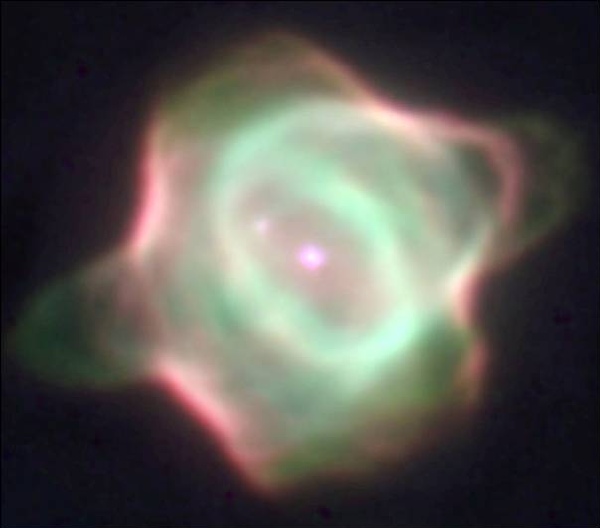
An unstable asymptotic giant branch star is a low- to medium-mass star, like our Sun, in its final phase of fusing hydrogen into helium. At this point, it has burned through all of the hydrogen in its core and is only burning hydrogen in an outer layer. It becomes unstable when it begins to pulsate, after which it will puff off its outer layer into what’s called a planetary nebula. This is the fate of our Sun.

Here’s the Stingray Nebula, in case you were curious.

The Stingray Nebula. Credit: NASA, Matt Bobrowsky (Orbital Sciences Corporation).

Scientific revenge poetry

There are few things more annoying for a scientist presenting at a conference than to be scheduled as the last presenter. A lot of attendees have lost interest by then or have left the conference, leaving you with a sparse and worn-out audience. When Australian astrophysicist, J. W. V. Storey, found himself in this unenviable situation in the 1980s, he got his revenge by presenting his research in the form of a poem and then later submitting his paper to the conference proceedings in poem-form.

Here is a sample:

I wrote my abstract, sent it in,
With words that don’t offend.
Imagine my horror to find that I
Am scheduled at the end.

Let me say, to be last speaker,
There are very few things worse.
And so this talk, to get revenge,
Will be entirely in verse.

The subject I address today
Is that of star formation.
And what we’ve found out recently
About the situation.

Stars start out as clouds of gas and
Dust and bits of spinning stuff.
Collapsing gravitationally
Until they’re dense enough.

They form themselves in little lumps,
(Or so says this bloke Jeans).
‘Dynamic Instabilities’
Whatever that term means.

It goes on for quite a while and includes figures, some of them charmingly hand-drawn. But the story doesn’t end there.

Last year, Storey’s family shared the following with one of my colleagues, which shows that the referee assigned to review Storey’s paper — who can now be identified as John Whiteoak — responded in kind, by producing his own poem to express his commentary (“Dick-Ed” is Richard McGee, the proceedings editor):

Whiteoak review


Weekly Psalm 19: The Needle Galaxy

Here is your weekly reminder of Psalm 19 — the Needle Galaxy.

This galaxy, also known by its catalog name, NGC 4565, is about as fine an example of an edge-on spiral galaxy as you’ll ever see. If the Milky Way were to be seen at the same distance of 43 million light-years and on its edge, it would look very much like this.

Edge-on spiral galaxy NGC 4565, also known as the Needle Galaxy. Credit: Bruce Hugo and Leslie Gaul/Adam Block/NOAO/AURA/NSF.

The puffy part in the center is the bulge of the galaxy and the extended part is the disk. The dark strip running the length of the galaxy is a dust lane. Dust typically makes up about 10% of the gaseous stuff between the stars in the disk of a spiral galaxy, which doesn’t sound like much, but it’s enough to block a lot of the intense starlight coming from the galaxy.

Vanquishing fear

For God gave us a spirit not of fear but of power and love and self-control. – 2 Timothy 1:7

The All-Father wove the skein of your life a long time ago. Go and hide in a hole if you wish, but you won’t live one instant longer. Your fate is fixed. Fear profits a man nothing. – Herger the Joyous, The 13th Warrior

Nine years ago, I stood in a terminal in Phoenix, Arizona, unable to board a connecting flight that was supposed to take me to visit family in Oregon. I was so gripped by fear that I was near hysteria, and a worried gate agent wanted to call an ambulance. Embarrassed, I told her, no, I was fine, but I was really far from it. I ended up renting a car that day and driving all the way home to Austin, Texas. That was the first of many long trips by car to visit people.

My fear of flying started about a year after my mom died from cancer. In my grief, I started to isolate myself and avoid any sort of discomfort. Not coincidentally, I found that I began to have irrational fears, which manifested most obviously in a fear of flying. It started with fear of turbulence, then fear of boarding, then fear of airports. It got so bad, I couldn’t even look at a plane in the sky without getting clammy with terror. Intellectually, I knew that my chances of being hurt or killed while driving were far greater than any chance of being killed in an air disaster. I even knew that my chances of being killed by falling out of bed at night were greater than being killed flying in a commercial airliner. But this did nothing to calm my anxiety. That’s why it’s called an irrational fear.

Fear is a hell of a thing, and so is its cousin, worry. In terms of the Christian faith, we know where fear and worry come from. They attack us when we abandon our trust in God and allow the Enemy to take control. In terms of biology, it’s equally simple. Fear and worry come from the over-enjoyment of security in the form of avoidance and from too much comfort. These two perspectives are complementary, by the way. We were meant to engage the world, not avoid it.

I knew deep down that it was wrong to let fear rule my life, partly because I despise weakness, but also because it showed a terrible lack of trust in God. So, after one final grueling drive from Texas to Canada last spring, I realized it was time to conquer my fear. My next trip would be by air.

My husband and I were going to fly with our baby daughter from Seattle to Austin. I was anxious the night before our flight, and even more so in the morning. Thankfully, the drive to the airport was interrupted when we were pulled over by a state trooper for speeding. That meant we had very little time to get from the ticket counter to the plane, and I had no time for dithering. We were up in the air before I even had time to reconsider.

It was a bumpy ride from the start; the turbulence was putting my nerves even more on edge. But instead of growing more fearful, a peculiar thing happened. I started to get angry. I couldn’t run from the fear, so, cornered, I turned and faced my adversary. I was going to sit there and feel every sensation in that plane; I was going to dare this stupid thing to kill me. So, I just let go and felt every single bump and jolt. I focused intensely on how it felt. And then, suddenly, there was a sense of utter peace. I turned and smiled at my husband, and told him the fear was gone. It was gone! Confronted head-on, the fear simply vanished.

I flew six more times that summer, all without anxiety. No worrying the night before, no cold sweat at the ticket counter, no sense of mounting panic as I boarded. There was only sweet, sweet victory.

While I don’t share the pagan view that our fates are fixed, I do believe Herger was right that hiding from danger — real or perceived — won’t extend our lives by even one second. Whatever is going to happen is largely out of our hands. We might as well go forth boldly.

Fire Back: Where the Readers Respond

In which a Twitter exchange exposes the blind faith of an anti-theist.

Here’s a person I think we can reasonably assume is an anti-theist. Last month, he pinged me on Twitter with the following:

By “FT” he means fine-tuning. What followed was an exchange that was more coherent than the one I had with “OpenMind” (see here and here), but no less demonstrative of the main problem many non-scientist anti-theists have, which is blind faith in their beliefs and unquestioned assumptions.

Before we continue, note that the reasoning I described in my testimony doesn’t really fall under what’s called the fine-tuning argument. This argument says that the improbability of our universe having precisely the right values for the many parameters and constants that permit human life to exist — the strengths of the fundamental forces, the masses of subatomic particles, the number of physical dimensions, etc. — is so high as to strongly imply the universe was designed by a personal being. However, in my testimony, I explained that I logically inferred the existence of a rational, transcendental being (God) who created the universe based on the fact that the universe is comprehensible. Not the same thing as fine-tuning. But no matter, I was game to see how exactly the fine-tuning argument for God constituted faith over reason, so I asked.

I don’t know if Joe’s World (JW) thinks the many, many atheist scientists who’ve embraced the multiverse idea on this basis are fools or what, but I suspected he didn’t understand the implications of fine tuning, so I asked him why he made his assertion.

His response surprised me a little, because it differs from the common anti-theist argument that God is merely superfluous to the workings of the universe. JW, on the other hand, believes that order arises spontaneously only in a godless universe and that a God-created universe would be nonsensical. I pointed out to him that this is the opposite of what Christians and even most atheists believe.

There are a number of problems with his assertion, the first of which is the origin of a “clockwork” universe in which complexity just arises. He’s begging the question. The problem is underscored by his metaphorical comparison of the universe to a clock — most of us are reasonably certain that precision instruments like clocks don’t just spring into being on their own, but are rather carefully designed and deliberately constructed by conscious beings.

Another problem is that he presupposes that the God of the Bible is a capricious being who would not create a rational universe with unchangeable laws. Sure, a supernatural being could in principle create anything he wants, but that’s not what’s important here. Since JW is talking to a Christian (me), that means we’re talking specifically about the God of the Bible. It doesn’t matter what anyone personally thinks about the God of the Bible, what matters is what scripture says about God and whether that’s contradicted or corroborated by reason and evidence. When we read the Bible, we see that God is not at all a capricious being, but rather a rational being. We are told throughout the Bible that God didn’t just slap together a whimsical universe, but by wisdom created a lawful universe:

By the word of the Lord the heavens were made (Psalm 33:6)

The Lord by wisdom founded the earth;
by understanding he established the heavens;
(Proverbs 3:19)

Do you know the laws of the heavens? (Job 38:33)

In the beginning was the Word, and the Word was with God, and the Word was God. (John 1:1)

Note that the Greek word translated in John 1:1 as “word” is logos, which also means logic, intellect, and wisdom. Putting all this together, Gerald Schroeder makes the argument that Genesis 1:1, properly translated, reads as follows: “With a first cause of wisdom, God created the universe.” (See Chapter Two of Schroeder’s book, God According to God.)

The heavens declare his righteousness (Psalm 50:6)

In other words, nature reveals the character of God. We see that nature operates according to knowable laws; God is not capricious.

As for corroboration, there’s a reason the Bible begins with Genesis. It first of all establishes the sovereignty of God as the creator of all things, but it also gives us a testable account of God’s creation. (See here for a discussion of Genesis 1 and modern science.)

What I found even more interesting than the backwards reasoning of JW was the tenacious way in which he clung to one particular belief in spite of the evidence, or rather the lack of it. I reminded him that there are only three options to explain why the universe is the way it is: necessity, luck, or God. I told him there’s no support for necessity, but he really, really wanted to believe it anyway.

It’s not difficult to define chance. The parameters, constants, all the things that make the universe fit for human life, can span a range of values. If there’s no physical theory requiring the universe to have three physical dimensions, the particular strengths of the various fundamental forces, the particular masses of subatomic particles, and so on, and no God to purposefully choose these values, then how did we end up with all of the “right” values? The answer is, a very, very lucky roll of the dice. In the multiverse, there is a mind-bogglingly huge number of universes, all with different parameters, and we just happen to inhabit one that hit the cosmic jackpot. (Incidentally, most physicists don’t seem to delight in this option. I get the impression most atheist physicists would prefer the necessity option, but as there’s no evidence for that, they grudgingly accept the multiverse.)

JW seemed to reject this notion, and he obviously wasn’t big on the God idea, so I challenged him, repeatedly, to show me which physical theories predict / require / necessitate the universe to be the way it is.

After a lot of back and forth, I finally got an answer out of him.

He admits he doesn’t know. The truth is, no one knows, and it’s deeply troubling to a lot of people, because it leaves as the only alternatives luck and God. Yet JW persists in his belief.

JW’s initial statement to me was that the fine-tuning argument was a triumph of faith over reason. But who’s exhibiting faith here? If you accept an explanation for why the universe is the way it is, then you must have evidence in favor of it or at least evidence ruling out the alternatives. Joe’s World has no scientific evidence, no physical theories predicting that the universe must be the way it is. Everything we know about the physical nature of the universe says that its various properties did not arise due to necessity. JW rejects God; I don’t know for certain if he rejects the multiverse, but I suspect he does. If so, then persisting in his belief in necessity is beyond faith — it’s blind faith.

Remember, having faith means holding onto a belief you once accepted through reason in spite of your transitory emotions. Blind faith means holding onto a belief without evidence or in spite of contradictory evidence. If you engage anti-theists long enough, you’ll find that a lot of them are the blind faithful. Christians, on the other hand, have good reasons to believe. If you’re a Christian, just make sure you can articulate what those reasons are.

Weekly Psalm 19: Jupiter

Here is your weekly reminder of Psalm 19 — the planet Jupiter.

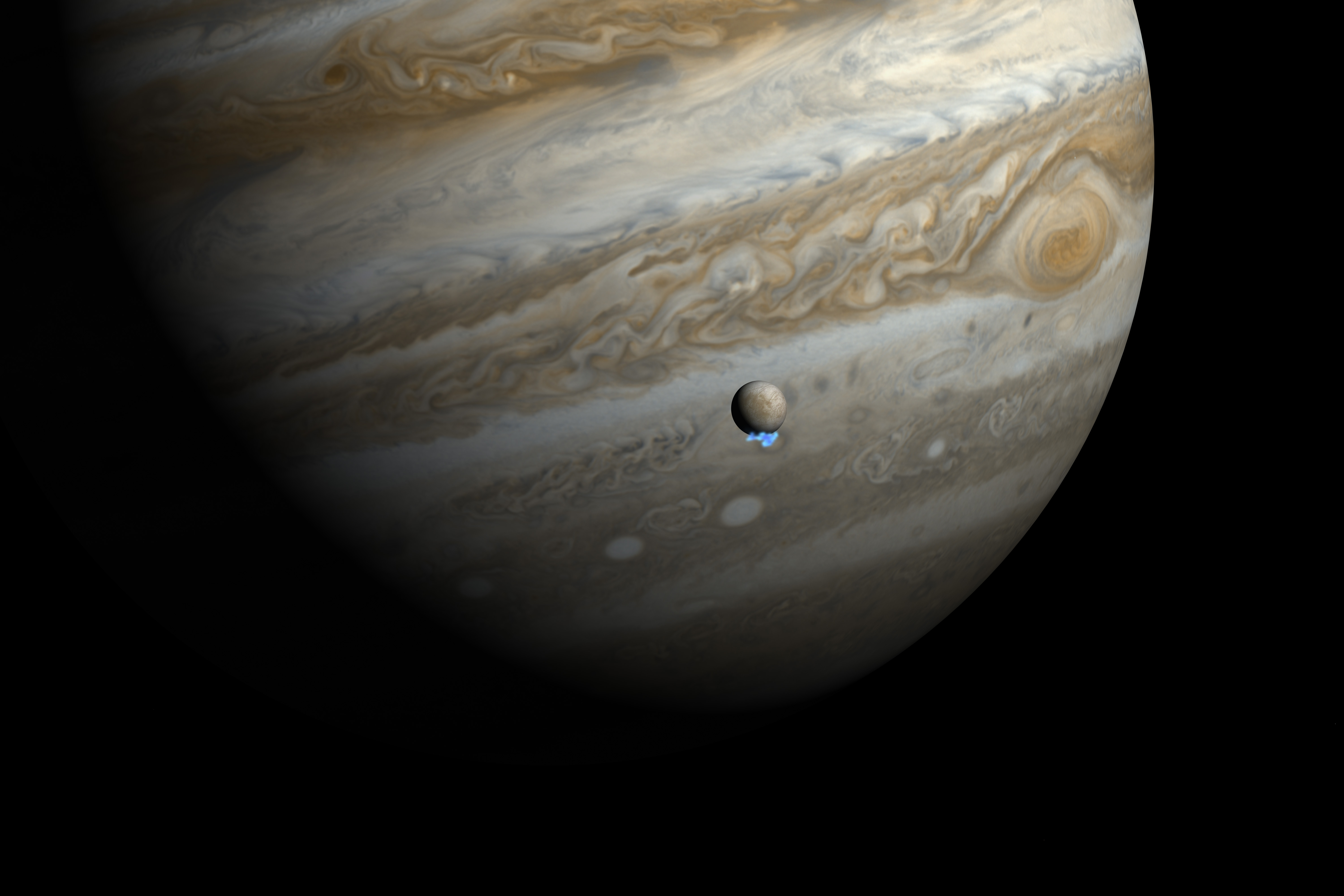
Anyone who has looked up at the night sky is acquainted with Jupiter. It’s the third-brightest object in our sky after the Sun and Venus. It’s also the largest planet in our solar system, a gaseous giant comprised almost entirely of hydrogen and helium. Interestingly, its size, in terms of orders of magnitude, places it exactly in the middle between the Earth and the Sun — it is almost exactly 10 times smaller than our Sun, but just over 10 times larger than the Earth.

This artist's impression shows Jupiter and its moon Europa using actual Jupiter and Europa images in visible light. The Hubble ultraviolet images showing the faint emission from the water vapour plumes have been superimposed, respecting the size but not the brightness of the plumes. Astronomers using Hubble have detected signs of water vapour being vented off this moon, creating variable plumes near its south pole — the first observational evidence of water vapour being ejected off the moon's surface.

An artist’s impression showing Jupiter and its moon Europa using actual Jupiter and Europa images in visible light with ultraviolet images of water vapor plumes superposed on Europa. Credit: NASA, ESA, and M. Kornmesser.

Some call Jupiter a failed star, but that’s an exaggeration. The defining characteristic of a star is that nuclear fusion is occurring in its core; however, Jupiter would need about 80 times more mass for this to occur, so it falls well short of the star limit. Still, it’s pretty massive as planets go, outweighing all of the other planets in our solar system combined by more than a factor of two.

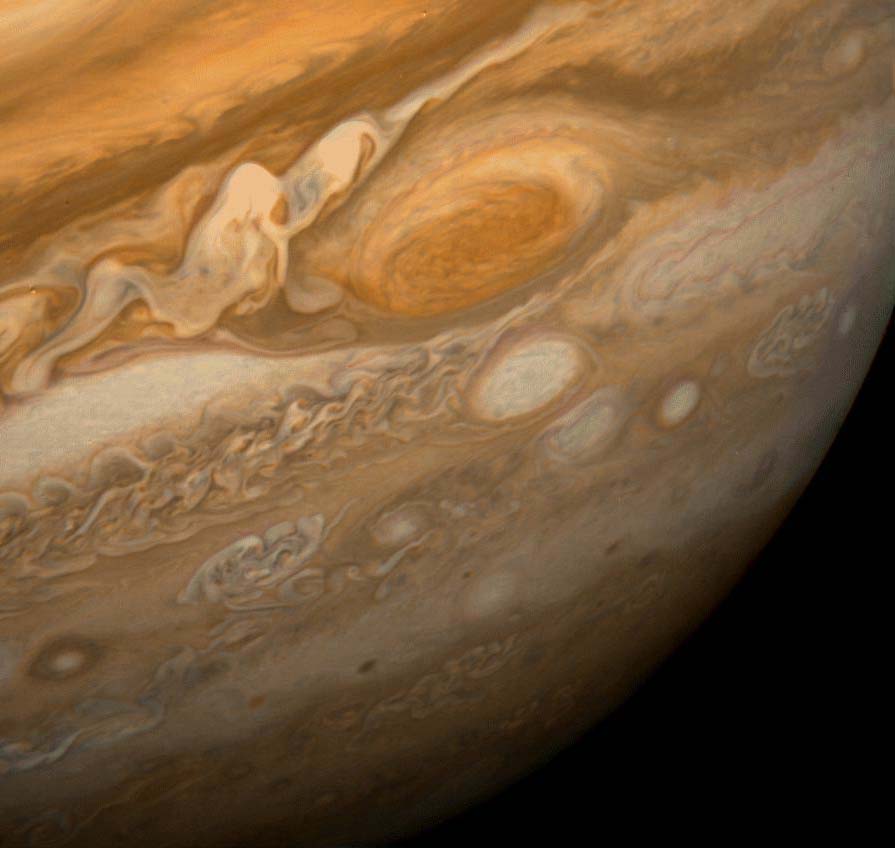
Jupiter is a visual treat for the astronomer for a number of reasons: its colorful bands of clouds, its Galilean moons, and its Great Red Spot. The bands represent regions of rising and descending clouds. The Galilean moons — Callisto, Europa, Ganymede, and Io — were discovered by (you guessed it) Galileo in the 17th century, and are visible through even small amateur telescopes. The Great Red Spot is a turbulent storm that has been raging on Jupiter for hundreds of years. To give you some perspective on size, consider that two Earths could fit inside the Great Red Spot.

Great_Red_Spot_From_Voyager_1

The Great Red Spot as seen from Voyager 1. Credit: NASA.