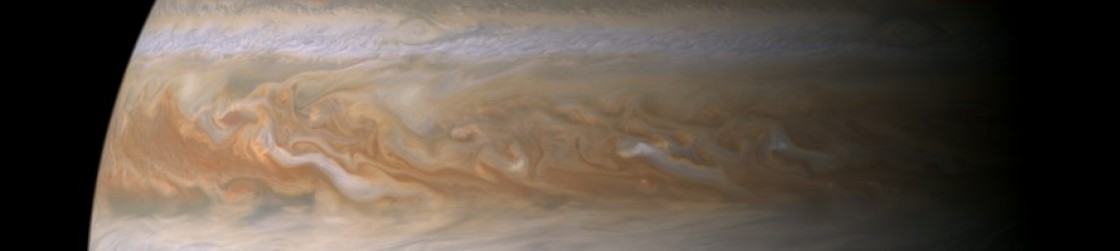
Science teacher James Drake assembled this time-lapse video from a series of hundreds of photographs taken by astronauts aboard the International Space Station. See if you can identify geographical features (a full listing is in the YouTube description). Note the yellow line of Earth’s ionosphere and the flashes of lightning.
Month: September 2011
Physicists apparently break the speed of light

The big news coming out of CERN is that scientists there have apparently exceeded the speed of light. The experiment, carried out repeatedly over a period of three years, involved the acceleration of neutrinos — tiny, neutrally-charged particles — over a distance of nearly 500 miles and timing their travel. Surprisingly, the neutrinos arrived 60 billionths of a second faster than light would have. It may sound like a miniscule difference, but considering that light travels over 186,000 miles per second, it’s actually quite significant.
If confirmed, the discovery would undermine Albert Einstein’s 1905 theory of special relativity, which says that the speed of light is a “cosmic constant” and that nothing in the universe can travel faster.
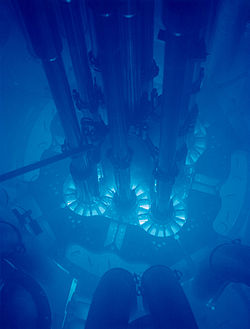
To be specific, Einstein’s theory says that particles with mass can be accelerated to speeds arbitrarily close to the speed of light in a vacuum — say, 99.9999999999% of the speed of light — but never at the speed of light in a vacuum, and certainly not exceeding it. In some cases, particles with mass can exceed the speed of light in certain types of material, for example high-energy electrons traveling through water in pool-type nuclear reactors. When this happens, the particles emit an eerie glow called Cherenkov radiation. (Fun fact: As you can see below, this glow is blue in color, not neon-green as seen on The Simpsons.)
As for the implications of breaking the speed of light, some physicists are holding off on scrapping the theory of relativity until the results are confirmed at other facilities.
Alvaro De Rujula, a theoretical physicist at CERN, the European Organization for Nuclear Research outside Geneva from where the neutron beam was fired, said he blamed the readings on a so-far undetected human error.
If not, and it’s a big if, the door would be opened to some wild possibilities.
The average person, said De Rujula, “could, in principle, travel to the past and kill their mother before they were born.”
Even in the face of such wild possibilities, I admire the restraint and humility of the CERN research group that conducted the experiment:
But Ereditato [spokesman for the CERN research group] and his team are wary of letting such science fiction story lines keep them up at night.
“We will continue our studies and we will wait patiently for the confirmation,” he told the AP. “Everybody is free to do what they want: to think, to claim, to dream.”
He added: “I’m not going to tell you my dreams.”
Compared with the wild speculation of some other scientists over similarly startling results in the recent past, this is refreshing.
Astronomers find several new “Super-Earths”
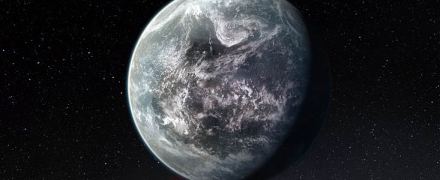
Is our planet alone in its ability to host life? So far, it’s unique in the Solar System, which is dominated by apparently lifeless bodies, but it may not be unique in the universe. Astronomers have long speculated about the presence of extraterrestrial life elsewhere in the cosmos, but thanks to two planet-searching projects — ESO’s HARPS project and NASA’s Kepler mission — they are closer than ever to finding suitable candidate hosts orbiting other stars. Teams for both have announced intriguing discoveries in the last year, the latest of which includes detection by HARPS of a planet that is only 3.6 times the mass of Earth.
While Kepler is a space-based mission that searches for planetary transits — planets periodically passing in front of their host stars — HARPS (High Accuracy Radial velocity Planet Searcher) is part of the land-based La Silla telescope located in the Atacama Desert of Chile. The HARPS spectrograph looks for periodic shifts in the light from stars, tell-tale signs of gravitational tugs by orbiting planets. Most of the planets discovered by Kepler are orbiting distant stars; the planets discovered by HARPS, however, are orbiting nearby stars, and will be much easier to observe in follow-up projects to detect, for instance, spectral signs of water and other substances necessary for life as we know it.
The HARPS team at ESO recently announced the discovery of 50 new extra-solar planets, or exoplanets, including 16 planets designated as “Super-Earths.” A Super-Earth is a planet 2-10 times the mass of the Earth, but not necessarily rocky in composition; such planets could also be gas dwarfs without any discernible solid surface. One of the recently-discovered Super-Earths, designated HD 85512 b, is a rocky planet located just within the habitable zone around its parent star. The habitable zone is the orbital proximity to a parent star that allows the presence of liquid water on a planet’s surface. The holy grail, as it were, of planet searches is an Earth-like planet with the presence of liquid water — the essential ingredient for life as we know it. The mass of HD 85512 b is tantalizingly close to that of Earth — about 3.6 times greater. Professor Dimitar Sasselov, an astronomer at Harvard University (and the scientist who coined the term “Super-Earth”), speculates that such planets may be even better suited for life than our own Earth due to increased tectonic activity and stable rotation.
Astronomers point out that the frequency of exoplanet discoveries is increasing, and we seem to be on the verge of discovering that the universe is awash in potential hosts for life. So what does all this mean for Christians? Personally, I do not rely on the uniqueness of Earth to bolster my belief in a Creator. It may well be that many planets suitable for advanced life exist elsewhere in the universe, and such planets and life would be part of God’s purpose, as the many different continents and the variety of life on Earth are undoubtedly part of God’s purpose. Furthermore, the existence of many potentially life-supporting planets in the vast universe in no way diminishes the power of the fine-tuning argument, which says that the many physical constants and parameters that permit the existence of life as we know it — nearly 100 characteristics as identified by Hugh Ross — are so finely tuned that even the ostensibly atheist astrophysicist, Fred Hoyle, concluded “the universe looks like a put-up job.”
Related posts:
Recommended reading:
Comet Elenin is not a threat to Earth
Comets have historically been regarded as omens, but whether good or bad is not always clear. Halley’s Comet appeared to observers in England in 1066 and was believed to be an omen. Harold II was defeated at the Battle of Hastings later that year, but William the Conquerer prevailed. Bad omen for Harold, good omen for William? In later centuries, Halley’s periodic appearance sometimes coincided with other historically significant events in Christendom, leading some — even prominent Church leaders at the time — to believe that the comet was a harbinger of doom.
We can forgive these people for their superstitions, given how little was known at that time about natural science. But in the 21st century, it is surprising (to me anyway), when so much is known about the natural causes of celestial events and how little physical influence they have on the Earth, that they are still regarded as omens. Take, for instance, the conspiracy theories involving the recently-discovered Comet Elenin. These “theories” mostly seem to predict cataclysmic events on Earth, yet are not based on any of the known facts about Elenin.
Motivated by the strange press surrounding the comet’s appearance, NASA’s Jet Propulsion Laboratory has compiled a list of answers to the most popular questions about Comet Elenin, and explains why it is not a threat to Earth. In short:
- It is one of many comets that are discovered each year.
- It is a smallish comet.
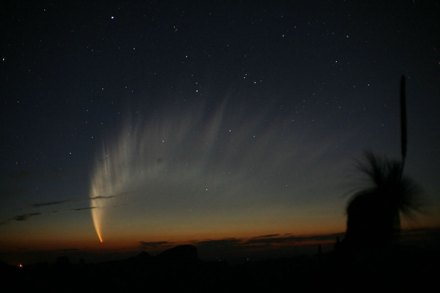
- It will remain far away. Its closest approach, in mid-October, will bring it 35 million km from Earth — that’s 90 times the distance from the Earth to the Moon. (Ed. note: Comet McNaught, pictured above, came even closer to Earth — 26 million km — in January, 2007.)
- Its gravitational influence on Earth, even at closest approach, will essentially be zilch.
- It will not block out any light from the Sun as it passes by.
There is no shortage of genuine disasters — both man-made and natural — that we can worry about. Strike Comet Elenin from the list.
The science of airplane boarding

Want to know the most efficient way to board a plane? Ask an astrophysicist. (Hint: boarding back-to-front is one of the least efficient ways.)
 SixDay Science