A super-hot, super-dense super-Earth

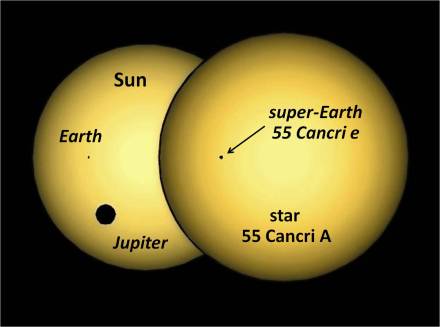
A simulation of a transit by 55 Cancri e as its orbit takes it in front of the star 55 Cancri A. The Sun, Earth, and Jupiter are shown for comparison.

How would you like to visit a “super-Earth” with three times the gravity of Earth, a surface temperature that’s 100 times hotter, and a year that’s only 18 hours long?

Welcome to exo-planet 55 Cancri e. Located 40 light-years from our solar system, this super-Earth is 60 percent larger in diameter than Earth and eight times as massive, making it about as dense as lead. 55 Cancri e orbits its own sun, a star called 55 Cancri A, in such a tight orbit that the star appears 60 times bigger in the sky than the Sun appears to Earth observers.

Astronomers discovered 55 Cancri e using the Doppler “wobble” method, where slight variations in the wavelength of light coming from the star are used to infer the presence of unseen planets exerting tiny gravitational tugs on the star. (Any potential observers on 55 Cancri e could infer the presence of Earth the same way: our own Sun wobbles slightly as it spins due to the gravitational influence of the planets in our solar system.) The orbital period, or year, for 55 Cancri e was measured by the transit method. This method requires very sensitive instruments, as it measures the tiny decrease in light coming from the star as the planet periodically passes in front of it (see above illustration).

If you have a clear view of the sky at night you can see 55 Cancri A for yourself. It’s a sixth magnitude yellow dwarf star that’s just visible to the naked eye. Look for it in the constellation Cancer, but don’t strain yourself looking for any of its planets — they’re too small to be seen even with the best telescopes.
Continue reading

“God particle” discovered?

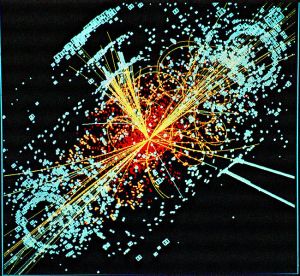
Simulated accelerator signal of a Higgs boson

Shhh! Rumor of a signal consistent with the elusive Higgs boson (aka the “God particle”) has been leaked from the LHC. However, a spokesman for CERN has said that it’s “way, way too early” to draw any conclusions from the data.

The Higgs boson is predicted to exist by the Standard Model of particle physics — the prevailing theory governing the organization of subatomic particles — and is supposed to explain how most subatomic particles get their mass. Physicist Peter Higgs, after whom the hypothetical particle is named, gave a formal description of the particle’s properties in a paper in 1966. Over four decades later, this is the first hint that it might actually exist. But as always in science, judgment should be deferred until the evidence is confirmed.

Continue reading

SpaceX’s Dragon capsule ready for Mars

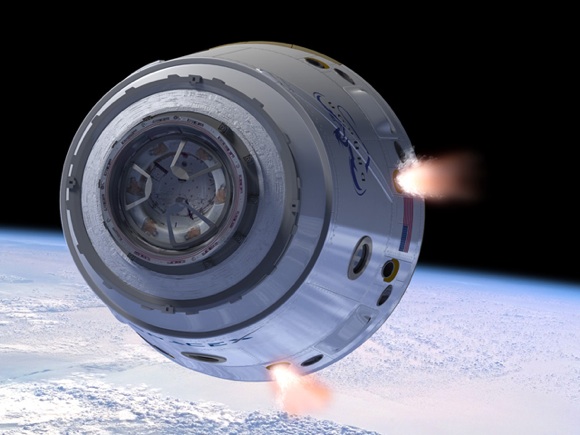
Artist's conception of the SpaceX Dragon capsule in space

As NASA’s Space Shuttle program winds down, the next generation of space ships is shaping up, most notably with SpaceX’s “Dragon” capsule. The Dragon capsule, intended in the near-term for unmanned supply missions to the International Space Station, has already been tested with a successful launch into space with SpaceX’s Falcon 9 rocket.

SpaceX also plans to make the capsule rated for manned missions. According to Elon Musk, the “nerdwealth” millionaire who is financing SpaceX, the Dragon capsule is capable of landing on other planets. In fact, Musk’s ultimate plans are to have colonies on Mars as soon as possible, and presumably the Dragon will play a role in getting people there.

Remarkably, only nine years after its inception, SpaceX is already reported to be operating at a level comparable to the European Space Agency, a collaboration between 19 European nations established 36 years ago. This is why I believe the future of space is with free enterprise. Motivated by competition and profit, private companies tend to operate far more efficiently and with more innovation than government agencies.

Continue reading

Endeavour’s last mission and strange physics

Shuttle flight #134 out of 135 is set to launch this Friday, April 29, when Space Shuttle Endeavour will blast into space for the last time. During its last mission, the Endeavour crew will deliver a special physics instrument to the International Space Station.

The instrument, called the Alpha Magnetic Spectrometer (AMS), is designed to make detections of exotic phenomena that are not observable from the surface of the Earth, including antimatter, dark matter, strangelets, and cosmic ray counts. These are all important for testing various theories and for practical reasons.

Antimatter

Big bang theory requires that equal amounts of matter and antimatter existed in the very early history of the universe. The matter and antimatter would collide and annihilate, producing a burst of energy. The great mystery is why our galaxy and everything we observe appears to be made of matter. Actually, the great mystery is why there is any matter at all, for if there was an equal amount of antimatter, all of it should have been annihilated. Some theories propose a tiny asymmetry, with slightly more matter than antimatter, but these theories raise problems of their own. It is important to determine whether any antimatter still exists in the universe, and this is where AMS comes in. AMS is designed to be highly sensitive to antimatter detections all the way to the “edge” of the observable universe.

Dark Matter

Anyone who has been fortunate enough to view the night sky free from the glow of city lights knows that the sky appears to be awash in stars. It’s tempting to think the entire universe looks this way, but this view is misleading. Our night sky provides a local view of a particularly dense area of the universe, the inside of a galactic disk of stars. Even the lovely visage of seemingly endless galaxies in the Hubble Ultra Deep Field may tempt the viewer into thinking the universe is overflowing with galactic material. The (theoretical) reality is that the vast majority of the “stuff” of the universe can’t be seen at all. In fact, according to the latest results from WMAP, stars and gas make up less than 5% of the total stuff out there. Dark matter is theorized to make up 23% of the total stuff (with dark energy making up the biggest chunk at 72% of the total). Even though it’s supposed to be a major constituent of the universe, dark matter has never been directly detected. AMS will look for neutralinos, the leading candidate for the dark matter particle. Theory predicts that when neutralinos collide, they produce other charged particles and energy, which can be detected by AMS.

Strangelets

One of the great discoveries of particle physics was the quark, the basic building block of matter. “Normal” matter (also called baryonic matter) comprises the familiar things of existence, from people to planets to stars. Normal matter is made of two kinds of quarks, called “up” and “down” quarks, bound together in groups of three. Four other types of quarks — called charm, strange, top, and bottom — were predicted to exist and subsequently discovered in particle accelerators. Some of these quarks are known to combine into other types of hadrons, or heavy particles. One theory predicts that strange quarks may group with up and down quarks to make extremely heavy “strange matter” particles called strangelets. Theory predicts that if strange matter comes into contact with normal matter, it could convert the normal matter into strange matter. AMS is designed to make detections of these strangelets if they do in fact exist.

Cosmic Ray Counts

If we have any hope of sending a manned mission to Mars we will need an accurate measurement for the rate of cosmic rays in our solar system. Cosmic rays are charged particles accelerated to near-light speeds, and they represent a major hazard to astronauts who would be exposed to them in space long term without the protection of the Earth’s atmosphere. AMS will make accurate counts of cosmic rays in the solar system so that scientists and engineers can devise appropriate protection for Mars-bound astronauts.

Continue reading

Supernova remnant a royal herald?

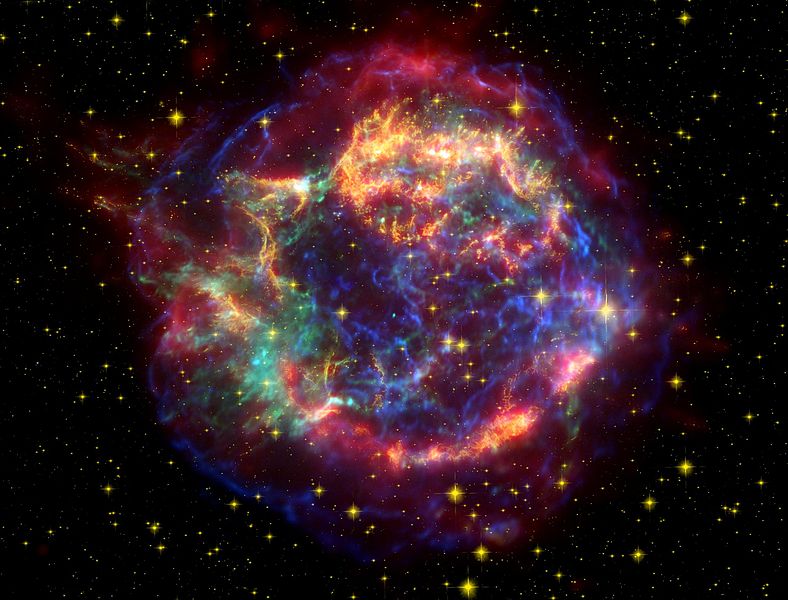
Multi-wavelength image of Cas A from the Hubble, Spitzer, and Chandra Observatories

Restoration historians in England may be giving astronomers reason to rethink the age of one of the most well known objects in our galaxy, supernova remnant Cassiopeia A (also called “Cas A”).

The Restoration refers to the return of Charles II to England, and thus the restoration of the monarchy. His father, King Charles I, was executed in 1649 at the height of the English Civil War, after which Oliver Cromwell became Lord Protector of England, Scotland, and Ireland. Cromwell ruled for nine years until his death in 1658. Two years later Charles II, who had retreated to mainland Europe, returned to England and assumed his father’s throne.

So far, all of this is established historical fact. What has been largely considered legend up until now is that a bright “star” appeared midday on May 19, 1630, the birth date of Charles II. Long thought to be Restoration propaganda, new historical evidence has emerged that lends credibility to this account. If true, it could be that the bright midday star was the light from supernova Cas A arriving at Earth. This means astronomers may have to rethink their estimate for the age of supernova remnant Cas A, since its appearance has typically been dated to 1667 or 1680.

King Charles II of England

Although recorded as a bright star in 1680 by John Flamsteed, England’s first Astronomer Royal, the supernova remnant wasn’t rediscovered until 1947 when — having long faded as a visible object — it was detected as a powerful radio source outside of our solar system.

Many descriptions of Cas A state that it exploded in the late 17th century, but this is a bit misleading. Cas A is estimated to be 11,000 light-years away from Earth, which means the supernova actually occurred 11,000 years before Charles II, or anyone else in the 17th century, was born — so what these descriptions mean is that the explosion would be visible to observers in the 17th century, when the light finally reached Earth.

Modern astronomers use the size of the remnant together with a measurement for how fast the remnant is expanding to work backward and calculate when the progenitor star must have exploded. The calculation predicted Cas A would be apparent to Earth observers in 1667. If instead the explosion was actually visible in 1630, it could be that the rate of expansion of the remnant has not been uniform as was assumed. In order to bolster this new hypothesis, however, historians will need to find accounts of the 1630 midday star in other historical records from that time.

Below is a time-lapse vid showing how Cas A has expanded noticeably in just a few years. Keep in mind the remnant is already 10 light-years across after ~340 years, so that material has been expanding very quickly — on average, about 20 million miles per hour.

Continue reading

NASA goes commercial

The SpaceX Falcon 9 rocket

NASA is trying to go commercial for its space delivery vehicles by awarding $269M toward private development

The awards, part of what NASA calls its commercial crew development program, are a bet, pushed by the Obama administration, that commercial companies will be able to get people to and from orbit more quickly and less expensively.

If all goes as planned, NASA anticipates commercial spacecraft will be able to deliver astronauts to the International Space Station mid-decade.

Continue reading

The free frontier

Yesterday, on the 50th anniversary of the first man in space, The Atlantic featured an article by Jim Hodges lamenting the decline of American exceptionalism in space:

[In the 1960s] Americans didn’t talk of their exceptionalism. They did exceptional things, and the world talked about it. In many places around the world, in science labs and classrooms, the NASA “meatball” was as recognizable as the Stars and Stripes.

People remember that President Kennedy said, “I believe that this nation should commit itself to achieving the goal, before this decade [of the 1960s] is out, of landing a man on the moon and returning him safely to the Earth.”

Forgotten is that just before that challenge, he said this as a preamble to it: “I believe we possess all of the resources and talents necessary [to lead the world into space]. But the facts of the matter are that we have never made the national decisions or marshaled the national resources required for such leadership. We have never specified long-range goals on an urgent time schedule, or managed our resources and our time as to insure their fulfillment.”

The government is certainly not doing that now, and we can’t count on it to do these things ever again.

However, I do not see this as occasion to despair. As well-intentioned as NASA has been, government almost always does things slower, costlier, and with less innovation than private enterprise. In fact, while government has been slashing NASA’s budget and scaling back its goals, private companies out in Mojave have been quietly innovating like crazy:

Continue reading

108 minutes that changed the world

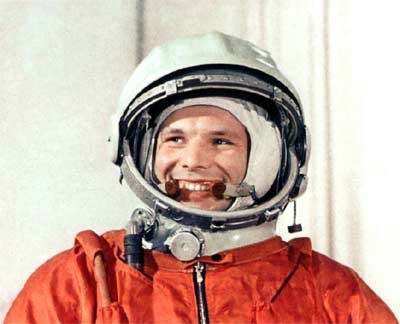
Tomorrow will mark the 50th anniversary of the first man in space. On April 12, 1961 Soviet cosmonaut, Yuri Gagarin, spent 108 minutes in space aboard the Vostok 1 spacecraft. It would be his only space flight. Gagarin continued his career designing spacecraft and training other cosmonauts. He died in 1968 when a jet he was piloting crashed.

Gagarin received many honors for his achievement, but perhaps none so great as being immortalized in musical form by French techno-artiste Jean-Michel Jarre:

Continue reading

Physicists discover new particle?

A proton - anti-proton collision at Fermilab provides evidence for the top quark in 1995 (Credit: LBNL)

Physicists at the Tevatron particle accelerator at Fermilab have discovered a strange new signal emerging from proton – anti-proton collisions that is unlike anything seen before. It could be a new kind of particle — and with it, possibly a new kind of fundamental force — or it could be a statistical blip. While the community is excited about the discovery, many physicists are understandably reserved about it until the result is replicated with the Large Hadron Collider.

Whatever it is, the signal is not consistent with a Higgs boson, the elusive “God particle” posited to explain why certain particles have mass. In fact, nobody seems to know what it could possibly be — music to a theorist’s ears. The last major particle discovery made at Fermilab was in 1995 with the top quark, whose existence (together with the bottom quark) was predicted to exist by physicists in 1973.

Continue reading

Our analysis of the Great Debate

Well, it didn’t quite take us a week — we were just so excited by “The Great Debate: Is There Evidence for God?” that we couldn’t wait to comment on it. The following analysis is co-written by Surak and Sarah.

The two opposing sides of the scientific debate over the God hypothesis were well represented on Wednesday by Dr. William Lane Craig (Christian Philosopher and Theologian from Talbot School of Theology) and Dr. Lawrence Krauss (Theoretical Physicist from Arizona State University). Dr. Craig’s argument was based on the clearly-stated and logical assertion that if God’s existence is more probable given certain information, that information meets the essential criterion for evidence. Dr. Krauss was equally clear in his definition of evidence: it must be falsifiable to be scientific. We find both standards to be very useful.

There was some confusion on the part of the moderator as to whether the topic of the debate was the existence of any evidence for God or the existence of enough evidence to prove God’s existence. We think the moderator erred in his statement of the debate’s purpose, since no one could reasonably argue that there is proof or disproof of God’s existence. As Dr. Krauss correctly stated, science cannot falsify God; so, the question can only be, “Is God likely?”

We will assess the debate in terms of whether or not there is any evidence for the existence of God, although Dr. Krauss tried to set the bar unfairly high with his assertion that a highly extraordinary proposition, such as the God hypothesis, requires extraordinary evidence. However, we think defenders of the God hypothesis can accept and meet this challenge.

Continue reading