Fire Back: Where the Readers Respond

In which we discuss inflation, the multiverse, and fine-tuning.

I had the following exchange with a reader in the comments of a previous post:

jlafan2001: What is your take on the discovery of cosmic inflation? Isn’t inflation evidence of a multiverse and doesn’t that refute the fine-tuning argument?

SS: Inflation is a compelling idea that answers some big cosmological questions, and, personally I think it’s correct. One flavor of multiverse — the bubble universe idea — is an outgrowth of the inflationary big bang model. The problem for a multiverse based on inflation is that inflation is also consistent with non-multiverse models. There is currently no way to distinguish between them based on the evidence. There is, to my knowledge, nothing that can be confidently stated about the multiverse based on evidence, therefore it would be beyond foolishness to say that the multiverse constitutes a genuine refutation of the fine-tuning argument.

jlafan2001: Thank you for your input, Dr. Salviander. Why would scientists then use the inflation model as evidence for the multiverse if it can go either way?

A not unreasonable question. The answer is, inflation is one of the very few (ambiguous) lines of evidence atheist scientists have for the multiverse, and there is considerable philosophical motivation to support the multiverse no matter how weak the evidence.

There are two main problems in physics for the atheist scientist:

  1. The big bang. A universe with a beginning logically implies a supernatural creative force for the universe.
  2. The fine-tuning of the universe, for which there are only three explanations: a) necessity; b) chance; c) design.

Contrary to what Young Earth Creationists believe, atheist scientists have never been happy with the big bang. To understand why, all you have to do is go back to February of 1961 when striking evidence in favor of the big bang was presented at a meeting of the Royal Astronomical Society in London. That evidence would later turn out to be flawed, but at the time it inspired some notable headlines in London newspapers. The Evening Standard published an article with the headline “‘How it all began’ fits in with Bible story” (Peter Fairley, 10 February 1961), and the Evening News and Star featured an article headlined, “The Bible was right” (Evening News Science Reporter, 10 February 1961).

These headlines reflected the big bang’s astounding confirmation of the first three words of the Bible. To understand the significance, consider that for millennia prior to this, the scientific consensus was that the universe was eternal. Obviously, this was a big problem for the Bible-believers, but not for atheists, who rested assured that the universe required no explanation. That all started to change in the 1920s with solutions to Einstein’s general relativity equations showing the universe could be dynamic, as well as Hubble’s evidence that the universe is expanding. Things finally changed in a big way in the 1960s with the discovery of the cosmic microwave background, which pretty much sealed the deal for the big bang.

To their credit, the vast majority of physicists accepted the big bang theory once there was sufficient evidence, even if a lot of them didn’t like it. However, there were a few notable holdouts, like renowned astrophysicist and atheist, Geoffrey Burbidge. It’s not a stretch to suggest that his steadfast support for an eternal universe in spite of the evidence was philosophically motivated, especially considering he famously accused many of his colleagues of “rushing off to join the First Church of Christ of the Big Bang.”

The evidence for the big bang is by now so overwhelming that few physicists doubt it. That leaves atheist physicists with a big problem, which is how to offer an alternative to God as the supernatural creative force behind the universe. Thus, we have the multiverse.

Now, it’s important to point out that, contra what some skeptical Christians believe, physicists did not metaphorically pull the multiverse out of a magician’s hat. There are different types of multiverse (or “levels” as physicist Max Tegmark calls them), each with a basis in physics and mathematics that makes the idea conceptually somewhat compelling. One level of multiverse is the bubble universe model. This model says that inflation — a period of extremely rapid expansion of the universe shortly after the big bang — leads to regions of localized inflation, which form like bubbles in a cosmic sea of foam. Each of these bubbles expands at such a rate that they are all causally cut off from each other, and each effectively forms its own universe. This is one type of inflationary universe; there are others that do not lead to multiverses. However, as I pointed out to jlafan2001, there is no way I’m aware of that you can observationally distinguish between an inflationary bubble universe and an inflationary non-bubble universe.

So, how does this tie into fine-tuning?

The fine-tuning argument says this: the many observable parameters of the universe that permit human life to exist are so finely-tuned as to strongly imply the universe was designed by a personal being. Physicists have ruled out necessity as an explanation for fine-tuning; this means there is nothing in any physical theory or any extension of physical theory that requires the various physical parameters describing our universe to be the way they are. That leaves chance and design. For an atheist physicist, design is obviously out, which leaves chance as the only explanation. It turns out physicists aren’t very happy about this — they would have preferred necessity as the explanation — but, they’re philosophically stuck with chance. Since there is already a theoretical basis in physics for the multiverse, and chance is built into its framework, atheist physicists latch onto it as a means to explain away the appearance of fine-tuning. It also has the virtue of addressing point #1 above by providing an alternative to God as the creative force behind the universe.

The so-far insurmountable problem with the multiverse is that there is no way to test it. One of the features of the multiverse is that each of the universes within it is causally separated from all of the other universes, which means there is no way we an observe any of them, directly or indirectly. There’s just no way we can peek outside of our universe to see if there are any others. So, we’re left with ambiguous evidence like inflation and “shadow particles” (ugh). Until physicists find a way to get around this problem, which is unlikely, the multiverse remains nothing more than a science-flavored idea.
Weekly Psalm 19: Hercules A

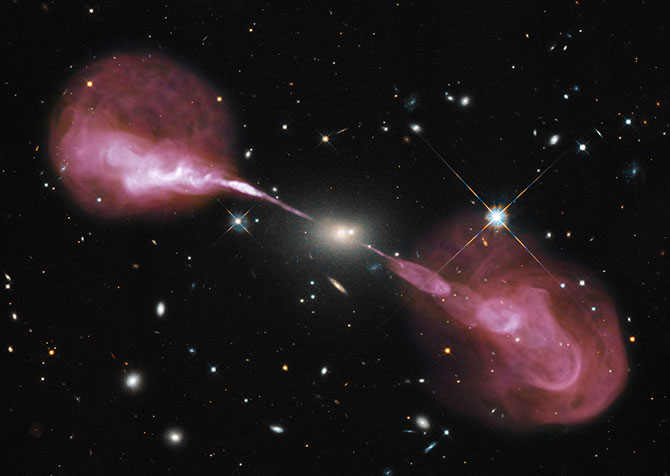
Here is your weekly reminder of Psalm 19 — the radio galaxy Hercules A.

709513main_hercules-670
Hercules A is a radio galaxy — an active galactic nucleus that emits an unusually high amount of radiation in the radio part of the EM spectrum. It’s about 2 billion light-years from Earth, and is the highest radio-emitting object in the constellation Hercules. Even though this galaxy is named for the constellation in which it appears, it certainly lives up to its name — it’s about 1,000 times more massive than the Milky Way, contains a black hole that is 1,000 times more massive than the black hole in the center of the Milky Way, and, as you can see in the image, it’s shooting out radio jets that span an incredible 1.5 million light-years in length.

This image is a composite of visible light (Hercules A in the center, as well as the stars in the foreground and other galaxies in the background) and radio light (the jets and lobes). The jets and lobes are comprised of charged particles accelerated to near-light speed and twisted magnetic fields. The jets and magnetic fields emanate from a region very close to the central, supermassive black hole.

Image credit: NASA, ESA, S. Baum and C. O’Dea (RIT), R. Perley and W. Cotton (NRAO/AUI/NSF), and the Hubble Heritage Team (STScI/AURA).

Has physics disproved the beginning of the universe?

I’ve been asked numerous times about a scientific paper published earlier this year purporting to show the universe has always existed:

The universe may have existed forever, according to a new model that applies quantum correction terms to complement Einstein’s theory of general relativity.

Apparently, some atheists are latching onto this to show that Genesis 1:1 is wrong, and some of you are unsure how to respond to such an argument.

The first thing I would like to point out is that atheists have been trying to get around the finite age of the universe since the 1960s, when the most compelling evidence for the big bang — the cosmic microwave background — was discovered. As many atheist scientists observed at the time, big bang cosmology is uncomfortably close to Genesis 1.

If you’re a Young Earth creationist who believes the big bang theory is an atheist conspiracy, this should be a compelling reason for you to reconsider that belief. Most atheist scientists are desperate to do away with the conventional big bang theory. They were quite happy prior to the 1960s when it seemed the universe was infinitely old — an infinitely old universe requires no explanation, and therefore requires no God. But we’re stuck with a universe with a beginning, and that’s a problem for atheists. This is why we hear so much about overblown stories about the big bang not happening or all these stories about the multiverse.

Anyway, here’s what you should keep in mind about this paper.

1. It’s just a model, not evidence.

The physicists who wrote the paper are proposing an explanation for the big bang by using a mathematical model. Models that speculate about how things might work are important in science, but you should always remember that a plausible model is not evidence. Think about it this way. I could come up with some very interesting and plausible explanations for who assassinated JFK and how they did it. While these explanations would suggest possible lines of investigation, they would not constitute evidence in a court of law.

2. The study’s conclusion follows from its assumptions.

This requires a bit of background to explain. The big bang was a sudden expansion of the universe from a hot, dense state. We can see by looking at the motions of galaxies all rushing away from each other that the universe is still expanding, and it’s cooling as it does this. If you think about running the movie of the universe in reverse, all these galaxies would appear to be rushing towards each other as we go back in time. Everything would be getting more smushed, and the universe would be getting denser and hotter, until we reached some initial very dense, very hot state; possibly even infinitely dense and hot, but nobody knows for sure what that initial state was.

In Einstein’s general relativity, the shortest distance between two points in spacetime is called a geodesic. As you go further and further back in the history of the universe, as things get smushed together and hot, all geodesics eventually converge and you get a singularity. The problem is, general relativity is unreliable on extremely small — that is to say, quantum — scales. For that reason, you can’t legitimately extrapolate all the way back to a singularity using general relativity, and that’s why physicists are working on a quantum version of gravity. To get around this problem, the physicists in this study used a quantum replacement for geodesics, called Bohmian trajectories. By their very nature, these quantum trajectories cannot converge to a singularity. So, big surprise, when you assume that you can’t get a singularity in your model, you don’t get a singularity in your model. This is why the headline of the phys.org article is so annoying: “No Big Bang? Quantum equation predicts universe has no beginning.” No, it does not predict the universe has no beginning; the assumptions in the equation require it! And, it’s wrong about this “prediction” anyway (see below).

3. Do we really care about a singularity?

So, what is a singularity, anyway? If you ask a random person, he’ll probably say it’s an infinitely small point. For physicists, it’s more complicated. It can be a hypothetical infinitely small point, but it can also represent a state of infinite density, even if space isn’t infinitely small. But this is problematic, as people like to say. It’s fine to talk about infinities in terms of mathematics, but physicists don’t like infinities in reality, because they play havoc with reason. That’s why we tend to think they don’t actually exist.

Anyway, the notion that the universe might not have begun with a singularity (of whatever kind) is not new. Physicists know general relativity becomes unreliable at the very earliest moments of the universe, because it just isn’t equipped to describe what’s going on at those scales. A common way of expressing this is to say physics breaks down at the smallest scales. So, if you ever hear a physicist talking about the big bang singularity, what he really means is the place at which physics doesn’t explain what’s going on. The best we’ve been able to say for a while now is that we don’t know exactly how the universe began. This is nothing new.

4. They’re playing fast and loose with the notions of potential and beginnings.

According to the model, the universe does not start off as a singularity, but existed eternally as a quantum potential. In an article at livescience.com, one of the authors of the paper is quoted as saying this could mean the universe is infinitely old, i.e. the universe had no beginning. Popular media writers are inferring this also means there was no big bang. However, both are wrong.

Let’s get this out of the way first: the scientific paper does not claim there was no big bang. ‘No singularity’ is not the same thing as ‘no big bang.’ It just means the big bang occurred from some state other than a singularity.

As for the universe not having a beginning, let’s use an analogy to explore potentials and beginnings, and we’ll see why this is wrong. We’ll start with an obvious statement: every person begins to exist. People argue about when the beginning of human life actually occurs, but there is little doubt that the very earliest we could possibly date it is the moment when a sperm fertilizes an egg. Let’s take you, for example. You exist. We could legitimately say that you began to exist as far back as when you were conceived in your mother’s womb. We could also legitimately say that the potential for your existence predated your conception. That potential existed in your mother and father, and, before them, in their mothers and fathers, and so on, all the way back to the earliest moments of the universe. But does that mean you’ve existed for 13.8 billion years? No reasonable person would make such a claim, for the simple reason that we intuitively understand that the potential to exist is not the same thing as existing. That’s why it’s silly and misleading to claim that a hypothetical eternal quantum potential for the universe implies the universe has always existed.

Here’s what you should take away from all of this. The big bang is still the moment in cosmic history when something significant happened — space began to rapidly expand from a mysterious and extreme initial state. It doesn’t matter that we can’t exactly specify what that state was; it still marks the beginning of the universe as we know it, and Genesis 1:1 is still true.

Weekly Psalm 19: The Bubble Nebula

Here is your weekly reminder of Psalm 19 — the Bubble Nebula.

BubbleNebula-1000
The Bubble Nebula is a shell of gas surrounding a massive hot star. Stellar winds from the star push the bubble of gas out, while radiation from the star excites the hydrogen gas in the bubble and causes it to glow. The magenta wisps at the bottom of the image are remnants from a star that went supernova long ago.

The nebula resides in a giant molecular gas cloud in the constellation Cassiopeia, and is about 7,000 – 11,000 light-years away. The Bubble itself is 3 – 5 light-years in size, and, if you could see it with your naked eye, would be half the apparent size of the full Moon on the sky.

Image credit:T.A. Rector/University of Alaska Anchorage, H. Schweiker/WIYN and NOAO/AURA/NSF.

In their own words — Robert Jastrow

jastrow

American astrophysicist, Robert Jastrow, is back as this month’s notable quote, taken from a 1982 interview in Christianity Today:

“Astronomers now find they have painted themselves into a corner because they have proven, by their own methods, that the world began abruptly in an act of creation to which you can trace the seeds of every star, every planet, every living thing in this cosmos and on the earth. And they have found that all this happened as a product of forces they cannot hope to discover. That there are what I or anyone would call supernatural forces at work is now, I think, a scientifically proven fact.”

Jastrow was not a believer, but he recognized the logical implication of the big bang and accepted it.

There are generally two atheist responses to this. One is to try to find a loophole in cosmology that gets them out of a beginning, and thus out of the supernatural. The other is to accept the existence of the supernatural and to posit an alternative — like the multiverse — to God as the supernatural creative force.

Image credit: unknown.

Accolades for renegades

My department will welcome a prestigious visitor this year: a person who received the Nobel Prize in physics in 2011. I looked back at the Nobel laureates for that year, and realized something remarkable — the physical sciences appreciate renegades.

Let’s face it, we’re all resistant to having our cherished ideas upended. But that’s what makes the physical sciences so remarkable — they are dynamic and willing to go where the data lead.

It was only a decade and a half ago that physicists believed the expansion of the universe might be slowing down. They tested that idea, and when evidence was found to the contrary, the physics community went where the data led. Physicists also had enough faith in their own laws and theories to largely accept the implication — an unknown force must be driving the accelerated expansion of the universe. A decade and half after overturning what seemed to be the obvious, the discoverers — Brian Schmidt, Adam Riess, and Saul Perlmutter — received the highest accolade possible in the physical sciences.

(It was only fifty years ago that many in the physics community believed the universe was eternal. Yet a relatively short time after the discovery by Penzias and Wilson of the “echo” of the big bang, physicists largely accepted the conclusion that the universe had a beginning in time. The big bang, once derided by some of the greatest minds in science, quickly became the prevailing paradigm for all of physics.)

In the 1980s, chemist Dan Schechtman made the startling discovery that atoms in solids could arrange themselves in a peculiar way not thought possible given the known laws of nature. He was criticized, ridiculed, and shunned by his colleagues. He persevered under these conditions, and within three decades experienced a complete reversal. He was the recipient of the greatest honor there is for a scientist when he received a Nobel Prize in chemistry in 2011. His discovery of quasicrystals, once derided by some of the greatest minds in science, led the International Union of Crystallography to change the definition of a crystal to incorporate Schechtman’s discovery.

Physics and chemistry are dynamic fields, willing to adopt new paradigms. There may be some initial resistance — which is actually necessary rigor — but they eventually go where the data and logic lead them. And the renegades are rewarded. I can think of few other fields of human study that are like that.


Weekly Psalm 19: Centaurus A

Here is your weekly reminder of Psalm 19 — Centaurus A.

Colour composite image of Centaurus A, revealing the lobes and jets emanating from the active galaxy’s central black hole. This is a composite of images obtained with three instruments, operating at very different wavelengths. The 870-micron submillimetre data, from LABOCA on APEX, are shown in orange. X-ray data from the Chandra X-ray Observatory are shown in blue. Visible light data from the Wide Field Imager (WFI) on the MPG/ESO 2.2 m telescope located at La Silla, Chile, show the stars and the galaxy’s characteristic dust lane in close to

Centaurus A is an active galaxy, also known as an AGN (active galactic nucleus). This means an unusually large amount of energy is radiating from its central region (i.e. its nucleus) compared with normal, quiescent galaxies like our own Milky Way. There is strong evidence that every AGN is powered by a supermassive black hole actively feeding on gaseous material; that material becomes superheated as it spirals down and releases a huge amount of radiation. The supermassive black hole in Centaurus A is measured to be 55 million times the mass of our Sun.

An extreme case of an AGN is a quasar, which can outshine a thousand Milky Way-type galaxies. Centaurus A is a less-extreme type of AGN called a radio galaxy, which means it emits an unusually large amount of radiation in the radio part of the spectrum.

The image above is a composite image showing the galaxy in visible light, with submillimeter emission in orange and X-ray emission in blue. Submillimeter radiation falls between the infrared and microwave parts of the electromagnetic spectrum; neither submillimeter nor X-ray emission can be detected with the human eye, so this is what’s called a false-color image. If we had eyes that could detect this sort of emission, this is what the galaxy might look like to us.

Centaurus A is about 12 million light-years from Earth, appearing in the constellation Centaurus. Its brightness makes it the fifth-brightest galaxy in the sky.

Image credit: ESO/WFI (Optical); MPIfR/ESO/APEX/A.Weiss et al. (Submillimetre); NASA/CXC/CfA/R.Kraft et al. (X-ray)

Backyard Astronomy: September 2015

Here are some fun astronomical events you and your family can enjoy in the month of September. All you need is an inexpensive telescope or binoculars for most of these events, but some of them are viewable with the naked eye.

September 4: Mercury at Greatest Eastern Elongation. What this means in plain language is that Mercury will be at its greatest apparent distance (27 degrees) from the Sun in the sky. It’s a great time to observe Mercury, because it’ll be highest in the sky in the evening, just after sunset.

September 23: September Equinox. During an equinox, the Sun shines directly onto the equator, so there is an equal amount of day and night everywhere in the world. This marks the first day of fall in the Northern Hemisphere (Autumnal Equinox), and the first day of spring in the Southern Hemisphere (Vernal Equinox).

September 27-28: Total Lunar Eclipse. A total lunar eclipse occurs when the Earth moves between the Sun and the Moon (see below). Unlike a solar eclipse, in which the Moon moves between the Sun and the Earth, you don’t need any protective eyewear to watch a lunar eclipse. During the eclipse, the Moon will gradually get darker, ultimately turning red in color. The lunar eclipse will be visible from the Americas, Europe, Africa, and parts of Asia. See here to determine visibility and times in your part of the world.

lunar_eclipse

Why haven’t we been back?

Bill Whittle observes that it’s becoming increasingly common for young people to question whether we ever landed on the Moon, despite reasonable explanations for their objections:

Now, I have no problem with people who are by default skeptical until they find compelling evidence and a logical argument for a claim. That’s actually pretty wise. But, like Whittle, I do have a problem with people who are too intellectually lazy to examine the arguments and evidence.

Whittle cites a common objection to the idea that we put men on the Moon in the 1960s and 1970s, which is that we haven’t been back since. Like other objections to the Moon landings, there’s a reasonable explanation for why we haven’t been back.

What’s truly astounding is that, in terms of technology, it really doesn’t take anything more than Newtonian physics and 1960s technology to go to the Moon. The proof of that is the mirrors placed on the Moon in the 1960s for experiments called laser-ranging — we use them to accurately measure the distance from the Earth to the Moon by bouncing laser-beams off of them. So, there’s no doubt we sent something to the Moon in the 1960s. But did that include men? There’s good reason to think so just based on the technology available, but there is one other ingredient that’s necessary to pull off a feat like that, and once you know what that is, you will understand why we haven’t been back.

The first thing we need to consider is the historical and cultural context of the Apollo program. The space program of the 1950s and 1960s was an outgrowth of Eisenhower’s powerful military-industrial complex. NASA’s budget at that time represented a whopping 5% of the federal budget (compare that with NASA’s current budget of just 0.5%). Two major wars in which the U.S. was victorious were still fresh in the memories of Americans. Our economy was doing well, and, culturally, the U.S. was still united. We also had a powerful common enemy — the Soviet Union. So great was our animus for the Soviets, that the U.S. at that time was almost singularly devoted — militarily, culturally, and economically — to beating them in the Cold War.

For those of us who were not around in the 1950s, it’s impossible to understand the shock and fear Americans felt in 1957 when the Soviets successfully put Sputnik in orbit. Then there was Yuri Gagarin and his historic orbital trip around the Earth. The Evil Empire, as Reagan would later call it, had made it to space before anyone else, and Americans were fearful that the Soviets would soon dominate space. So, it was determined that we would do everything in our power to beat the Soviets in the space race, and what better way to beat them than by going to the Moon?

Mountains of money and countless hours of manpower went into the Mercury and Gemini programs, eventually leading up to Apollo. But even then, by the mid-1960s, the political and cultural infrastructure supporting the space program was beginning to weaken. It was after the success of Apollo 11, when men finally set foot on the Moon, that the cracks began to show. NASA continued with five of six remaining Apollo missions, because they had already been planned and budgeted, but with the exception of the doomed Apollo 13 mission, the public wasn’t all that interested in these anticlimactic follow-up trips to the Moon.

By the 1970s, the fervor that had kept the Apollo program going was simply no longer there, and going back was of little interest. What were we going to do there that we hadn’t already done? Establishing a Moon base would require dedicating economic and technological resources far in excess what was required for the Apollo missions. Going to Mars was a long ways off. That didn’t much leave in terms of foreseeable goals for manned missions. It also didn’t help that there was an energy crisis at the time, with the emphasis on conserving energy as much as possible. For those reasons, there was little public or political support for continuing to fund NASA at such a high level.

The government shifted priorities and decided to focus on orbiting space stations and satellites, the reusable Space Shuttles, and the much more feasible robotic explorers that could go anywhere in the Solar System for a fraction of the cost and none of the risk of sending human explorers. With this shift in priorities, the military-industrial infrastructure and the technological and engineering manpower that went into designing and manufacturing manned lunar rockets disappeared.

By the 1980s, the Cold War was also increasingly winding down, or at least competition with the Soviets wasn’t seen as such a high priority. When the Evil Empire formally collapsed in 1991, there was nothing against which the U.S. needed to push back. Much like we build body strength by pushing weights, cultural strength is often achieved by pushing back against some external cultural force. But what Americans were pushing back against by the 1970s wasn’t even clear. Gas shortages? The Iranians? Disco? And what do Americans have to push back against today, except perhaps the increasingly confused and demoralized War on Terror? It’s costing the U.S. trillions in the long term, and it has absolutely nothing to do with space. No politician is going to divert any of that money to going back to the Moon.

So, what else is America fighting against? Global warming, trans-fats, a never-ending list of social justice grievances? I hope you see what I’m getting at here. Unlike the America of the 1950s and 1960s, we have no coherent culture. There is no common enemy. More importantly, there are no common values and goals, and no common vision. All you have to do is look at the political landscape to see that we’re a fractured and demoralized nation, and that’s effective death for any culture.

It didn’t take much in the way of physics to land men on the Moon. What it did take was enormous cultural capital — a compelling reason, a monumental economic and technological effort, and the will of a strong, united, and invigorated people. We need a compelling reason to return to the Moon, and the only reason would be to establish a semi-permanent human settlement. Do we have the will to do that? The America of today hardly resembles its former self, so it shouldn’t be surprising in the least that we, as a nation, haven’t taken any meaningful steps towards expanding the human exploration of space.

Fortunately, that’s not the end of the story. There are still parts of America that remain strong and invigorated. One of those parts is in Mojave, California, where there is a burgeoning private space enterprise. Bill Whittle talks about the Free Frontier here:

Weekly Psalm 19: M74

Here is your weekly reminder of Psalm 19 — galaxy M74.

202918main_hstimg_20071129_m74
Galaxy M74 is a perfect example of what’s called a grand design spiral galaxy, and it’s one of my all-time favorites. M74 appears face-on from our position on Earth, allowing us to see its symmetrical arms spiral gracefully out of its center. Note the blue clusters of star formation and glowing pink pockets of excited hydrogen gas. The dark swirls are dust lanes that obscure starlight, much the way dust in the Earth’s atmosphere blocks sunlight. M74 (the 74th object in the Messier catalog) is about 32 million light-years from Earth and appears in the constellation Pisces.

Image of M74 credit:NASA, ESA, and the Hubble Heritage (STScI/AURA)-ESA/Hubble Collaboration.