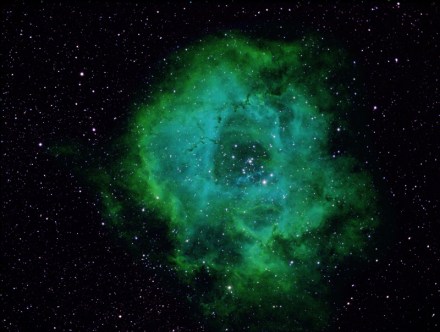
Credit: Herb Bubert
In honor of St. Patrick’s Day, the Rosette Nebula photographed using three different filters that combine to give a lovely green hue.
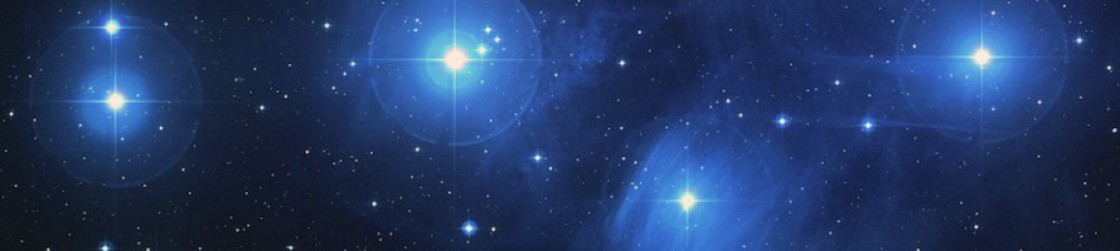
Credit: Herb Bubert
In honor of St. Patrick’s Day, the Rosette Nebula photographed using three different filters that combine to give a lovely green hue.

The case for dark energy is looking stronger, thanks to new results from the recently-installed Wide Field Camera 3 instrument aboard the Hubble Space Telescope. Dark energy has been hypothesized as the mysterious force causing the expansion of the universe to speed up, but competing models suggest other reasons for the accelerated expansion. A leading competitor is a bubble model that suggests our Milky Way galaxy sits at the center of a relatively sparse region of the universe, and the resulting weaker gravity is causing our local “bubble” to expand more rapidly than the universe as a whole. However, astrophysicists at the Space Telescope Science Institute claim that refined measurements made with the WFC3 have ruled out the bubble model, which predicts a different expansion rate than what is observed.
There are philosophical objections to the bubble model, as well. Ever since Copernicus put forth his Sun-centered model of the solar system, scientists have tended to reject the notion that we occupy any special place in the universe. A model that requires Earth-observers to be at the center of a cosmic bubble makes us a little too special for comfort for most scientists. This alone doesn’t disprove the model (we must never be locked into a conclusion by our philosophy), but it can certainly offer guidance. Adam Riess, head of the research team publishing the new results, comments,
“I know that a lot of people have not taken that theory very seriously because of a major problem with it,” he said. “We tend to believe theories where we don’t live in any special place in the universe. That would be very strange – why should we be in a special place?”
Now that scenario is even less likely to be true, Riess said.
“But on the other hand, dark energy’s pretty weird too,” he said.
Every revolutionary idea in science seems weird at first. If the dark energy model survives the rigors of scientific testing, people a hundred years from now probably won’t find it any weirder than we find the electromagnetic theory of light.
Sometimes words are inadequate, so no commentary for this. Turn up the sound, click on full-screen, and watch:
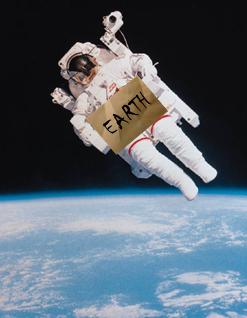
Now that the U.S. is retiring its shuttle fleet, Russia seems to be embracing the concept of supply and demand. Can’t really blame the Russians for taking advantage of the situation, but still … yikes:
The new deal will allow NASA to fly a dozen astronauts from the U.S. or its partner agencies on Russia’s venerable Soyuz spacecraft between 2014 and 2015 at a cost of about $62.7 million per seat. That’s an increase from the $55.8 million per seat NASA paid under a deal for six round trips to the station in 2013 and 2014.
At least we’re on friendly terms with them now. I remember what a big deal it was back in 1984 to portray American astronauts hitching a lift with the Soviets in the sequel to 2001: A Space Odyssey. But nobody ever thought they’d be fleecing us someday just for a ride to the International Space Station.
Happily, this is not a permanent arrangement. NASA’s priority for 2015 and beyond is to have private American companies develop spacecraft to deliver our astronauts into space, at which point it’s dasvidaniya to the Russians.

Tired of having to charge your cell phone battery every couple of days? Nanotechnology may be coming to the rescue with an improvement in cell phone technology that could reduce the drain on your battery by a factor of 100 — that means months of use without having to charge your battery. The new technology involves the use of carbon nanotubes to reduce the size of tiny wires that convey digital information in your phone, which in turn cuts the amount of electricity that’s needed to make your phone work. Even better: reduced power consumption could eventually lead to cell phones that are powered by heat or sunshine.
Check out this quickie vid if you’re wondering what in the world these carbon nanotube thingies are anyway. (Note how the nanotube professor describes what he does as “curiosity-driven science.” That’s an outstanding explanation.)
Physicist Michio Kaku, who has penned several popular books about science, has written a new book called Physics of the Future in which he describes the sorts of innovations we can expect in the 21st century. Among the technological breakthroughs-in-the-making:
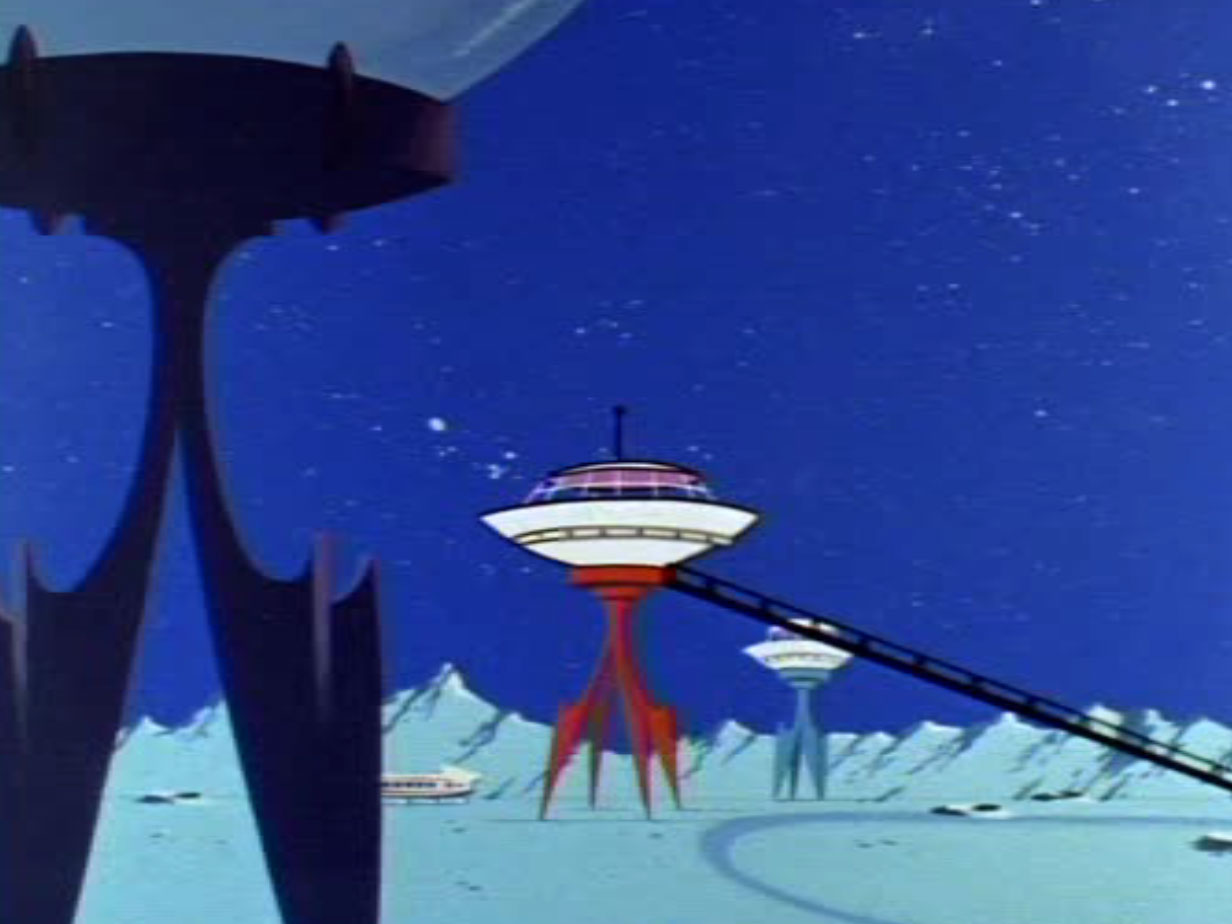
Any science fiction junkie will tell you that all of these ideas have been around for decades in television shows, movies, novels, and short stories. My two favorite TV shows when I was a kid were Star Trek and The Jetsons, and it occurred to me recently that an awful lot of what was imagined in those shows has become reality, or is about to according to Kaku.
I’m not sure which is more impressive — the prescience of the writers who seemingly foretold the future or the genius of the scientists and engineers who are making it all happen — but one thing seems certain: anything we can imagine we can eventually make reality.
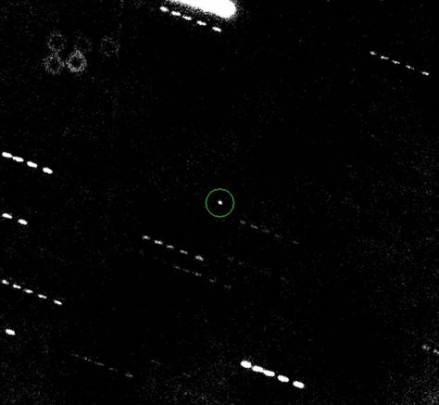
Asteroid Apophis is followed with a camera in a series of five photos as it moves against a background of stars. The rings in the upper left are from a dust grain on the telescope instrument. (Credit: D. Tholen, M. Micheli, G. Elliott, UH Institute for Astronomy)
Astronomers are keeping an eye on asteroid Apophis, which was recently caught in a series of photos made from a telescope on Hawaii’s Mauna Kea mountaintop observatory. In April of 2029 the orbit of the 900-ft space rock will bring it closer to Earth than some of our satellites, but a collision with either the Earth or the Moon has been ruled out. There is a very slight chance that the flyby in 2029 could put it on a collision course with Earth in 2036, but the odds of a collision are deemed quite small — about 1 in 250,000. Apophis will come close to Earth two more times in the 21st century, again with small probabilities of actually making an impact.
Nuclear power is used by many countries to produce electricity, including Japan where the 8.9-magnitude earthquake that shook the country on Friday has caused the Fukushima I facility’s backup safety systems for two of its eight reactors to fail. The No. 1 reactor suffered an explosion, likely fueled by hydrogen gas, that has apparently not affected the reactor containment structure. The USAF has supplied emergency coolant to the reactors, but the situation is critical enough that tens of thousands of residents within a 20 km radius of the plant have been evacuated.
Experts from around the world, including the deputy director of the Chernobyl nuclear safety center, have said this will not be a repeat of the Chernobyl disaster that occurred in Ukraine in 1986. Japan’s 54 nuclear reactors, and all Western civil nuclear facilities, are designed with better safety standards than the Chernobyl facility. Still, it seems the extent of the damage to the Fukushima facility is unclear, and residents are understandably nervous.
Please keep the Japanese people in your prayers.
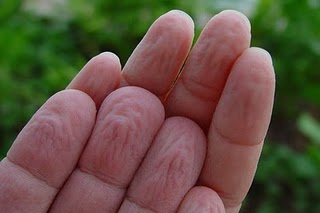
Have you ever thought about how incredible it is that our skin not only doesn’t dissolve after being submerged in water for a long time, but retains its strength? Mathematicians are thinking about it, and are hoping the study of pruny skin will shed light on new ways to provide structural stability. Myfanwy Evans, an Australian mathematician who specializes in topology — a branch of math that studies how geometric figures remain unchanged even after they have been bent and stretched — has used her experience with strange shapes called gyroids1 to come up with a “stringy skin model” that may explain how our skin works. This model could lead to the development of new materials that provide the same structural stability as human skin.

 SixDay Science