
Replay: Our analysis of “The Great Debate: Is There Evidence for God?”

Traffic’s up after the informal announcement of the publication of our Astronomy and Astrophysics curriculum, so in the coming weeks we’re going to replay some of our more important posts from the archives for our new readers.

On March 30, 2011, Christian theologian and philosopher William Lane Craig debated atheist physicist Lawrence Krauss at North Carolina State University. The topic was, “The Great Debate: Is There Evidence for God?” Video of the rather lengthy event is here. What follows is our analysis of the debate. 

** Written by Sarah and “Surak” **

The two opposing sides of the scientific debate over the God hypothesis were well represented on Wednesday by Dr. William Lane Craig (Christian Philosopher and Theologian from Talbot School of Theology) and Dr. Lawrence Krauss (Theoretical Physicist from Arizona State University). Dr. Craig’s argument was based on the clearly-stated and logical assertion that if God’s existence is more probable given certain information, that information meets the essential criterion for evidence. Dr. Krauss was equally clear in his definition of evidence: it must be falsifiable to be scientific. We find both standards to be very useful.

There was some confusion on the part of the moderator as to whether the topic of the debate was the existence of any evidence for God or the existence of enough evidence to prove God’s existence. We think the moderator erred in his statement of the debate’s purpose, since no one could reasonably argue that there is proof or disproof of God’s existence. As Dr. Krauss correctly stated, science cannot falsify God; so, the question can only be, “Is God likely?”

We will assess the debate in terms of whether or not there is any evidence for the existence of God, although Dr. Krauss tried to set the bar unfairly high with his assertion that a highly extraordinary proposition, such as the God hypothesis, requires extraordinary evidence. However, we think defenders of the God hypothesis can accept and meet this challenge.

Dr. Krauss acknowledges that the big bang is fact and one of science’s great achievements. The big bang theory establishes that the universe had a beginning, and that the universe was created from nothing. There was some debate and confusion about the meaning of “nothing.” It can mean the absence of matter, such as in “empty” space, or it can mean no space, no matter, and no time. The big bang involves the second notion of nothing, which is about as much of a nothing as most human minds can conceive of.

The appearance of our universe from this nothing makes it an undeniable instance of creation – something coming from nothing – as opposed to an example of making, which is something being fashioned from something that’s already there. Science is based on the premise that everything has a cause, especially if it has a beginning. Since the universe had a beginning, it must have a cause, and a reasonable extension of the big bang theory is that the cause must be something greater than and outside of the universe.

The cause of our universe must therefore be a transcendent or super-natural cause. This ultimate cause must include not only the difficult idea that some entity “exists” outside our universe, but also the humanly inconceivable idea that it has as part of its nature the capacity to exist and make other things come into existence. In other words, there must be something that is its own cause and the essence of existence. We humans can never understand such an entity, but it’s the only way to avoid a common patch of logical quicksand that threatens to swallow anyone who attempts to discuss the origins of our universe.

This danger to fruitful discussion is best illustrated by a story that appeared in Stephen Hawking’s A Brief History of Time. One of the greats of science, probably Bertrand Russell, had given a lecture on astronomy. He described how the Earth orbits around the Sun and how our solar system is part of a much larger galaxy. After the lecture, he was approached by a little old lady who informed him that the Earth is really sitting on the back of a giant tortoise. Russell replied, “What is the tortoise standing on?” “You’re very clever, young man, very clever,” said the old lady. “But everyone knows it’s turtles all the way down!” We must accept that at the bottom of any conceivable pile of cosmic turtles, there must ultimately be one that has as part of its nature the power of existence.
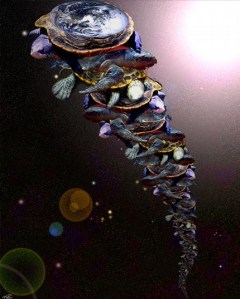
There is perhaps only one relevant or useful question humans can pose about this scientifically unknowable causal agent of the universe, “Is it conscious or unconscious?” If the transcendent cause of the universe is conscious, God is the most useful name we can give it. If the cause of the universe is unconscious, then it is some kind of super-nature. The best known and most likely candidate for the super-natural is the ‘eternal multiverse.’

This brings us to what we thought was the best question from the audience: What testable prediction does the God hypothesis make? Let’s examine this question in light of two things that Dr. Krauss said:

  1. Truly scientific evidence must be falsifiable.
  2. The big bang is established fact.

The Judeo-Christian God hypothesis includes a prediction made over 3,000 years ago in Genesis 1 that the universe had a beginning. This prediction ran counter to the theory of an eternal universe that dominated philosophical and scientific thinking until the 1960s. The great physicist and Jesuit priest, Georges Lemaître, developed the big bang theory in part because of his belief in the Genesis account of Creation. This Genesis prediction was testable and turned out to be true.  So, at least one major testable prediction of the God hypothesis meets the standard for scientific evidence.
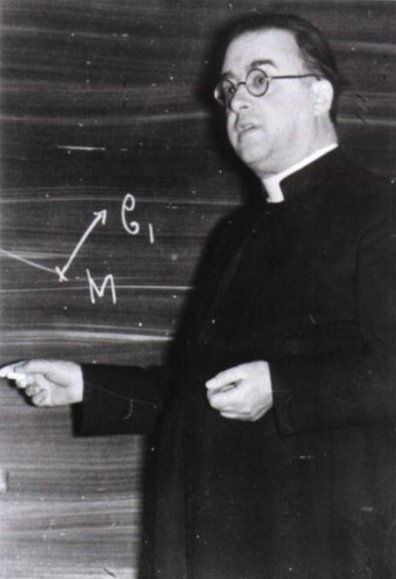
The Father of the Big Bang, Georges Lemaître

It is not proof of God, but it is undeniable evidence for God that meets even the “extraordinary” benchmark set by Dr. Krauss. The prediction that the universe had a beginning is more than ordinary evidence because it is so ancient. It turns Dr. Krauss’s somewhat derisive comment about Bronze Age peasants back on his own argument: how indeed could such scientifically ignorant people have boldly stated what would three millennia later become astonishing fact?

Apply the same test to the best super-nature alternative: what testable prediction(s) does the multiverse hypothesis make? We are still learning about the different multiverse hypotheses, but there are at least two predictions that we’re aware of. The first involves an explanation for the weakness of gravity, which is by far the weakest of the four fundamental forces of nature. Some physicists predict that gravity is weak, because gravitons – the particles responsible for conveying the force of gravity – escape our universe into parallel universes.

The second prediction is the existence of “ghost particles” from parallel universes. Some physicists believe these particles must exist in order explain one of the great mysteries of quantum physics, the interference pattern observed when electrons pass through a double-slit. Interference is behavior we expect from waves, not particles; moreover, the pattern is observed even if electrons are fired at the double-slit one at a time, ruling out any possibility that two electrons, each going through a different slit, are interfering with each other. The interference pattern must arise, the prediction goes, from the electrons in our universe interfering with ghost electrons in a parallel universe.
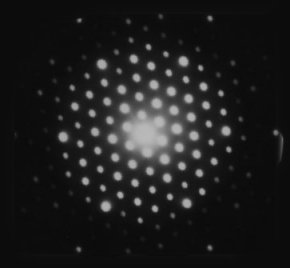
Electron interference pattern

There are two insurmountable problems with these predictions. Not only do they contradict Dr. Krauss’ assertion that parallel universes are causally disconnected from each other, but neither of these predictions is testable. The evidence for the multiverse does not rise to the level of the scientific — not because we currently lack the knowledge or technology to perform the experiments, but because they are not falsifiable in principle. Science is limited to the study of this universe. The multiverse idea as it is currently framed is not scientific, it is metaphysical.

It seems that at this time the God hypothesis is superior in evidence to the best “natural” alternative.

The evidence in favor of the God hypothesis is even stronger than what Dr. Craig presented. We at SixDay Science propose that the Genesis 1 account of Creation makes at least 26 scientifically testable statements. All 26 are compatible with modern science and they are in the correct order. A discussion of this is available here. We believe this evidence is so extraordinary that it comes close to being something akin to J. B. S. Haldane’s “Precambrian rabbit” in the sense that a creation story which succeeded in anticipating so much of modern science by 3,000 years is just as out of place in time as a fossilized rabbit in 600 million year old rock.

Genesis time and the changing length of a day

Scientists have discovered an exoplanet that spins so fast its day is just eight hours long. Beta Pictoris b, which is 65 light-years from Earth, rotates on its axis at a whopping 62,000 miles per hour, about 50 times faster than Earth’s rotation rate (since the exoplanet is much bigger than the Earth, its day is a third as long). Scientists made this calculation using the same method meteorologists use to track earthly weather systems — the Doppler effect.

What is not generally known is that the Earth once had a much shorter day than it does now, due to its changing gravitational interaction with the Moon (and the Sun). Because of tidal friction — the loss of energy due to the gravitational tugging on Earth’s oceans — the Moon is gaining orbital energy at the cost of Earth’s rotational energy. As a result, the length of an Earth day increases. With the extra bit of orbital energy, the Moon’s orbit is increasing by about 4 cm each year and the length of a day increases by a couple of milliseconds per century. It doesn’t sound like much, but over millions and billions of years, it adds up. Computer simulations suggest that billions of years in the past, the Moon was so close to the Earth that an Earth day was a mere six hours long.

Intriguingly, an Earth-day that changes in duration is consistent with Gerald Schroeder’s reconciliation of a literal interpretation of Genesis 1 and an old Earth. Schroeder argues that the length of each Genesis day is 24 actual hours, but only measured from God’s perspective. From our earthly perspective, each of those days is a different length, ranging from billions to millions of years. It isn’t until humans appear on Day 6 that Genesis time comes to agree with Earth time. It would seem God chose a perspective for Genesis that was 24 hours, because that’s how long an Earth day would be once Adam appeared. For a detailed explanation of this reconciliation, see here.

Why are Americans skeptical of some scientific ideas?

A recent poll indicates that Americans are skeptical of evolution by natural selection, global warming, and the big bang theory. Surprisingly (for me, anyway), the biggest scientific loser is the big bang, with 51% of the respondents skeptical that the universe was created approximately 14 billion years ago.

Frankly, this astonishes me. There are sound reasons to be skeptical of the theory of evolution by natural selection (TENS) and anthropogenic (man-made) global warming, but the evidence and arguments for the big bang theory are excellent — and also consistent with the Bible, which is no small thing, since the poll indicated that religiosity is correlated with disbelief in the big bang.

So, why are most Americans skeptical of the big bang?

This is not a rhetorical question; it’s something I’m striving to understand. Some Christians make the argument that a literal interpretation of the Bible requires a young Earth and young universe, but it appears to me that this belief is inspired, or supported, by an argument against evolution. Many people who are skeptical of TENS (particularly evangelical Christians) believe that it requires billions of years to work, therefore if the universe and the Earth are only thousands of years old, TENS doesn’t work. Never mind that billions of years can’t even begin to help TENS, that doesn’t explain why more people are skeptical of the big bang than evolution.

In any case, scientists are, understandably, distressed by these results. Randy Schekman, a Nobel laureate in medicine at UC-Irvine, said, “Science ignorance is pervasive in our society, and these attitudes are reinforced when some of our leaders are openly antagonistic to established facts.”

Schekman is both right and wrong. If quizzed on why he or she disbelieves in certain scientific ideas, I’m confident the average individual would not be able to explain the best evidence and arguments for and against the ideas. However, I don’t believe it has anything to do with leaders (presumably, he means religious and political leaders) being antagonistic to facts, but rather a vocal minority of scientists and their advocates being openly antagonistic to religious belief.

The poll highlights “the iron triangle of science, religion and politics,” said Anthony Leiserowitz, director of the Yale Project on Climate Change Communication.

And scientists know they’ve got the shakiest leg in the triangle.

To the public “most often values and beliefs trump science” when they conflict, said Alan Leshner, chief executive of the world’s largest scientific society, the American Association for the Advancement of Science. [emphasis added]

Of course values and beliefs trump science in a conflict. Unlike science, values and beliefs comprise an entire worldview, one that has been around much longer than modern science and has been much more influential.

But there was a time, at the beginning of the era of modern science up until the mid-20th century, when the Christian worldview and science largely went hand-in-hand. In the 17th century, many if not most natural philosophers (what scientists were called at the time) were Christians, and they saw their work as glorifying God. Mitch Stokes, in his brief biography of Newton, writes:

According to metaphor, God has written two books—Scripture and Nature—and He is glorified by the study of either one. This view, this “belief in the sacral nature of science,” was prevalent among natural philosophers of the seventeenth century. As Frank Manuel, one of Newton’s most important twentieth-century biographers, says:

“The traditional use of science as a form of praise to the Father assumed new dimensions under the tutelage of Robert Boyle and his fellow-members of the Royal Society, and among the immediate disciples of Isaac Newton. … In the Christian Virtuoso, demonstrating that experimental philosophy [experimental science] assisted a man to be a good Christian, Boyle assured readers that God required not a slight survey, but a diligent and skilful scrutiny of His works.”

Although Newton’s intensity while pursuing his work ranges from humorous to alarming, it is put into a different light if we see it as a measure of his devotion to God. For Newton, “To be constantly engaged in studying and probing into God’s actions was true worship.” This idea defined the seventeenth-century scientist, and in many cases, the scientists doubled as theologians. [emphasis added]

There was only occasional conflict for scientists like Newton in the form of struggling to understand how certain aspects of nature are consistent with their interpretation of scripture.

The antagonistic sort of conflict we see today goes back at least as far as Thomas Huxley using Darwinian evolution to undermine Christian belief. Huxley knew TENS had insurmountable problems, but he saw it as a useful weapon to attack Christianity, which he despised.

Unfortunately, this sort of practice has become increasingly commonplace into the 20th and 21st centuries. Global warming isn’t by its nature useful as a direct attack on Christian belief, but it does represent an attack on the Christian ideal of limited government. The historical misuse of biology as a weapon against Christian belief began with Huxley and continues with modern biologists and their supporters — so much so that the public has little idea how much the most recent findings of evolutionary biology support the Christian view of creation. The misuse of physics to undermine Christian belief, however, is relatively new. I find it distressing not only because it is my field of study, but because the field of physics has historically led the way for the other sciences and represents the greatest scientific support for the Christian view of creation.

As a scientist — and irrespective of my Christian beliefs — I find the behavior of the attackers perplexing. The majority of Americans are either Christian or hold some general belief in a supreme being, so why do some scientists go out of their way to alienate a majority of people who support science by sending their children to universities and by paying taxes for government-supported science programs? At some point, they’re just not going to see the value of either. And they’re certainly not going to make the effort to become more literate in a topic that they’re told is in opposition to their faith. Modern scientists like Stephen Hawking who use their considerable scientific knowledge to attack religious belief are therefore doing a tremendous disservice to science. I don’t know what Hawking’s motivation is, but if he dislikes Christianity to the extent that he’s trying to undermine it, as Huxley did, then he is only indirectly realizing this goal and at the cost of eroding confidence in good science.

Poll results notwithstanding, big bang theory is good science — in fact, it is arguably the crowning achievement of modern science — and it is not only compatible with Christian belief, but in my opinion mandated by it. (I will expand on this in a future post.)

Meanwhile, there’s no use blaming political and religious “leaders” for the lack of confidence in science, because, if history has taught us anything, it’s that they don’t tend to lead the way, but jump out in front of the direction in which people are already going. If good science is going to flourish in America, two things must happen. Christians must become scientifically literate — which is something I hope to encourage with my ministry — but scientists have got to stop the public antagonism toward Christian belief.

Crash some planets (or not)

Thanks to Facebook, this game is becoming popular with my colleagues:

Super Planet Crash

The goal is to see if you can create a stable planetary system that includes, not just a few piddly Earth-mass planets, but giant ice planets and stellar companions, as well. Stable, in this case, means the system lasts at least 500 years without any planets crashing. It helps if you know a bit about Newtonian mechanics, but even if you know nothing about physics, you can gain some intuition just by playing the game. (Read more about the game here.)

So, how many planets can you cram into two Earth orbits?

Stephen Hawking is still wrong

Stephen Hawking is at it again:

The Big Bang and the subsequent expansion of the Universe did not need God to set it off, theoretical physicist Stephen Hawking suggested to an audience in California this week.

A combination of quantum theory and the theory of relativity [would better] explain our existence than divine intervention, he told a packed auditorium at the California Institute of Technology.

Hawking is doing a tremendous disservice to science. In his later years he is transforming himself from respected physicist and successful author of popular science books to a pathetic amateur philosopher with a grudge against the notion of God. Here are the major problems with what he said in California:

1. The combination of quantum theory and the theory of relativity would explain a great deal. That’s why so many great scientists have tried to unify the two theories for almost a century. The problem is that no one has yet figured out how to combine them. So, Hawking is writing God off on the basis of a scientific achievement that hasn’t occurred and shows no sign that it is even achievable.

2. Even if physicists manage to combine them or figure out some other way to the long sought after theory of everything, it would not provide the ultimate answer to the question of how the universe came to be. At best,  we might be able to push back the question of the universe’s origin one step. But, then what? Hawking’s speculation implies the laws of nature pre-date the universe, which raises the question, where did the laws of nature come from? Are they eternal? How would we know? Remember that science is limited to studying our material universe.

3. Far from ruling out God as the creator of the universe, the idea of pre-existing laws of nature is supportive of biblical truth. As Gerald Schroeder points out in his book, God According to God, the Bible tells us that wisdom (the collective laws of the universe) predates the creation of the universe:

John 1:1: “In the beginning was the logos [logic, intellect, word].”

Psalm 33:6: “With the word of God the heavens were made.”

Proverbs 8:12, 22-24: “I am wisdom. … God acquired me [wisdom] as the beginning of His way, the first of His works of old. I [wisdom] was established from everlasting, from the beginning, from before there ever was an earth. When there were no depths I [wisdom] was brought forth.”

Putting these passages together with a translation of the opening words of the Bible more faithful to the ancient Hebrew of Genesis 1:1 (“With a first cause, God created the heavens and the earth.”), the Bible tells us that with the first cause of wisdom (the laws of nature), God created the universe. We already know the laws of nature predate the universe, and with the help of the Bible we know Who acquired those laws.

I have respect for Hawking as a scientist and great admiration for him as an individual who has prevailed over a devastating disease. But, he is tarnishing his reputation and diminishing the public’s respect for science when he abuses the authority that comes with being a physicist by making these silly and unscientific pronouncements about God’s redundancy.

Related post:

Christianity and the center of the universe

Not long ago, someone asked me if I’d seen the documentary, The God Who Wasn’t There (2005), which explores the “Jesus myth” and Christianity in general. It’s been out for several years, and despite the fact that it’s viewable for free on YouTube, I haven’t bothered to watch it, because it looks like an uninspired retread of common challenges to the Christian faith that tend to be very weak. However, from what I can tell, it does perpetuate one historical distortion that is worth refuting. From a partial transcript on IMDb, TGWWT puts forth the idea that it was primarily Christians who were wrong about the Earth-centered universe:

Narrator: The Earth revolves around the Sun. But it wasn’t always that way. The Sun used to revolve around the Earth. It was like that for hundreds of years, until it was discovered to be otherwise, and even for a few hundred years after that. But, ultimately, after much kicking and screaming, the Earth did, in fact, begin to revolve around the Sun. Christianity was wrong about the solar system. What if it’s wrong about something else, too? This movie’s about what happened when I went looking for Jesus.

Or, more likely, what happened when he went looking for anything but Jesus, but never mind. The problem with this statement is that it implies only Christians were wrong about the solar system, when the truth is that just about everyone was wrong about the solar system at one time or another. So why single out Christians? Without having seen the movie, I am fairly confident of the answer (hint: look at who appears in the movie). Unfortunately, the notion that the medieval Church was scientifically ignorant and held back scientific progress is a fairly easy misconception to perpetuate, because people who believe it are usually already eager to believe misconceptions about Christianity and/or they do not know enough to evaluate its validity.

I made a point to cover geocentric theory in my astronomy 101 courses, so let’s explore what my college freshmen students knew about this subject that TGWWT‘s writer/director Brian Flemming apparently did not (or did not want you to know about).

The geocentric model of the solar system, which places the Earth at the center of the universe, is an idea that is found in nearly every ancient culture. In Western Civilization, the idea is usually attributed to the ancient Greek philosopher Aristotle (384 BC – 322 BC), and was later systematized by the Alexandrian astronomer Claudius Ptolemaeus (aka Ptolemy, ~64 AD – 165 AD). The geocentric model persisted for more than 1,700 years, and while medieval interpretation of biblical scripture seemed to loosely support the idea, its formulation had nothing to do with Christianity.

To understand why the geocentric model persisted for so long, I want you to place yourself, just for a moment, in the ancient world where there is no such thing as telescopes, astronauts, or satellites. Your only notion of the Earth’s place in the universe is based on what your human senses tell you about the apparent motions of the heavens. You notice that the Sun and Moon make daily journeys across the sky from east to west, and that the stars at night travel in the same daily east-west direction. The familiar constellations also seem to drift across the sky over the course of weeks and months. To your human senses, it appears that the Earth is stationary and that objects in the heavens move about it in very predictable cycles. Armed only with these observations, it is entirely reasonable to assume that the Earth is at the center of the universe.

We owe a tremendous debt of gratitude to the Greeks, who were the first to seek natural explanations for the phenomena they observed. This reliance on natural explanations heralded the birth of science. But what is science? It is actually a difficult concept to define. Most of us understand science to be the search for knowledge, but knowledge can be acquired by other means. The scientific method works by making observations and asking questions in a very systematic way. One observes a phenomenon in nature (say, the motions of the heavens) and posits an educated guess about the nature of the phenomenon (everything in the heavens orbits the Earth, which is stationary). This educated guess is referred to as an hypothesis. The hypothesis then makes a prediction (where objects in the sky will appear on a certain date), and one carries out tests or observations to determine how well the hypothesis performs. If the hypothesis fails the test or cannot account for new observations, then it must be revised or abandoned in favor of a new hypothesis.

One such test of the geocentric model came in the form of retrograde motions of the planets. The Greeks observed that a handful of objects in the heavens moved in a way that was different from the other objects. For one thing, their positions were not fixed like the stars, but appeared to wander over a period of months. (The word “planet” comes from the Greek word for wanderer.) This retrograde motion, or apparent looping back of the planet’s path in the sky, is now understood in the context of the Sun-centered (heliocentric) model, but in ancient times it represented a significant challenge to the geocentric model. This challenge was resolved by placing each of the planets in a smaller orbit, called an epicycle, upon its larger orbit about the Earth. This was a key feature of the model put forth by Ptolemy, which is referred to as the Ptolemaic model.

The Ptolemaic model persisted for almost two millenia, because, clunky as it was, it made accurate predictions about the motions of the planets. Moreover, several key objections to the heliocentric model were unresolved. Centuries before Ptolemy, the Greek astronomer Aristarchus (310 BC – ~230 BC) proposed a Sun-centered solar system, but was ridiculed by his peers for it. First, the idea that the Earth was moving was counterintuitive, because of the apparent motions of the heavens. But the most significant objection was that stellar parallax was not observed. This is the apparent shifting of position of closer stars relative to more distant background stars, which must occur if the Earth is moving around the Sun. As this was not observed, it was reasonable for Aristarchus’ fellow Greeks to reject his idea.

Fast-forward almost two millennia to Nicolaus Copernicus (1473 – 1543 AD), who was a true Renaissance man. In addition to being an astronomer, he was also a physician, scholar, cleric, and military leader. Like Aristarchus before him, Copernicus went against popular sentiment and proposed a heliocentric system. There is evidence that Copernicus knew he was recycling Aristarchus’ ancient model, but his genius was in recognizing its potential as a much more elegant and compelling model than the geocentric model. It is true that Copernicus’ book stirred some controversy within the Church, but contrary to popular belief, the Church was not monolithically opposed to, but rather divided on, the subject of heliocentrism. Secular scientists at the time likewise held to the Aristotelian school of thought, and mostly rejected Copernicus’ ideas. There was good reason for this, as the major objections to the heliocentric model had not yet been overcome. In particular, since Copernicus used circular orbits for the planets, instead of what we now know to be elliptical orbits, the predictions of the Copernican model were less accurate than those of the Ptolemaic model. Heliocentrists also had to contend with the lack of observed stellar parallax, and there were still more objections based on Aristotelian notions about nature. For instance, long before Newton developed his laws of motion, Aristotle held that all objects naturally come to rest, which meant that if the Earth was moving it would leave airborne objects (birds, clouds, etc.) behind. It was not until Galileo anticipated Newton’s first law (objects in motion tend to stay in motion) with simple experiments and made some key observations with his telescope—among them, that the stars are too far away to observe parallax1—that these objections were overcome and the Copernican Revolution was solidified.

It is important to understand that there was as much objection to the Copernican model from secular scientists as from the Church. Perhaps more. (For instance, it was supposedly a secular rival who reported Galileo to the Inquisition, illustrating that scientific enterprise has always been a little cut-throat.) The objections of the Church were only partially founded on Christian doctrine, which was based at that time on interpretation of scripture that was consistent with the Aristotelian school of thought. There is, in fact, nothing in scripture that dictates an Earth-centered system. The politics of the time also complicated things, with the Catholic Church struggling to come to grips with the tremendous effects of the Reformation. The most influential figure of the Reformation, Martin Luther, strongly objected to the ideas of the “upstart astrologer” Copernicus, and the Catholic Church was anxious to stay abreast with Protestantism on such an important issue. It is also important to understand that Copernicus was eventually shown to be incorrect in his placement of the Sun at the center of the universe; we now understand that there is no ‘center’ to the universe, an idea that is difficult to accept for many people.

What can we conclude from all of this? We can conclude that the most important factor preventing wide-spread acceptance of the heliocentric model was simple human nature. As clever as we sometimes are, we are constrained by limited perspective and emotion. Limited perspective prevented scientists from perceiving the stellar parallax that was predicted by the heliocentric model. Human emotion means cherished ideas often have a powerful hold on people, especially when it comes to accepted ideas that have served mankind well for many centuries. Put these two constraints together and you have the very non-linear progression from old ideas to new ideas that is evident throughout human history.

Having not seen TGWWT, I can only surmise from the partial transcript that either Flemming knows very little about scientific history, classical thought, and theology, or he is being deliberately disingenuous to make Christians look bad. Which is unfortunate, because, with just a few changes to the quote from the transcript, I think we could have turned his movie into a much more interesting narrative on the fallibility of human reason:

Narrator: The Earth revolves around the Sun. But it wasn’t always that way. The Sun used to revolve around the Earth. It was like that for hundreds of years, until it was discovered to be otherwise, and even for a few hundred years after that. But, ultimately, after much kicking and screaming, the Earth did, in fact, begin to revolve around the Sun. Mankind was wrong about the solar system, but eventually figured it out. What is it today that we don’t yet understand that will be obvious to mankind hundreds of years from now? Let’s speculate…

[1] With the advent of larger and more sophisticated telescopes, stellar parallax was indeed observed.

Recommended reading:

  • What’s So Great About Christianity by Dinesh D’Souza

Particle physics for the non-physicist

If you want to know what’s going on in particle physics / cosmology, check out Professor Matt Strassler’s blog, Of Particular Significance. Strassler is a theoretical particle physicist at Rutgers University, and seems enthusiastic about explaining his field of expertise to the public in a way that even those with no physics background can understand. He recommends that laypeople start here. In addition to getting the basics of particle physics and the real scoop on topics like the search for the Higgs boson, readers will get a sense for how the media (and a few complicit scientists) sometimes present a distorted view of what’s going on in science. If you see something about physics in the news—for example, the latest results from the Planck mission—be sure to check out what Professor Strassler might have to say about it.

Questions from Christian Students, Part 11

Sarah was recently invited, along with two other scientists, to take part in a panel discussion for a group of mostly Christian students. After the main discussion, students were invited to submit questions via text message; there was very little time to address them, so only a few were answered. The questions were quite good, so over the next few weeks, Surak and Sarah will answer most of them here. All of the questions are listed in the Intro to this series. See also: Part 1Part 2Part 3Part 4Part 5Part 6Part 7Part 8Part 9; Part 10

How does evolution relate to the belief of a creator? And please address the time frame. / Please address the timing of evolution and the Bible. / How do you reconcile biologists teaching evolution and coming from apes with the creation story in Genesis?

There is no conflict between Christianity and science inherent in scripture or the theory of evolution. There are at least 26 scientifically testable statements in Genesis 1 about the origins of the universe as well as the origins and diversity of life. All 26 statements are consistent with modern science without any dodgy interpretations of the Bible or contortions of the science to fit religious beliefs. And, all 26 statements are in the correct order according to modern science. See here for a detailed scientific explanation of this.

At the time of Darwin, there was a serious conflict between the Christian belief in a created universe and the scientific consensus of the time that the universe was eternal. That conflict was resolved in favor of the Christian view when big bang theory prevailed in the 1960s, because the basic premise of this theory (very simply stated) is that our universe had a beginning and came into being out of ‘nothing.’ Taking this one logical step further, the fundamental scientific concept of cause and effect requires something outside of and greater than (super-) our material world (-natural) capable of causing the universe to come into existence. In other words, based on the best evidence available, the supernatural must be part of the scientific discussion. Evolution cannot be isolated from consideration of the supernatural since everything biological is made of the stuff that makes up the universe.

In regard to evolution specifically, the Genesis account of creation lists several stages in the development of life on earth: vegetation, animal life in the oceans, flying creatures (winged insects), great sea creatures, life forms that crawl on land, every species of winged creature, land animals which became livestock (mammals), and finally man. There can be no doubt that this indicates a scriptural acceptance and understanding of a progression in the development of life. It is also important that this order of events conforms to the fossil evidence. So, there is no conflict about the fossil evidence between Judeo-Christian scripture and the theory of evolution.

There is a seemingly insurmountable disagreement between scripture and science in terms of the time it took for life to be created. The Bible says that all of creation took just six days. Science provides abundant and convincing evidence that this is absurd. As a result, the notion that the amazing diversity of life was accomplished in a few days is widely ridiculed in scientific circles as a silly and hopelessly unscientific myth of an ignorant ancient people. But, scientists, having lost one great argument with scripture, should have been somewhat humbled and exercised more care in their criticism of the Bible.

A continued lack of humility did in fact set Darwinists up for another scientific fall. There was something else the great minds of the mid-19th century were not aware of besides the big bang—relativity. In all the years since Einstein proposed his theories of relativity, only one man had the insight and ability to use Einstein’s first great achievement to gain a deeper understanding of scripture. Physicist and theologian, Gerald Schroeder, found, through a skillful and honest reading of Genesis coupled with a scientist’s understanding of Einstein’s relativity, that the six-day account of creation does not deserve the ridicule it has received for so many generations.

The first clue to this has always been available to anyone with an open mind. According to Genesis 1:2, for the first two days of Genesis “The earth was without form.” The Earth was not formed until the third day. Since there was no Earth for the first two days of the Genesis account, one has to wonder how time was being reckoned. The author of Genesis must have been marking time according to some other means than the time it takes the Earth to spin on its axis.

It is totally understandable why non-scientists failed to pick up on this clue. Einstein told humankind something hugely counterintuitive—that time passes at a comparatively different rate for every location in the universe. The commonly accepted age of the universe—10 to 20 billion years–is very likely true, but only from the perspective of Earth-bound beings looking back in time. The age of the universe and the passage of time from any other perspective would be very different—seemingly strange, but scientifically indisputable. The same is true of all evolutionary estimates of biological events; scientific observations that life emerged 3.8 billion years ago or that the dinosaurs were destroyed 65 million years ago are only valid from that same extremely limited perspective.

A combination of Einstein’s relativity, Edwin Hubble’s discovery that the universe is expanding, and the big bang theory provides scientists a different way of measuring time—a universal clock based on the frequency of the cosmic background radiation left over from the big bang. This is the only all-inclusive perspective available to us. When this ‘universal clock’ is applied to events since the big bang, something truly amazing is revealed—the six days of Genesis are literally true and completely compatible with modern science. See here for a rudimentary explanation of the science of the universal clock and its application to the six days of creation.

There are a number of clues which substantiate this claim. The earthly measure of time is not used in the Bible until after man is created. During the six days of creation, time is not tied directly to the events described. As Gerald Schroeder explains, events are listed and then the reader is informed that another day has passed. After the creation of Adam, time is directly linked for the first time to events on Earth. Another important clue is found in Psalms 90:4, “A thousand years in Your eyes are as a day that passes …” This is clearly an expression of the relativity of time by an ancient writer who had only scripture and revelation to go by.

The Bible’s use of universal time 3,000 years before humans discovered the relativity of time is far beyond remarkable. It is a scientifically inexplicable mystery equal to that of someone actually finding a genuine fossil of J. B. S. Haldane’s famous ‘Precambrian rabbit.’ Haldane used this amusing idea to make the point that one way to empirically falsify evolution theory would be to find a fossil so out of place (hence the rabbit in the Precambrian age) there could be no explanation for it within the bounds of Darwinism. This test can be applied to the Genesis account of creation; the ancient biblical use of universal time is so far out of place there is no scientific explanation for it. It could not have been a lucky or informed guess; it can only be the result of revelation.

Darwin himself said that a person could be a Christian and an evolutionist. Not only is there nothing in scripture or science that prevents a person from believing that evolution was the means by which God created the great diversity of life on Earth, there is evidence for it. Sean B. Carroll is a biologist and modern Darwinist at the forefront of a wonderful new field of study known as evolutionary developmental biology (or ‘evo-devo’ for short). In his fascinating book, Endless Forms Most Beautiful: The New Science of Evo Devo and the Making of the Animal Kingdom, Professor Carroll is compelled to use a word that seems completely at odds with the basic concept of evolution, and he uses it over a dozen times in the book.

The incongruous word he employs over and over again is ‘logic.’ You can find it on pages 8, 12, 26, 35, 54, 55, 56, 60, 60, 61, 106, 195, and 271. The word seems so inappropriate, because it is being used to describe something he and all other Darwinists believe is the result of a mindless, random process, even though logic is the product of a rational mind. Nevertheless, Professor Carroll can’t help using this ill-fitted word, because everything he observes in the operation of animal DNA is so elegantly intricate, efficient, and consistent—something like an unimaginably good computer program.

It is unfortunate that his mind and those of most of his fellow biologists are evidently so closed by the current scientific prejudice against the notion of God that it doesn’t occur to any of them what he is really saying in his hugely informative and enjoyable book: There is significant evidence of a great rational mind at work in the structure and workings of genes.

The universe is a little older than previously thought

Scientists using data from the ESA Planck mission have measured the age of the universe to be a little older — about 100 million years older — than previously thought. The official age, based on measurements of the cosmic microwave background, is now 13.8 billion years. Also, the proportions of matter and dark energy have changed a little, with slightly more matter (‘normal’ matter + dark matter) and slightly less dark energy than previously measured.

Related posts: