Christians must reclaim science

Modern science exists because of the Christian faith. That is a provable fact. So, why is there so much conflict over the supposed conflict between science and Christianity? In terms of explaining the atheist myth-making about the supposed conflict — having once been an arrogant atheist, myself — I can tell you that it’s born of either total ignorance (as was the case with me) or the kind of hostility that makes a person blind to the truth or willing to distort it. In terms of Young-Earth Creationism, however, I’m still trying to figure that one out. Modern science is one of the many blessings of the Christian faith, and I can only surmise that YECs have allowed the atheists to frame the argument and have accepted a gross distortion — and outright omission — of historical facts.

The Stand to Reason Blog explains that, in contrast to atheist fables, science and Christianity go way back:

The myth begins with the notion of the “dark ages,” a time when the church suppressed education. It’s just not true. Scholarship was alive and well prior to Copernicus. In fact, scholars were working on heliocentric theories before Copernicus. He learned these in university and built on them when he published in final work. His theory didn’t emerge from a dark vacuum, but from rich science that had been nurtured in the universities, many of them established by the church.

In fact, as the article goes on to point out, sociologist of religion, Rodney Stark, found that 50 out of 52 of the key figures of the scientific revolution were religious.

Hugh Ross goes even further and explains how the scientific method comes straight from the Bible:

The Bible not only commands us to put everything to the test, it shows us how. Christian scholars throughout church history, from early church fathers to present-day evangelical scientists, philosophers, and theologians, have noted a pattern in biblical narratives and descriptions of sequential physical events such as the Genesis creation account. Bible authors typically preface such depictions by stating the narrative or description’s frame of reference or point of view. In the same statement or immediately thereafter comes a listing of the initial conditions for the narrative or description. The narrative or the description itself follows. Finally, the author describes final conditions and conclusions about what transpired.

Furthermore, there is not just one narrative or description of physical events in the Bible. There are dozens. Because the Bible is inspired by God––for whom it is impossible to lie or deceive––these dozens must be consistent with one another. Therefore, each of these dozens of descriptive accounts can be used to test the validity of the interpretation of the others.

In the near future, I’ll be posting an article about the concept of linear time that’s necessary for the emergence of modern science, and how it comes from Christianity.

It’s simple: the pillars upon which modern science stand — the notion of scholarship as a form of true worship, the scientific method, and the concept of linear time / cause-and-effect — were all built by the Christian faith. As the influence of the Christian worldview wanes in the West, replaced by a worldview that actively hammers away at the pillars of science, so will the quality of science diminish. This is why Christians must reclaim science instead of turning away from it.

Replay: Our analysis of “The Great Debate: Is There Evidence for God?”

Traffic’s up after the informal announcement of the publication of our Astronomy and Astrophysics curriculum, so in the coming weeks we’re going to replay some of our more important posts from the archives for our new readers.

On March 30, 2011, Christian theologian and philosopher William Lane Craig debated atheist physicist Lawrence Krauss at North Carolina State University. The topic was, “The Great Debate: Is There Evidence for God?” Video of the rather lengthy event is here. What follows is our analysis of the debate. 

** Written by Sarah and “Surak” **

The two opposing sides of the scientific debate over the God hypothesis were well represented on Wednesday by Dr. William Lane Craig (Christian Philosopher and Theologian from Talbot School of Theology) and Dr. Lawrence Krauss (Theoretical Physicist from Arizona State University). Dr. Craig’s argument was based on the clearly-stated and logical assertion that if God’s existence is more probable given certain information, that information meets the essential criterion for evidence. Dr. Krauss was equally clear in his definition of evidence: it must be falsifiable to be scientific. We find both standards to be very useful.

There was some confusion on the part of the moderator as to whether the topic of the debate was the existence of any evidence for God or the existence of enough evidence to prove God’s existence. We think the moderator erred in his statement of the debate’s purpose, since no one could reasonably argue that there is proof or disproof of God’s existence. As Dr. Krauss correctly stated, science cannot falsify God; so, the question can only be, “Is God likely?”

We will assess the debate in terms of whether or not there is any evidence for the existence of God, although Dr. Krauss tried to set the bar unfairly high with his assertion that a highly extraordinary proposition, such as the God hypothesis, requires extraordinary evidence. However, we think defenders of the God hypothesis can accept and meet this challenge.

Dr. Krauss acknowledges that the big bang is fact and one of science’s great achievements. The big bang theory establishes that the universe had a beginning, and that the universe was created from nothing. There was some debate and confusion about the meaning of “nothing.” It can mean the absence of matter, such as in “empty” space, or it can mean no space, no matter, and no time. The big bang involves the second notion of nothing, which is about as much of a nothing as most human minds can conceive of.

The appearance of our universe from this nothing makes it an undeniable instance of creation – something coming from nothing – as opposed to an example of making, which is something being fashioned from something that’s already there. Science is based on the premise that everything has a cause, especially if it has a beginning. Since the universe had a beginning, it must have a cause, and a reasonable extension of the big bang theory is that the cause must be something greater than and outside of the universe.

The cause of our universe must therefore be a transcendent or super-natural cause. This ultimate cause must include not only the difficult idea that some entity “exists” outside our universe, but also the humanly inconceivable idea that it has as part of its nature the capacity to exist and make other things come into existence. In other words, there must be something that is its own cause and the essence of existence. We humans can never understand such an entity, but it’s the only way to avoid a common patch of logical quicksand that threatens to swallow anyone who attempts to discuss the origins of our universe.

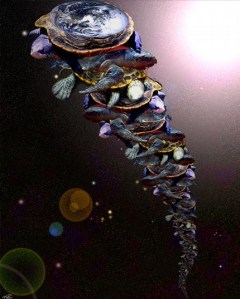
This danger to fruitful discussion is best illustrated by a story that appeared in Stephen Hawking’s A Brief History of Time. One of the greats of science, probably Bertrand Russell, had given a lecture on astronomy. He described how the Earth orbits around the Sun and how our solar system is part of a much larger galaxy. After the lecture, he was approached by a little old lady who informed him that the Earth is really sitting on the back of a giant tortoise. Russell replied, “What is the tortoise standing on?” “You’re very clever, young man, very clever,” said the old lady. “But everyone knows it’s turtles all the way down!” We must accept that at the bottom of any conceivable pile of cosmic turtles, there must ultimately be one that has as part of its nature the power of existence.

There is perhaps only one relevant or useful question humans can pose about this scientifically unknowable causal agent of the universe, “Is it conscious or unconscious?” If the transcendent cause of the universe is conscious, God is the most useful name we can give it. If the cause of the universe is unconscious, then it is some kind of super-nature. The best known and most likely candidate for the super-natural is the ‘eternal multiverse.’

This brings us to what we thought was the best question from the audience: What testable prediction does the God hypothesis make? Let’s examine this question in light of two things that Dr. Krauss said:

  1. Truly scientific evidence must be falsifiable.
  2. The big bang is established fact.

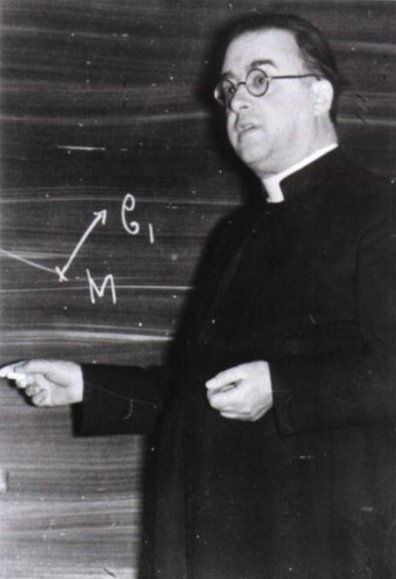
The Judeo-Christian God hypothesis includes a prediction made over 3,000 years ago in Genesis 1 that the universe had a beginning. This prediction ran counter to the theory of an eternal universe that dominated philosophical and scientific thinking until the 1960s. The great physicist and Jesuit priest, Georges Lemaître, developed the big bang theory in part because of his belief in the Genesis account of Creation. This Genesis prediction was testable and turned out to be true.  So, at least one major testable prediction of the God hypothesis meets the standard for scientific evidence.

The Father of the Big Bang, Georges Lemaître

It is not proof of God, but it is undeniable evidence for God that meets even the “extraordinary” benchmark set by Dr. Krauss. The prediction that the universe had a beginning is more than ordinary evidence because it is so ancient. It turns Dr. Krauss’s somewhat derisive comment about Bronze Age peasants back on his own argument: how indeed could such scientifically ignorant people have boldly stated what would three millennia later become astonishing fact?

Apply the same test to the best super-nature alternative: what testable prediction(s) does the multiverse hypothesis make? We are still learning about the different multiverse hypotheses, but there are at least two predictions that we’re aware of. The first involves an explanation for the weakness of gravity, which is by far the weakest of the four fundamental forces of nature. Some physicists predict that gravity is weak, because gravitons – the particles responsible for conveying the force of gravity – escape our universe into parallel universes.

The second prediction is the existence of “ghost particles” from parallel universes. Some physicists believe these particles must exist in order explain one of the great mysteries of quantum physics, the interference pattern observed when electrons pass through a double-slit. Interference is behavior we expect from waves, not particles; moreover, the pattern is observed even if electrons are fired at the double-slit one at a time, ruling out any possibility that two electrons, each going through a different slit, are interfering with each other. The interference pattern must arise, the prediction goes, from the electrons in our universe interfering with ghost electrons in a parallel universe.

Electron interference pattern

There are two insurmountable problems with these predictions. Not only do they contradict Dr. Krauss’ assertion that parallel universes are causally disconnected from each other, but neither of these predictions is testable. The evidence for the multiverse does not rise to the level of the scientific — not because we currently lack the knowledge or technology to perform the experiments, but because they are not falsifiable in principle. Science is limited to the study of this universe. The multiverse idea as it is currently framed is not scientific, it is metaphysical.

It seems that at this time the God hypothesis is superior in evidence to the best “natural” alternative.

The evidence in favor of the God hypothesis is even stronger than what Dr. Craig presented. We at SixDay Science propose that the Genesis 1 account of Creation makes at least 26 scientifically testable statements. All 26 are compatible with modern science and they are in the correct order. A discussion of this is available here. We believe this evidence is so extraordinary that it comes close to being something akin to J. B. S. Haldane’s “Precambrian rabbit” in the sense that a creation story which succeeded in anticipating so much of modern science by 3,000 years is just as out of place in time as a fossilized rabbit in 600 million year old rock.

Replay: When philosophy dominates science

Traffic’s up after the informal announcement of the publication of our Astronomy and Astrophysics curriculum, so in the coming weeks we’re going to replay some of our more important posts from the archives for our new readers. 

** Written by “Surak” **

Dr. Robb Wilson, who blogs at The Scholar Redeemer, commented on my article “Separating philosophy from science,” and made the following important points:

“good science is NOT aphilosophical”

“a blanket statement that philosophy corrupts science is misleading … there is a philosophy at the root of methodological naturalism as well.”

In light of his excellent comment, I would like to take another shot at what I intended to say.

Ancient Greek philosophy was indeed the solid and necessary foundation on which the first scientific efforts took place, and it was the Judeo-Christian worldview that made modern science possible. I fully accept that whenever and wherever the dominant philosophy/religion of the day acted as a rational foundation on which something higher and broader could be constructed, science flourished. But sometimes the dominant worldview has included beliefs that act like confining walls and a low ceiling on science. The most obvious example is the ancient belief that the Earth was the center of the universe, which helped delay modern science by about 1,800 years.

The point I wanted to make in my original article is that there is today a philosophy that dominates most Western centers of learning, and elements of that philosophy threaten to delay desperately-needed scientific advances in fields such as biology, medicine, psychology, and social behavior. My fears seem to be confirmed by an article published in the February 7, 2011 online edition of the New York Times, titled “Social Scientist Sees Bias Within” by John Tierney. The article quotes Jonathan Haidt, a social psychologist at the University of Virginia, regarding what he describes as a liberal bias in his field:

“This is a statistically impossible lack of diversity,” Dr. Haidt concluded, noting polls showing that 40 percent of Americans are conservative and 20 percent are liberal. In his speech and in an interview, Dr. Haidt argued that social psychologists are a “tribal-moral community” united by “sacred values” that hinder research and damage their credibility — and blind them to the hostile climate they’ve created for non-liberals.

While Tierney and Haidt appear to see the problem largely in political terms as part of a liberal vs. conservative struggle, the root of the problem for this branch of science is really philosophical because the “sacred values” cited by Dr. Haidt are those of humanism.  Our original article on ‘transcranial magnetic stimulation’ was an attempt to demonstrate that a similar philosophical problem exists in biology.

There is also evidence that humanist dominance is causing severe problems in the field of anthropology, for example, the controversial decision last year by the American Anthropological Association to remove the word “science” from an official statement of its long-range plan. The problem extends to general psychology, as well. In their 2005 book, Destructive Trends in Mental Health: The Well-Intentioned Path to Harm, Rogers H. Wright and Nicholas A. Cummings identify some distressing developments in behavioral science. In the preface they include the following statements:

Why, after decades of fighting to establish the rightful role of professionalism in psychology, do we now question the validity and integrity of some of the prevalent practices in our profession? The answer is simple: psychology and mental health have veered away from scientific integrity and open inquiry, as well as from compassionate practice in which the welfare of the patient is paramount.

These taboo topics typically unleash a silencing array of unwarranted charges ranging from political incorrectness, insensitivity, and lack of compassion to (in the extreme) bigotry. We are troubled that disciplines such as psychology, psychiatry, and social work, which pride themselves on diversity, scientific inquiry, intellectual openness, and compassion for those who need help, have created an atmosphere in which honest, albeit controversial, points of view are squelched.

We decry the extremism on the right, but we do not address it in this volume because that is not the problem within organized mental health today. Psychology, psychiatry, and social work have been captured by an ultraliberal agenda, much of which we agree with as citizens. However, we are alarmed with the damaging effect it is having on our science, our practice, and our credibility.

It [American Psychological Association] is no longer perceived as an authority that presents scientific evidence and professional facts. The APA has chosen ideology over science, and thus diminished its influence on the decision makers in our society.

Within the profession of psychology there is currently debate over treatment techniques and interventions that have not been scientifically validated.

It is obvious that we need a greater diversity of ideas and a counterbalance to the prevailing ideologies within mental health circles today. … We must broaden the debated by reducing the ridicule and intimidation of ideas contrary to the thinking of the establishment in the field of psychology.

Once again, the ultra-liberalism identified by the authors is best understood as the political manifestation of a relatively new philosophical orthodoxy, and the indisputable truth is that humanism is the philosophy that dominates many if not most universities and colleges in America today. I believe a strong case can be made that some humanists are guilty of many of the same transgressions against science that Christians have long been accused of, including

  • Attempting to establish a new orthodoxy verging on dogma
  • Stifling of descent
  • Condemning and purging those with non-humanist views
  • Corrupting science for political, social and economic goals

If psychology and the social ‘sciences’ continue to be dominated by a philosophy hostile to the free exploration and exchange of ideas, how will they ever develop desperately needed casual understanding about the human condition? A delay in the behavioral sciences similar to the delay in the physical sciences that occurred between Aristarchus and Copernicus would be more than a scientific tragedy; it would be a disaster for humankind. Our hope has to be that the study of human behavior will somehow break through the confining walls of humanism, undergo a cathartic paradigm shift, and become true science.

Giant impact theory of Moon’s formation challenged by new evidence

Scientists are puzzled over the water content of the Moon:

The amount of water present in the moon may have been overestimated by scientists studying the mineral apatite, says a team of researchers led by Jeremy Boyce of the UCLA Department of Earth, Planetary and Space Sciences.

Boyce and his colleagues created a computer model to accurately predict how apatite would have crystallized from cooling bodies of lunar magma early in the moon’s history. Their simulations revealed that the unusually hydrogen-rich apatite crystals observed in many lunar rock samples may not have formed within a water-rich environment, as was originally expected.

The prevailing model for how the Moon formed involves a Mars-sized planet crashing into the Earth, ejecting bits of the Earth into space, and some of these bits coalescing into what is now the Moon. If that’s the case, then the Moon should be similar in composition to the Earth — except that lighter elements, like hydrogen (which is a component of water), are believed to have escaped the Moon’s relatively weak gravity and drifted off into space, leaving the Moon rather dry.

In 2010, scientists took samples from the Moon and found apatite crystals, which contained a lot of hydrogen, suggesting that the Moon wasn’t as dry as previously thought. Now, however, with scientists concerned that the amount of hydrogen in these crystals overestimates the amount of water on the Moon, the “giant impact” theory of how the Moon formed is called into question:

“We had 40 years of believing in a dry moon, and now we have some evidence that the old dry model of the moon wasn’t perfect,” Boyce said. “However, we need to be cautious and look carefully at each piece of evidence before we decide that rocks on the moon are as wet as those on Earth.”

This study shows that scientists still have much to learn about the composition and environment of the early moon.

“We’re knocking out one of the most important pillars of evidence regarding the conditions of the formation and evolution of the moon,” Boyce said. “Next, we plan to determine how badly apatite has distorted our view of the moon and how we can best see past it to get at the moon’s origin.”

This is how science works. New evidence refines — or sometimes completely blows away — a theory/hypothesis. You can never be so wedded to an idea that you overlook important evidence that contradicts your model. It’ll be interesting to see if this latest evidence overturns the giant impact theory, and, if so, what the next favored model will be.

Self-correction in science

A common claim about the superiority of science over other ways of knowing is that science is self-correcting; science may take wrong turns from time to time, but it eventually finds its way back on the right road. As a supporter of science, I believe in the power of the scientific method; and generally speaking, it’s true that science self-corrects. However, it’s important to understand how human limitations—scientists are human, after all—sometimes undermine the process of self-correction.

Science will never give full understanding of anything. All that we can hope for are useful approximations of the objective reality we hope is out there. Under ideal circumstances, science is certainly self-correcting in the sense that it provides a process for arriving at consistently closer approximations. But, in too many instances the self-correcting potential of ideal science cannot overcome common human frailties. The most famous example from the field of astronomy will illustrate this.

Physics, like all of the sciences, started out as ‘natural philosophy,’ which functioned as an integrated branch of the whole philosophy/religion of the ancient Greeks. Science in its rudimentary form was thus shackled to the Greek worldview that placed humans forever at the center of the universe and effectively limited scientific thought to what would become Ptolemaic theory. This geocentric view of mankind’s place in the universe also prevailed because it conformed nicely to what the ancients observed with their limited senses, and because it had a powerful appeal to human emotions that subsequent theories could never have.

It is testimony to the power of the human mind and the potential of science that at least one individual was able to overcome all of this and figure out a closer approximation of the truth. An ancient Greek astronomer named Aristarchus proposed a heliocentric universe in the 3rd century B.C. Unfortunately his hypothesis was quickly squashed by contemporaries who condemned his idea as impious and foolish—in other words, it didn’t conform to the dominant philosophy/religion of the day. The Copernican revolution did finally take place, 1,800 years later, but those who have faith that science is the best way (or only way) to know things shouldn’t take much comfort from this example. Yes, the scientific method was eventually successful, but the self-correction was at best tragically slow.

This example has some scary implications, because the weak sister of modern science, the study of human behavior, is currently at a stage comparable to physics 2,000 years ago and shows no signs of correcting itself. With all of the social and behavioral problems facing an increasingly complex and technological world, it is possible that modern society cannot survive another 2,000 years without viable theories of individual and group behavior. So, it is important that all of us who depend on science to solve (or at least mitigate) the world’s problems understand how the three major things that prevented physics from correcting itself for about 2,000 years—the debilitating effects of ideology, the limiting nature of human perspective, and the immense power of emotions to mislead—are still at work today preventing the newer branches of science from correcting themselves.

To appreciate the ways in which science’s ability to self-correct can be thwarted, one has to be very clear about the basics of the scientific method. They can be outlined in rudimentary form in the following manner:

  • Preliminary observations of some natural phenomenon are made
  • A scientist brainstorms possible explanations of what is observed
  • A workable hypothesis is formed
  • An organized plan for additional observations and experiments is made and carried out
  • If additional evidence for the hypothesis is found, it advances to a level of confidence higher than that of a hypothesis but lower than that of a theory (we can call it a conjecture)
  • The newly elevated conjecture is then presented for the peer review process, in which some scientists will find evidence to support the conjecture and others will try to tear it apart
  • If the conjecture survives the peer review process and gains additional evidence and the support of a large number of scientists it will eventually become accepted as a viable theory

The two parts of this process that make self-correction possible are the brainstorming and peer review stages. Unfettered brainstorming makes it possible for scientists to consider all possibilities—that’s how we got Einstein and Georges Lemaître, the father of the big bang1. If religion or philosophy makes some ideas unthinkable, the brainstorming stage will be inhibited, and ‘unpopular’ possibilities will be missed. The humanist philosophy that dominates the behavior and social sciences departments today is making the self-correction in those fields impossible just as much as the philosophy of the ancient Greeks made physics impossible.

The peer review process makes it possible to challenge popular but false notions. In modern times this stage has become highly susceptible to the negative influences of politics and government funding. The controversy over global warming / climate change is a good example. Regardless of a person’s views on climate change, it should be deeply disturbing that one side of what should be a scientific debate has been corrupted by government funding into political advocacy. When any scientist becomes an advocate of policy, he is no longer a scientist, because science can only serve one master—the search for truth. It is even more disturbing that those on the other side of the scientific debate have been tagged with the vicious label of ‘deniers.’ Those who use this label in such a pejorative manner are trying to preemptively shut down the peer review process and mandate scientific orthodoxy.

It is dangerous, therefore, to assume that science has an inherent ability to overcome human failings to the point that we can depend on it to be self-correcting. That it can effectively reach that goal is demonstrated by the fairly rapid acceptance of big bang theory in the mid-20th century over the strong objections of those who were philosophically opposed to it.  But what has only recently become true of a branch of science that is over 450 years old, is not true of the newer sciences. Biology, psychology, and the social sciences are nowhere near the stage where self-correction is automatic.

Now, there is one assumption I’ve made in this discussion, that self-correction means we’re making better and better approximations of reality. But there is another issue: what if there isn’t always an objective truth that we can get closer to by self-correction? That’s an altogether different topic, but let me say that relativity and quantum mechanics do suggest that this might be true. This is a topic for another article.

[1] “Father” in more than one sense: Lemaître was also a priest.

Recommended reading:

  • The Structure of Scientific Revolutions by Thomas Kuhn

Christianity and the center of the universe

Not long ago, someone asked me if I’d seen the documentary, The God Who Wasn’t There (2005), which explores the “Jesus myth” and Christianity in general. It’s been out for several years, and despite the fact that it’s viewable for free on YouTube, I haven’t bothered to watch it, because it looks like an uninspired retread of common challenges to the Christian faith that tend to be very weak. However, from what I can tell, it does perpetuate one historical distortion that is worth refuting. From a partial transcript on IMDb, TGWWT puts forth the idea that it was primarily Christians who were wrong about the Earth-centered universe:

Narrator: The Earth revolves around the Sun. But it wasn’t always that way. The Sun used to revolve around the Earth. It was like that for hundreds of years, until it was discovered to be otherwise, and even for a few hundred years after that. But, ultimately, after much kicking and screaming, the Earth did, in fact, begin to revolve around the Sun. Christianity was wrong about the solar system. What if it’s wrong about something else, too? This movie’s about what happened when I went looking for Jesus.

Or, more likely, what happened when he went looking for anything but Jesus, but never mind. The problem with this statement is that it implies only Christians were wrong about the solar system, when the truth is that just about everyone was wrong about the solar system at one time or another. So why single out Christians? Without having seen the movie, I am fairly confident of the answer (hint: look at who appears in the movie). Unfortunately, the notion that the medieval Church was scientifically ignorant and held back scientific progress is a fairly easy misconception to perpetuate, because people who believe it are usually already eager to believe misconceptions about Christianity and/or they do not know enough to evaluate its validity.

I made a point to cover geocentric theory in my astronomy 101 courses, so let’s explore what my college freshmen students knew about this subject that TGWWT‘s writer/director Brian Flemming apparently did not (or did not want you to know about).

The geocentric model of the solar system, which places the Earth at the center of the universe, is an idea that is found in nearly every ancient culture. In Western Civilization, the idea is usually attributed to the ancient Greek philosopher Aristotle (384 BC – 322 BC), and was later systematized by the Alexandrian astronomer Claudius Ptolemaeus (aka Ptolemy, ~64 AD – 165 AD). The geocentric model persisted for more than 1,700 years, and while medieval interpretation of biblical scripture seemed to loosely support the idea, its formulation had nothing to do with Christianity.

To understand why the geocentric model persisted for so long, I want you to place yourself, just for a moment, in the ancient world where there is no such thing as telescopes, astronauts, or satellites. Your only notion of the Earth’s place in the universe is based on what your human senses tell you about the apparent motions of the heavens. You notice that the Sun and Moon make daily journeys across the sky from east to west, and that the stars at night travel in the same daily east-west direction. The familiar constellations also seem to drift across the sky over the course of weeks and months. To your human senses, it appears that the Earth is stationary and that objects in the heavens move about it in very predictable cycles. Armed only with these observations, it is entirely reasonable to assume that the Earth is at the center of the universe.

We owe a tremendous debt of gratitude to the Greeks, who were the first to seek natural explanations for the phenomena they observed. This reliance on natural explanations heralded the birth of science. But what is science? It is actually a difficult concept to define. Most of us understand science to be the search for knowledge, but knowledge can be acquired by other means. The scientific method works by making observations and asking questions in a very systematic way. One observes a phenomenon in nature (say, the motions of the heavens) and posits an educated guess about the nature of the phenomenon (everything in the heavens orbits the Earth, which is stationary). This educated guess is referred to as an hypothesis. The hypothesis then makes a prediction (where objects in the sky will appear on a certain date), and one carries out tests or observations to determine how well the hypothesis performs. If the hypothesis fails the test or cannot account for new observations, then it must be revised or abandoned in favor of a new hypothesis.

One such test of the geocentric model came in the form of retrograde motions of the planets. The Greeks observed that a handful of objects in the heavens moved in a way that was different from the other objects. For one thing, their positions were not fixed like the stars, but appeared to wander over a period of months. (The word “planet” comes from the Greek word for wanderer.) This retrograde motion, or apparent looping back of the planet’s path in the sky, is now understood in the context of the Sun-centered (heliocentric) model, but in ancient times it represented a significant challenge to the geocentric model. This challenge was resolved by placing each of the planets in a smaller orbit, called an epicycle, upon its larger orbit about the Earth. This was a key feature of the model put forth by Ptolemy, which is referred to as the Ptolemaic model.

The Ptolemaic model persisted for almost two millenia, because, clunky as it was, it made accurate predictions about the motions of the planets. Moreover, several key objections to the heliocentric model were unresolved. Centuries before Ptolemy, the Greek astronomer Aristarchus (310 BC – ~230 BC) proposed a Sun-centered solar system, but was ridiculed by his peers for it. First, the idea that the Earth was moving was counterintuitive, because of the apparent motions of the heavens. But the most significant objection was that stellar parallax was not observed. This is the apparent shifting of position of closer stars relative to more distant background stars, which must occur if the Earth is moving around the Sun. As this was not observed, it was reasonable for Aristarchus’ fellow Greeks to reject his idea.

Fast-forward almost two millennia to Nicolaus Copernicus (1473 – 1543 AD), who was a true Renaissance man. In addition to being an astronomer, he was also a physician, scholar, cleric, and military leader. Like Aristarchus before him, Copernicus went against popular sentiment and proposed a heliocentric system. There is evidence that Copernicus knew he was recycling Aristarchus’ ancient model, but his genius was in recognizing its potential as a much more elegant and compelling model than the geocentric model. It is true that Copernicus’ book stirred some controversy within the Church, but contrary to popular belief, the Church was not monolithically opposed to, but rather divided on, the subject of heliocentrism. Secular scientists at the time likewise held to the Aristotelian school of thought, and mostly rejected Copernicus’ ideas. There was good reason for this, as the major objections to the heliocentric model had not yet been overcome. In particular, since Copernicus used circular orbits for the planets, instead of what we now know to be elliptical orbits, the predictions of the Copernican model were less accurate than those of the Ptolemaic model. Heliocentrists also had to contend with the lack of observed stellar parallax, and there were still more objections based on Aristotelian notions about nature. For instance, long before Newton developed his laws of motion, Aristotle held that all objects naturally come to rest, which meant that if the Earth was moving it would leave airborne objects (birds, clouds, etc.) behind. It was not until Galileo anticipated Newton’s first law (objects in motion tend to stay in motion) with simple experiments and made some key observations with his telescope—among them, that the stars are too far away to observe parallax1—that these objections were overcome and the Copernican Revolution was solidified.

It is important to understand that there was as much objection to the Copernican model from secular scientists as from the Church. Perhaps more. (For instance, it was supposedly a secular rival who reported Galileo to the Inquisition, illustrating that scientific enterprise has always been a little cut-throat.) The objections of the Church were only partially founded on Christian doctrine, which was based at that time on interpretation of scripture that was consistent with the Aristotelian school of thought. There is, in fact, nothing in scripture that dictates an Earth-centered system. The politics of the time also complicated things, with the Catholic Church struggling to come to grips with the tremendous effects of the Reformation. The most influential figure of the Reformation, Martin Luther, strongly objected to the ideas of the “upstart astrologer” Copernicus, and the Catholic Church was anxious to stay abreast with Protestantism on such an important issue. It is also important to understand that Copernicus was eventually shown to be incorrect in his placement of the Sun at the center of the universe; we now understand that there is no ‘center’ to the universe, an idea that is difficult to accept for many people.

What can we conclude from all of this? We can conclude that the most important factor preventing wide-spread acceptance of the heliocentric model was simple human nature. As clever as we sometimes are, we are constrained by limited perspective and emotion. Limited perspective prevented scientists from perceiving the stellar parallax that was predicted by the heliocentric model. Human emotion means cherished ideas often have a powerful hold on people, especially when it comes to accepted ideas that have served mankind well for many centuries. Put these two constraints together and you have the very non-linear progression from old ideas to new ideas that is evident throughout human history.

Having not seen TGWWT, I can only surmise from the partial transcript that either Flemming knows very little about scientific history, classical thought, and theology, or he is being deliberately disingenuous to make Christians look bad. Which is unfortunate, because, with just a few changes to the quote from the transcript, I think we could have turned his movie into a much more interesting narrative on the fallibility of human reason:

Narrator: The Earth revolves around the Sun. But it wasn’t always that way. The Sun used to revolve around the Earth. It was like that for hundreds of years, until it was discovered to be otherwise, and even for a few hundred years after that. But, ultimately, after much kicking and screaming, the Earth did, in fact, begin to revolve around the Sun. Mankind was wrong about the solar system, but eventually figured it out. What is it today that we don’t yet understand that will be obvious to mankind hundreds of years from now? Let’s speculate…

[1] With the advent of larger and more sophisticated telescopes, stellar parallax was indeed observed.

Recommended reading:

  • What’s So Great About Christianity by Dinesh D’Souza

Questions from Christian Students, Part 8

Sarah was recently invited, along with two other scientists, to take part in a panel discussion for a group of mostly Christian students. After the main discussion, students were invited to submit questions via text message; there was very little time to address them, so only a few were answered. The questions were quite good, so over the next few weeks, Surak and Sarah will answer most of them here. All of the questions are listed in the Intro to this series. See also: Part 1Part 2Part 3Part 4Part 5Part 6; Part 7

What is the most important piece of knowledge you have come to learn about evolution since becoming a believer?

Darwin was a great scientist and pioneer in the field of biology. In that regard he is similar to Copernicus in the field of physics. Physicists honor Copernicus, but they also recognize and readily admit his shortcomings. He helped accomplish the first great paradigm shift that set science on its present course of discovery. What a great thing to do! But he was wrong about some important things; the Sun is not the center of the universe, and planets do not travel in perfectly circular orbits. We forgive Copernicus for his mistakes, because he did his work before the basic tools and higher mathematics of astronomy were developed. How could he be expected to get everything right four hundred years ago?

Darwin worked under similar limitations decades before the revolutionary discoveries of the Burgess Shale fossils and genes. So, once again, how could the great pioneer in the field of biology have gotten everything right all the way back in the mid 1860s? That would not be a fair expectation on the part of either supporters or detractors of Darwin.

The main principles of Darwinism are common descent, random mutation, natural selection, and gradualism. Each of these components is a necessary part of current evolutionary theory, which is important because people often confuse evolution theory for just one of these parts—the common descent of all animal life. It is true that common descent has all but been ‘proven,’ about as well as any scientific belief can be proven, and there can be little remaining doubt about it. But, the massive evidence in favor of common descent neither establishes the truth of evolution theory as a whole nor undercuts Christian beliefs. The most that can be said is that Darwin’s championing of this principle counts as a great success of the same magnitude as Copernicus’ heliocentric theory.

But, Darwin, just like Copernicus, got some things wrong. The fossil evidence does not support gradualism. In the words of one of the most respected biologists of modern times, Niles Eldredge, curator at the American Museum of Natural History in New York City: “The fossil record we were told to find for the past 120 years does not exist.”

It was Darwin who told biologists what to expect in the fossil record, and this mistake was a significant failure on his part.

In fact, the fossil evidence contradicts Darwin so badly, it compelled Eldridge and his more famous partner, Stephen Jay Gould, to offer something they called ‘punctuated equilibrium’ as an alternative to strict Darwinism. There are other serious problems with Darwinism (the mathematics of random mutations doesn’t work and there is a fatal lack of empirical evidence for natural selection), but, for the sake of brevity, it is enough to say that without gradualism Darwinism is seriously undone. In other words, Darwin was wrong about at least one major thing.

In light of this, the most important thing any scientist can come to learn about evolution is that biologists are generally incapable of saying the following words: “Darwin was wrong.”

Physicists can say without hesitation that there were times when “Galileo was wrong, Newton was wrong, and Einstein was wrong.” In spite of their mistakes, Galileo, Newton, and Einstein are still considered giants in the field of physics. Why can’t biologists make the same and obviously true statement about Darwin? I believe it is because strict Darwinism has become anti-Christian gospel, and many biologists are betraying science by promoting and defending this dogma.

Would the discovery of intelligent life on another planet disprove the existence of God?

Why would God be limited to creating one group of beings with souls in just one part of a vast universe? While the Bible is addressed to and concerned about the conscious beings inhabiting the Earth, there is nothing in the Bible that says that life was created only on Earth. “In my Father’s house are many rooms” (John 14:2). See here and here for further discussion.

Questions from Christian Students, Part 6

Sarah was recently invited, along with two other scientists, to take part in a panel discussion for a group of mostly Christian students. After the main discussion, students were invited to submit questions via text message; there was very little time to address them, so only a few were answered. The questions were quite good, so over the next few weeks, Surak and Sarah will answer most of them here. All of the questions are listed in the Intro to this series. See also: Part 1Part 2Part 3Part 4; Part 5

What’s the most common scientific argument you encounter against Christianity? How have you responded?

The most common scientific arguments against Christianity are the following:

1. The six days of creation are completely contrary to modern science.

This is false. See here for a thorough explanation of this.

2. Evolution explains everything and makes God ‘unnecessary.’

The first part of this statement is false; the second part is an extremely weak and silly argument. First, Darwinism in all of its forms has not provided answers for the most fundamental biological questions of all: how did life originate, what caused the tremendous explosion of life forms in the Cambrian explosion, why do different phyla of animal life share common genes, what is human consciousness, and where does human consciousness come from? Modern biologists who make grand pronouncements about God end up sounding like teenagers who discover where their mom and dad keep the car keys and the credit cards and then declare that their parents are no longer necessary. They are also like kids in their immature conviction that they know everything. They once confidently declared that they knew how life started: huge amounts of time in which nearly infinite random combinations of chemicals occurred solved the problem of the origins of life on Earth. Then the fossil evidence destroyed that argument by showing that life arose almost immediately after water formed on the Earth; there was no long period of time for random processes to work their magic (it really was a case of magical thinking all along).

Then the Darwinists said, well, never mind that we really don’t have an explanation for the origins of life; once life started, it developed and diversified without any supernatural help. According to evolutionary theory the various phyla of the animal kingdom all evolved separately according to the laws of random mutation and natural selection. That claim turned out not to be true either.

Sean B. Carroll is a current Darwinist biologist at the forefront of a new field of study known as evolutionary developmental biology (evo-devo). In his book, Endless Forms Most Beautiful: The New Science of Evo Devo and the Making of the Animal Kingdom, he announces the startling discovery that animal life forms as different as mammals and insects share interchangeable genes, something that Darwinists always believed was impossible:

[T]he prevailing view of the architects and adherents of Modern Synthesis was that the process of random mutation and selection would so alter DNA and protein sequences that only closely related species would bear homologous genes. … Virtually everything I have described … has been discovered in the past twenty years. … The insights provided by these discoveries … [have] forced biologists to rethink completely their picture of how forms evolve. (p. 285, emphasis added)

In other words, Darwinists (“the architects and adherents of Modern Synthesis”) are “completely” wrong about how life developed on Earth. With a track record like this, biologists should be humble enough not to make grand pronouncements that God does not exist or is unnecessary.

3. The idea of a creator god doesn’t provide any final or satisfying answer, because the question remains ‘who or what made God?’

This is more of a philosophical question with scientific overtones and implications.

Whether atheists like it or not (and they don’t), big bang theory necessitates the inclusion of the supernatural in all philosophical and scientific discussions about the origins of the universe and life. Something outside and greater than (super-) the universe (nature) must have caused it to come into being. Taking this logic one step further, there must be something outside our universe that has, as an inherent quality, the power to exist. In other words, at the bottom of everything is something or ‘someone’ that was not made by something else. We can’t understand this power or the nature of the thing that holds it, but we are living proof that it ‘exists’ in some unfathomable manner.

Rather than argue about the unknowable, we should pose the most obvious question worth asking, “Is this entity that possesses the power to exist conscious or unconscious?” These two alternatives seem to exhaust the possibilities and be mutually exclusive. If you can think of another possibility, let me know.

If one prefers to believe that the creative power behind the universe is unconscious, then the fundamental entity would be some form of eternal material universe based on equally eternal natural laws. Since we are reasonably sure this universe is not eternal, we would be forced to fall back on notions such as the multiverse. Because of the limitations of science, these ideas will never be anything more than unprovable speculation forever consigned to the realms of philosophy, science fiction, or anti-Christian dogma.

I find these unconscious alternatives not only emotionally and intellectually unsatisfying, but truly terrifying. Atheists generally take this idea just one baby-step further by grandly pronouncing that all we have is this one life, and we should courageously accept the truth and live that life to the fullest. But, why bother? According to them, all of humankind will be exterminated and nothing anyone does, feels, or learns will have any lasting significance. As bad as that sounds, the reality of an eternal universe is actually far worse.

One of the most annoying things about atheists who make this argument about ‘who made God’ is their inability to take an idea all the way to its most logical conclusion. Consider for a moment the two most fundamental aspects of their eternal material universe:

  1. Another word for eternal is infinite (in time).
  2. In the unconscious eternal material universe, everything would happen according to the laws of probability.

Put these two things together and the result is total weirdness that offends reason.

We don’t know what the exact probability of you existing in an eternal material world is, but we do know it is some positive non-zero value, because you exist. So, what is the probability that you could exist twice? According to the mathematics of probability, you can calculate that by multiplying the probability you will exist by itself. Well, a positive number multiplied by a positive number is … a positive number. In other words, you could exist in two or more places at the same time, and you will definitely exist again given an infinite amount of time. But it gets more complicated than that because an infinite amount of anything plays havoc with our sense of reality.

If the universe is eternal, you have already lived an infinite number of lives. You have already lived each of these lives an infinite number of times. Each life was lived and then completely lost—no memories, no lasting achievements, no personal growth, no enduring love. There is only an endless and pointless repetition. Really! I can imagine no more terrifying prospect than this utter and endless lack of purpose.

Science is ultimately incapable of proving anything either way. So, I chose for non-scientific but rational reasons to hope that the creative power behind the universe is conscious. That is the only chance we have for meaning, purpose, and love.

Questions from Christian Students

Sarah was recently invited, along with two other scientists, to take part in a panel discussion for a group of mostly Christian students. After the main discussion, students were invited to submit questions via text message; there was very little time to address them, so only a few were answered. The questions were quite good, so over the next few weeks, Surak and Sarah will answer most of them here. They are listed below, in no particular order. (Despite the title of this post, at least two of the questions appear to be from students who are currently struggling with belief.) 

Since becoming a Christian and living in an environment where your faith is tested every day, have you experienced doubt? If so, what has brought you through those doubts? (Part 9)

Was Adam the first man created or was he chosen from an already existing population? (Part 2)

Has an effort by students to share their faith with you ever made an impact on you in any way? (Part 3)

Have you ever had a student challenge an idea during class? (Part 3)

How does evolution relate to belief in a creator? And please address the time frame. / Please address the timing of evolution and the Bible. / How do you reconcile biologists teaching evolution and coming from apes with the creation story in Genesis? (Part 11)

What was it about Christianity that made you feel hostile towards it before you read the Bible? (Part 5)

Do you wish you could talk about your faith in the classroom / office hours? If so, what keeps you from doing it? (Part 3)

How do you account for the Higgs boson particle? (Part 1)

How hard is it to work in the field of academia in an anti-Christian environment from a faith perspective? (Part 9)

How do you recommend Christian students react to professors who are intolerant of their Christian faith? (Part 9)

You mentioned the big bang. In your interpretation, does the big bang coincide with the moment of creation? / How does scientific proof of the big bang line up with the biblical teaching of creationism? (Part 4)

Within your field of study what has been the most remarkable observation that you have made that reinforces your faith? (Part 1)

What was the most difficult specific objection to faith (particularly Christianity) that you had to get past? / What was the biggest stumbling block to faith that you had to overcome? / For new believers, how do you get past the line of ‘the Bible is just a story’ into faith? I’ve accepted that there is a God, but I’m struggling with accepting Jesus. (Part 7)

Outside of the creation story, have you found other parts of the Bible that support what you have observed scientifically? (Part 10)

What’s the most remarkable, undeniable discovery you have used to prove or disprove the faiths of different persons? (Part 1)

What’s the most common scientific argument you encounter against Christianity? How have you responded? (Part 6)

What is the most important piece of knowledge you have come to learn about evolution since becoming a believer? (Part 8)

What is your colleagues’ biggest reason for thinking the Gospel is not worth believing? (Part 5)

Would the discovery of intelligent life on another planet disprove the existence of God? (Part 8)

What would you say to someone who can’t believe in Christianity because of its exclusive claims, that no one enters the gates of Heaven without first meeting Jesus? (Part 12)

Astronomy news round-up

Crab is emitting super-energetic gamma rays

Here’s another chapter for the books of “Persistence Pays Off” and “Who Woulda Thought?” A team of astronomers has discovered very energetic gamma-ray pulses emanating from the core of the Crab Nebula, in defiance of current theory. The nebula, a remnant of a 1,000 year-old supernova, is a semi-chaotic mass of gas surrounding a type of neutron star called a pulsar, the source of the gamma rays. Like all neutron stars, a pulsar is the tiny, extremely dense, collapsed core of a progenitor star; what makes these objects special is that the axis of rotation is offset from the bright magnetic poles, so that every time they spin they are observed to emit a pulse, like a lighthouse. Given its relative young age and close proximity to Earth — a mere 6,500 light-years — the Crab pulsar has been well-studied by astronomers. Theorists thought it was not possible for a pulsar to emit such energetic gamma-ray pulses, leading some of their colleagues to tell members of the team they were “crazy” for even trying to observe them. But the astronomers’ persistence paid off, and the new discovery is already changing how theorists think about these objects.

“We thought we understood the gamma-ray emission, and this was really becoming a foundational feature of our models, but that’s now thrown out,” [one of the authors of the study, Andrew] McCann explained. “The reason why this is so exciting is that it’s turning things around in the field.”

You gotta love how astronomers and physicists get excited every time a new discovery shoots down current theory. That’s exactly the kind of attitude that moves science forward.

Uranus pummeled by other planets?

The distant gaseous planet has long been a puzzle to astronomers, who have been trying to explain its peculiar axis tilt ever since it was discovered.

Most of the planets in the solar system exhibit axis tilt — this is where the axis of a planet’s rotation is at an angle to an imaginary line that runs perpendicular to the planet’s orbital plane. Mercury is alone in that it has virtually zero axis tilt, though Jupiter’s is also diminutive at just 3 degrees. The Earth’s axis tilt is 23.5 degrees, and Venus is nearly upside down with its rotation axis pointing almost completely downward (this is also somewhat of a mystery to astronomers).

Uranus is the strangest of all, as it rotates flopped over on its side. Some astronomers have hypothesized that Uranus was pummeled by another planet in the early history of the solar system, and this collision resulted in Uranus’ 98-degree axis tilt. However, another collision might be required to explain the spin of Uranus’ moons, which should otherwise spin backwards. A new simulation created by astronomers indicates that collisions with two Earth-sized planets could explain Uranus’ observed configuration. The main problem with this idea, however, is to explain where the two Earth-sized planets came from.

Evidence for water on Mars?

Astronomers have discovered seasonal dark streaks on the surface of Mars that could be signs of melted water running across the surface. Meanwhile, NASA’s Curiosity rover is slated to visit Mars next year to look for signs of water in the Gale crater. The discovery of liquid water on Mars will greatly facilitate any plans to establish future colonies there.