Christians must reclaim science

Modern science exists because of the Christian faith. That is a provable fact. So, why is there so much conflict over the supposed conflict between science and Christianity? In terms of explaining the atheist myth-making about the supposed conflict — having once been an arrogant atheist, myself — I can tell you that it’s born of either total ignorance (as was the case with me) or the kind of hostility that makes a person blind to the truth or willing to distort it. In terms of Young-Earth Creationism, however, I’m still trying to figure that one out. Modern science is one of the many blessings of the Christian faith, and I can only surmise that YECs have allowed the atheists to frame the argument and have accepted a gross distortion — and outright omission — of historical facts.

The Stand to Reason Blog explains that, in contrast to atheist fables, science and Christianity go way back:

The myth begins with the notion of the “dark ages,” a time when the church suppressed education. It’s just not true. Scholarship was alive and well prior to Copernicus. In fact, scholars were working on heliocentric theories before Copernicus. He learned these in university and built on them when he published in final work. His theory didn’t emerge from a dark vacuum, but from rich science that had been nurtured in the universities, many of them established by the church.

In fact, as the article goes on to point out, sociologist of religion, Rodney Stark, found that 50 out of 52 of the key figures of the scientific revolution were religious.

Hugh Ross goes even further and explains how the scientific method comes straight from the Bible:

The Bible not only commands us to put everything to the test, it shows us how. Christian scholars throughout church history, from early church fathers to present-day evangelical scientists, philosophers, and theologians, have noted a pattern in biblical narratives and descriptions of sequential physical events such as the Genesis creation account. Bible authors typically preface such depictions by stating the narrative or description’s frame of reference or point of view. In the same statement or immediately thereafter comes a listing of the initial conditions for the narrative or description. The narrative or the description itself follows. Finally, the author describes final conditions and conclusions about what transpired.

Furthermore, there is not just one narrative or description of physical events in the Bible. There are dozens. Because the Bible is inspired by God––for whom it is impossible to lie or deceive––these dozens must be consistent with one another. Therefore, each of these dozens of descriptive accounts can be used to test the validity of the interpretation of the others.

In the near future, I’ll be posting an article about the concept of linear time that’s necessary for the emergence of modern science, and how it comes from Christianity.

It’s simple: the pillars upon which modern science stand — the notion of scholarship as a form of true worship, the scientific method, and the concept of linear time / cause-and-effect — were all built by the Christian faith. As the influence of the Christian worldview wanes in the West, replaced by a worldview that actively hammers away at the pillars of science, so will the quality of science diminish. This is why Christians must reclaim science instead of turning away from it.

Replay: Our analysis of “The Great Debate: Is There Evidence for God?”

Traffic’s up after the informal announcement of the publication of our Astronomy and Astrophysics curriculum, so in the coming weeks we’re going to replay some of our more important posts from the archives for our new readers.

On March 30, 2011, Christian theologian and philosopher William Lane Craig debated atheist physicist Lawrence Krauss at North Carolina State University. The topic was, “The Great Debate: Is There Evidence for God?” Video of the rather lengthy event is here. What follows is our analysis of the debate. 

** Written by Sarah and “Surak” **

The two opposing sides of the scientific debate over the God hypothesis were well represented on Wednesday by Dr. William Lane Craig (Christian Philosopher and Theologian from Talbot School of Theology) and Dr. Lawrence Krauss (Theoretical Physicist from Arizona State University). Dr. Craig’s argument was based on the clearly-stated and logical assertion that if God’s existence is more probable given certain information, that information meets the essential criterion for evidence. Dr. Krauss was equally clear in his definition of evidence: it must be falsifiable to be scientific. We find both standards to be very useful.

There was some confusion on the part of the moderator as to whether the topic of the debate was the existence of any evidence for God or the existence of enough evidence to prove God’s existence. We think the moderator erred in his statement of the debate’s purpose, since no one could reasonably argue that there is proof or disproof of God’s existence. As Dr. Krauss correctly stated, science cannot falsify God; so, the question can only be, “Is God likely?”

We will assess the debate in terms of whether or not there is any evidence for the existence of God, although Dr. Krauss tried to set the bar unfairly high with his assertion that a highly extraordinary proposition, such as the God hypothesis, requires extraordinary evidence. However, we think defenders of the God hypothesis can accept and meet this challenge.

Dr. Krauss acknowledges that the big bang is fact and one of science’s great achievements. The big bang theory establishes that the universe had a beginning, and that the universe was created from nothing. There was some debate and confusion about the meaning of “nothing.” It can mean the absence of matter, such as in “empty” space, or it can mean no space, no matter, and no time. The big bang involves the second notion of nothing, which is about as much of a nothing as most human minds can conceive of.

The appearance of our universe from this nothing makes it an undeniable instance of creation – something coming from nothing – as opposed to an example of making, which is something being fashioned from something that’s already there. Science is based on the premise that everything has a cause, especially if it has a beginning. Since the universe had a beginning, it must have a cause, and a reasonable extension of the big bang theory is that the cause must be something greater than and outside of the universe.

The cause of our universe must therefore be a transcendent or super-natural cause. This ultimate cause must include not only the difficult idea that some entity “exists” outside our universe, but also the humanly inconceivable idea that it has as part of its nature the capacity to exist and make other things come into existence. In other words, there must be something that is its own cause and the essence of existence. We humans can never understand such an entity, but it’s the only way to avoid a common patch of logical quicksand that threatens to swallow anyone who attempts to discuss the origins of our universe.

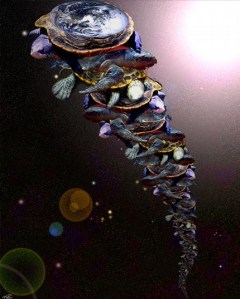
This danger to fruitful discussion is best illustrated by a story that appeared in Stephen Hawking’s A Brief History of Time. One of the greats of science, probably Bertrand Russell, had given a lecture on astronomy. He described how the Earth orbits around the Sun and how our solar system is part of a much larger galaxy. After the lecture, he was approached by a little old lady who informed him that the Earth is really sitting on the back of a giant tortoise. Russell replied, “What is the tortoise standing on?” “You’re very clever, young man, very clever,” said the old lady. “But everyone knows it’s turtles all the way down!” We must accept that at the bottom of any conceivable pile of cosmic turtles, there must ultimately be one that has as part of its nature the power of existence.

There is perhaps only one relevant or useful question humans can pose about this scientifically unknowable causal agent of the universe, “Is it conscious or unconscious?” If the transcendent cause of the universe is conscious, God is the most useful name we can give it. If the cause of the universe is unconscious, then it is some kind of super-nature. The best known and most likely candidate for the super-natural is the ‘eternal multiverse.’

This brings us to what we thought was the best question from the audience: What testable prediction does the God hypothesis make? Let’s examine this question in light of two things that Dr. Krauss said:

  1. Truly scientific evidence must be falsifiable.
  2. The big bang is established fact.

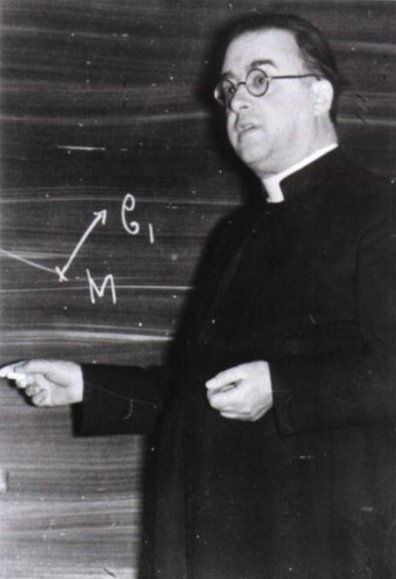
The Judeo-Christian God hypothesis includes a prediction made over 3,000 years ago in Genesis 1 that the universe had a beginning. This prediction ran counter to the theory of an eternal universe that dominated philosophical and scientific thinking until the 1960s. The great physicist and Jesuit priest, Georges Lemaître, developed the big bang theory in part because of his belief in the Genesis account of Creation. This Genesis prediction was testable and turned out to be true.  So, at least one major testable prediction of the God hypothesis meets the standard for scientific evidence.

The Father of the Big Bang, Georges Lemaître

It is not proof of God, but it is undeniable evidence for God that meets even the “extraordinary” benchmark set by Dr. Krauss. The prediction that the universe had a beginning is more than ordinary evidence because it is so ancient. It turns Dr. Krauss’s somewhat derisive comment about Bronze Age peasants back on his own argument: how indeed could such scientifically ignorant people have boldly stated what would three millennia later become astonishing fact?

Apply the same test to the best super-nature alternative: what testable prediction(s) does the multiverse hypothesis make? We are still learning about the different multiverse hypotheses, but there are at least two predictions that we’re aware of. The first involves an explanation for the weakness of gravity, which is by far the weakest of the four fundamental forces of nature. Some physicists predict that gravity is weak, because gravitons – the particles responsible for conveying the force of gravity – escape our universe into parallel universes.

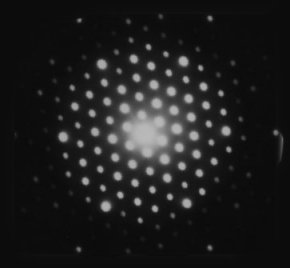
The second prediction is the existence of “ghost particles” from parallel universes. Some physicists believe these particles must exist in order explain one of the great mysteries of quantum physics, the interference pattern observed when electrons pass through a double-slit. Interference is behavior we expect from waves, not particles; moreover, the pattern is observed even if electrons are fired at the double-slit one at a time, ruling out any possibility that two electrons, each going through a different slit, are interfering with each other. The interference pattern must arise, the prediction goes, from the electrons in our universe interfering with ghost electrons in a parallel universe.

Electron interference pattern

There are two insurmountable problems with these predictions. Not only do they contradict Dr. Krauss’ assertion that parallel universes are causally disconnected from each other, but neither of these predictions is testable. The evidence for the multiverse does not rise to the level of the scientific — not because we currently lack the knowledge or technology to perform the experiments, but because they are not falsifiable in principle. Science is limited to the study of this universe. The multiverse idea as it is currently framed is not scientific, it is metaphysical.

It seems that at this time the God hypothesis is superior in evidence to the best “natural” alternative.

The evidence in favor of the God hypothesis is even stronger than what Dr. Craig presented. We at SixDay Science propose that the Genesis 1 account of Creation makes at least 26 scientifically testable statements. All 26 are compatible with modern science and they are in the correct order. A discussion of this is available here. We believe this evidence is so extraordinary that it comes close to being something akin to J. B. S. Haldane’s “Precambrian rabbit” in the sense that a creation story which succeeded in anticipating so much of modern science by 3,000 years is just as out of place in time as a fossilized rabbit in 600 million year old rock.

Why are Americans skeptical of some scientific ideas?

A recent poll indicates that Americans are skeptical of evolution by natural selection, global warming, and the big bang theory. Surprisingly (for me, anyway), the biggest scientific loser is the big bang, with 51% of the respondents skeptical that the universe was created approximately 14 billion years ago.

Frankly, this astonishes me. There are sound reasons to be skeptical of the theory of evolution by natural selection (TENS) and anthropogenic (man-made) global warming, but the evidence and arguments for the big bang theory are excellent — and also consistent with the Bible, which is no small thing, since the poll indicated that religiosity is correlated with disbelief in the big bang.

So, why are most Americans skeptical of the big bang?

This is not a rhetorical question; it’s something I’m striving to understand. Some Christians make the argument that a literal interpretation of the Bible requires a young Earth and young universe, but it appears to me that this belief is inspired, or supported, by an argument against evolution. Many people who are skeptical of TENS (particularly evangelical Christians) believe that it requires billions of years to work, therefore if the universe and the Earth are only thousands of years old, TENS doesn’t work. Never mind that billions of years can’t even begin to help TENS, that doesn’t explain why more people are skeptical of the big bang than evolution.

In any case, scientists are, understandably, distressed by these results. Randy Schekman, a Nobel laureate in medicine at UC-Irvine, said, “Science ignorance is pervasive in our society, and these attitudes are reinforced when some of our leaders are openly antagonistic to established facts.”

Schekman is both right and wrong. If quizzed on why he or she disbelieves in certain scientific ideas, I’m confident the average individual would not be able to explain the best evidence and arguments for and against the ideas. However, I don’t believe it has anything to do with leaders (presumably, he means religious and political leaders) being antagonistic to facts, but rather a vocal minority of scientists and their advocates being openly antagonistic to religious belief.

The poll highlights “the iron triangle of science, religion and politics,” said Anthony Leiserowitz, director of the Yale Project on Climate Change Communication.

And scientists know they’ve got the shakiest leg in the triangle.

To the public “most often values and beliefs trump science” when they conflict, said Alan Leshner, chief executive of the world’s largest scientific society, the American Association for the Advancement of Science. [emphasis added]

Of course values and beliefs trump science in a conflict. Unlike science, values and beliefs comprise an entire worldview, one that has been around much longer than modern science and has been much more influential.

But there was a time, at the beginning of the era of modern science up until the mid-20th century, when the Christian worldview and science largely went hand-in-hand. In the 17th century, many if not most natural philosophers (what scientists were called at the time) were Christians, and they saw their work as glorifying God. Mitch Stokes, in his brief biography of Newton, writes:

According to metaphor, God has written two books—Scripture and Nature—and He is glorified by the study of either one. This view, this “belief in the sacral nature of science,” was prevalent among natural philosophers of the seventeenth century. As Frank Manuel, one of Newton’s most important twentieth-century biographers, says:

“The traditional use of science as a form of praise to the Father assumed new dimensions under the tutelage of Robert Boyle and his fellow-members of the Royal Society, and among the immediate disciples of Isaac Newton. … In the Christian Virtuoso, demonstrating that experimental philosophy [experimental science] assisted a man to be a good Christian, Boyle assured readers that God required not a slight survey, but a diligent and skilful scrutiny of His works.”

Although Newton’s intensity while pursuing his work ranges from humorous to alarming, it is put into a different light if we see it as a measure of his devotion to God. For Newton, “To be constantly engaged in studying and probing into God’s actions was true worship.” This idea defined the seventeenth-century scientist, and in many cases, the scientists doubled as theologians. [emphasis added]

There was only occasional conflict for scientists like Newton in the form of struggling to understand how certain aspects of nature are consistent with their interpretation of scripture.

The antagonistic sort of conflict we see today goes back at least as far as Thomas Huxley using Darwinian evolution to undermine Christian belief. Huxley knew TENS had insurmountable problems, but he saw it as a useful weapon to attack Christianity, which he despised.

Unfortunately, this sort of practice has become increasingly commonplace into the 20th and 21st centuries. Global warming isn’t by its nature useful as a direct attack on Christian belief, but it does represent an attack on the Christian ideal of limited government. The historical misuse of biology as a weapon against Christian belief began with Huxley and continues with modern biologists and their supporters — so much so that the public has little idea how much the most recent findings of evolutionary biology support the Christian view of creation. The misuse of physics to undermine Christian belief, however, is relatively new. I find it distressing not only because it is my field of study, but because the field of physics has historically led the way for the other sciences and represents the greatest scientific support for the Christian view of creation.

As a scientist — and irrespective of my Christian beliefs — I find the behavior of the attackers perplexing. The majority of Americans are either Christian or hold some general belief in a supreme being, so why do some scientists go out of their way to alienate a majority of people who support science by sending their children to universities and by paying taxes for government-supported science programs? At some point, they’re just not going to see the value of either. And they’re certainly not going to make the effort to become more literate in a topic that they’re told is in opposition to their faith. Modern scientists like Stephen Hawking who use their considerable scientific knowledge to attack religious belief are therefore doing a tremendous disservice to science. I don’t know what Hawking’s motivation is, but if he dislikes Christianity to the extent that he’s trying to undermine it, as Huxley did, then he is only indirectly realizing this goal and at the cost of eroding confidence in good science.

Poll results notwithstanding, big bang theory is good science — in fact, it is arguably the crowning achievement of modern science — and it is not only compatible with Christian belief, but in my opinion mandated by it. (I will expand on this in a future post.)

Meanwhile, there’s no use blaming political and religious “leaders” for the lack of confidence in science, because, if history has taught us anything, it’s that they don’t tend to lead the way, but jump out in front of the direction in which people are already going. If good science is going to flourish in America, two things must happen. Christians must become scientifically literate — which is something I hope to encourage with my ministry — but scientists have got to stop the public antagonism toward Christian belief.

He Is Risen!

He is risen

But Mary stood weeping outside the tomb, and as she wept she stooped to look into the tomb. And she saw two angels in white, sitting where the body of Jesus had lain, one at the head and one at the feet. They said to her, “Woman, why are you weeping?” She said to them, “They have taken away my Lord, and I do not know where they have laid him.” Having said this, she turned around and saw Jesus standing, but she did not know that it was Jesus. Jesus said to her, “Woman, why are you weeping? Whom are you seeking?” Supposing him to be the gardener, she said to him, “Sir, if you have carried him away, tell me where you have laid him, and I will take him away.” Jesus said to her, “Mary.” She turned and said to him in Aramaic, “Rabboni!” (which means Teacher). Jesus said to her, “Do not cling to me, for I have not yet ascended to the Father; but go to my brothers and say to them, ‘I am ascending to my Father and your Father, to my God and your God.'” Mary Magdalene went and announced to the disciples, “I have seen the Lord”—and that he had said these things to her.

John 20:11-18

Good Friday

Now from the sixth hour there was darkness over all the land until the ninth hour. And about the ninth hour Jesus cried out with a loud voice, saying, “Eli, Eli, lema sabachthani?” that is, “My God, my God, why have you forsaken me?” And some of the bystanders, hearing it, said, “This man is calling Elijah.” And one of them at once ran and took a sponge, filled it with sour wine, and put it on a reed and gave it to him to drink. But the others said, “Wait, let us see whether Elijah will come to save him.” And Jesus cried out again with a loud voice and yielded up his spirit.

–Matthew 27:45-50

It wasn’t the rats after all

It seems that not only did rats get an undeservedly bad rap for the Black Death, but that the evidence favors a very simple explanation for its deadliness. Researchers have determined that the plague that wiped out 60% of London’s population in the 14th century was pneumonic — meaning spread through the air — rather than bubonic:

On Sunday, London scientists who’d studied 25 skeletons discovered in a new rail line said everything we’d thought about the bubonic plague — what caused it, what kind of disease it was, its strength — was wrong. Most of the ensuing coverage focused on the finding that the disease wasn’t likely spread by rats’ fleas, as has been taught in every high school in the West, but had actually been airborne.

But that discovery overshadowed a bunch of other equally fascinating findings, which provided a glimpse into how Europeans lived during the darkest chapter in human history.

And the article goes on to describe how horribly Europeans lived at that time.

It’s not clear if people are grasping the full meaning of this. The exact same strain of the plague that wiped out millions upon millions of people in a relatively short time surfaced in Madagascar last year and only managed to kill 60 people. What’s the difference between now and then? Most people living in London in the 14th century had horrible lifestyles — they were dirty, malnourished, got into a lot of fights, and were probably working under brutal conditions. When a person’s overall lifestyle is poor, that makes him much more susceptible to deadly disease. It’s the same principle that explains why some people with HIV go on to get devastating diseases like AIDS and some don’t. Adopting a very restrictive and healthy lifestyle is the best protection a person has against not only infectious disease, but against functional disorders like neuroses, cancer, adult-onset diabetes, and so on.

We’ll be writing a lot more about this topic in the future and how it relates to a meta-principle that turns out to vindicate Christian philosophy in a most powerful way.

Christianity and the center of the universe

Not long ago, someone asked me if I’d seen the documentary, The God Who Wasn’t There (2005), which explores the “Jesus myth” and Christianity in general. It’s been out for several years, and despite the fact that it’s viewable for free on YouTube, I haven’t bothered to watch it, because it looks like an uninspired retread of common challenges to the Christian faith that tend to be very weak. However, from what I can tell, it does perpetuate one historical distortion that is worth refuting. From a partial transcript on IMDb, TGWWT puts forth the idea that it was primarily Christians who were wrong about the Earth-centered universe:

Narrator: The Earth revolves around the Sun. But it wasn’t always that way. The Sun used to revolve around the Earth. It was like that for hundreds of years, until it was discovered to be otherwise, and even for a few hundred years after that. But, ultimately, after much kicking and screaming, the Earth did, in fact, begin to revolve around the Sun. Christianity was wrong about the solar system. What if it’s wrong about something else, too? This movie’s about what happened when I went looking for Jesus.

Or, more likely, what happened when he went looking for anything but Jesus, but never mind. The problem with this statement is that it implies only Christians were wrong about the solar system, when the truth is that just about everyone was wrong about the solar system at one time or another. So why single out Christians? Without having seen the movie, I am fairly confident of the answer (hint: look at who appears in the movie). Unfortunately, the notion that the medieval Church was scientifically ignorant and held back scientific progress is a fairly easy misconception to perpetuate, because people who believe it are usually already eager to believe misconceptions about Christianity and/or they do not know enough to evaluate its validity.

I made a point to cover geocentric theory in my astronomy 101 courses, so let’s explore what my college freshmen students knew about this subject that TGWWT‘s writer/director Brian Flemming apparently did not (or did not want you to know about).

The geocentric model of the solar system, which places the Earth at the center of the universe, is an idea that is found in nearly every ancient culture. In Western Civilization, the idea is usually attributed to the ancient Greek philosopher Aristotle (384 BC – 322 BC), and was later systematized by the Alexandrian astronomer Claudius Ptolemaeus (aka Ptolemy, ~64 AD – 165 AD). The geocentric model persisted for more than 1,700 years, and while medieval interpretation of biblical scripture seemed to loosely support the idea, its formulation had nothing to do with Christianity.

To understand why the geocentric model persisted for so long, I want you to place yourself, just for a moment, in the ancient world where there is no such thing as telescopes, astronauts, or satellites. Your only notion of the Earth’s place in the universe is based on what your human senses tell you about the apparent motions of the heavens. You notice that the Sun and Moon make daily journeys across the sky from east to west, and that the stars at night travel in the same daily east-west direction. The familiar constellations also seem to drift across the sky over the course of weeks and months. To your human senses, it appears that the Earth is stationary and that objects in the heavens move about it in very predictable cycles. Armed only with these observations, it is entirely reasonable to assume that the Earth is at the center of the universe.

We owe a tremendous debt of gratitude to the Greeks, who were the first to seek natural explanations for the phenomena they observed. This reliance on natural explanations heralded the birth of science. But what is science? It is actually a difficult concept to define. Most of us understand science to be the search for knowledge, but knowledge can be acquired by other means. The scientific method works by making observations and asking questions in a very systematic way. One observes a phenomenon in nature (say, the motions of the heavens) and posits an educated guess about the nature of the phenomenon (everything in the heavens orbits the Earth, which is stationary). This educated guess is referred to as an hypothesis. The hypothesis then makes a prediction (where objects in the sky will appear on a certain date), and one carries out tests or observations to determine how well the hypothesis performs. If the hypothesis fails the test or cannot account for new observations, then it must be revised or abandoned in favor of a new hypothesis.

One such test of the geocentric model came in the form of retrograde motions of the planets. The Greeks observed that a handful of objects in the heavens moved in a way that was different from the other objects. For one thing, their positions were not fixed like the stars, but appeared to wander over a period of months. (The word “planet” comes from the Greek word for wanderer.) This retrograde motion, or apparent looping back of the planet’s path in the sky, is now understood in the context of the Sun-centered (heliocentric) model, but in ancient times it represented a significant challenge to the geocentric model. This challenge was resolved by placing each of the planets in a smaller orbit, called an epicycle, upon its larger orbit about the Earth. This was a key feature of the model put forth by Ptolemy, which is referred to as the Ptolemaic model.

The Ptolemaic model persisted for almost two millenia, because, clunky as it was, it made accurate predictions about the motions of the planets. Moreover, several key objections to the heliocentric model were unresolved. Centuries before Ptolemy, the Greek astronomer Aristarchus (310 BC – ~230 BC) proposed a Sun-centered solar system, but was ridiculed by his peers for it. First, the idea that the Earth was moving was counterintuitive, because of the apparent motions of the heavens. But the most significant objection was that stellar parallax was not observed. This is the apparent shifting of position of closer stars relative to more distant background stars, which must occur if the Earth is moving around the Sun. As this was not observed, it was reasonable for Aristarchus’ fellow Greeks to reject his idea.

Fast-forward almost two millennia to Nicolaus Copernicus (1473 – 1543 AD), who was a true Renaissance man. In addition to being an astronomer, he was also a physician, scholar, cleric, and military leader. Like Aristarchus before him, Copernicus went against popular sentiment and proposed a heliocentric system. There is evidence that Copernicus knew he was recycling Aristarchus’ ancient model, but his genius was in recognizing its potential as a much more elegant and compelling model than the geocentric model. It is true that Copernicus’ book stirred some controversy within the Church, but contrary to popular belief, the Church was not monolithically opposed to, but rather divided on, the subject of heliocentrism. Secular scientists at the time likewise held to the Aristotelian school of thought, and mostly rejected Copernicus’ ideas. There was good reason for this, as the major objections to the heliocentric model had not yet been overcome. In particular, since Copernicus used circular orbits for the planets, instead of what we now know to be elliptical orbits, the predictions of the Copernican model were less accurate than those of the Ptolemaic model. Heliocentrists also had to contend with the lack of observed stellar parallax, and there were still more objections based on Aristotelian notions about nature. For instance, long before Newton developed his laws of motion, Aristotle held that all objects naturally come to rest, which meant that if the Earth was moving it would leave airborne objects (birds, clouds, etc.) behind. It was not until Galileo anticipated Newton’s first law (objects in motion tend to stay in motion) with simple experiments and made some key observations with his telescope—among them, that the stars are too far away to observe parallax1—that these objections were overcome and the Copernican Revolution was solidified.

It is important to understand that there was as much objection to the Copernican model from secular scientists as from the Church. Perhaps more. (For instance, it was supposedly a secular rival who reported Galileo to the Inquisition, illustrating that scientific enterprise has always been a little cut-throat.) The objections of the Church were only partially founded on Christian doctrine, which was based at that time on interpretation of scripture that was consistent with the Aristotelian school of thought. There is, in fact, nothing in scripture that dictates an Earth-centered system. The politics of the time also complicated things, with the Catholic Church struggling to come to grips with the tremendous effects of the Reformation. The most influential figure of the Reformation, Martin Luther, strongly objected to the ideas of the “upstart astrologer” Copernicus, and the Catholic Church was anxious to stay abreast with Protestantism on such an important issue. It is also important to understand that Copernicus was eventually shown to be incorrect in his placement of the Sun at the center of the universe; we now understand that there is no ‘center’ to the universe, an idea that is difficult to accept for many people.

What can we conclude from all of this? We can conclude that the most important factor preventing wide-spread acceptance of the heliocentric model was simple human nature. As clever as we sometimes are, we are constrained by limited perspective and emotion. Limited perspective prevented scientists from perceiving the stellar parallax that was predicted by the heliocentric model. Human emotion means cherished ideas often have a powerful hold on people, especially when it comes to accepted ideas that have served mankind well for many centuries. Put these two constraints together and you have the very non-linear progression from old ideas to new ideas that is evident throughout human history.

Having not seen TGWWT, I can only surmise from the partial transcript that either Flemming knows very little about scientific history, classical thought, and theology, or he is being deliberately disingenuous to make Christians look bad. Which is unfortunate, because, with just a few changes to the quote from the transcript, I think we could have turned his movie into a much more interesting narrative on the fallibility of human reason:

Narrator: The Earth revolves around the Sun. But it wasn’t always that way. The Sun used to revolve around the Earth. It was like that for hundreds of years, until it was discovered to be otherwise, and even for a few hundred years after that. But, ultimately, after much kicking and screaming, the Earth did, in fact, begin to revolve around the Sun. Mankind was wrong about the solar system, but eventually figured it out. What is it today that we don’t yet understand that will be obvious to mankind hundreds of years from now? Let’s speculate…

[1] With the advent of larger and more sophisticated telescopes, stellar parallax was indeed observed.

Recommended reading:

  • What’s So Great About Christianity by Dinesh D’Souza
He is risen!

He is risen

But Mary stood weeping outside the tomb, and as she wept she stooped to look into the tomb. And she saw two angels in white, sitting where the body of Jesus had lain, one at the head and one at the feet. They said to her, “Woman, why are you weeping?” She said to them, “They have taken away my Lord, and I do not know where they have laid him.” Having said this, she turned around and saw Jesus standing, but she did not know that it was Jesus. Jesus said to her, “Woman, why are you weeping? Whom are you seeking?” Supposing him to be the gardener, she said to him, “Sir, if you have carried him away, tell me where you have laid him, and I will take him away.” Jesus said to her, “Mary.” She turned and said to him in Aramaic, “Rabboni!” (which means Teacher). Jesus said to her, “Do not cling to me, for I have not yet ascended to the Father; but go to my brothers and say to them, ‘I am ascending to my Father and your Father, to my God and your God.'” Mary Magdalene went and announced to the disciples, “I have seen the Lord”—and that he had said these things to her.

John 20:11-18

New origin date for the Shroud of Turin

According to a book just released in Italy, researchers have established a new date of origin for the Shroud of Turin. Using a method involving spectroscopy and infrared light, researchers are now placing the origin of the shroud between 300 B.C. and 400 A.D., consistent with the lifetime of Jesus (other reports claim a range of 280 B.C. to 220 A.D.). Previous attempts to date the shroud using radiocarbon dating placed its origin between the 13th and 14th centuries, suggesting it had been faked. However, this origin was in dispute, not only because the level of sophistication required to produce such a fake did not exist at that time, but because the sample was apparently contaminated by newer fibers used to repair the shroud after it was damaged in a fire.

Although the Catholic Church has so far not taken an official position on its authenticity, Pope Francis will appear on Italian television today to introduce images of the famous shroud.

Good Friday

Now from the sixth hour there was darkness over all the land until the ninth hour. And about the ninth hour Jesus cried out with a loud voice, saying, “Eli, Eli, lema sabachthani?” that is, “My God, my God, why have you forsaken me?” And some of the bystanders, hearing it, said, “This man is calling Elijah.” And one of them at once ran and took a sponge, filled it with sour wine, and put it on a reed and gave it to him to drink. But the others said, “Wait, let us see whether Elijah will come to save him.” And Jesus cried out again with a loud voice and yielded up his spirit.

–Matthew 27:45-50