Politics, science, and a false dichotomy

** Written by “Surak” **

There was a political confrontation last Thursday in New Hampshire between conservative politician, Rick Perry, and a liberal woman protestor. The dispute concerned Perry’s views about evolution and creationism, and it demonstrated why we need to be concerned about the future of science in America. Governor Perry spoke to the woman’s young son in front of the usual swarm of reporters eager for a headline. Perry gave them one by telling the boy that evolution was a theory with gaps in it. In an obvious attempt to contrive an unflattering media incident to hurt the Texas governor’s campaign, the mother could be heard urging the child to ask Perry why he didn’t believe in science. Perry ignored the mother and told the boy that in Texas both evolution and creationism are taught, “… because I figured you’re smart enough to figure out which one is right.” I am appalled by what the mother did and troubled by the implications of Perry’s response.

The mother undoubtedly thinks of herself as a defender of ‘science,’ by which I guess she means the usual vague understanding of the currently popular but failed mid-20th century version of evolution. Whatever her beliefs, it was an abuse of science to pull a cheap political trick like this. And, it was a disturbing corruption of her child’s innocence by putting words in his mouth he couldn’t possibly have understood. She obviously thought she was protecting him and other children from false ideas, but her actions amount to nothing more than a crude form of indoctrination based on the prevailing conviction that any questioning of ‘evolution’ is an intellectual sin.

Continue reading

Heroes sometimes fail: Why Stephen Hawking is wrong

Please excuse the inactivity of the last few weeks. I was busy with extensive travel and work, but am now back to posting on a regular basis. The biggest story to emerge while I was away concerned Stephen Hawking’s comments about the non-existence of heaven and the nature of the human brain. I asked Surak to write a response to this, since he has a particular interest in the monist vs. dualist argument. – Ed.

** Written by “Surak” **

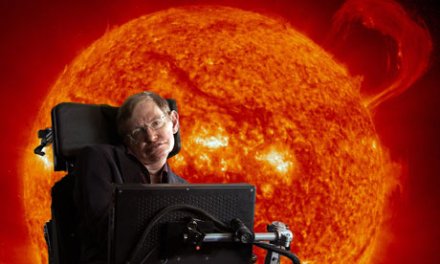
As a human being who often struggles with relatively trivial difficulties in life, I have long felt admiration for Stephen Hawking’s courage and determination to continue working in spite of a highly-debilitating disease. As a physics enthusiast, I have the greatest respect for his accomplishments. But now, as a result of an article published in The Guardian two weeks ago, I also feel embarrassment for, and disappointment in, Hawking. The article reported his views on religion and metaphysics — they were unoriginal, ill-informed, biased, insensitive, and even arrogant.

The article was entitled, “Stephen Hawking: ‘There is no heaven; it’s a fairy story’.” I don’t believe Hawking is capable of such an inane statement, so I attribute this bit of silliness to the reporter’s desire for an attention grabbing headline. It’s just another example of why no one can trust reporters. Unfortunately the rest of the silliness that follows is undoubtedly Hawking’s.

Continue reading

Our analysis of the Great Debate

Well, it didn’t quite take us a week — we were just so excited by “The Great Debate: Is There Evidence for God?” that we couldn’t wait to comment on it. The following analysis is co-written by Surak and Sarah.

The two opposing sides of the scientific debate over the God hypothesis were well represented on Wednesday by Dr. William Lane Craig (Christian Philosopher and Theologian from Talbot School of Theology) and Dr. Lawrence Krauss (Theoretical Physicist from Arizona State University). Dr. Craig’s argument was based on the clearly-stated and logical assertion that if God’s existence is more probable given certain information, that information meets the essential criterion for evidence. Dr. Krauss was equally clear in his definition of evidence: it must be falsifiable to be scientific. We find both standards to be very useful.

There was some confusion on the part of the moderator as to whether the topic of the debate was the existence of any evidence for God or the existence of enough evidence to prove God’s existence. We think the moderator erred in his statement of the debate’s purpose, since no one could reasonably argue that there is proof or disproof of God’s existence. As Dr. Krauss correctly stated, science cannot falsify God; so, the question can only be, “Is God likely?”

We will assess the debate in terms of whether or not there is any evidence for the existence of God, although Dr. Krauss tried to set the bar unfairly high with his assertion that a highly extraordinary proposition, such as the God hypothesis, requires extraordinary evidence. However, we think defenders of the God hypothesis can accept and meet this challenge.

Continue reading

Summary of Gerald Schroeder event

As previously announced here, acclaimed scientist and theologian, Dr. Gerald Schroeder, presented a lecture last evening in Austin on the origins of humankind from a scientific and biblical perspective. By my count, over 150 people attended the lecture, with the audience skewing very young. Dr. Robb Wilson of The Scholar Redeemer audio-recorded the lecture, and we should have a podcast of sorts available here within the next few days. In the meantime, here is a brief summary of the event.

Dr. Schroeder began with his explanation for reconciling the biblical calendar with the scientifically-calculated age of the universe of 14 billion years using the well-studied phenomenon of time dilation that arises from the expansion of the universe. His explanation hinges on an ancient interpretation of Genesis 1, which says that the first six days are distinct and separate from the rest of the biblical calendar. He argued that these six days actually contain billions of years if looked at properly. Genesis time stops partway through the sixth day with a special event — the creation of Adam — at which point the conventional biblical calendar starts. Dr. Schroeder then segued into the main topic by announcing that Adam had parents. I suspect some people were rather shocked by this notion, but Dr. Schroeder laid out the overwhelming scientific evidence for pre-Adam hominids as well as evidence from the Bible itself. The key point was that the creation of Adam was a spiritual creation, not a physical one. Human-like beings existed prior to Adam, but they were not human because they lacked the neshama (which we may be tempted to call the “soul,” but it’s more than that). After Adam received the neshama, he is described as becoming a “communicating spirit.” This tells us that the defining quality of Adam as a human being, what separated him from his predecessors, was the ability to communicate with God.

The lecture ran slightly long, which unfortunately only left time for half a dozen questions from the audience. But they were all good, substantive questions; one in particular (which I can’t remember, but will hopefully be audible on the recording) was of particular interest to Dr. Schroeder. Several young people approached Dr. Schroeder after the lecture with more questions and comments and requests for book signings. I noticed that several of them were also taking photos of the diagrams he made on the whiteboard during his talk. For any of our readers who were present at the lecture and would like to know more about the information in those diagrams, I strongly encourage you to read his best-selling book, The Science of God.

Update: Due to some unforeseen difficulties posting the audio recording, there will be no podcast of the lecture. Sorry.

Continue reading

Alien life and the Christian view of Creation

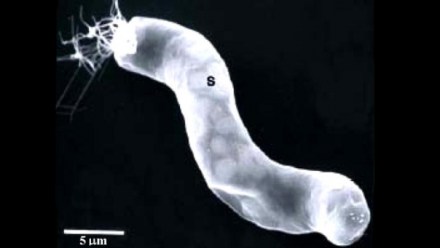
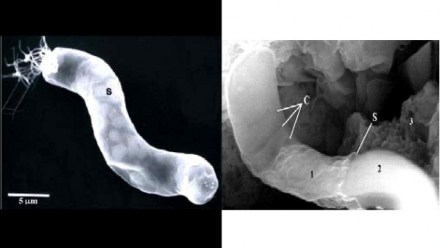
A bacterium from the meteorite (right) is similar in size and structure to the terrestrial bacterium Titanospirillum velox (left) (Riccardo Guerrero / Richard B. Hoover / Journal of Cosmology)

Fascinating:

Dr. Richard B. Hoover, an astrobiologist with NASA’s Marshall Space Flight Center, has traveled to remote areas in Antarctica, Siberia, and Alaska, amongst others, for over ten years now, collecting and studying meteorites. He gave FoxNews.com early access to the out-of-this-world research, published late Friday evening in the March edition of the Journal of Cosmology. In it, Hoover describes the latest findings in his study of an extremely rare class of meteorites, called CI1 carbonaceous chondrites — only nine such meteorites are known to exist on Earth.

Though it may be hard to swallow, Hoover is convinced that his findings reveal fossil evidence of bacterial life within such meteorites, the remains of living organisms from their parent bodies — comets, moons and other astral bodies. By extension, the findings suggest we are not alone in the universe, he said.

Claims like this have been made before, and while previous claims turned out to be unsupported by the evidence, they always give rise to the question of whether the presence of life elsewhere in the universe undermines the Judeo-Christian view of Creation. The best answer is the simplest one: it doesn’t. Ancient and medieval Jewish scholars of the Genesis account of creation maintained that the universe was created with the potential for life built into it. This agrees with the growing scientific evidence that the universe is undeniably tuned for life. Working from both perspectives, I would be surprised if we did not eventually find evidence of at least the most basic forms of life elsewhere.

The religiously pivotal question is whether or not we ever find intelligent or even conscious life elsewhere since, according to the Judeo-Christian view, these would have to be deliberate creations by God. As physicist and theologian Gerald Schroeder points out in his book The Science of God, two different verbs are used in Genesis when describing key events: “created” and “made.” The former refers to the instantaneous act of bringing something into existence from nothing. Genesis uses this word only three times: first for the creation of the universe on day one, then for the creation of animal (intelligent) life on the fifth day, and for the last time on the sixth day when Adam is endowed with a human soul. For the remaining events of the six days of Genesis, including the third day when life first appears, the word “made” is used, as though something that already existed was merely being restructured. Non-intelligent forms of life, like the primitive bacteria discovered by Dr. Hoover, would fall under the category of “made.” Intelligent and conscious forms of life would fall under the category of “created.”
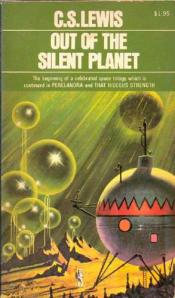
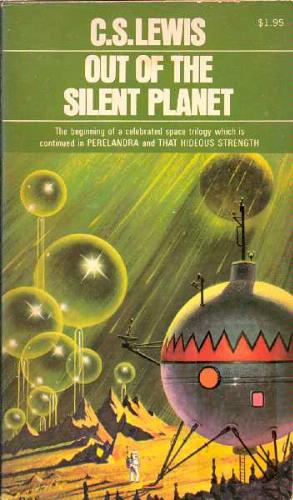
With this in mind, let’s ask a revised version of the key question, “Would the discovery of conscious beings elsewhere in the universe undermine the Judeo-Christian view of Creation?” It would if Genesis stated that the creation of Adam is a unique event, not to be repeated elsewhere in space or time. I have not seen anything in scripture to suggest this is the case. In fact, the great Christian apologist, C. S. Lewis, laid out a plausible scenario for conscious life on other planets within the context of the Judeo-Christian view in The Space Trilogy. In these novels, humans encounter alien beings on other planets in the solar system that, though they have some things in common with us, are wonderfully unfallen and thus enjoy direct communication with the Creator.

This brings us to one of the great problems for the materialist view that humans have no spiritual component: the need to explain why an overwhelming majority of humans throughout history have demonstrated a deep longing for the spiritual. The prevailing explanation seems to be that it is an evolutionary tic, an unfortunate byproduct of an otherwise beneficial genetic mutation. So let’s engage in a bit of speculation to turn the tables: would the discovery of conscious beings on another planet who turn out to be as spiritually-inclined as humans undermine the materialist view of existence? Seems to me it would, given the immense improbability of two entirely different species of conscious beings developing the same evolutionary tic independently.

Continue reading

Austin lecture event: The Origins of Humankind

For those of you in the Austin, Texas area, the Christian Faculty Network is coordinating a special event in early March:

The Origins of Humankind: From Mud to Man
Comparing Biblical Writings with the Fossil Record

Presented by Dr. Gerald Schroeder

Tuesday, March 8th, 7:00 – 8:00 PM with Q&A to follow
The University of Texas at Austin, Ernest Cockrell Jr. Hall, Rm. 1.202

Free and open to the public

Gerald Schroeder is an MIT-trained physicist and author of the bestselling book The Science of God. He was on the staff in the physics department at MIT before moving to Israel to join the Weizmann Institute, the Volcani Research Institute, and the Hebrew University. He has consulted for agencies of several national governments and lectured all over the world. He has several scientific publications, and his work has been reported in Time, Newsweek, and Scientific American. His formal training in chemistry, physics, and the Earth and planetary sciences provides the basis for the broad scientific perspective he brings to his books and lectures. For the past twenty five years, Dr. Schroeder has also pursued a study of ancient biblical interpretation. An ability to handle the biblical material in the original languages allows him to tap the subtle depths contained in the original texts.

Continue reading

Billions of planets in the Milky Way?

About 50 billion, to be specific. If you take the results from the Kepler Mission and do a bit of math, that’s the implication. Hundreds of millions of those planets are predicted to be in the habitable zone, too.

I’ve seen a moderate amount of hubbub about the theological implications of finding life elsewhere in the universe, especially intelligent life. I’ll likely post on this in the future, but for now I’ll just point out two things: 1) the Bible is mute on the subject; and 2) the great Christian apologist, C. S. Lewis, had no problem with the prospect of intelligent life out there. (He did, however, express concern about humankind’s likely behavior toward any alien life we might encounter. Unfortunately, he’s probably right, but I’ll keep watching Star Trek and hoping for the best anyway.)

Continue reading