A super-hot, super-dense super-Earth

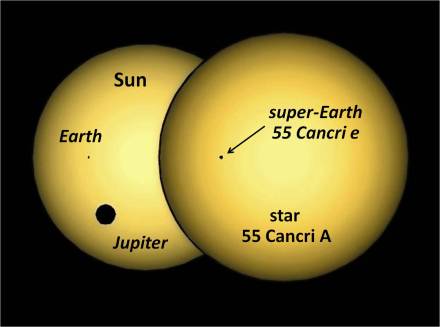
A simulation of a transit by 55 Cancri e as its orbit takes it in front of the star 55 Cancri A. The Sun, Earth, and Jupiter are shown for comparison.

How would you like to visit a “super-Earth” with three times the gravity of Earth, a surface temperature that’s 100 times hotter, and a year that’s only 18 hours long?

Welcome to exo-planet 55 Cancri e. Located 40 light-years from our solar system, this super-Earth is 60 percent larger in diameter than Earth and eight times as massive, making it about as dense as lead. 55 Cancri e orbits its own sun, a star called 55 Cancri A, in such a tight orbit that the star appears 60 times bigger in the sky than the Sun appears to Earth observers.

Astronomers discovered 55 Cancri e using the Doppler “wobble” method, where slight variations in the wavelength of light coming from the star are used to infer the presence of unseen planets exerting tiny gravitational tugs on the star. (Any potential observers on 55 Cancri e could infer the presence of Earth the same way: our own Sun wobbles slightly as it spins due to the gravitational influence of the planets in our solar system.) The orbital period, or year, for 55 Cancri e was measured by the transit method. This method requires very sensitive instruments, as it measures the tiny decrease in light coming from the star as the planet periodically passes in front of it (see above illustration).

If you have a clear view of the sky at night you can see 55 Cancri A for yourself. It’s a sixth magnitude yellow dwarf star that’s just visible to the naked eye. Look for it in the constellation Cancer, but don’t strain yourself looking for any of its planets — they’re too small to be seen even with the best telescopes.

Continue reading

Endeavour’s last mission and strange physics

Shuttle flight #134 out of 135 is set to launch this Friday, April 29, when Space Shuttle Endeavour will blast into space for the last time. During its last mission, the Endeavour crew will deliver a special physics instrument to the International Space Station.

The instrument, called the Alpha Magnetic Spectrometer (AMS), is designed to make detections of exotic phenomena that are not observable from the surface of the Earth, including antimatter, dark matter, strangelets, and cosmic ray counts. These are all important for testing various theories and for practical reasons.

Antimatter

Big bang theory requires that equal amounts of matter and antimatter existed in the very early history of the universe. The matter and antimatter would collide and annihilate, producing a burst of energy. The great mystery is why our galaxy and everything we observe appears to be made of matter. Actually, the great mystery is why there is any matter at all, for if there was an equal amount of antimatter, all of it should have been annihilated. Some theories propose a tiny asymmetry, with slightly more matter than antimatter, but these theories raise problems of their own. It is important to determine whether any antimatter still exists in the universe, and this is where AMS comes in. AMS is designed to be highly sensitive to antimatter detections all the way to the “edge” of the observable universe.

Dark Matter

Anyone who has been fortunate enough to view the night sky free from the glow of city lights knows that the sky appears to be awash in stars. It’s tempting to think the entire universe looks this way, but this view is misleading. Our night sky provides a local view of a particularly dense area of the universe, the inside of a galactic disk of stars. Even the lovely visage of seemingly endless galaxies in the Hubble Ultra Deep Field may tempt the viewer into thinking the universe is overflowing with galactic material. The (theoretical) reality is that the vast majority of the “stuff” of the universe can’t be seen at all. In fact, according to the latest results from WMAP, stars and gas make up less than 5% of the total stuff out there. Dark matter is theorized to make up 23% of the total stuff (with dark energy making up the biggest chunk at 72% of the total). Even though it’s supposed to be a major constituent of the universe, dark matter has never been directly detected. AMS will look for neutralinos, the leading candidate for the dark matter particle. Theory predicts that when neutralinos collide, they produce other charged particles and energy, which can be detected by AMS.

Strangelets

One of the great discoveries of particle physics was the quark, the basic building block of matter. “Normal” matter (also called baryonic matter) comprises the familiar things of existence, from people to planets to stars. Normal matter is made of two kinds of quarks, called “up” and “down” quarks, bound together in groups of three. Four other types of quarks — called charm, strange, top, and bottom — were predicted to exist and subsequently discovered in particle accelerators. Some of these quarks are known to combine into other types of hadrons, or heavy particles. One theory predicts that strange quarks may group with up and down quarks to make extremely heavy “strange matter” particles called strangelets. Theory predicts that if strange matter comes into contact with normal matter, it could convert the normal matter into strange matter. AMS is designed to make detections of these strangelets if they do in fact exist.

Cosmic Ray Counts

If we have any hope of sending a manned mission to Mars we will need an accurate measurement for the rate of cosmic rays in our solar system. Cosmic rays are charged particles accelerated to near-light speeds, and they represent a major hazard to astronauts who would be exposed to them in space long term without the protection of the Earth’s atmosphere. AMS will make accurate counts of cosmic rays in the solar system so that scientists and engineers can devise appropriate protection for Mars-bound astronauts.

Continue reading

Supernova remnant a royal herald?

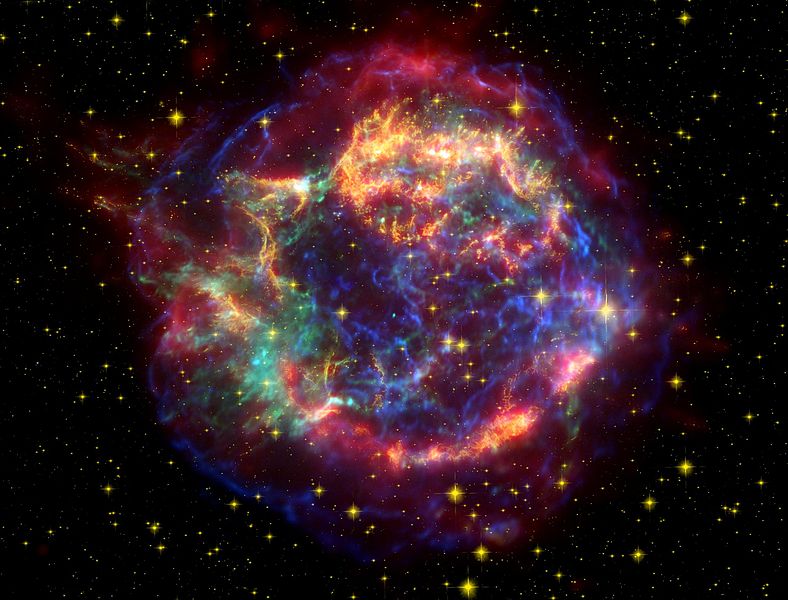
Multi-wavelength image of Cas A from the Hubble, Spitzer, and Chandra Observatories

Restoration historians in England may be giving astronomers reason to rethink the age of one of the most well known objects in our galaxy, supernova remnant Cassiopeia A (also called “Cas A”).

The Restoration refers to the return of Charles II to England, and thus the restoration of the monarchy. His father, King Charles I, was executed in 1649 at the height of the English Civil War, after which Oliver Cromwell became Lord Protector of England, Scotland, and Ireland. Cromwell ruled for nine years until his death in 1658. Two years later Charles II, who had retreated to mainland Europe, returned to England and assumed his father’s throne.

So far, all of this is established historical fact. What has been largely considered legend up until now is that a bright “star” appeared midday on May 19, 1630, the birth date of Charles II. Long thought to be Restoration propaganda, new historical evidence has emerged that lends credibility to this account. If true, it could be that the bright midday star was the light from supernova Cas A arriving at Earth. This means astronomers may have to rethink their estimate for the age of supernova remnant Cas A, since its appearance has typically been dated to 1667 or 1680.

King Charles II of England

Although recorded as a bright star in 1680 by John Flamsteed, England’s first Astronomer Royal, the supernova remnant wasn’t rediscovered until 1947 when — having long faded as a visible object — it was detected as a powerful radio source outside of our solar system.

Many descriptions of Cas A state that it exploded in the late 17th century, but this is a bit misleading. Cas A is estimated to be 11,000 light-years away from Earth, which means the supernova actually occurred 11,000 years before Charles II, or anyone else in the 17th century, was born — so what these descriptions mean is that the explosion would be visible to observers in the 17th century, when the light finally reached Earth.

Modern astronomers use the size of the remnant together with a measurement for how fast the remnant is expanding to work backward and calculate when the progenitor star must have exploded. The calculation predicted Cas A would be apparent to Earth observers in 1667. If instead the explosion was actually visible in 1630, it could be that the rate of expansion of the remnant has not been uniform as was assumed. In order to bolster this new hypothesis, however, historians will need to find accounts of the 1630 midday star in other historical records from that time.

Below is a time-lapse vid showing how Cas A has expanded noticeably in just a few years. Keep in mind the remnant is already 10 light-years across after ~340 years, so that material has been expanding very quickly — on average, about 20 million miles per hour.

Continue reading

Our analysis of the Great Debate

Well, it didn’t quite take us a week — we were just so excited by “The Great Debate: Is There Evidence for God?” that we couldn’t wait to comment on it. The following analysis is co-written by Surak and Sarah.

The two opposing sides of the scientific debate over the God hypothesis were well represented on Wednesday by Dr. William Lane Craig (Christian Philosopher and Theologian from Talbot School of Theology) and Dr. Lawrence Krauss (Theoretical Physicist from Arizona State University). Dr. Craig’s argument was based on the clearly-stated and logical assertion that if God’s existence is more probable given certain information, that information meets the essential criterion for evidence. Dr. Krauss was equally clear in his definition of evidence: it must be falsifiable to be scientific. We find both standards to be very useful.

There was some confusion on the part of the moderator as to whether the topic of the debate was the existence of any evidence for God or the existence of enough evidence to prove God’s existence. We think the moderator erred in his statement of the debate’s purpose, since no one could reasonably argue that there is proof or disproof of God’s existence. As Dr. Krauss correctly stated, science cannot falsify God; so, the question can only be, “Is God likely?”

We will assess the debate in terms of whether or not there is any evidence for the existence of God, although Dr. Krauss tried to set the bar unfairly high with his assertion that a highly extraordinary proposition, such as the God hypothesis, requires extraordinary evidence. However, we think defenders of the God hypothesis can accept and meet this challenge.

Continue reading

MESSENGER’s first image from orbit

The MESSENGER probe began sending images of Mercury back to Earth yesterday. Here is the historic first image from orbit:

Click on the image to go to the MESSENGER website and download a larger version.

The large feature with rays, near the top of the photo, is an impact crater named Debussy. The crater is about 85 km across, with the rays stretching hundreds of km, covering much of the southern half of the planet. Radio images of the crater and rays indicate that it’s a relatively young crater, though astronomers don’t know how young.

Image of impact crater Debussy taken by MESSENGER during a previous flyby of Mercury

Continue reading

Astronomers discover an unusually bright supernova

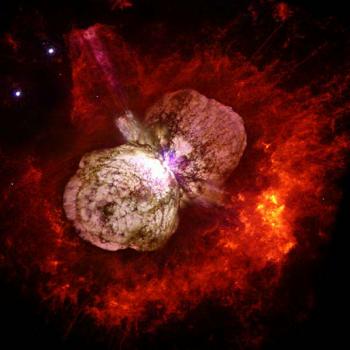
Astronomers have discovered a rare, ultra-luminous supernova whose intrinsic brightness, at peak luminosity, was 100 billion times that of the Sun. This special type of stellar explosion, called a self-interacting supernova or super-luminous supernova, results from exploded material interacting with previously puffed-off layers from the star. The type of progenitor star whose fate it is to end this way is called a luminous blue variable. A well-known example in our own galaxy is Eta Carinae, pictured below.

Luminous blue variable star, Eta Carinae, could end its life as a super-luminous supernova

Measured to be about 3.7 billion light-years away, the extreme brightness of the newly discovered supernova allowed astronomers to detect it using a relatively small robotic telescope that’s part of the ROTSE Supernova Verification Project (RSVP). So far, RSVP has found five of the 12 known supernovae of this type. To give you some idea how rare these objects are, consider how supernovae are named. This particular object is called SN 2008am. The numbers tell us the year it was discovered, while the letters tell us the order in which it was discovered. The first supernova detected in 2008 was called 2008a, the second 2008b, and so on. This makes SN 2008am the 39th supernova discovered that year. I don’t know the total number of supernovae that were discovered in 2008, but the RSVP website indicates an object named SN 2008io, which means there were at least 249. (All of those are in other galaxies, by the way — we haven’t observed a supernova in our own galaxy for about three hundred and fifty years.) So, 12 super-luminous supernovae out of hundreds of all types observed annually makes these particular objects rare indeed.

Continue reading

Evidence for jet mechanism of black hole Cygnus X-1

Artist's conception of material from a nearby star forming a plasma disk around black hole Cygnus X-1. Credit: ESA

Astrophysicists have observed what appears to be direct evidence of strong magnetic fields around a black hole, supporting a popular theory about the production of plasma-and-radiation jets observed to emanate from these mysterious objects. The evidence comes from seven years of data showing high-energy polarized light radiated from a region near the event horizon of Cygnus X-1, the first black hole ever observed.

Polarized light is light that vibrates in a specific pattern, and it can be a signature of radiation from charged particles that are sped up in a magnetic field. The magnetic field is a product of super-hot plasma — material torn from a nearby star — that’s smeared into a disk around the black hole. The twisting of the magnetic field lines as the black hole rotates is believed to be the mechanism for producing jets.

Cygnus X-1 was discovered as a mysterious X-ray source in the 1960s, but it was many years later when astrophysicists reached consensus that it was a black hole1. The discovery and speculation as to its nature inspired the prog-rock band, Rush, to write a song about Cygnus X-1 in the late 1970s, complete with some of the best rock-song lyrics of all time:

Continue reading

Coldest-ever brown dwarf discovered

Astronomers have discovered the coldest-ever failed star with a surface temperature of 100o C. To give you some perspective, consider: 1) the hardiest Finns can easily withstand 120o C saunas; and 2) our Sun, a relatively mediocre star, has a surface temperature of almost 5,500o C.

This lukewarm object, called CFBDSIR J1458+1013B, appears to be a brown dwarf, a class of objects somewhere between star and super-planet. The distinction between star and brown dwarf is clear — a star is only a star if it undergoes nuclear fusion in its core — but the distinction between brown dwarf and super-planet isn’t as clear.  Brown dwarfs are all about the same size as Jupiter, but they pack a lot of mass into that space — at the high end of the range, they can be 90 times the mass of Jupiter — and unlike planets, they sometimes emit X-rays. CFBDSIR J1458+1013B is at the lower end of the range with a mass of about 6-15 Jupiter-masses. With its super-cool surface temperature, astronomers speculate that it could even have water clouds in its atmosphere.

Continue reading

Stars caught in the act of merging

It appears a close binary system — a pair of stars orbiting so close they were touching — has finally merged into a single stellar object, producing an enormous flash of light in the process. The pair, called V1309 Sco, was observed by astronomers to briefly reach a luminosity 10,000 times greater than normal (30,000 times more luminous than the Sun) before settling back down to its normal brightness. Astronomers believe the unusual flash corresponded to the moment when the two stars merged — the first time such an event has been directly observed.

It is not known how common such close pairs are, but multiple-star systems of larger separation are quite common. This vid features animation (apparently using real data) showing the orbits of several known binary star systems.

Continue reading