Weekly Psalm 19: Mars

Here is your weekly reminder of Psalm 19 — Mars.

mars-globe-valles-marineris-enhanced-br2

This image shows Mars from 2500 km above its surface. The great slash covering more than half of Mars’ apparent diameter is Valles Marineris (Mariner Valley), named after its discoverer, the Mariner 9 orbiter that visited the Red Planet in the early 1970s. Valles Marineris dwarfs the Grand Canyon — it is 4,000 km long, 200 km wide, and in some parts it is 7 km deep. To put this into perspective, consider that the distance from Seattle to New York is 4,600 km.

Why do we love Mars so much? I think it’s because for two centuries Mars offered the most tantalizing possibility of extraterrestrial life in the universe. It started in the 18th century when William Herschel was moved by similarities between the Red Planet and Earth to speculate that it may be inhabited, and was further fueled a century later by Giovanni Schiaparelli’s observations of what he thought were canals on its surface.

We’ve observed Mars in much greater detail through several NASA missions, including landers, and have found no compelling evidence that is now or has ever been inhabited. Yet that hardly seems to matter. Perhaps it is because Mars offers a challenge that’s tantalizingly within reach — to visit the planet and perhaps even colonize it — that we remain so fascinated with our nearest planetary neighbor.

Image credit:NASA/JPL-Caltech.

Which god is the Creator?

Speaking of anklebiters, ‘francisco’ asked the following in the comments to an article about quantum mechanics and the creation of the universe:

is there physical evidence that the cause of the universe is a superior been?
and if that was the case, which one of the thousands of gods the human has created is the cause of the universe?

I suspect he is not entirely sincere in his desire to know the answer to the first question (anklebiters are tediously reliable with their tells). In any case, francisco, if you’re reading this, I suggest you look through the archives of this website [here and here, especially] and read Gerald Schroeder’s book, The Science of God, to acquaint yourself with the evidence for God’s existence.

The second question is meant to show how arbitrary it is to believe in any one particular god as the creator of the universe, so, ha ha, aren’t we Christians a bunch of rubes. But it’s really just a silly question that betrays an ignorance of the basics of world religions and unforgivably superficial thinking.

Let’s consider the panoply of gods in Greek mythology. Each god governs an aspect of nature, or an abstract idea, an occupation, and so on. Zeus rules the skies, Poseidon rules the seas, Aphrodite is the goddess of love and beauty, and so on. None of them is a supreme being or creator god, so we can rule them all out. Likewise for the Roman gods, the Viking gods, the Babylonian gods, and so on. That narrows things down considerably.

That’s not to say that these religious traditions do not include creation myths. In fact, it’s become something of a secular fad to point out the similarities of the earliest creation myths with details of Genesis in an attempt to discredit the latter. However, once you examine these creation myths you begin to see that they invariably skirt the issue of the creation of the universe and deal instead with the establishment of the divinity of earthly rulers or the creation of a new world, land, or empire. Such is the case with the Mesopotamian and Egyptian creation myths that predate the writings of Moses, as well as others like the Greek, Roman, and Viking myths.

What we’re left with is three religious traditions that hold to a definite, coherent account of the creation of the universe from nothing by a supreme being. Furthermore, they are the only religious traditions I’m aware of that recognize the linearity of time and a timeline for creation that corresponds to the scientific record. These are, in order of their historical establishment, Judaism, Christianity, and Islam. So, it really comes down to two supreme beings — God and Allah. There are ways to distinguish between the two as the most likely candidate for the creator of the universe, but I’ll save that for a later discussion.

Anklebiters

There is a particular type of atheist who just can’t help but strike a pose of sneering superiority every time someone posts my testimony somewhere on the Internet:

These guys usually turn out to be the variety of atheist known as “anklebiter,” described by Vox Day here:

Anklebiters are a brain-damaged form of midwit. They are almost always atheist, further pointing towards the atypical neurological profile required for that, they are usually male, and they tend to be unexpectedly poorly educated and badly read despite their observable intelligence. Most importantly, they lack the normal ability to admit failure, back up, and start over that normal individuals possess. And lacking it, they therefore lack any ability to improve their arguments or even to question any of their adopted beliefs.

That’s why anklebiters are always disappearing when trounced, only to reappear again and make the exact same arguments that have already been dismissed. The problem … is that this renders them immune to dialectic, and they tend to ignore pure rhetoric because they are not emotionally invested in their nonsense arguments. The more virulent form, the trolls, are sociopathic and have no meaningful human emotions to which one can appeal.

In effect, anklebiters are little more than genetically human bots, which is why there is no point in arguing with them or insulting them. They are not capable of adding anything to the discourse, so as soon as an anklebiter is identified, they are best ignored…

If they start showing up here in numbers, I will probably have to take that advice. For now, I tend to engage them, because I can practically guarantee they will disappear as soon as I invite them to participate in meaningful discussion. 

I have not heard from this person since. Maybe he’s reading through the website and formulating a response. If he fails to respond with anything substantial, it will be consistent with the anklebiter profile.

Speaking of which, our old friend OpenMind back popped up again to suggest I read some book or other:

Never got a response to that. Maybe he’s reading Vox’s book, but I tend to doubt it. I challenged another atheist who was email-pelting me with endless questions to read it, and never heard back from him. (Vox’s book seems to have the same affect on atheists that a crucifix has on vampires.)

[If you’re wondering what a midwit is, see here.]

Weekly Psalm 19: The Horsehead Nebula

Here is your weekly reminder of Psalm 19 — the Horsehead Nebula.

Hubble_Sees_a_Horsehead_of_a_Different_Color
The Horsehead is one of the best-known nebulae, owing to its distinctive shape in the likeness of — you guessed it — a horse’s head. This is one small part of a region of ongoing star formation in the great Orion Molecular Cloud Complex. The pink color in the cloud is a result of hydrogen gas excited by the ultraviolet light from a nearby star.

Most images of the Horsehead Nebula show it in visible light; the above image is in infrared, which allows us to peer into the inner structure of the cloud. Visible light is blocked by dusty gas, but longer wavelength infrared light can penetrate the dust.

Image credit:NASA/ESA/Hubble Heritage Team.

Darwin’s junk science

One of our readers, Russell, is studying Darwin’s On the Origin of Species, and finding it less than compelling:

I’m halfway through “On the Origin of Species” So far, it’s been junk science. I’m serious, multiple times now he’s said something along of the lines of “I totally have super-solid proof, but I don’t have room in the book to share it. Any of it. Ever. But believe me, it’s totes awesome.” And “Let’s say evolution could possibly do X.” Then a few sentences later, “Since evolution does X, it does Y.” No proof offered, nothing but assertions and denial of actual data.

So far, he’s done one experiment with bees, gave up in the middle of it, and then declared it was a success!

How this became as popular as it did baffles me. How it became a cornerstone of scientific thought confuses me to no end.

If people, especially scientists, actually read his book with the same skepticism they use for just about anything else, I’m sure they’d toss out Darwin’s evolution and start over.

For me, as a believing Christian, Darwin’s book has only strengthen my conviction that the Bible’s account of creation is more accurate in description than the theory of evolution.

This is why you should always go to the source, and not take anyone’s word for what an author said or meant.

As for why the book became so popular, my guess is that it’s mostly to do with Thomas Huxley, aka Darwin’s Bulldog. Huxley latched onto Darwinian evolution as a way to undermine Christianity, even though he was aware of its scientific shortcomings. It’d be difficult to quantify, but he was at least modestly successful in that regard. Huxley’s most profound achievement, however, was to undermine scientific advancement in the field of biology and to erode public trust in science in general. If he had known that this would be the cost of attacking Christianity, I wonder if he still would have promoted Darwin’s idea.


God of the gaps

For all their bluster about how they “*&%#ing love science,” the worldview of the skeptic is, in reality, profoundly unscientific. From Dinesh D’Souza’s, Life After Death:

[While] the skeptic typically fancies himself a champion of science, his whole line of argument is just as unscientific as that of the creationist [who posits the God of the gaps]. For the skeptic, a gap is a kind of nuisance, a small lacuna of scientific ignorance that is conceded to exist as a kind of misfortune, and is expected to soon be cleared up. True scientists, by contrast, love and cherish gaps. They seek out gaps and work assiduously within these crevasses because they hope that, far from being a small missing piece of the puzzle, the gap is actually an indication that the whole underlying framework is wrong, that there is a deeper framework waiting to be uncovered, and that the gap is the opening that might lead to this revolutionary new understanding.

Gaps are the mother lode of scientific discovery. Most of the great scientific advances of the past began with gaps and ended with new presuppositions that put our whole comprehension of the word in a new light.

Next time you find yourself engaged in discussion with an atheist, ask him how he regards gaps in scientific understanding. If it’s anything like this, you know you’re dealing with someone who is intellectually boxed in.

Weekly Psalm 19: Saturn’s Rings and Titan

Here is your weekly reminder of Psalm 19 — Saturn’s Rings and Titan.

saturn-fly-ring-1
At least I think it’s Titan. It’s one of Saturn’s moons, anyway. This image was taken by the Cassini spacecraft as it orbited Saturn. The spacecraft is named after the 17th century Italian astronomer, Giovanni Cassini, who studied Saturn extensively.

Here you can see the outer rings of Saturn, including the Cassini Division (the large division between the rings) and the Encke Gap (the smaller gap between the outermost rings). The rings are made of icy and rocky particles that range in size from a thousandth of a millimeter (about the size of smoke particles) up to a meter. It is not known for certain how the rings were formed. One hypothesis is that a moon of Saturn was either ripped apart by Saturn’s gravity or smashed by an asteroid, and the debris formed the rings; another is that the rings are made of leftover material from the formation of the solar system.

Image of Saturn and Titan, credit: Cassini Imaging Team, SSI, JPL, ESA, NASA.

Backyard Astronomy: August 2015

Here are some fun astronomical events you and your family can enjoy in the month of August. All you need is an inexpensive telescope or binoculars for most of these events, but some of them are viewable with the naked eye.

August 7: Mercury, Jupiter, and Regulus will be within one degree of each other in the sky.

August 12-13: Perseids Meteor Shower. Meteor showers occur when the Earth moves through a cloud of debris left behind by a comet. The Perseids are debris from Comet Swift-Tuttle. As meteor showers go, this one is top-notch, producing many bright streaks and up to 60 meteors per hour at its peak. The shower runs every year from July 17th to August 24th, but will peak on the night of the 12th and the early morning of the 13th. Look in the direction of the constellation Perseus after midnight for your best chance.

August 19: Mars will appear to cross in front of the Beehive Cluster, an open cluster of stars located in the constellation Cancer.

August 29: Super Moon. The Moon will be at its closest approach to the Earth during its full moon phase, making it a little bigger and brighter than usual. This will be the first of three Super Moons for 2015.

Earth-like planet kills God dead!

The big news last week was that astronomers (incidentally, some of them colleagues of mine) discovered an Earth-like planet orbiting a Sun-like star. The exoplanet, dubbed Kepler-452b, was discovered by the Kepler space telescope and recently announced by its discoverers. It is 1,400 light-years away from Earth and appears in the constellation Cygnus.

It’s exciting news, and probably had more than a few nerds thinking we’re one step closer to the United Federation of Planets, but apparently the really big news is that the discovery of this planet was the death-knell for religious tradition.

In what I suppose is a serious commentary on the discovery Kepler-452b and not satire, Jeff Schweitzer, a scientist and former White House analyst, declares that Earth 2.0 is “bad news for God.” Why? Because Genesis doesn’t mention alien worlds. Of course, Genesis also doesn’t mention bananas, but to my knowledge no one has argued that the existence of bananas rocks religious tradition to its core.

Schweitzer’s first mistake was referring to Kepler-452b as “Earth 2.0.” This newly discovered exoplanet is believed to be Earth-like in terms of its size and proximity to its Sun-like star, and that’s sort of big news, because the majority of known exoplanets are Jupiter-sized or larger and very close to non-Sun-like stars. Kepler-452b is at just the right distance to its Sun-like star to permit liquid water on its surface (a necessary component for life). All this means is that we can’t rule out the existence of liquid water on its surface; it doesn’t mean there is water. And there are known differences between Kepler-452b and Earth: it’s estimated to be 60% larger than Earth (so it’s more like a “Super-Earth”), it’s about 1.5 billion years older than the Earth, it receives 10% more light from its sun than the Earth does from its Sun, its gravity could be anywhere from 80% to 300% of the Earth’s gravity, etc. We don’t know its composition. Is it rocky? Does it have a fluid core that would lead to a dynamo effect? Does it have an atmosphere? Plate tectonics? We currently don’t know the answers to these questions. We therefore have no idea exactly how Earth-like Kepler-452b is or whether it’s suitable for life. And it’s not the only known Earth-like exoplanet, nor is it even the most Earth-like. All good reasons why it’s absurd to call this particular exoplanet “Earth 2.0.”

Nevertheless, Schweitzer goes on to declare that we are coming “ever closer to the idea that life is common in the universe.” That’s quite a leap from the discovery of an exoplanet about which we know very little. But never mind. His point here is to preemptively declare that the discovery of life elsewhere in the universe would be a big problem for “the world’s major religions.” And by “the world’s major religions” he seems to mean Judaism and Christianity (and probably just the latter), since the Bible is the sole focus of his critique.

He begins his theological discussion thusly: “Let us be clear that the Bible is unambiguous about creation:”

Let’s look at what the Bible unambiguously claims about creation, according to Schweitzer:

1. “the earth is the center of the universe”

He doesn’t mention which verse says this. Probably because there is no verse, that I’m aware of, that says this. Ancient Greek philosophy held that the Earth is the center of the universe, and this view was eventually adopted by the Church, whose philosophy was heavily influenced by Aristotle.

2. “only humans were made in the image of god”

Of all the creatures mentioned in Genesis, yes, only humans were made in the image of God. This doesn’t preclude other creatures, not mentioned in Genesis, being made in the image of God. This doesn’t preclude other creatures, not mentioned in Genesis, not being made in the image of God.

3. “and all life was created in six days”

No, all life was created in four days. Plant life appeared on Day 3, animal life appeared on Day 5, and human life appeared on Day 6.

4. “All life in all the heavens. In six days.”

No, all life on Earth. In four days. (See here for why six creation days are fully compatible with a billions-year-old universe.)

Notice that he does not support any of these claims with the biblical verses that supposedly “unambiguously” say these things. Instead, later in his piece, he quotes the Pope during the trial of Galileo on what the Church believed the Bible claimed at the time.

This is why you should never rely on what an anti-theist says about the Bible. Schweitzer is completely wrong. Which means his conclusion is completely wrong, for he goes on to say:

“So when we discover that life exists or existed elsewhere in our solar system or on a planet orbiting another star in the Milky Way, or in a planetary system in another galaxy, we will see a huge effort to square that circle with amazing twists of logic and contorted justifications. But do not buy the inevitable historical edits: life on another planet is completely incompatible with religious tradition. Any other conclusion is nothing but ex-post facto rationalization to preserve the myth.”

Nonsense. What he’s attempting to do is use false assumptions and specious reasoning to justify his leaping out in front of this discovery before anyone’s had a chance to comment thoughtfully on it, and claim it as a victory for atheism. Dibs, everyone!

Is Schweitzer unaware that Christians have already commented on the topic of alien life in the context of Christian theology? C. S. Lewis not only wrote a well-known essay (“Religion and Rocketry“) on the topic, but wrote a science fiction trilogy exploring it in great depth (The Space Trilogy). (Incidentally, I wrote on this topic a few years ago.)

The rest of Schweitzer’s article is filled with theological analysis and reasoning of similar quality. For instance, he quotes Genesis 1:1 and then makes the following claim:

“Nothing in that mentions alien worlds, which of course the ancients knew nothing about. Man was told to rule over the fish on the earth, not on other planets. But god would have known of these alien worlds, so it is curious he did not instruct the authors to include the language.”

One might reasonably ask how man could possibly rule over the fish on other planets, and therefore why it would be of any concern to him that there might be fish on other planets. (I seriously wondered if Schweitzer was having us all on at this point, but since this was The Huffington Post and not The Onion, I had to assume he was sincere.) (Also, what is it with the childish refusal of some atheists to capitalize the ‘G’ in God? Lower-case ‘g’ god denotes a lesser god. God is the supreme being, the God, which is why ‘God’ is capitalized. Spelling it correctly doesn’t mean you agree God exists, it means you understand the concept of a proper noun. It just makes you look like an idiot to refuse to capitalize the name.)

He then goes on some weird tangent about some verses in Genesis that shows he doesn’t understand that Genesis refers to the entire universe for the first two days, and then specifically the Earth for the remaining days. It was all so contorted and confused that it made my head hurt. He amusingly concludes this word-salad passage with “Let us be perfectly clear…”

Schweitzer ends his piece with the statement that, “none of this will matter upon life’s discovery elsewhere. Religious leaders will simply declare that such life is fully compatible with, in fact predicted by, the Bible.” He’s right that this sort of poor understanding of the Bible and lousy reasoning are utterly inconsequential to any possible discovery of life elsewhere in the universe. As for whether the existence of life elsewhere is compatible with, even predicted by, the Bible, consider that the great biblical commentator, Nahmanides, inferred from Genesis that the universe was created with the potential for life built into it. Since he claimed this over 700 years ago, I’d say our side had dibs long before Schweitzer’s.

Weekly Psalm 19: The Antennae Galaxies

Here is your weekly reminder of Psalm 19 — the Antennae Galaxies.

hs-2006-46-a-large_web

This spectacular pair of colliding spiral galaxies is located 45 million light-years from Earth. They started their encounter a few hundred million years ago, but the entire collision will likely last a couple billion years. Drawn together by their mutual gravitational attraction, they will undergo several passes and collisions before their stars and gas finally settle down to make a new, single galaxy. The interaction has sparked intense star formation, visible as the blue regions, surrounded by excited hydrogen gas, visible in pink.

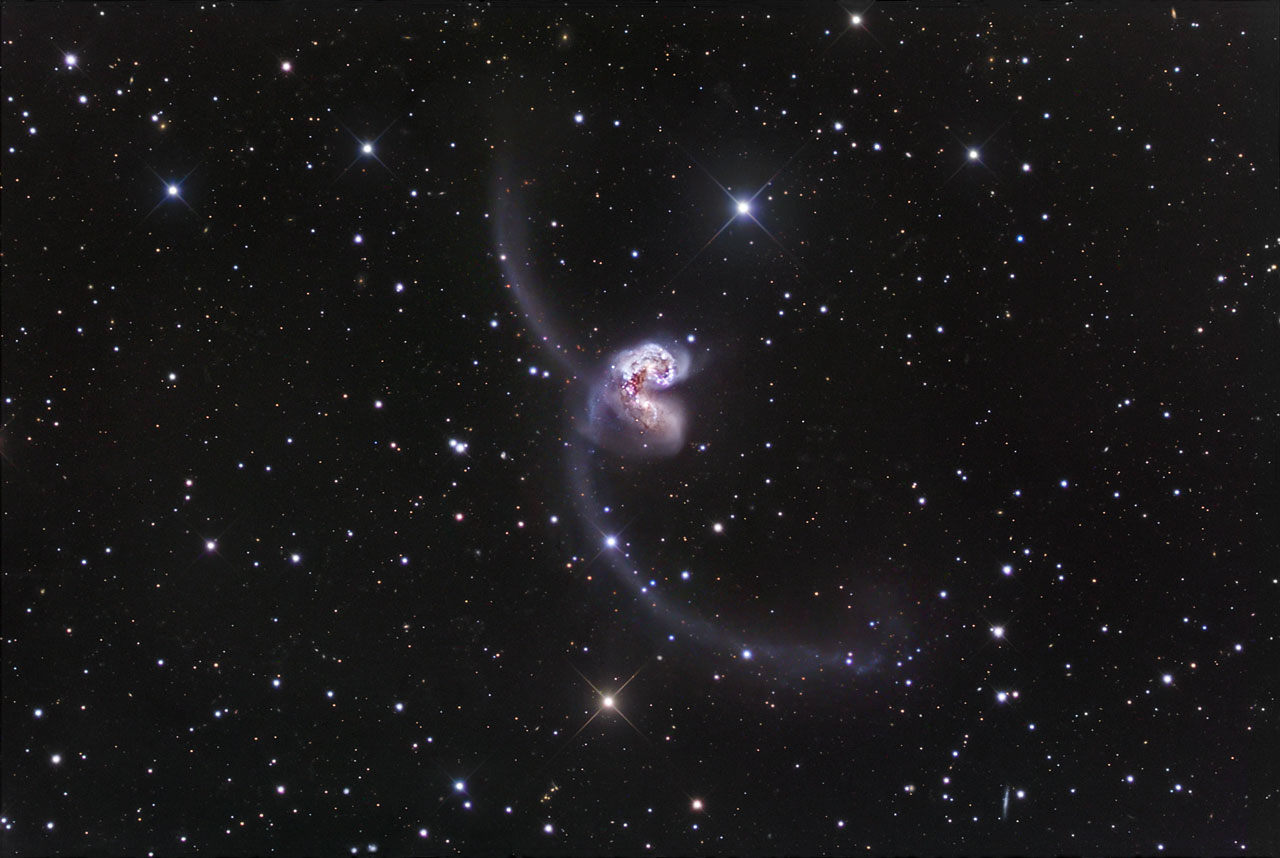
The Antennae Galaxies derive their name from the long streams of stars that extend from the galaxies like antennae, seen in wider-field images, like the one below.

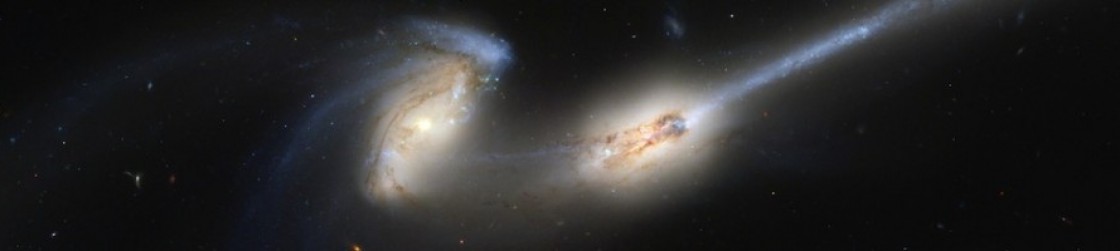
The Milky Way Galaxy is on a collision course with its nearest neighbor, the Andromeda galaxy. At some point during this future encounter, the collision will probably look much the same as the Antennae Galaxies:

Top image of the Antennae Galaxies, credit: NASA, ESA, and the Hubble Heritage Team (STScI/AURA)-ESA/Hubble Collaboration. The wide-field ground-based image was taken by Robert Gendler.