Scientists at Yale University construct the world’s first “nega-laser.” It’s interesting from a mad scientist perspective, but it also has practical applications for cancer treatment and optical computing.
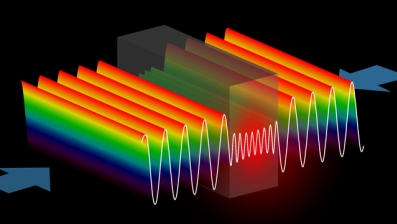
Yidong Chong/Yale University

Scientists at Yale University construct the world’s first “nega-laser.” It’s interesting from a mad scientist perspective, but it also has practical applications for cancer treatment and optical computing.
Yidong Chong/Yale University
Astronomers have known about the existence of planets around other stars since the early 1990s. Since then, over 500 confirmed extra-solar planets (or “exoplanets”) have been discovered. Most of them are gas giants like Jupiter, since these are the easiest to detect. The holy grail, as it were, of exoplanet searches is Earth-like planets in habitable zones around other stars. The habitable zone is the orbital distance from a star that would permit the presence of liquid water and Earth-like life. The Kepler mission, launched into space in 2009, has found more than 1,200 candidates for Earth-sized planets around other stars, with over 50 of these possibly in the habitable zone.

Artist concept of Kepler-10b, the first rocky planet confirmed by the Kepler mission. Credit: NASA
NASA’s Stardust spacecraft will have a special Valentine’s Day rendezvous with Comet Tempel-1 tonight. This is the second time NASA has visited the comet — the first was in 2005 when the Deep Impact spacecraft made a planned impact on the comet’s surface.

NASA image taken shortly after Deep Impact collided with Comet Tempel-1
 SixDay Science