This is the second part of the two-part article about a particular type of atheist I call the science-fetishist anti-theist (SFA). See here for the first part describing the primary and secondary traits of the SFA.
We’ll now go over actual encounters with SFAs to illustrate those traits.
The following examples are from a minor Twitter “debate” I had with someone who calls himself OpenMind. He initiated contact with me after I posted a Tweet about my testimony; more on that here. What ensued was a confusing morass of SFA talking points, most of which served to show without any doubt that I was dealing with a fairly pure example of a SFA. I tried to move the discussion to this blog, because OpenMind was so scattershot and slippery with his responses on Twitter, but to no avail. So instead I’ll categorize his responses in terms of the SFA traits (some fall into more than one category) and provide some commentary.
The stuff in boldface are the traits.
The stuff after the boldface in italics are the Tweets.
The stuff after that in regular font is my commentary.
Here we go…
Almost immediately refers to the supposed conflict between science and religion in any discussion of science and/or religion with a Christian
OpenMind @MyOpenMind101
@sarahsalviander my view is that religion and science parted company as explanatory tools around the time of Galileo.
OpenMind @MyOpenMind101
@sarahsalviander before them the two on most issues were almost indistinguishable.
OpenMind @MyOpenMind101
@sarahsalviander since then science has provided the best explanation of the natural world and left religion, as a science, in its wake.
Science and religion have never been at odds. That’s an historical lie told by SFAs and other anti-theists to try to divorce Christians from science and science from Christianity. OpenMind does diverge from the SFA script a bit here when he says that science and religion were indistinguishable prior to Galileo, i.e. he seems to concede that they weren’t always at odds; but he frames it as though science was as repressed as religion prior to Galileo’s time, but heroically broke free and left religion “in its wake.” More on this below.
—
If you beg to differ, brings up Galileo and/or Bruno
OpenMind @MyOpenMind101
@sarahsalviander I think both Galileo and Giordano Bruno would disagree. Truth was suppressed as heresy. pic.twitter.com/vysIGXOV5K
Galileo and Bruno are just buzzwords for the SFA. Most likely he doesn’t really understand the history involved. More on this below.
—
Denounces faith as anti-intellectual or anti-reason or anti-science
OpenMind @MyOpenMind101
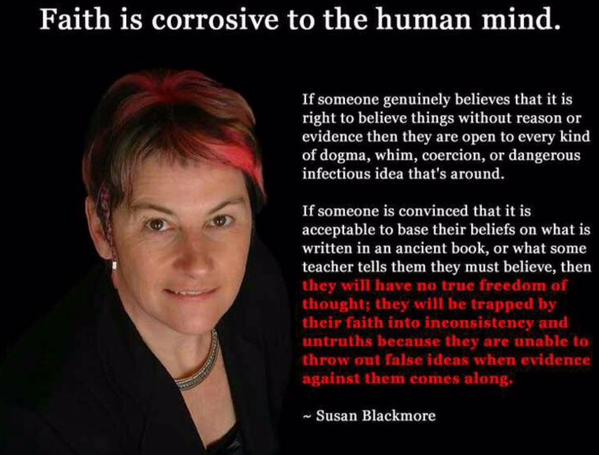
@sarahsalviander you don’t have knowledge, you have a #faith-based belief. #Faith is corrosive to the human mind….. pic.twitter.com/fK4mp2ESZw
This is the image he included.
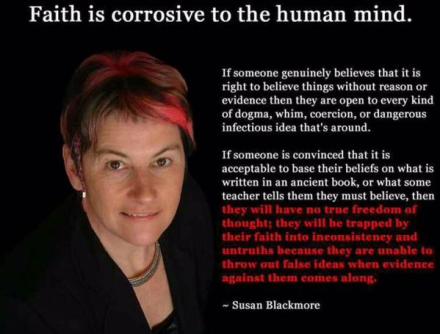
I’d never heard of this person before, but she’s apparently an English atheist and psychologist. Notice how she redefines faith to suit her purpose — she asserts it’s believing something without reason or evidence. This is a secondary trait of the SFA. Whether it’s based on outright deception or ignorance is not always obvious, but my guess is neither this psychologist nor OpenMind have bothered to see what actual people of faith say faith means. C.S. Lewis, arguably the most well-known and respected modern Christian thinker, defined faith as (and I’m paraphrasing here) a belief you’ve accepted on the basis of reason and evidence in spite of your transitory emotions.
The fact is, Christianity is first and foremost a religion of reason and evidence. An atheist may not accept the reasons or the evidence as true, but that doesn’t mean they aren’t offered. If a person has read the Bible, he cannot possibly assert with honesty that Christians are required to believe without reason or evidence. The Bible is filled with reasons to believe, from the opening passages of Genesis to the resurrection of Jesus Christ. We are provided with arguments and evidence for every claim. Jesus Himself performed miracles with the authority of God before hundreds and hundreds of people as evidence for His claims. It’s ludicrous to assert that faith is belief without reason or evidence, but that’s the only way the SFA can position himself as superior to a person of faith.
OpenMind @MyOpenMind101
@sarahsalviander to start with the conclusion in mind as all apologetics does is to force the mind to close, thus rewiring the brain.
Another absurd redefinition. The word apologetic comes from the Greek word apologia, meaning “to give reasons for belief,” not “conjuring up ex post facto reasons for a conclusion I already believe for no apparent reason.”
—
Uses the word “science” a lot as a catch-all for responses to questions
OpenMind @MyOpenMind101
@sarahsalviander since then science has provided the best explanation of the natural world and left religion, as a science, in its wake.
OpenMind @MyOpenMind101
@sarahsalviander your presentation isn’t science.
OpenMind @MyOpenMind101
@sarahsalviander your presentation on the other hand is not science. It is christian apologetics, the antithesis of science.
Blah blah blah science blah blah blah I hope you’re sufficiently dazzled blah blah science blah …
—
Uses the word “science” in nonsensical ways
OpenMind @MyOpenMind101
@sarahsalviander since then science has provided the best explanation of the natural world and left religion, as a science, in its wake.
This is a non-sequitur. Religion is not a science. OpenMind shows how SFAs seem to think that any method of knowing or revealing information is by definition “science,” and some sciences — like religion — are really terrible at science.
—
Refers to any attempt to demonstrate that the Bible is not in conflict with science as “creationism”
OpenMind @MyOpenMind101
@sarahsalviander wow, more creation nonsense. You’re basing this all on bad philosophy. WLC and other apologist try this trick all the time.
In another Tweet, OpenMind accused me of starting with a conclusion in mind, and then justifying it, but that’s essentially what the SFA does. He holds it as self-evident that the Bible is in conflict with science, therefore any attempts to reconcile the two are automatically “creationism” which is synonymous with “magic.”
“WLC” refers to William Lane Craig, a well known Christian apologist, philosopher, and theologian who debates atheists using robust philosophical arguments to demonstrate that there are very sound reasons for belief in God. Contrary to OpenMind’s assertion, these arguments are not “creation nonsense.”
Notice also how OpenMInd redefines an effective counter to atheist arguments as philosophical trickery. (Those nasty, tricksy Hobbitses!) This is the classic “heads, I win; tails, you lose” framing. If you don’t have an effective argument against an atheist’s claims, then you’re engaging in blind faith (belief without reason or evidence), but if you come up with convincing reasons or evidence, it’s trickery.
—
Uses the word “superstition” in reference to your beliefs
OpenMind @MyOpenMind101 May 18
@swiftfoxmark2 Our ancestors superstitions fascinate me.
@sarahsalviander @Spacebunnyday
It’s just a way to try to disqualify your beliefs from being taken seriously without taking the time to refute any particular claims.
—
Despite displaying a near-reverence for science, does not actually know much about science
OpenMind @MyOpenMind101
@sarahsalviander since then science has provided the best explanation of the natural world and left religion, as a science, in its wake.
Sarah Salviander @sarahsalviander
.@MyOpenMind101 Religion was never a science. Modern science is a product of the Christian faith.
OpenMind @MyOpenMind101
@sarahsalviander really? I think you’ll find science predates recorded history and our species….
http://m.rstb.royalsocietypublishing.org/content/366/1567/1028.full.pdf …
Sarah Salviander @sarahsalviander
.@MyOpenMind101 You’ll note I said modern science. And technology != science.
When I point out that modern science (that’s the term used for science that follows the Copernican Revolution) is a product of Christianity, he provides a link to an article about how prehistoric people had stone tool technology millions of years ago. I mean, it’s interesting and all, but even birds with their puny bird brains use technology. Would he claim they’re doing science?
Technology is not synonymous with science. Science and technology often inform each other or make the other one possible, but they are not equivalent. The practice of science involves using the scientific method. If you’re not following the scientific method, you’re not doing science.
Sandy Packer @STPacker915
@MyOpenMind101 @sarahsalviander I have a question. If there was a nothing, then an explosion and life, what exploded? Hawking can’t answer.
OpenMind @MyOpenMind101
@STPacker915 if you read about eternal inflation you might have a better clue. Do engineers still do physics? @sarahsalviander
Someone who appears to be an engineer stepped into the discussion with the above question, and OpenMind’s response was to throw something sciencey at him. (This is related to the frequent use of the word “science” as a catch-all for responses to questions.) Are you dazzled by OpenMind’s response to Sandy’s question? You shouldn’t be. With this response, OpenMind is showing that he is either unaware of or doesn’t care about the limitations of science.
One of the problems with this response is that it’s based on speculation. Inflation is an ingenious idea posited by physicist Alan Guth to explain some otherwise difficult-to-explain features of our universe, and involves a period of extremely rapid expansion just following the big bang. (Personally, I like the inflationary model, and believe that it’s correct, but it remains to be seen whether it stands up to testing.) Eternal inflation was proposed independently by physicists Paul Steinhardt and Alexander Vilenkin not long after Guth first proposed his inflation model, and posits that at least in some parts of the universe, this inflation occurs eternally in the past and the present, giving rise to bubble universes. So, the idea is, what we consider the universe could just be a bubble universe that formed out of another part of a bigger universe. The main problem, of course, is testability. It sounds impressive to answer one of the biggest questions about existence with “eternal inflation!” but we have to consider whether it really answers the question. That’s one of the reasons I wanted to bring the discussion off Twitter and onto this blog, so we could get into it more in depth. I would’ve asked OpenMind what the predictions of the model were and whether they have they been borne out by observation. The answer, by the way, is no, they have not. It’s really just a speculative idea that’s already possibly being ruled out by other cosmological models. The other problem is that it’s not an ultimate answer. Even if it turned out that evidence supported the idea of our universe being a bubble in a larger universe, it doesn’t answer the question of what caused that universe. (In fact, a lot of these atheist rebuttals to “where did the universe come from?” end up being “turtles all the way down.”)
—
Is unaware of most of the history of science
OpenMind @MyOpenMind101
@sarahsalviander since then science has provided the best explanation of the natural world and left religion, as a science, in its wake.
Sarah Salviander @sarahsalviander
.@MyOpenMind101 Religion was never a science. Modern science is a product of the Christian faith.
OpenMind @MyOpenMind101
@sarahsalviander really? I think you’ll find science predates recorded history and our species….
http://m.rstb.royalsocietypublishing.org/content/366/1567/1028.full.pdf …
Sarah Salviander @sarahsalviander
.@MyOpenMind101 You’ll note I said modern science. And technology != science.
OpenMind @MyOpenMind101
@sarahsalviander Galileo, Kepler, Newton, Bacon, Harvey, Boyle, von Guericke among many others performed science as we would now recognise.
Sarah Salviander @sarahsalviander
.@MyOpenMind101 You are not equipped to debate this topic. You do not even realize that “modern science” refers to science post-Copernicus.
OpenMind @MyOpenMind101
@sarahsalviander and ALL the pioneers I mentioned were all performing “science” in the early post Copernican era, your claim is a #fallacy.
This guy has no clue. Modern science by definition refers to the era of science following the Copernican Revolution. It does not by any stretch include prehistorical caveman technology. When I point this out, OpenMind then responds in a way that is so incoherent that I’m not even sure what his point of confusion is. All of the people he listed were contributors to modern science, and all of them were Christians doing modern science in Christian Europe, which supports my claim.
OpenMind @MyOpenMind101
@sarahsalviander I think both Galileo and Giordano Bruno would disagree. Truth was suppressed as heresy. pic.twitter.com/vysIGXOV5K
This is a SFA favorite, but it’s also very easy to refute. A little bit of research reveals that the modern mythologies that have sprung up around Galileo and Bruno are false.
The atheist version of the Galileo story is based on 19th century fabrications by John William Draper and Andrew Dickson White, and goes like this. Copernicus proposed that the Earth goes around the Sun, and when Galileo promoted this obviously-true belief, he was hauled before the Inquisition for heresy, forced to recant by threat of torture, and then jailed for the rest of his life for promoting a view that was in opposition to Church teachings. However, as Dinesh D’Souza points out in his book, What’s So Great About Christianity, the real story is more nuanced and complex than a simple narrative of the Church vs. Galileo. For one thing, the Church did not originate the idea of a geocentric, or earth-centered, universe, the Greeks did. The philosophy of the Church was largely rooted in Aristotelianism, and so there were efforts to make scripture consistent with it. Contrary to the mythology, the Church was not uniformly opposed to the notion that the Earth goes around the Sun, but was divided on it, in no small part due to the lack of evidence in support of it at the time. There is much more to this story (see here and here for succinct accounts), but the TL;DR version is this: Galileo was kind of a jerk who not only went back on an agreement he made with the Church not to promote heliocentrism, but gratuitously humiliated his friend the Pope in the process; there was not yet good evidence in favor of heliocentrism; he was never tortured or threatened with torture or mistreated in any way; the Church was very balanced in its approach to science at the time.
As for Bruno, who was burned at the stake, he was not, as popular myth has it, executed for his scientific views. Rather, his extreme and heretical views on Jesus (not the Son of God), Mary (not a Virgin), and Satan (destined to be redeemed by God) are what got him into hot water with the Church. But, like Galileo, he was turned into a scientific martyr by 19th century historians eager to give the impression that the Church has always been at war with science.
—
Quotes Dawkins, Harris, Stenger, or any other number of anti-theist scientists at you
I can’t remember if OpenMind actually quoted one of these guys at me, but his Twitter feed is rife with quotes from guys like this. The quotes are usually pithy-sounding, but they invariably crumble under the least bit of scrutiny. Take this one for example
“I am against religion because it teaches us to be satisfied with not understanding the world.” Richard Dawkins
It’s a ludicrous claim, given that most of the greatest scientists of the Copernican and post-Copernican era were Christian. Consider this quote from Isaac Newton, a biography of the great scientist by Mitch Stokes:
According to metaphor, God has written two books—Scripture and Nature—and He is glorified by the study of either one. This view, this “belief in the sacral nature of science,” was prevalent among natural philosophers of the seventeenth century. As Frank Manuel, one of Newton’s most important twentieth-century biographers, says:
“The traditional use of science as a form of praise to the Father assumed new dimensions under the tutelage of Robert Boyle and his fellow-members of the Royal Society, and among the immediate disciples of Isaac Newton. … In the Christian Virtuoso, demonstrating that experimental philosophy [experimental science] assisted a man to be a good Christian, Boyle assured readers that God required not a slight survey, but a diligent and skilful scrutiny of His works.”
Although Newton’s intensity while pursuing his work ranges from humorous to alarming, it is put into a different light if we see it as a measure of his devotion to God. For Newton, “To be constantly engaged in studying and probing into God’s actions was true worship.” This idea defined the seventeenth-century scientist, and in many cases, the scientists doubled as theologians. [emphasis added]
—
I hope this has demonstrated to my Christian readers that it’s quite easy to puncture the bubble of nonsense surrounding a SFA. Twitter is not a good venue in which to carry on a debate with a SFA. Arguing with a SFA on Twitter is like being asked to dance in a phone booth; I wanted to move the dance to a stage where we had more room to move around. When I asked OpenMind to come over here, he refused, citing my “ignorance.” He did ask me one question repeatedly that I was willing to answer, but only after he answered a question I posed to him first. For whatever reason, he refused to answer my question (typical avoidance), so I never responded to him on Twitter (that’s one of the first rules of arguing with a SFA: if you ask him a question, do not answer any of his questions until he answers yours first). Here is the question he asked me:
OpenMind @MyOpenMind101 May 18
. @sarahsalviander if you’re [sic] claimed god were proved not to exist would you still want to believe?
OpenMind @MyOpenMind101
@sarahsalviander if your claimed god did not exist would you still want to believe?
It’s obvious he’s trying to bait me into saying something he can dig into, which is why I had no intention of answering it as it was framed. There is a modified version of this question that’s more interesting, and I’ll answer that instead. (Let’s never mind that there is no conceivable disproof of God’s existence, and answer it anyway.) The original question, as framed, is like being asked, If it were proved that your mother didn’t love you, would you still want to believe she loved you? My answer to that would be no, I would not still want to believe that she loved me, because that would be a delusion, and I don’t want to persist in a delusion. But if I was asked, Would you still want your mother to love you? the answer, of course, would be yes. Who doesn’t want their mother to love them? So, the modified and more interesting version of OpenMind’s question is, If it were somehow proved that God didn’t exist, would you still wish he existed? The answer is yes, and I’ll expound on that in a later post.



 SixDay Science